
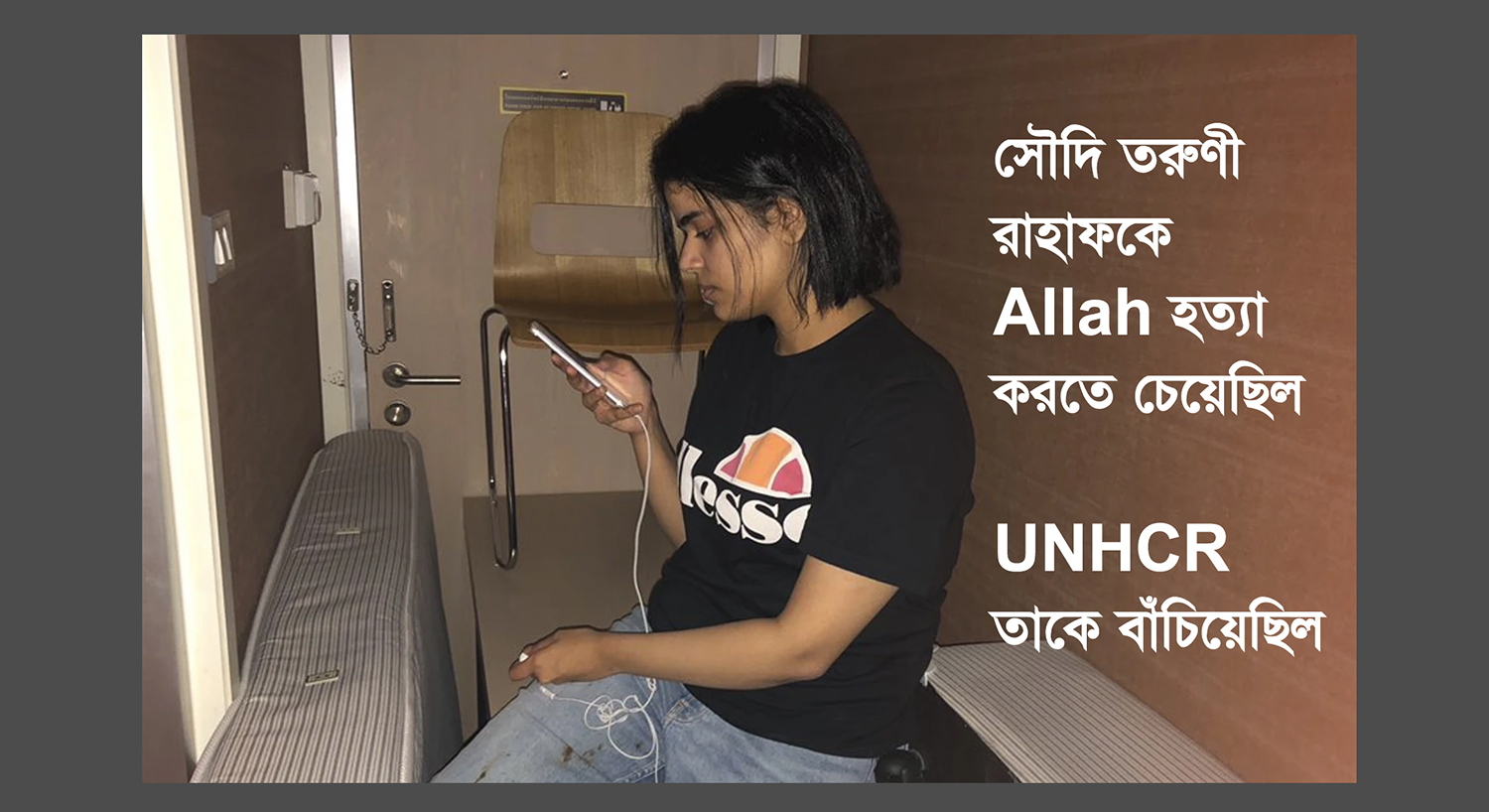
Why is Allah so Cruel?
A Saudi young woman, Rahaaf, was targeted for death by Allah, but UNHCR saved her
“I am afraid, my family will kill me.”
Rahaaf was a young woman aged 18 years and 10 months. Born on March 11, 2000, in the Hail province of Saudi Arabia, this young woman was taken, in Islamic terms, by Allah and his messenger — the two rulers of the world — across a razor-thin bridge. Just a little more, and her head would have been severed from her neck.
To save her life, she fled Saudi Arabia, traveling through Kuwait and aiming for Australia. The date was January 5, 2019. Due to a long transit at Thailand’s Suvarnabhumi Airport, she booked a hotel at the airport, but Thai authorities had already confiscated her passport. Saudi authorities informed the Thai government that a great criminal (!) from their country was there — someone whom the two masters of the world, Allah with two right hands and his child-desiring gangster messenger, had ordered to be killed. “Who the hell do you Thai authorities think you are? First catch her, send her back, and we will separate her head from her body in the name of Allah and the messenger.” The Thai authorities were terrified by Saudi pressure. They sent armed officers to her hotel room to capture her — she was, after all, an enemy of Allah!
Rahaaf realized the danger she was in. No matter what happened, she decided to keep the door locked. Thai security personnel first tried to persuade her to open the door. She refused. Using all the furniture and bedding in the room, she barricaded herself inside, keeping Allah outside the door. On January 6 and 7, 2019, she posted a live tweet: “I’m afraid, my family WILL kill me.”
That single tweet reached millions of people worldwide within a few hours. On January 8–9, 2019, under pressure from Human Rights Watch and international media, Thai authorities allowed Rahaaf to contact the UNHCR. Her father and brother arrived in Bangkok to take her back. Rahaaf refused to return with them, as her family had allegedly arranged to carry out an honor killing.
On January 9, UNHCR officially granted Rahaaf refugee status. On January 11, Canadian Prime Minister Justin Trudeau announced that Canada would accept her as a refugee at UNHCR’s request. She departed for Canada via Seoul. On January 12, 2019, Rahaaf arrived at Toronto Pearson International Airport. Canada’s Foreign Minister Chrystia Freeland welcomed her.
In this way, modern humanitarian people saved a young woman from the cruelty of Allah and his messenger. This journey was extremely perilous. At every step, there was a real fear of execution — she could have been sent back to Saudi Arabia and killed publicly in the name of Allah at any moment.
Rahaaf Mohammed Mutlaq al-Qunun — after growing up in an environment of physical abuse and control at home, she eventually left Islam. Under Saudi law, this is punishable by death, and she said her family had threatened to kill her in the name of “honor.”
Saudi Arabia is an Islamic state where there is no separation between religion and state. Article 1 of the country’s Basic Law states that Islam is the state religion and the Qur’an and Hadith are its constitution. Under this Sharia-based system, both blasphemy and apostasy — leaving Islam — are punishable by death.
What is prohibited and punishable under Saudi law
Apostasy — death penalty
Blasphemy — death penalty or long-term imprisonment
Criticism of Islam — prohibited
Freedom of movement for women — requires male guardian’s permission
Family disobedience — imprisonment
According to international human rights organizations, the definition of blasphemy in Saudi law is extremely vague and broad — judges decide cases based on their own discretion. Even a small social media post or expression of opinion can lead to blasphemy charges. Blogger Raif Badawi was sentenced to 600 lashes and 7 years in prison on blasphemy-related charges.
Rahaaf’s escape was not only due to blasphemy laws — the male guardianship system in Saudi Arabia was equally responsible. Under this system, women require permission from a male guardian for every major decision in life — travel, marriage, education, employment. Leaving the country, or even acting against family expectations, can be considered “family disobedience” punishable by imprisonment.
“I am one of the lucky ones. I know many unfortunate women who tried to escape and disappeared, or never had any opportunity to change their reality.”
— Rahaaf Mohammed, Toronto, January 2019
In Muslim countries, hundreds of stories like Rahaaf’s never receive international attention — they are silently forced back into what is described as the cruelty of Islam, or they disappear forever, and we never learn those chapters of their lives. How many lives have been lost in history under what is described as the violent rage of Islam, its Allah, and its messenger — or how many survive through compromise — does not appear in the records of humanitarian statistics. For a religious ideology that, based on personal belief, can demand the extinguishing of a human life — how long will peace-loving people continue to give space to such an ideology?
Related Posts
Why do Islamist clerics consider Bengali cultural festivals their enemy?
This year, unlike many previous years, the major Hindu religious festival Durga Puja in BangladeshRead More
ইসলামিস্ট মোল্লারা কেন বাঙালিদের আনন্দ উৎসবকে তাদের শত্রু মনে করে?
এবার বাংলাদেশে অন্যবারের তুলনায় বেশ শান্তিপূর্ণ, উৎসবমুখর পরিবেশে হিন্দু ধর্মের বড় ধর্মীয় উৎসব দূর্গাপূজা হয়েRead More
Why do Islamist cyber‑jihadis insult, threaten, and file false reports against people with different opinions?
Maulana Azhari once advised Islamists that sharing his Facebook posts is also an Islamic act;Read More
Comments are Closed