
Islam’s Hypocrisy and the Hijab
‘Hijab is my choice’ – the same people who make this claim in secular countries often force women to wear hijab in their own countries
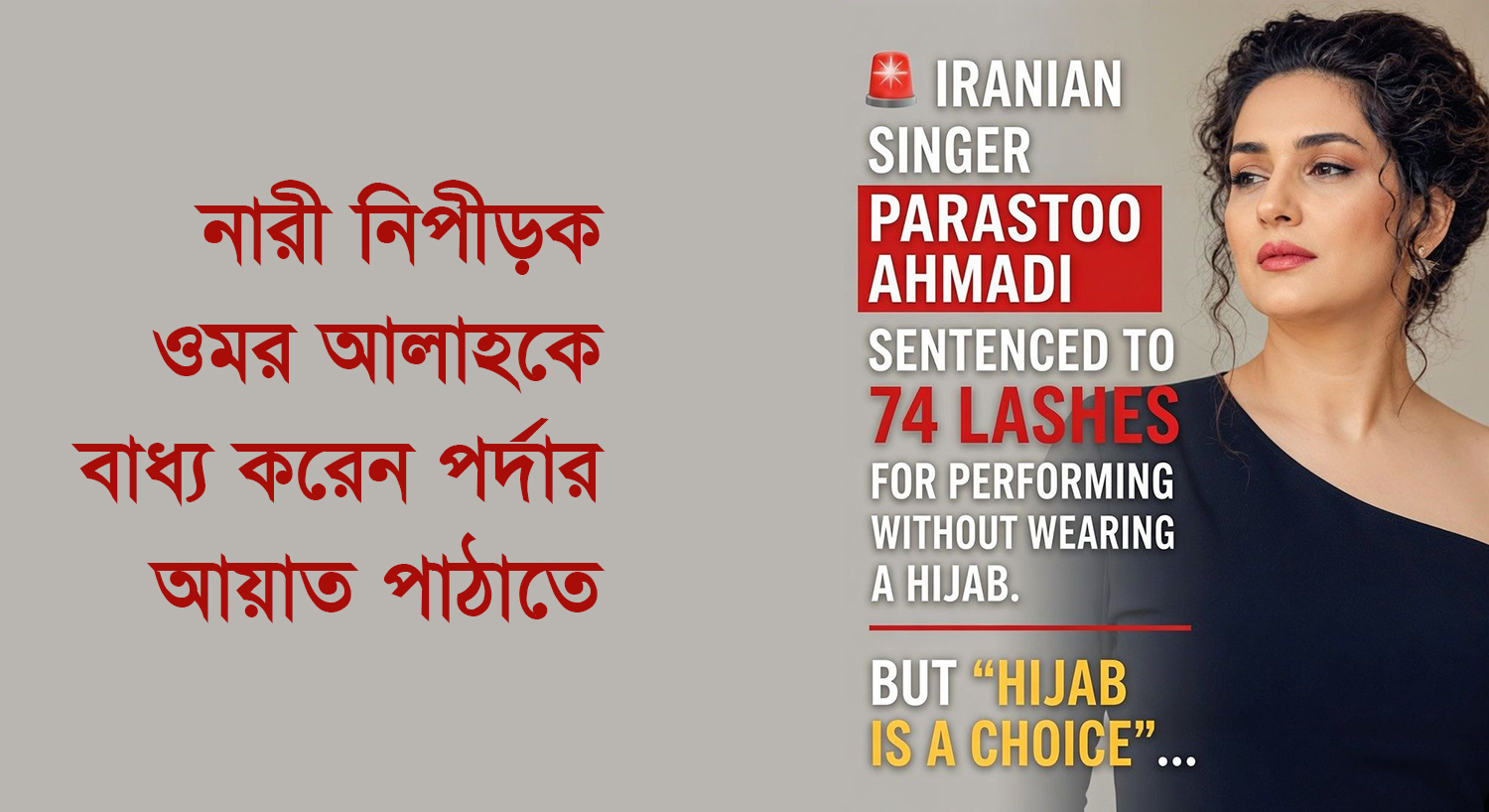
Iranian singer Parastu Ahmadi has been sentenced to 74 lashes for the “crime” of performing on stage without hijab. This incident is not an isolated one – it is part of Islam’s long history, where control over women’s clothing has been used as an instrument of state and patriarchal power. Do you know how hijab entered Islam, why it turned into a patriarchal political weapon, and how it should be evaluated from a human rights perspective?
The woman-oppressor Umar forces Allah to send down the verse of veiling
To analyze the origin of hijab or the practice of veiling, we have to go back to the social reality of seventh-century Arabia, where an ambitious political leader was building his future by capitalizing on religious emotions. What do Islamic sources say? Umar was a ferocious bandit. He set out with a sword to kill Muhammad; on the way, the companion Na’im bin Abdullah informed him that his sister and brother-in-law had accepted Islam. Enraged, he went to their house and, upon hearing verses of the Qur’an, was captivated and his heart changed. Then he went to Dar al-Arqam and openly accepted Islam. This is the Islamic narrative, isn’t it? Now think with common sense. In the first 6 years of Islam there were only 40 followers, in 10 years around 100, and in 13 years at most 300! Who were these followers? Apart from a few professionals like Khadija, most of them were vagabonds, desert bandits, whose main occupation was theft, robbery, and looting trade caravans. It was mainly the lure of these things that drew them to Islam. Did Umar accept Islam being attracted by the great beauty of Islam? In reality, he joined Islam in the hope of robbery and of engaging in the inhumane war called jihad, to enjoy women obtained as war booty and to acquire looted wealth. That is the reality.
Since Umar already had extensive experience in banditry, he was influential in Muhammad’s team. Even the Prophet Muhammad himself was cautious in dealing with him. Umar was so reckless that he did not even refrain from harassing the Prophet’s wives. In ancient Arabia there were no modern toilets inside houses. As a result, in the darkness of night, the women of Medina—especially the wives of the Prophet Muhammad—would hold their urine and feces all day and at night go to an open field of Medina called ‘al-Manasi’ to relieve themselves. Umar wanted the Prophet’s wives to remain behind the veil and not go outside. For this reason, he would follow them at night and harass them.
Sahih al-Bukhari (Hadith no. 146): Narrated from Hazrat Aisha (ra), “The Prophet’s wives used to go out at night to ‘Manasi’ (an open place) for relieving themselves. Umar (ra) used to say to the Prophet (sa), ‘Make your wives observe veil.’ But the Messenger of Allah (sa) did not do so. One night, under Umar’s strict watch, the Prophet’s wife Sawda bint Zam’a (who was a very tall woman) went out at the time of Isha. Umar recognized her and shouted, ‘O Sawda! Know that we have recognized you!’ Umar’s intention was that this embarrassment would lead to the introduction of the veil system.”
Sahih Muslim (Hadith no. 2170): In this narration it is clearly mentioned that, at Umar’s sudden shout and remark, the Prophet’s wife Sawda became extremely embarrassed and ashamed, and quickly went to Muhammad and lodged a strong complaint about Umar’s behavior.
According to the description in the hadith, it was after this incident that the verses regarding the injunction of veiling were revealed. That is, the injunction which is presented today as “Allah’s eternal command” had a context tied to a specific time: it was a social solution to protect women from deliberate harassment by men—so that women going out at night to relieve themselves could be identified and thus not harassed. And the interesting thing is that Umar, in effect, forced Allah—i.e., Muhammad—to have this verse revealed.
The geographical and environmental basis of clothing
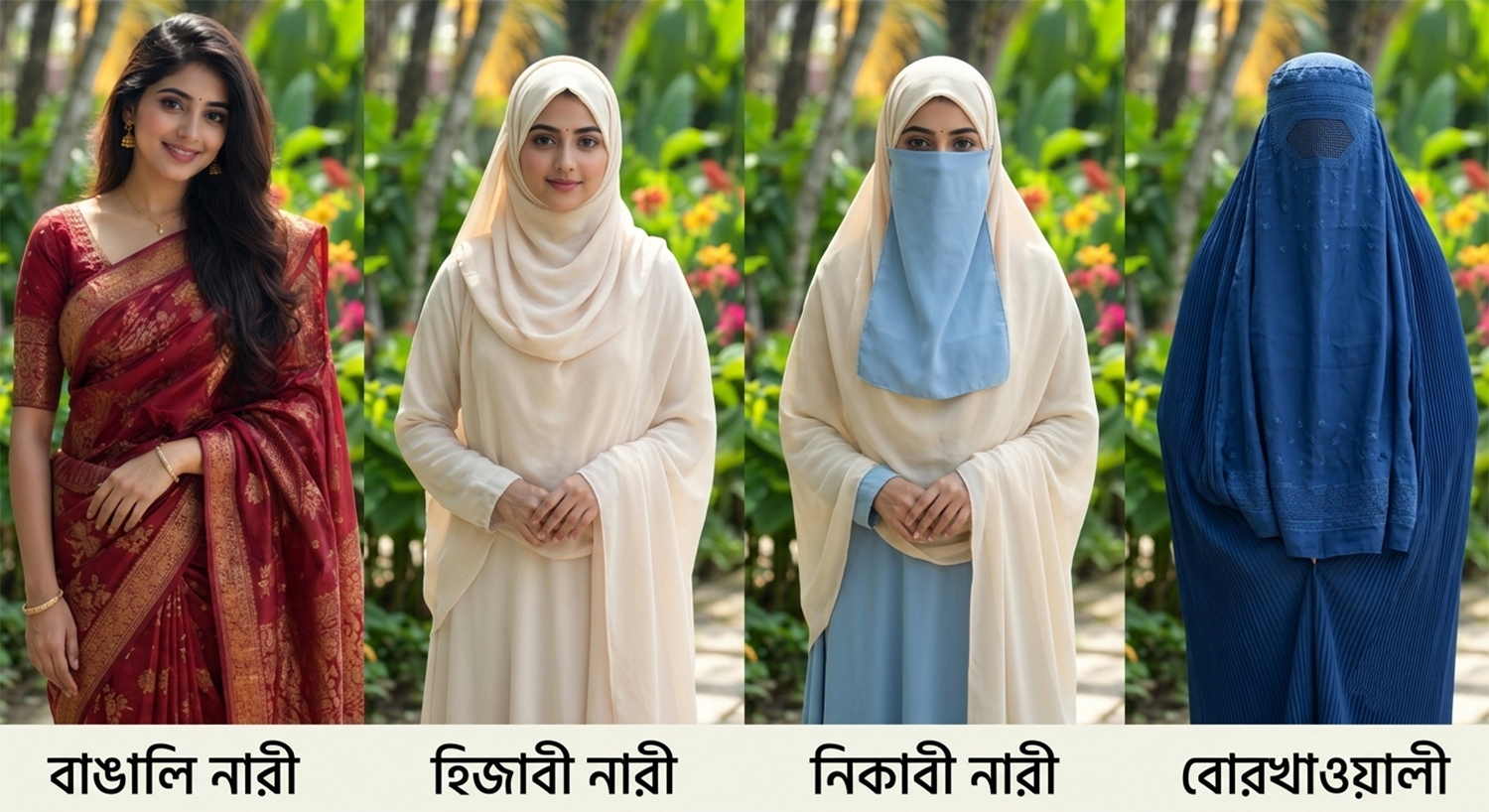
According to anthropological and sociological analysis, human clothing is not something miraculous or accidental; rather, it evolves based on the climate, humidity, sunlight, and the biological need for vitamin D in a particular region. In the harsh sun and dust storms of the Arabian desert, the practice of wearing loose clothing that covers the entire body is completely scientific for that environment. However, imposing this regional and geographical clothing as a universal divine command in humid, summer-dominated regions like Bangladesh, in the tropical forests of Indonesia, or in cold countries like Scandinavia is a form of cultural imperialism; it not only destroys local traditions but also obstructs the natural biological process by which humans adapt to their environment.
The opposite picture is seen in Scandinavia and various other cold countries, where for a large part of the year there is little sunlight, creating serious physical and mental health risks due to vitamin D deficiency. Therefore, in order to live healthily and to allow direct sunlight on the skin, women there go out in the sun wearing light clothing—this is not moral degradation, but a scientific and biological method of adapting to nature. Thus, just as it is inappropriate to make sweeping criticisms without understanding the health-related clothing practices of cold regions, it is equally an irrational cultural domination to forcibly impose the clothing of the Arabian desert on everyone in this climatically diverse world.
The example of Iran
Before the Islamic Revolution of 1979, women in Iran had freedom in choosing clothing, as well as in education and employment. But after the revolution, under the rule of Ayatollah Khomeini, hijab was made mandatory and the notorious morality police were deployed to enforce it. As punishment for violating this law, the state introduced cruel measures such as fines, imprisonment, and public flogging, thereby imposing absolute authoritarian control over women’s bodies and personal autonomy.
The most heinous recent example is the case of musician Parastu Ahmadi. For the “crime” of singing without hijab in a virtual concert in 2024, a court in June 2026 sentenced her and her team to 74 lashes and a two-year ban on artistic activity. Similarly, actresses like Taraneh Alidoosti, human rights activists like Jino Mohammadi, or athletes like Elnaz Rekabi have also been arrested, placed under house arrest, and subjected to state harassment for not wearing hijab or for protesting; this proves the systemic cruelty of this regime.
The anger accumulated over several decades exploded in September 2022, when young woman Mahsa Amini, arrested on charges of not wearing hijab properly, died in custody. This killing gave birth to the historic “Jin, Jiyan, Azadi” (Woman, Life, Freedom) movement across the world. Hundreds of thousands of Iranian women took to the streets, burning hijabs and cutting their hair in protest. This was not an anti-religion movement; it was a struggle to reclaim sovereign control over their own bodies and lives, which proves that freedom of clothing here is one of the major forms of political resistance against tyranny.

The example of Afghanistan
Since the Taliban seized power in Afghanistan, the situation of women’s rights in the country has faced an extreme humanitarian catastrophe, where strict clothing requirements are being used as the first institutional step to erase women entirely from society and confine them to their homes. According to the harsh decrees issued by the Taliban, women in public must cover their entire face and body except for the eyes, one example being the strict order to wear the traditional heavy burqa or niqab. Not only that, in a new law on “Promotion of Virtue and Prevention of Vice” enacted in August 2024, even hearing a woman’s voice in public has been prohibited, turning women outside the home into completely invisible and voiceless objects. If any woman slightly violates this strict dress code or behavioral code, she faces public humiliation and arrest at the hands of the Taliban’s morality police, while her male guardians (mahram) face heavy fines and punishment. By erecting this artificial wall of clothing, Afghan women have been forcibly transformed from independent individuals into property subordinate to the state.
This process of controlling clothing and appearance has paved the way for stripping women of every fundamental right in their lives. At present, girls in Afghanistan are completely banned from attending school beyond the sixth grade, making it the only country in the world where adolescent girls and young women have no legal opportunity for formal education. Subsequently, the scope of this ban has been expanded to completely close universities, public and private jobs, beauty parlors, amusement parks, and gyms to women. For example, the Taliban’s excuse for banning women from parks or gyms was that women there do not wear hijab properly. By taking away one right after another, women have been so confined within four walls that it is now almost impossible for them to go outside without a male guardian. This discriminatory policy of the Taliban is not just a battle over clothing; it is, in essence, a terrifying gender apartheid—a system of gender-based segregation—aimed at systematically erasing an entire sex from society, the economy, and the state structure and consigning them to complete servitude in the name of religion.
The slow change in Saudi Arabia
For decades in Saudi Arabia, it was legally mandatory for women in public to wear the black ‘abaya’ (a long garment covering the whole body), which was a visible symbol of state authority and the patriarchal guardianship (wilayah) system. Although, as part of Crown Prince Mohammed bin Salman’s “Vision 2030” initiative, this rule has been somewhat relaxed since 2019 and the obligation to wear abaya has been lifted, requiring only “modest clothing,” the fundamental structural oppression and psychological surveillance have not disappeared from society. Even now, if women break these clothing rules or appear slightly “immodest” in the eyes of the conservative social structure, they face indirect social harassment, workplace discrimination, and legal complications. In the past, the notorious religious police, the “Mutawa,” used to directly patrol the streets to control women’s clothing; in today’s modern Saudi Arabia, that visible brutality has somewhat decreased, but it has been replaced by digital surveillance and strict state legal censorship. In this system, even for making mild criticisms about freedom of clothing or women’s rights on social media, progressive activists like Loujain al-Hathloul or Salma al-Shehab have been subjected to years of imprisonment and severe torture, which proves that despite the outward relaxation of dress codes, the ultimate control of the state over women’s bodies and the limitations on their freedom still remain equally present.
“Hijab is my choice” – the hypocrisy of Islamist double standards
A stark ideological double standard and opportunism is particularly noticeable in the global propaganda of Islamist groups. When they reside in Western democratic countries, they become extremely vocal against any legal attempt to ban hijab, niqab, or burkini. At that time, they borrow the language of Western human rights and strongly argue in favor of “personal freedom,” “religious rights,” and “the right to choose one’s own clothing.” Yet, when these same groups gain their own political power and dominance in any region or state of the world, that same freedom no longer applies to women. As soon as the balance of power shifts, their tone changes, and they easily impose mandatory dress codes on women; this proves that, for them, “the right to clothing” is not a principled position, but merely a two-faced political tool—used to extract benefits from Western societies and to control women’s bodies in their own territories.
The irresistible slogan that progressive and human rights activists raise against bans on hijab or burqa in France or any other Western country—“My Body, My Choice”—should be equally applicable, by the same humane and rational standard, to Iran’s Parastu Ahmadi or the oppressed women of Afghanistan, shouldn’t it? If in Western liberal societies the decision to keep the hijab on one’s head can be a woman’s completely personal and free choice, then in conservative societies like Iran, Afghanistan, or Saudi Arabia, the decision to remove the hijab or abaya should equally be a woman’s deeply personal political and social choice. But in reality, we see that many of those who shout themselves hoarse in favor of the freedom to wear hijab in the West remain completely silent about the state-administered flogging of women in Iran for not wearing hijab, or about the brutal killing of young women like Mahsa Amini. This is a vile example of gendered hypocrisy in the realm of global human rights.
In fact, the concept of “choice” or free decision in any society can only be meaningful when both different options or decisions are equally dignified and completely risk-free in the eyes of society and the state. In a society or state system where a woman who decides not to wear hijab is haunted by the fear of being disowned by her family, socially boycotted, losing her job, being humiliated by morality police, or facing state prisons and physical torture—there, a woman’s wearing hijab can in no way be called a “free choice”; it is essentially a compulsion to survive and to remain in society. True freedom and clothing choice will only be established when a woman who voluntarily decides to wear hijab is given social dignity in the same way that another woman who decides not to wear hijab or to remove it is also granted equal dignity, security, and civil rights.
Hijab bans in different countries of the world – reasons and debates
In light of the secular state structure and legal philosophy of Europe, there is also a specific institutional explanation for these clothing rules. Several European countries, including France, Belgium, and the Netherlands, have completely banned all types of visible religious-symbolic clothing or accessories in their government institutions, courts, and schools and colleges. The main philosophical and political rationale behind this is to strictly uphold the principle of state secularism (such as Laïcité in the case of France)—where the state remains completely neutral and does not grant any particular religion extra advantages or disadvantages in the public sphere. Under this principle of equality, not only Muslim women’s hijab but also Christians’ large crucifix necklaces, Jews’ kippah (skullcap), and Sikhs’ turbans are all equally banned. Therefore, instead of viewing these Western bans as blanket Islamophobia or solely anti-Muslim sentiment, they should also be considered as a structural effort to maintain absolute equality of all citizens and all religions in the eyes of the state and to preserve the non-sectarian character of public institutions.
At the same time, in several European countries, the bans imposed on face-covering garments like niqab or burqa in public spaces are backed by a very strong and legitimate argument of state and citizen security. In a modern democratic state, it is considered necessary for each citizen’s face to be visible for identification, law and order, and crime prevention. In banks, airports, CCTV-monitored areas, or any crowded public place, this is a universal legal requirement to ensure security. Although many conservative groups or human rights organizations have criticized this protective law as religious discrimination or interference with individual freedom of dress, ultimately, for public safety, mutual transparency in social interaction, and the effective enforcement of state law, the requirement to keep the face visible is being accepted worldwide as an integral part of modern state systems.
Evaluation from a human rights perspective
According to the Universal Declaration of Human Rights and the Convention on the Elimination of All Forms of Discrimination against Women (CEDAW):
- Every person has the right to autonomy over their own body, clothing, and private life.
- The state cannot prescribe clothing, especially when it applies only to one gender.
- Corporal punishment—such as flogging—falls under the definition of torture and is universally prohibited.
The sentence of 74 lashes for Parastu Ahmadi violates multiple provisions of international law—it is torture, it is discrimination, and it is a violation of freedom of opinion and expression.
Throughout history, whenever a state or religious institution has sought to consolidate its power, it has targeted women’s bodies for control. Clothing control is the first step—then comes control over movement, control over education, and the deprivation of property rights.
The core question in the hijab debate is therefore not about clothing itself—the question is who will decide: the woman herself, or the state and the patriarchal system?
Can clothing that goes against nature and culture be anyone’s “choice”?
The fundamental philosophy of human rights is very clear: wearing hijab or not wearing it—both are entirely a woman’s personal right. When the state determines clothing by threatening with whips and imprisonment, it crosses the boundary of belief and turns into all-encompassing oppression.
“Hijab is a choice” or “Hijab is a free choice”—this modern human rights slogan can only be true and meaningful when not wearing hijab or taking it off is also an equally dignified and completely safe choice. As long as there is fear of punishment or humiliation for not wearing it, this phrase remains nothing but an echo of the hypocrisy of Islam and power.
We see this same hypocrisy and structural coercion very starkly in the social reality of Bangladesh. In various parts of our country, it is often seen that if a woman does not wear hijab or a scarf, she is subjected to various forms of social taunts, mental harassment, and teasing on the streets, in educational institutions, or at workplaces. From the outside, these may seem like isolated incidents, but a deeper look reveals that they are essentially dirty social-religious tactics to indirectly force women to wear hijab.
An even greater crisis lies hidden within four walls. In our patriarchal social structure, when a father, brother, or husband uses family authority to force a woman to wear hijab or burqa, or when she faces neglect, domestic violence, or psychological abuse if she does not wear it, then her wearing hijab can in no way be called a “choice.” It is essentially a compulsion to survive in the family and to protect the so-called “honor” constructed by men. True choice or freedom will only be established when, in society and in the family, both decisions—wearing hijab and not wearing hijab—are accepted with equal security, respect, and legal protection.
Related Posts
Why do Islamist clerics consider Bengali cultural festivals their enemy?
This year, unlike many previous years, the major Hindu religious festival Durga Puja in BangladeshRead More
ইসলামিস্ট মোল্লারা কেন বাঙালিদের আনন্দ উৎসবকে তাদের শত্রু মনে করে?
এবার বাংলাদেশে অন্যবারের তুলনায় বেশ শান্তিপূর্ণ, উৎসবমুখর পরিবেশে হিন্দু ধর্মের বড় ধর্মীয় উৎসব দূর্গাপূজা হয়েRead More
Why do Islamist cyber‑jihadis insult, threaten, and file false reports against people with different opinions?
Maulana Azhari once advised Islamists that sharing his Facebook posts is also an Islamic act;Read More
Comments are Closed