
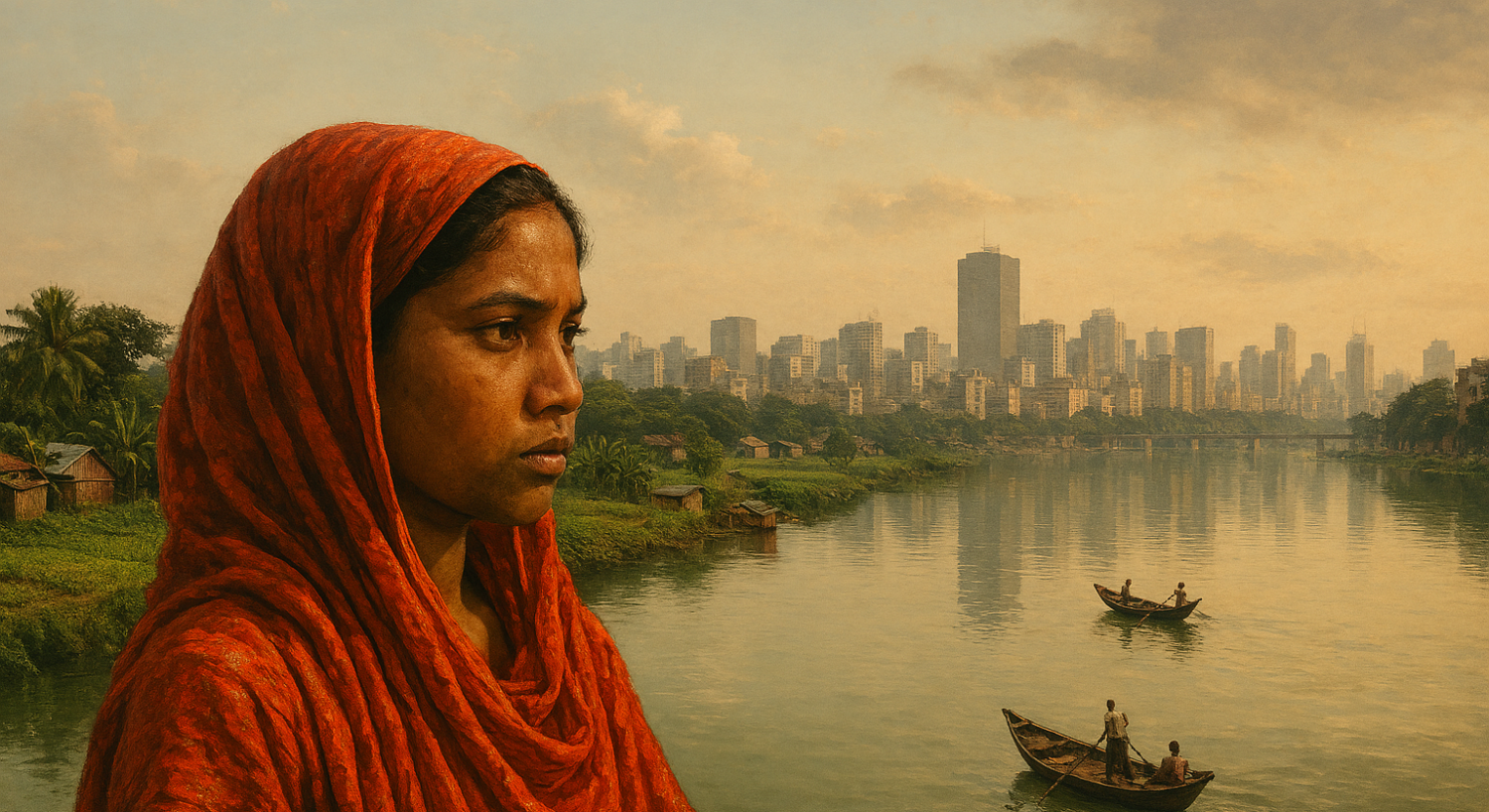
When will Bangladesh change?
Will Bangladesh move closer to a humane nation after the election?
You’ve heard of election engineering, but have you ever heard of social engineering? Changing Bangladesh is not so simple. The problems here are deeply embedded in the society and civilization itself. Transforming Bangladesh is not merely a political project—it is one of the world’s most difficult social engineering challenges. Because the issue is not just about changing the government; it’s about uprooting entrenched culture, behavior, values, and power structures. That’s why this transformation cannot be achieved in one, two, or five years; it requires at least two decades of patient, generational reform.
1. Why Change Is So Difficult: Crises Rooted Deep Within State Structures
Bangladesh has laws, a constitution, and policies—all sufficient on paper. But in reality, those who make the laws are the first to break them. As a result, law becomes a tool of power, not of the state. Here, corruption, nepotism, looting, fraud, and forgery are not just crimes—they are a culture.
A culture where—
- Power means privilege
- Politics means occupation
- Administration means commission
- Business means syndicate
- Morality means weakness
In such a society, expecting change from a mere puff of breath is childish naivety. So many crossfires, disappearances, and suppressions—none have reduced crime. Did the sacrifices of so many lives during the 2024 monsoon uprising bring any change to the politicians or political culture of this country? Political parties and the state all seek to suppress people through fear. When the state governs through intimidation instead of enforcing the law, crime doesn’t decrease; criminals grow stronger. Because they know—law is not the final word, power is.
2. Lack of Democracy Within Political Parties: The Main Obstacle to State-Level Democracy
Demanding democracy in the state while lacking it within political parties is laughable. How many political leaders practice democracy in their own character and within their parties?
Bangladesh’s major political parties are—
- Run by dynasties
- Intolerant of dissent
- Suppressors of opposing views
- Focused solely on power grab as the goal of politics
Therefore, the question of establishing democracy through them doesn’t arise. Democracy is a culture—it’s not just a rule for changing power. In a democratic country, its essence must be felt everywhere. Otherwise, it cannot be called a democratic nation—like Bangladesh.
3. The Only Path to Change: Long-Term Investment Focused on Children
In a society where adult values are already distorted, change cannot come through them. To bring change, we must focus on today’s children. They must be raised free from the toxins of society, with proper, science-oriented, humane education. Only a visionary leader with genuine intent can make this possible.
If a visionary leader truly wants change, they must—
- Allocate a large budget for children
- Ensure quality education
- Provide nutrition and healthcare
- Teach morality, scientific thinking, and humanity
- Instill values of creativity and hard work
If these are done, only then will those children grow up in two decades to naturally remove today’s autocrats, corrupt figures, and occupiers. Because they will be—responsible citizens, intelligent, honest, skilled, hardworking, and accountable. They will learn to question their families, society, and the state, and will be able to point out the truth with clarity.
4. The Historic Opportunity Bangladesh Had After the 2008 Election
After the 2008 election, Bangladesh had a rare opportunity. Sheikh Hasina received that rare chance. Because she had—
- Massive public support
- International acceptance
- Political stability
- Administrative control
- Economic potential
- Public desire for change
- Long-term continuity
There was no one to challenge her or her decisions. All she needed was a little goodwill. With this opportunity, she could have—
- Reformed the judiciary
- Ensured administrative transparency
- Changed political culture
- Developed education and human resources
- Fought corruption
- Strengthened the foundation of democracy
– He could have initiated all of this.
But he and his party chose instead—
- Power grab
- Suppression of opposition
- Control over the judiciary
- Turning elections into a farce
- Human rights violations
- Politicization of state institutions
- Unbounded looting
- Crimes against humanity like enforced disappearances and killings
- Brutal repression
- Spread of extremism and fundamentalism
- Killing and exiling dissenters
Where he had the opportunity to become a great human being, he instead carved his place in history as an authoritarian, repressive, and anti-humanitarian ruler. In the end, over 1,400 people gave their lives, more than 20,000 were maimed, and he was expelled from the country. Yet today’s politicians have learned nothing from this. They remain trapped in the same old mindset.
5. Another Opportunity May Come After the Upcoming Election
Tomorrow morning, Bangladesh faces an election. History sometimes offers a second chance. After the upcoming election, another leader may face a similar opportunity—to lead the country toward long-term transformation.
But the question is—
- Will he be a visionary?
- Or will he be another conventional authoritarian occupier?
- Will he plan for two decades?
- Or will he be content with five years of power, then cling to it by reinstating autocracy?
We must wait to find the answer to these questions.
Change Is Possible, But It Is Generational
Bangladesh’s transformation will not happen overnight. It will be—
- Slow
- Difficult
- Long-term
- Generational
But it is not impossible. If a visionary leader—
- Focuses on children
- Invests in education and human resources
- Establishes democracy and rule of law
- Frees state institutions from political control
- Begins dismantling the culture of corruption
Then Bangladesh can truly change in two decades. That change will begin with today’s children—it may not be possible through today’s adults. And it will be led by that one visionary who prioritizes the future over power.
Related Posts

Actresses Shabana, Moushumi, Popy – Religious Sentiment and the Politics of the Public Sphere
In the history of Bangladeshi cinema, names like Shabana, Moushumi and Popy mark important chapters.Read More
নায়িকা শাবানা, মৌসুমী, পপি – ধর্মানুভূতি এবং জনপরিসরের রাজনীতি
বাংলাদেশের চলচ্চিত্র ইতিহাসে শাবানা, মৌসুমী কিংবা পপির মতো নাম গুরুত্বপূর্ণ অধ্যায়। তারা আশি, নব্বই ওRead More
In Bangladesh, the very meaning of the “blasphemy” law is to find a new pretext for persecuting minorities
The attack on the house, shop, and temple of Deepto Roy in Tahirpur, Sunamganj isRead More
Comments are Closed