
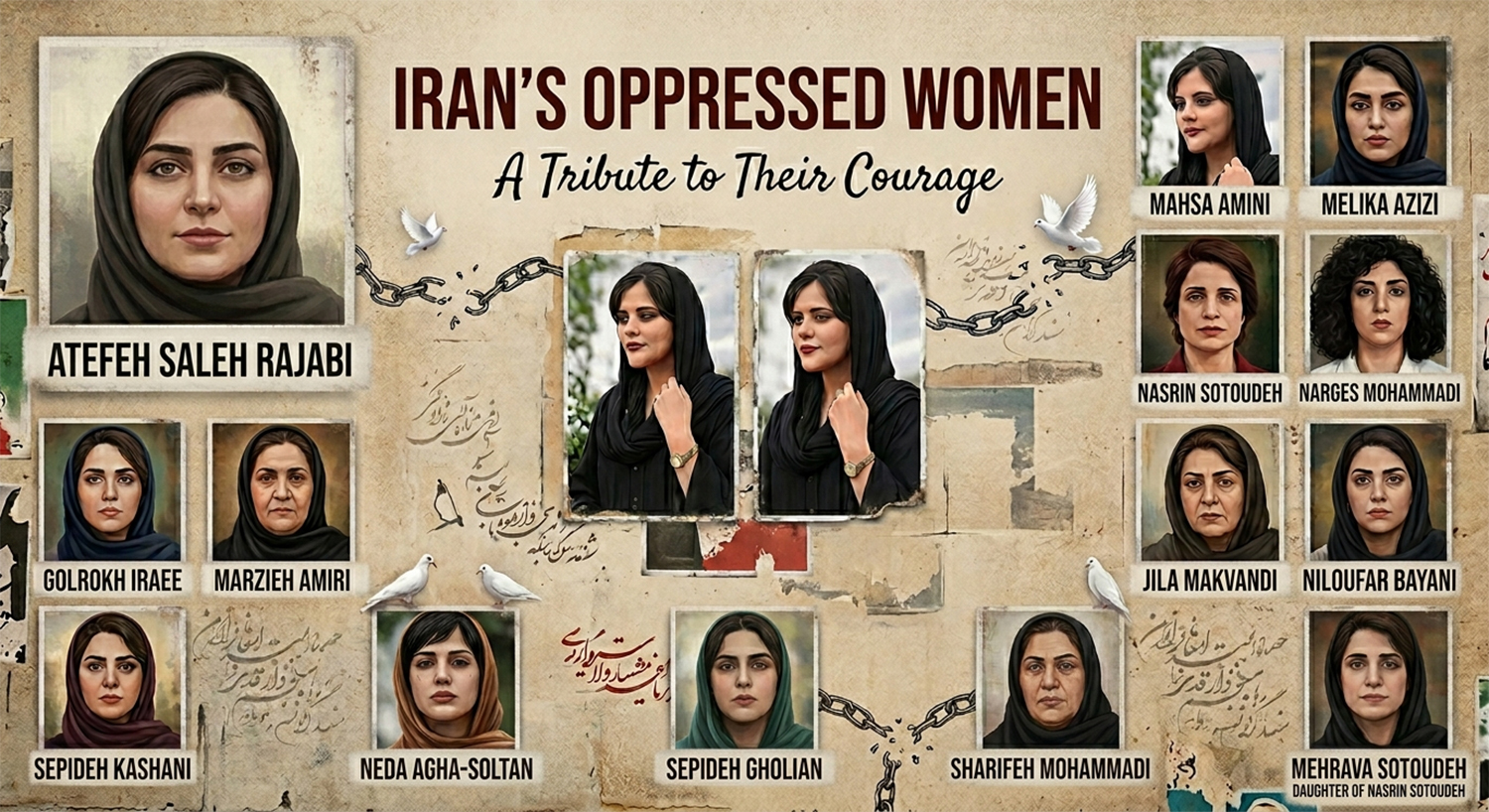
The brutality of Iran’s Islamic regime
Even in Bangladesh, one can receive death threats for protesting the repression of Iran’s Islamic regime
Under Iran’s Islamic rule, people’s fundamental human rights are severely curtailed. No one is allowed to express their opinion. Women cannot move freely dressed as they choose. Anyone who protests against the Khamenei regime is labeled a traitor, a foreign agent — particularly an Israeli spy — and subjected to harsh punishment. Most of the time, this punishment is carried out in public, by hanging from a crane.
On March 22, 2026, I published a post on my Facebook titled “Melika Azizi will be hanged by crane in Iran” (https://facebook.com/smsaifrahman/posts/pfbid02Ef5GdHhHCqfuePHXqiHjQKNdysKPuqfifULBkZjjZ3c9d4Drw59EaCSdyHCGoAsvl), in which I wrote about the brutality of Iran’s rulers and their suppression of dissent — particularly the horrific atrocities committed against women. As of my last check, the post reached a considerable audience — over 550,000 views, more than 4,500 likes, comments, shares, expressions of disgust and anger. Over 200 people saved it to read later. Of the more than 700 comments that came in, nearly all were filled with intense hatred, rage, and threats directed at me — including vile abuse: that I am a bastard, that my mother is a prostitute, that they will rape my mother, beat me, cut me, kill me — a bizarre assortment of threats. In Bangladesh, where extremist activities run with state, social, and political patronage, should it surprise anyone that this enormous mass of fanatical, religiously bigoted, violent people keeps growing by the day? To them, killing even a minor writer like me would please Allah and their prophet Muhammad — because my criticism of Iran’s regime means I am an enemy of Allah and the prophet. Among those commenting, I noticed a large number of women. While they expressed themselves somewhat more moderately, they flatly refused to acknowledge that women in Iran are subjected to extreme humiliation, degradation, and oppression. In their view, Islam has granted women the highest honor and the most exalted dignity.
Iran is a country governed by strict Islamic law. The core pillar of its rule is a religious myth or superstition. The foundation of Iran’s state system rests upon a theological myth. The concept of the 12 Imams is well known in Shia Imamiyya doctrine. According to their belief, the 11th Imam, before his death, concealed his five-year-old son — Muhammad al-Mahdi — and that child “disappeared” at the age of five. This child is, in the Shia view, the 12th Imam, who has remained hidden for 1,200 years and will one day return to establish justice. Khamenei is the representative of that Mahdi — and therefore whatever Khamenei desires or decrees is the supreme law of the land.
The outside world rarely learns of the protesters who are persecuted, oppressed, and crushed under Iran’s strict Islamic rule. There, criticizing Khamenei is treated as an act of war against Islam itself. These are, in fact, the teachings of Islam. For instance, Islam prescribes the death penalty for the “Shatim al-Rasul” — one who criticizes the Prophet. You may be forgiven for criticizing Allah, but the slightest criticism of the Prophet, any opposition to his decisions, or even a hint of doubt about his words or deeds makes you a Shatim al-Rasul. There is no possibility of forgiveness; killing you becomes the duty of the Islamists. For further reading, see: https://tinyurl.com/yf47vmv5 and https://tinyurl.com/4yjb4hhj — references from Islamic sources are cited there. That is why criticizing the Prophet, or his successor the Mahdi, or the Mahdi’s representative Khamenei, is also considered a grave crime in Iran. The greatest victims of this persecution are women who dare to protest. To understand how Islam actually views women, read: https://tinyurl.com/4ddazbrr — those who claim that the divine ordinances Allah has laid down for women must be obeyed without question would do well to read these Islamic references.
Let us now look at some notable women who have suffered horrific persecution under Khamenei’s rule in Iran. This list is only a small fraction, yet let us examine it.
Atefeh Saleh Rajabi (1987–2004)
At 6 o’clock in the morning on August 15, 2004, in the city of Neka in Iran’s Mazandaran province, 16-year-old Atefeh Rajabi was dragged from her prison cell and taken to the gallows. Throughout the journey, this mentally troubled teenager kept screaming “tawbah, tawbah” (repentance, repentance). Her crime was “acts against morality” — meaning she had been repeatedly raped, could not produce four male eyewitnesses as required under Islamic law, and had protested against the judge’s injustice. The very judge who sentenced her to death personally placed the noose around her neck — such was his rage. Her national identity card listed her age as 16, but the state claimed she was 22. Suspended from the arm of a crane, Atefeh writhed in the agony of death for 45 minutes while the crowd wept. The man who had repeatedly raped her received only a few lashes and a brief prison term.
Masha (Mahsa) Amini (1999–2022)
On September 13, 2022, 22-year-old Kurdish-Iranian woman Mahsa Amini was arrested in Tehran by Iran’s religious morality police, the “Guidance Patrol,” while visiting the city with her brother — the charge being that she had not worn her hijab properly. Photos of her released from the hospital showed bleeding from her ears and bruising under her eyes. The police claimed she had died of a heart attack, but a March 2024 report by the UN Human Rights Council confirmed that Amini’s death was caused by physical violence sustained while in custody. Her death triggered an unprecedented mass uprising across Iran, giving birth to the “Woman, Life, Freedom” movement. Security forces opened live fire on protesters and beat them with batons; by December 2022, at least 476 people had been killed.
Melika Azizi (born 2007)
On January 9, 2026, 18-year-old Melika Azizi was arrested in the city of Masal in Gilan province — the charge being that she had set fire to a government symbol. This was part of the movement that followed “Bloody Week,” during which hundreds of young people were allegedly killed by security forces. After 45 days in solitary confinement, Melika was brought before the court. When the judge told her to ask for forgiveness, Melika looked him in the face and said, “You let so much young blood be spilled. How can I stay silent? I don’t care what happens to me. Kill me.” She has been charged with “moharebeh” — “war against God” — the maximum punishment for which is the death penalty. On March 21, 2026, Iran’s Islamic regime officially confirmed Melika’s death sentence.
Niloufar Hamedi and Elahe Mohammadi
Journalists Niloufar Hamedi and Elahe Mohammadi were arrested in September 2022, just days after protests erupted following the death of Mahsa Amini. Hamedi had posted photos of Amini’s grieving parents at the hospital on social media, while Mohammadi had gone to report on Amini’s funeral. Both were charged with “cooperation with the hostile government of the United States” and “conspiracy against national security.” Hamedi received a 13-year sentence and Mohammadi a 12-year sentence. Years behind bars for doing nothing more than fulfilling their journalistic duties — what greater testament to press freedom in Iran could there be.
Nasrin Sotoudeh
Nasrin Sotoudeh is an Iranian human rights lawyer who has spent her life defending opposition activists, women protesting the hijab, and minors facing the death penalty. Repeated arrests, prolonged imprisonment, and constant harassment have been her constant companions. She has been sent to prison again and again for providing legal assistance to women who protest the hijab. In 2021, Time Magazine included her on its list of the 100 most influential people in the world.
Narges Mohammadi
Narges Mohammadi is an Iranian woman and human rights activist. She was awarded the 2023 Nobel Peace Prize for her struggle against the oppression of women in Iran and for the human rights and freedom of all. In 2016 she was sentenced to 16 years in prison. Even from behind bars she has not stopped — she has continued her protests against the mandatory hijab law and maintained her solidarity with fellow prisoners.
Golrokh Irai
During the Mahsa Amini movement, on September 26, 2022, Golrokh Ebrahimi Irai was arrested by security forces at her home in Tehran and taken to an undisclosed location. She is known for her long-standing struggle against the punishment of stoning and prison conditions. She was sentenced to seven years in prison on charges of “assembly and conspiracy against the regime” and “propaganda against the state,” along with a ban on leaving the country and joining political parties.
Marzieh Amiri
Journalist Marzieh Amiri was arrested in Tehran in 2019 while covering a workers’ protest. She was charged with “propaganda against national security” and “participation in illegal gatherings.” After her arrest she was held in Evin Prison and subjected to prolonged interrogation. Performing professional journalistic duties was her only “crime.”
Zila Maqvandi
Zila Maqvandi is an activist from the Kurdish-populated region of Iran who faced a death sentence in 2010 on charges of “moharebeh.” Although her sentence was suspended under international pressure, she spent years imprisoned in Evin Prison. Being a Kurdish woman in Iran means suffering double persecution — for both ethnic and gender identity.
Niloufar Bayani
Niloufar Bayani is an Iranian wildlife conservation researcher who was arrested in January 2018 by the Islamic Revolutionary Guard Corps on charges of espionage. She had worked with the UN Environment Programme. In prison, her interrogators tortured her and threatened her with sexual violence. Her trial was held behind closed doors, without a lawyer. On April 8, 2024, after nearly six and a half years in prison, she was released.
Sepideh Kashani
Environmental activist Sepideh Kashani was arrested alongside Niloufar Bayani in 2018 on similar charges. While working to protect Iran’s endangered cheetahs, she was imprisoned on the false accusation of “spying for Israel.” Even the innocent work of protecting the environment becomes “treason” in the eyes of Iran’s rulers.
Mehraveh Sotoudeh (daughter of Nasrin Sotoudeh)
Nasrin Sotoudeh’s daughter Mehraveh took to the streets in protest during her mother’s trial. The Iranian regime targets not only those who protest, but their families as well. Mehraveh has also been subjected to harassment for no reason other than standing by her mother’s side.
Neda Agha-Soltan (1982–2009)
Neda Agha-Soltan was shot and killed in Tehran on June 20, 2009, during post-election protests. Someone captured the moment of her death on a mobile phone, and the footage spread across the world, turning her into an immortal symbol of the Iranian freedom movement. “Neda” means “voice” in Farsi — and that voice was silenced forever by Khamenei’s bullets.
Sepideh Gholian
Journalist Sepideh Gholian has been arrested multiple times for exposing the brutalities of the IRGC. She has been imprisoned on several occasions while reporting on workers’ rights. Even from prison, she managed to smuggle out accounts of her fellow inmates’ suffering and wrote letters of solidarity. In December 2025, she was arrested again while attending a memorial ceremony and was beaten at the time of her arrest.
Sharifeh Mohammadi
Sharifeh Mohammadi is an Iranian social activist and political prisoner. After being arrested at her home in Rasht in December 2023, on July 4, 2024, the Revolutionary Court of Rasht sentenced her to death on charges of “baghi” — armed rebellion. Her sole crime was having joined a labor organization more than a decade earlier. Although the Supreme Court initially overturned the verdict, her death sentence was re-confirmed in August 2025. Narges Mohammadi and fifteen other women prisoners stated in a joint declaration: “This is not just Sharife’s death sentence — it is a death sentence for all of us.”
The list above represents only a tiny fraction. Each name stands for an entire life — a story of dreams, love, courage, and unwavering resistance in the face of state brutality. Beyond these women, Atena Daemi, Yasaman Aryani, Bahareh Hedayat, Monireh Arabshahi, and countless others have suffered and continue to suffer similar persecution.
The Minimum Condition of Civilization
The way a state treats its dissenting citizens is the truest mirror of its character. A state that beats a young woman to death for not wearing a hijab, imprisons a scientist for working to protect the environment, sentences a journalist to ten years in prison merely for reporting the news, and hangs an eighteen-year-old girl from a crane for joining a protest — such a state cannot claim to be civilized. The most urgent task of our time is to engrave this fundamental truth of human civilization into the hearts of people: no matter how great a state power may be, it cannot silence its citizens’ voices forever. A system of governance that treats dissent as war against God and punishes it with the gallows is nothing more than the practice of cruelty in the name of religion. Every Neda, every Melika, every Narges — each of these names reminds us that the claim to human dignity, the claim to human rights, cannot be erased by any ruler’s decree. Even in death, that claim lives on in the outcry of humane people across the world.
Related Posts
Actresses Shabana, Moushumi, Popy – Religious Sentiment and the Politics of the Public Sphere
In the history of Bangladeshi cinema, names like Shabana, Moushumi and Popy mark important chapters.Read More
নায়িকা শাবানা, মৌসুমী, পপি – ধর্মানুভূতি এবং জনপরিসরের রাজনীতি
বাংলাদেশের চলচ্চিত্র ইতিহাসে শাবানা, মৌসুমী কিংবা পপির মতো নাম গুরুত্বপূর্ণ অধ্যায়। তারা আশি, নব্বই ওRead More
In Bangladesh, the very meaning of the “blasphemy” law is to find a new pretext for persecuting minorities
The attack on the house, shop, and temple of Deepto Roy in Tahirpur, Sunamganj isRead More
Comments are Closed