
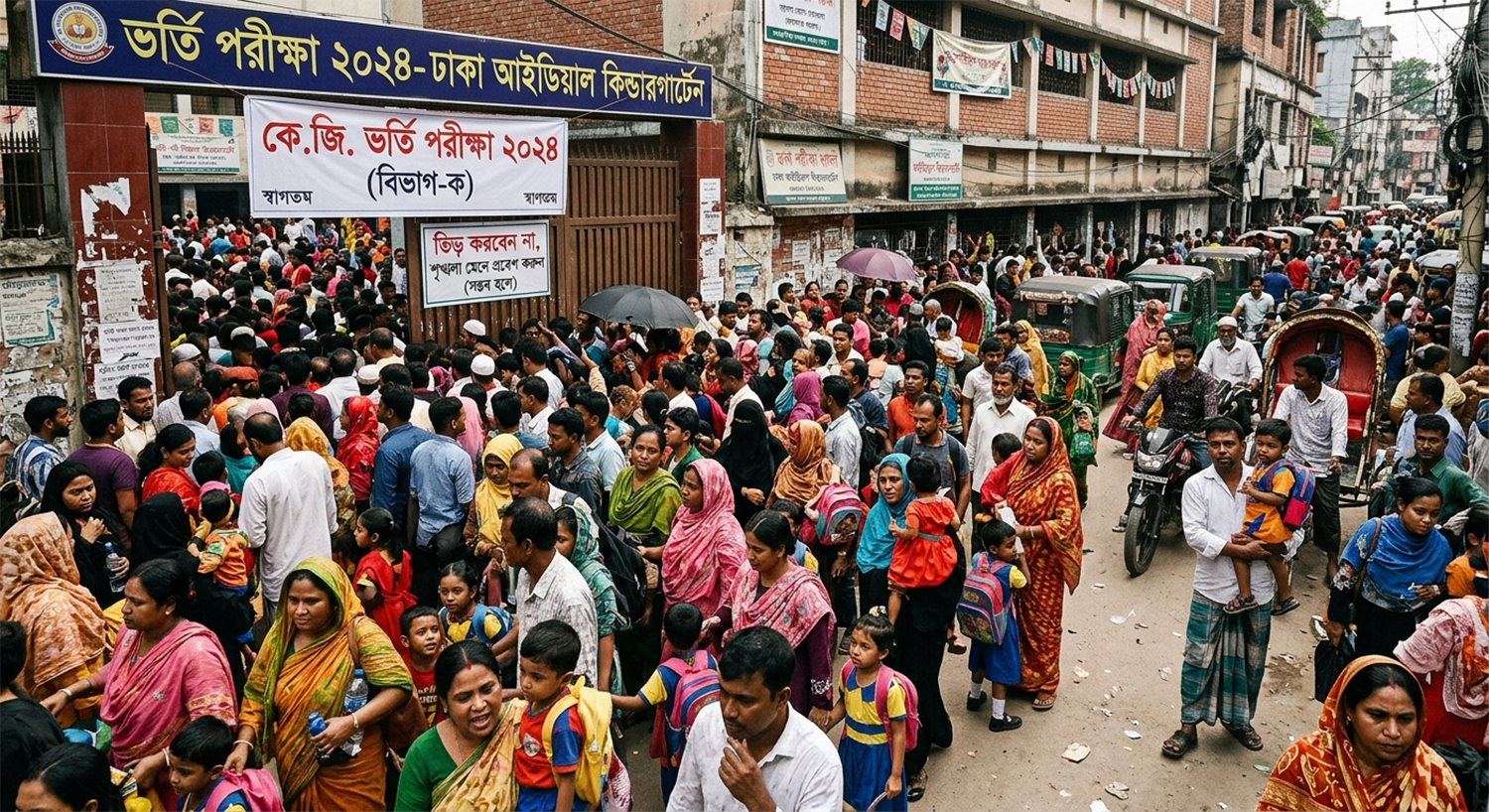
Stop Child Abuse!
The decision to subject children to the oppressive battle of entrance examinations is deeply inhumane
Just as Hasnat Abdullah’s demands are not always correct, it is equally true that Sheikh Hasina made many landmark decisions during her tenure.
The question is not merely procedural — it is also a profound ethical and pedagogical one: is it consistent with children’s rights to subject them to competitive examinations at the very start of their educational lives? In this essay, we will comparatively analyze these two systems in the context of Bangladesh and attempt to present a comprehensive assessment informed by the experiences of education systems around the world.
History of Admission Systems in Bangladesh
The Era of Entrance Examinations (Before 2011)
Before 2011, competitive entrance examinations were used to admit children into schools in Bangladesh. Under this system, a child’s “merit” was assessed even before being enrolled in school. The consequences were deeply troubling:
First, a thriving industry of coaching centres and private tutoring emerged. Children as young as five or six were sent to coaching centres, robbing them of a normal childhood. Second, widespread irregularities, corruption, and nepotism surrounded the admission process. Third, while children from financially well-off families could afford coaching, those from poorer households were left at a disadvantage. This deepened inequality in education significantly.
Introduction of the Lottery System (2011)
To address these problems, the lottery system was made mandatory for Grade 1 admissions in government secondary schools starting from the 2011 academic year. The following year, the same system was extended to private schools. However, admissions from Grade 2 through Grade 9 continued to be conducted through examinations.
Due to the COVID-19 pandemic, the 2021 academic year saw the lottery system extended to all grades, and it has continued in the same form ever since.
The New Decision of 2026
In March 2026, following a question raised in the National Parliament by NCP leader Hasnat Abdullah, the Education Minister stated that the lottery system did not seem reasonable to him, and the very next day an official announcement was made abolishing it. The minister indicated that “a very simple examination will be held” and that plans are in place to gradually introduce a “zoning system.”
Child Psychology and the Theory of Early Education
A Child Development Perspective
According to modern child psychology and educational theory, children between the ages of five and seven are not yet mentally equipped for abstract thinking or competitive environments. According to the theory of renowned psychologist Jean Piaget, children at this age are in the “pre-operational” stage, and their mode of learning should be play-based and exploratory.
Professor Kamrul Hasan Mamun of the Department of Physics at Dhaka University remarked in this context that failing an entrance examination amounts to “tagging” a child as incapable, and placing a child in such trauma is wrong. Experiences of failure in examinations during a child’s early years can negatively affect their self-confidence and enthusiasm for learning in the long term. Research has shown that test anxiety developed at an early age can have lasting effects throughout a child’s educational life.
The Question of Equity
A child’s capacity to learn depends far more on their surrounding environment, nutrition, family support, and pre-school education than on innate intelligence. A child from a wealthy family who has attended a kindergarten, received coaching, and grown up in a study-conducive home will naturally perform better in an entrance exam than a child from a poor family. This is not a difference in talent — it is a difference in opportunity. Entrance examinations, therefore, do not measure merit; they reproduce socioeconomic inequality.
Experiences from Around the World
The American Model: Proximity-Based Enrollment and a Ladder for Talent Development
In the United States, children entering elementary school are not subjected to any competitive examinations. Every child is enrolled in the school closest to their home, known as the “neighborhood school” or “zoned school.” Thereafter, if a child demonstrates exceptional talent during their schooling, they are transferred to a specialized program.
These specialized programs include:
Magnet Schools: Specialized schools for students with a focused interest in particular fields such as science, arts, or technology.
Gifted Programs: Challenging curricula designed for children who meet certain criteria of advanced ability.
Accelerated Programs: Fast-tracked learning pathways for children who demonstrate the ability to learn at a faster pace.
The beauty of this model is that every child begins with an equal opportunity. Only afterward do pathways open up according to each child’s talent and interest. A single examination at the point of entry does not determine any child’s future.
The Finnish Model: An Examination-Free Childhood
In Finland, widely regarded as having the world’s finest education system, there are no examinations at the primary level whatsoever. Children begin school at age seven and face no formal assessments for the first six years. Yet Finland’s educational standards remain among the highest in the world. The reason is that children’s innate curiosity and love of learning are nurtured, rather than crushed under the weight of examinations.
The Contrasting Experience of Korea and Japan
South Korea and Japan operate intensely examination-driven education systems. While academic standards in these countries are high, the mental health crisis among children and adolescents, the rate of suicide, and the problem of burnout are extremely serious. In Korea, this issue has become so acute that the government is now actively working to reduce dependence on examinations.
The United Kingdom, Canada, and Australia
These countries also predominantly follow a proximity-based enrollment policy at the primary level. While separate programs exist for specialized or gifted learners, entry into those programs does not require sitting a competitive examination before starting school.
Arguments in Favour of Entrance Examinations and Their Critique
Argument 1: Merit-Based Selection
Some believe that entrance examinations allow talented students to gain access to better schools, thereby maintaining the quality of education.
Critique: It is not possible to objectively measure a child’s “merit” at the age of five or six. At this age, an examination primarily reflects the family’s socioeconomic standing and access to coaching — not genuine ability.
Argument 2: Ensuring Access to Better Schools
Some argue that under the lottery system, many talented students fail to gain access to good schools while less talented ones do.
Critique: This argument sidesteps the root problem. The real question is: why are not all schools of equal quality? As long as a disparity between “good” and “bad” schools exists, a large portion of children will be disadvantaged regardless of the admission method used.
Argument 3: Accountability and Standards
Having examinations maintains a benchmark for educational standards.
Critique: There are many ways to maintain educational standards. A single entrance examination does not serve that purpose. It is post-enrollment evaluation methods and teacher training that genuinely ensure educational quality.
Advantages and Limitations of the Lottery System
Advantages
The greatest advantage of the lottery system is that it offers equal opportunity to all. Every child — rich or poor, coached or uncoached — has an equal chance. It places no psychological burden on children, creates no dependence on coaching centres, and allows the early years to be spent in the joy of childhood.
BRAC University’s Emeritus Professor Manzoor Ahmed has said that under the current circumstances, the lottery system is comparatively better for admitting young children, although it is also important to ensure that the lottery is conducted transparently.
Limitations
The main criticism of the lottery system is that it relies on chance, and where disparities in school quality exist, children who are unlucky in the draw may be compelled to attend lower-quality schools. Moreover, if the lottery is not conducted transparently, it opens the door to corruption.
The Core Problem: Inequality in School Quality
At the heart of the entrance examination versus lottery debate lies a far deeper problem: the vast disparity in the quality of schools across Bangladesh. The difference between a school in Motijheel, Dhaka, and one in a remote upazila is enormous. Even within the same city, there are enormous gaps between government schools.
Professor Kamrul Hasan Mamun stated plainly that the government cannot call any one of its government schools “good.” If all schools were of equal or similar quality, there would be no need for a lottery — nor for an entrance examination. Children in a given area would simply attend the school in that area. He argued that what is needed is greater investment in education, the appointment of quality teachers, and the improvement of schools.
Viewed from this angle, both entrance examinations and the lottery are merely two different symptoms of a failing system. The real solution is to reform the system itself.
The Perspective of Children’s Rights
The United Nations Convention on the Rights of the Child (CRC), which Bangladesh has signed, clearly states that every child has the right to education and that such education must be in the child’s best interest. Access to quality education is a child’s right — it is not a prize to be won in a competition.
If a school is considered “good” and admission to it requires sitting an examination, the question must be asked: is it just for a child who fails that examination to be denied access to quality education? No, it is not. It is the responsibility of the state to make every school a quality school, so that no child must compete for the privilege of attending a “good school.”
An Alternative Vision: Proximity-Based Enrollment and Specialized Pathways
An effective solution for Bangladesh could take the form of a three-tiered policy:
Tier One: Proximity-Based Enrollment (Primary Level)
At the primary and lower secondary levels, every child would be enrolled in the school nearest to their home. This would reduce traffic congestion, strengthen community bonds, and alleviate psychological pressure on children.
Tier Two: Ensuring Quality Parity
The government would ensure that every school in every area meets a defined quality standard. This would require teacher training, infrastructural development, and an increased education budget.
Tier Three: Specialized Pathways for Talent Development
Children who demonstrate exceptional talent during their schooling would have access to specialized programs and institutions in areas such as science, mathematics, the arts, or sports. But this opportunity would come after several years of schooling — not before a child has even set foot in a classroom.
Questions About the Decision-Making Process
Rasheda K. Chowdhury, former Adviser for Primary and Mass Education in the caretaker government, has raised questions about the very process by which this decision was made. In her view, there is still ample time before the next academic year begins, and it was therefore inappropriate to make such a hasty decision. The matter should have been studied more thoroughly and discussed with all relevant stakeholders before a conclusion was reached.
Announcing a final decision on a matter as complex and long-term as education policy just one day after a question is raised in parliament is concerning from a good governance perspective. Policy changes of this nature should not be made without extensive consultation with educators, parents, child development specialists, psychologists, and the teaching community.
The world’s most successful education systems teach us that cooperation and exploration, not competition, yield the most fruitful learning in childhood. From Finland to Canada, proximity-based enrollment and examination-free environments at the primary level have consistently supported improvements in educational quality.
For Bangladesh, the solution lies not in debating the method of admission, but in directing attention to the root problem: making all schools of equal quality. This requires adequate budget allocation for education, the recruitment and training of qualified teachers, and infrastructural development across all schools. Until that work is done, the lottery system remains comparatively the more just option — because it at least ensures equality of opportunity.
A child’s future should not be determined by the result of a single examination taken at the age of five. It is the responsibility of the state to ensure equal quality education for every child — this is not a prize to be won in competition, but the birthright of every child.
Related Posts

Actresses Shabana, Moushumi, Popy – Religious Sentiment and the Politics of the Public Sphere
In the history of Bangladeshi cinema, names like Shabana, Moushumi and Popy mark important chapters.Read More
নায়িকা শাবানা, মৌসুমী, পপি – ধর্মানুভূতি এবং জনপরিসরের রাজনীতি
বাংলাদেশের চলচ্চিত্র ইতিহাসে শাবানা, মৌসুমী কিংবা পপির মতো নাম গুরুত্বপূর্ণ অধ্যায়। তারা আশি, নব্বই ওRead More

In Bangladesh, the very meaning of the “blasphemy” law is to find a new pretext for persecuting minorities
The attack on the house, shop, and temple of Deepto Roy in Tahirpur, Sunamganj isRead More
Comments are Closed