
Sharia Law and Crime
Why can’t Sharia law reduce crimes like rape
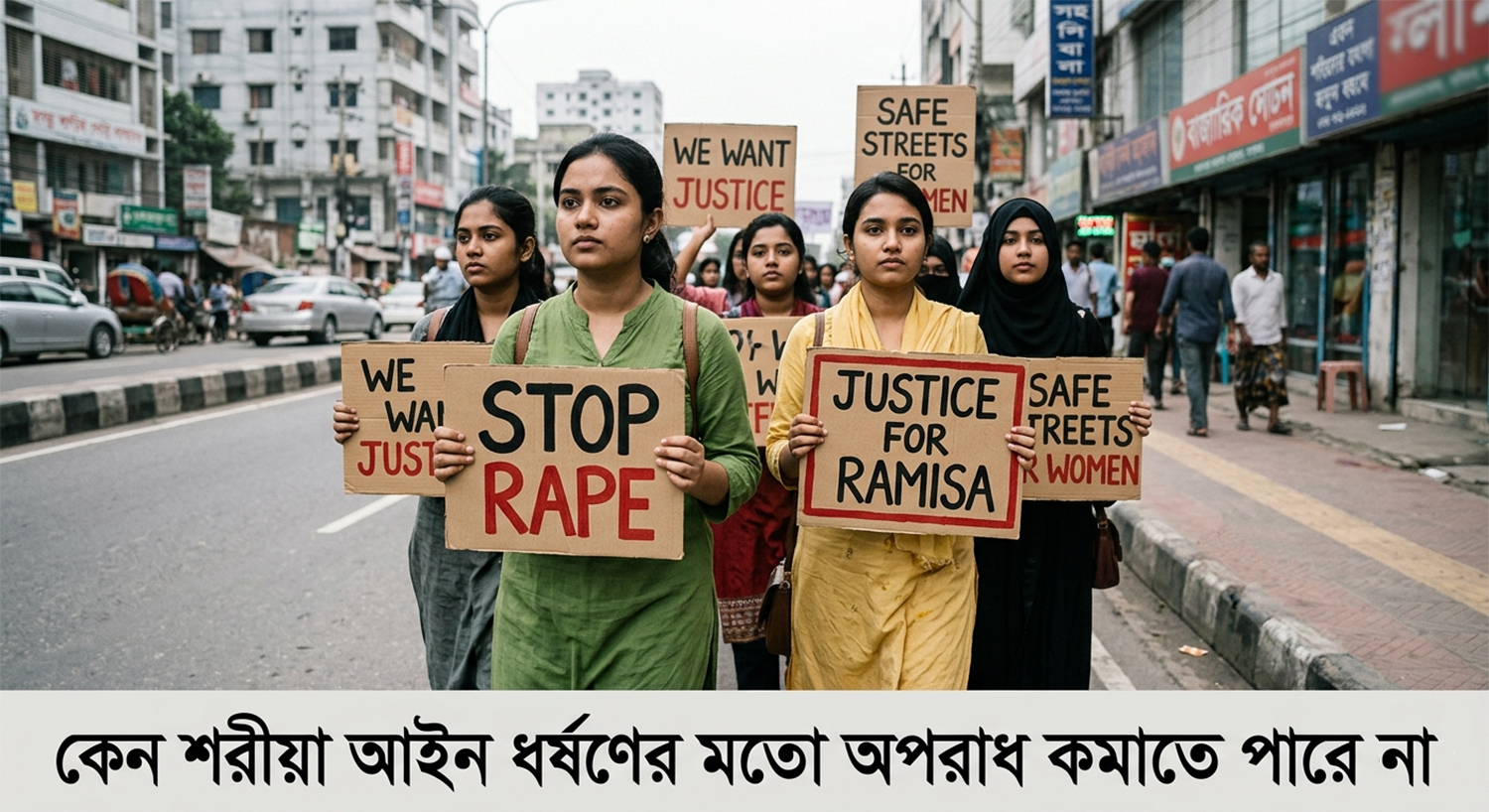
In Bangladesh, whenever a sensational murder, rape, or corruption incident occurs, a group of clerics and Islamist leaders demand that everything would be fixed if Sharia law were implemented. Yet at the same time, in 2026 in Madan Upazila of Netrokona, a teacher named Aman Ullah at a Qawmi madrasa raped an 11-year-old girl and made her pregnant—and after this horrific incident, some clerics, instead of showing sympathy for the victim, questioned, “If an 11-year-old can become pregnant, what is the logic of keeping the marriage age at 18?” In other words, they demand Sharia for punishing rape, yet also seek to legitimize rape under Sharia! This question of legitimizing child rape within Sharia is not only morally abhorrent but also completely flawed from the perspectives of medical science, criminology, and international human rights. How can a system that itself enables rape be expected to deliver justice for it? Is that logical?
Alongside demanding Sharia-based justice, Ahmadullah claimed that rape is caused by lack of Islam, moral degradation, perverse tastes, sexual freedom, and lack of proper justice. Well, at least this time he didn’t blame women’s clothing! Apart from the lack of justice, none of these have been proven as causes of rape—how exactly does “lack of Islam” cause crime? Do places without Islam celebrate rape? Meanwhile, other clerics like Abu Toha Adnan have blamed women themselves, arguing that if a woman is raped while moving without a male guardian, then she bears responsibility.

Why Does Rape Occur? A Criminological Explanation
Many people believe rape occurs because of an inability to control sexual urges. This is a serious misconception. Decades of criminological research have proven that rape is primarily a crime of power, control, and domination—not sexual desire. A landmark study conducted for the U.S. Department of Justice (Connecticut Correctional Institute, over 16 years, involving 1,000 convicted rapists) classified rapists into three main types:
(a) Power Rapist: The most common type. They premeditate forcing the victim into submission, using sex as a tool of dominance. Their primary drive is a narcissistic urge to prove their “masculinity.”
(b) Anger Rapist: Acts spontaneously out of intense rage, attacking with extreme brutality. The primary goal is to hurt the victim.
(c) Sadistic Rapist: The most dangerous type. They combine sexuality with brutality and derive pleasure from extreme cruelty.
Researchers have also identified a fourth category — the “Opportunistic Rapist,” who commits rape when the opportunity arises during another crime. Indiana State University criminologist Professor Shannon Barton-Bellessa has analyzed this category in detail.
According to a 2025 research summary by Crime Victim Law Firm, the psychological causes of rape include:
(1) Sense of entitlement and narcissism — the rapist believes sex is his right, and the victim’s consent is irrelevant;
(2) Misogyny and gender-biased attitudes — studies show that patriarchal values and objectification of women are strongly linked to sexual violence;
(3) Lack of empathy — many rapists cannot perceive or do not care about the victim’s suffering.
An NIH-published paper, “Mental Health Assessment of Rape Offenders” (PMC3777344), clearly states that most rapists are not mentally ill. They commit rape not due to psychological disorders but as a conscious abuse of power. It is entirely a crime of choice.

Why Do Rapists Choose Brutality?
The relationship between rape and brutality is multifaceted. A Stanford Law School paper, “Rape as Torture” (Teo, 2016), explains that the purpose of brutality is not just physical harm, but also the destruction of the victim’s dignity and psychological strength. Particularly for anger-driven rapists, brutality reflects an explosion of long-suppressed hatred and contempt toward women.
A key factor is a cultural environment where women are portrayed as second-class citizens, half-witnesses, or property confined behind veils. In such contexts, brutality appears more “normal” to the perpetrator. Research (Malamuth & Check, 1985) shows that “rape-supportive attitudes” (rape myths) and cultural devaluation of women significantly increase sexual violence. Religious frameworks that reduce women’s testimony, restrict their mobility, or obligate them to fulfill male sexual demands undermine their human dignity and indirectly foster a culture of sexual violence.
In the context of Bangladeshi madrasas, another issue is evident. An AFP investigative report (Prothom Alo/Gulf News, 2019) found that some former students reported that certain teachers considered sexual acts with children to be a “lesser offense” compared to adultery between adults. This mentality creates fertile ground for child sexual abuse—and its roots lie in the legitimization of child marriage.
Definition and Legal Structure of Rape in Sharia Law
Sharia law has no independent legal framework specifically for rape. The Qur’an or Hadith do not explicitly define rape as a separate crime. Instead, Islamic jurists often treat rape under the category of zina (extramarital sexual relations). However, in modern law, consensual relations between adults are not criminalized, whereas in Sharia they can be punishable by death. At the same time, obtaining justice for non-consensual rape under Sharia is extremely difficult.
To prove zina under Sharia, two paths exist: either voluntary confession by the accused or testimony from four adult male witnesses who directly observed the act (Surah An-Nur 24:4). Women’s testimony is generally not accepted across the four major schools of jurisprudence. Since rape is not committed publicly, obtaining four witnesses is practically impossible, and perpetrators rarely confess voluntarily.
According to two Hasan hadiths recounting cases judged by Prophet Muhammad, in one case the rapist confessed, and in another, witnesses initiated the case themselves. It is suggested that there was an inclination to allow the accused to deny and escape punishment. The victim, meanwhile, was told that God would forgive “her sin of zina,” raising serious questions about why a victim of rape would be considered sinful at all.
The Victim Becomes the Accused: Structural Cruelty in Sharia
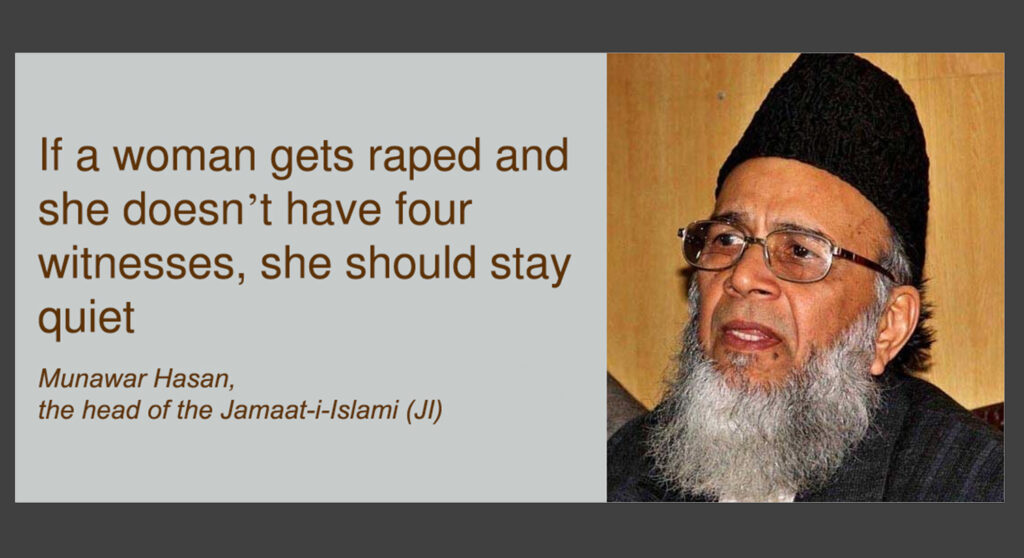
One of the most alarming aspects of Sharia law is that if sufficient witnesses are not produced, the victim herself may be charged with zina. If married, she could face death by stoning; if unmarried, 100 lashes. Former Jamaat-e-Islami leader Munawar Hasan publicly stated that without four male witnesses, a rape victim should remain silent.
The experience of Sudan was even more disturbing. Before legal reforms under international pressure, a gang rape victim from Ethiopia was convicted of “indecent behavior.” Sudanese lawyer Hikma Ahmed noted that rape allegations were often treated as confessions of adultery.
In Iran, a 16-year-old girl, Atefeh Sahaleh, was executed for zina—her “crime” being that she was sexually abused by adult men. These are not isolated incidents but systemic outcomes of such legal structures.
Child Marriage and Sexual Slavery: Does Sharia Legalize Rape?
In modern law, any sexual activity with a minor below the age of consent is considered rape. However, in Sharia, child marriage is permitted, and sexual relations with a child spouse are considered lawful after marriage. Islamic scholar Abul Ala Maududi, in his tafsir “Tafhimul Qur’an,” explicitly stated that even seclusion (khalwa) with prepubescent girls is permissible.
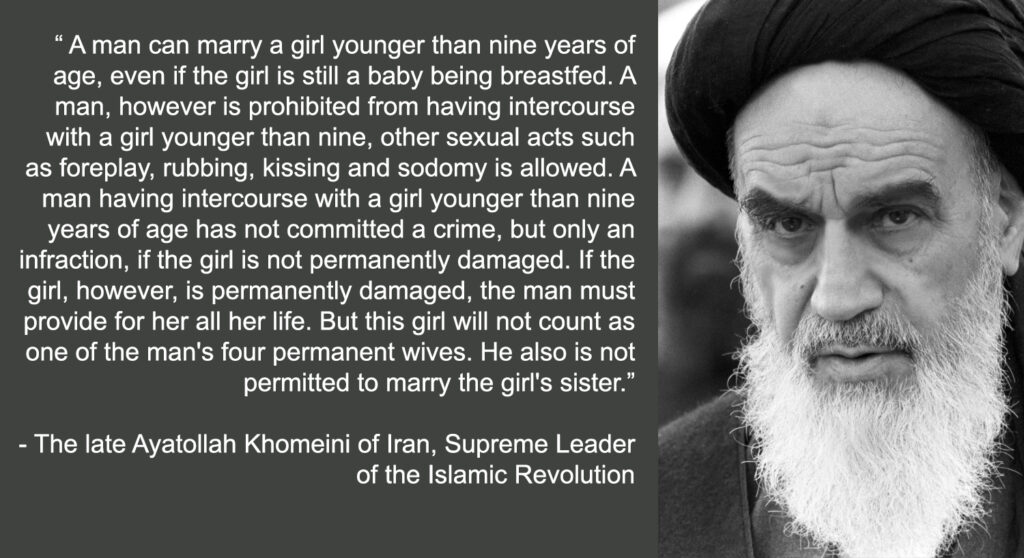
Clerics often cite the example of Prophet Muhammad’s marriage to Aisha to justify child marriage. There is no fixed age defined in Islamic law for marriage. Some scholars interpret historical narratives as allowing marriage at very young ages. Statements attributed to figures like Ayatollah Khomeini have also been cited to argue for permissibility of marriage with minors under certain conditions.
Sharia also historically permitted sexual relations with female slaves, for whom consent was not a requirement, as they were considered property. Extremist groups like ISIS have used such interpretations to justify the enslavement and sexual exploitation of Yazidi women. Reports have also documented instances of such practices being revived in certain contexts.
Medical Perspective: Does Pregnancy at 11 Justify Marriage?
In the Netrokona case, the examining physician, Dr. Sayma Akter, clearly stated that the pregnancy posed severe health risks due to the child’s age and physical condition. The argument that “if a girl can become pregnant, she can marry” directly contradicts medical science.
According to WHO (2025), complications from pregnancy and childbirth are among the leading causes of death for girls aged 15–19 worldwide. Each year, over 21 million adolescents in low- and middle-income countries become pregnant, and about 50% of these pregnancies are unintended. For an 11-year-old, the risks are significantly higher.
Research from Harvard Medical School (“Child Marriage: A Silent Health and Human Rights Issue,” PMC2672998) and Frontiers in Sociology (2024) highlights the medical consequences of child marriage:
(1) Obstetric Fistula — about 65% of fistula patients are under 18, leading to severe, debilitating injuries;
(2) Infant and maternal mortality — children born to mothers under 20 face a 50% higher risk of death, and maternal mortality is also significantly higher;
(3) Eclampsia, postpartum hemorrhage, sepsis, obstructed labor — immature pelvic structures complicate childbirth;
(4) Brain immaturity — the prefrontal cortex, responsible for decision-making and understanding consequences, matures around age 25. At 11, a child cannot meaningfully consent or comprehend the implications of marriage or sexual activity.
Therefore, the onset of menstruation or the ability to become pregnant is not evidence of readiness for marriage or sexual activity. It is merely a basic biological process. The maturity of both body and mind—and the psychological capacity to give consent—requires at least 18 years of development. This is the unanimous position of the World Health Organization, UNFPA, and UNICEF.
Saudi Arabia: The Reality of Sharia Law in Practice
Saudi Arabia is a state governed entirely by Sharia law. So, is the rate of rape there near zero? Not at all. In August 2019 alone, 111 Bangladeshi female domestic workers returned home after being abused—38 of them reported being raped by their employers. If just one month yields such numbers, then considering a full year and including workers from other countries, the actual rate becomes unimaginable. Yet in the entire year of 2019, only 8 rape cases were prosecuted in Saudi Arabia.
Do Harsh Punishments Reduce Crime? The Clear Answer from Criminology
Saudi Arabia is among the countries that carry out the highest number of executions by beheading each year. While Bangladesh rarely enforces the death penalty in many years, the number in Saudi Arabia continues to rise annually. What does this imply? If fear of punishment reduced crime, then criminals should gradually decrease over time. Has tightening penalties for drug trafficking reduced such crimes in Bangladesh? Have stricter traffic laws reduced violations? The punishment for rape is death—yet has rape decreased?
The core argument of Sharia supporters is that terrifying punishments—such as amputation, public flogging, beheading, and stoning—will deter crime. However, over a hundred criminological studies have firmly rejected this idea.
The U.S. National Institute of Justice (NIJ), in its study “Five Things About Deterrence,” conclusively states that it is not the severity of punishment, but rather the certainty of being caught that is far more effective in preventing crime. It is the fear of being apprehended—not the harshness of punishment—that deters offenders.
Long-term research by Daniel S. Nagin (Carnegie Mellon University, Criminology & Public Policy, 2013) and reports by the Sentencing Project (Wright, 2010) both confirm that longer or harsher sentences do not reduce the likelihood of reoffending. Comparative studies in England, Wales, and Sweden show no strong statistical relationship between punishment severity and crime rates.
This means that even if the extreme punishments proposed under Sharia were fully implemented, rape would not significantly decrease. This is because the main drivers of rape—abuse of power and the perceived likelihood of evading punishment—remain unchanged within such a system.
The Nordic Paradox: More Reporting Does Not Mean More Rape
A common argument is that “liberal” countries like Sweden or Denmark have higher rape rates, implying that women’s freedom increases rape. This is a misinterpretation of data.
Global reports (DataPandas.org, 2026) and analyses by Sweden’s crime research agency Brå (2020) explain the so-called “Nordic Paradox”: Sweden has a very broad definition of rape (especially after the 2018 consent law, where absence of explicit consent constitutes rape), reporting rates are high because victims trust the police, and social stigma is low. In contrast, countries like Saudi Arabia, Pakistan, and Bangladesh have low reporting rates because victims risk punishment themselves if they come forward.
In the Women’s Danger Index, Denmark ranks 1st (0.932), Sweden 3rd (0.926)—making them among the safest countries for women. Despite freedom of dress and lower levels of religiosity, these societies are safer because their justice systems function effectively, victims report crimes, and there is a higher certainty of offenders being caught.
By contrast, India reports only 26 rape cases per 100,000 people—but Indian researchers themselves estimate that 99% of rapes go unreported. Low data often indicates high risk. Countries operating under Sharia-like systems fall into this “low data” category—where fewer reported cases reflect not lower crime, but victims’ inability or fear to speak out.
UNICEF Data: Secular vs Religious States in Child Protection
According to international data published by the United Nations (UNICEF, EIU, Interpol), the most effective countries in preventing child sexual violence are: the United Kingdom (82.7), Sweden (81.5), Canada (75.3), Australia (74.9), and Germany (73.1). All are secular states where human-made laws govern society and where irreligious populations are relatively higher.
Among the most at-risk countries are Pakistan, Bangladesh, Afghanistan, Iraq, and Algeria—all Muslim-majority nations where religious norms significantly influence social control. Notably, in Iran, marriage for girls is legal from age 13, and even adoptive fathers may legally marry their adopted daughters—laws derived from religious frameworks.
These statistics establish a clear truth: states based on religious law consistently fail in child protection, while secular systems grounded in human rights provide more effective protection.
Madrasas in Bangladesh: Safe Havens for Child Abuse Under the Guise of Religion
The Netrokona incident is not isolated. Investigative reports by AFP and Prothom Alo (2019) reveal that child sexual abuse in Bangladeshi madrasas is so widespread that one student who attended three madrasas said, “Every student there knows about it.” In July 2019 alone, at least five madrasa teachers were arrested for child rape.
Abdus Shahid, head of the Bangladesh Shishu Odhikar Forum, stated: “For years, these crimes remained hidden because speaking against religious institutions is perceived as going against one’s religion.” In other words, the religious environment itself shields perpetrators.
Clerics who demand Sharia for punishing rape in society remain silent about repeated incidents of sexual abuse and murder of children within madrasas. This is clear hypocrisy. Nearly every week, reports emerge linking madrasa teachers to rape cases.
Solutions Exist—but Not in Sharia
Sharia law has failed to reduce rape—this is not an opinion, but the combined conclusion of criminology, medical science, and global data. The reasons are clear:
First, Sharia legitimizes child marriage and sexual slavery—meaning it legalizes certain forms of rape itself. Second, the evidentiary requirements (four male witnesses) make justice nearly unattainable, and victims risk punishment when seeking justice. Third, criminological research shows that certainty of punishment—not severity—reduces crime, yet Sharia provides no such certainty. Fourth, religious frameworks that position women as second-class citizens foster a culture that enables sexual violence.
To reduce rape, what is needed: placing women’s consent at the center of law, ensuring certainty of punishment (not just severity), encouraging victims to report, establishing gender equality, and implementing scientifically grounded, humane child protection laws. Not a single one of these conditions is fulfilled under Sharia. A secular legal system grounded in human welfare is the only viable path—not a matter of opinion, but a conclusion drawn from global evidence.
References and Research Papers
1. OJP/NCJRS — Rape: Understanding and Investigating Sexual Assault Offenders (Connecticut Correctional Institute, 16-year study)
2. Thornhill R. & Palmer C.T. — Why Do Men Rape? An Evolutionary Psychological Perspective, ResearchGate, 2008
3. NIH PMC3777344 — Mental Health Assessment of Rape Offenders (India context, cross-disciplinary)
4. Teo, Z.P. — Rape as Torture: The Psychology and Motivations of Perpetrators, Stanford Law School DOJ, 2016
5. Nagin, D.S. — Deterrence in the 21st Century, Crime & Justice, Vol. 42, Carnegie Mellon University, 2013
6. National Institute of Justice (NIJ.gov) — Five Things About Deterrence, 2016
7. Wright, V. — Deterrence in Criminal Justice: Evaluating Certainty vs. Severity of Punishment, Sentencing Project, 2010
8. WHO Health Policy Watch — Child Marriage Driving Adolescent Pregnancy Crisis, April 2025
9. NIH PMC2672998 — Child Marriage: A Silent Health and Human Rights Issue, Harvard Medical School/Brigham & Women’s Hospital
10. Frontiers in Sociology — Effects of Early Marriage among Women Married Before 18, 2024
11. JMRH 2019 — Reproductive and Sexual Health Consequences of Child Marriage (systematic review)
12. DataPandas.org — Rape Statistics by Country (global dataset), March 2026
13. Brå (Sweden) — Reported and Cleared Rapes in Europe, Report 2020:13
14. Amnesty International — Nordic Countries: Survivors of Rape Unite to End Impunity, April 2019
15. Human Rights Watch — Marry Before Your House is Swept Away: Child Marriage in Bangladesh, 2015
16. Oxford Human Rights Hub — Condoning Child Marriage in Bangladesh, April 2023
17. AFP/Gulf News/Prothom Alo — Bangladeshis Speak Up About Rampant Rapes in Madrasas, August 2019
18. TBS News — 11-year-old Pregnant After Rape in Netrokona, Case Filed Against Madrasah Teacher, May 2026
Related Posts

Why do Islamist clerics consider Bengali cultural festivals their enemy?
This year, unlike many previous years, the major Hindu religious festival Durga Puja in BangladeshRead More
ইসলামিস্ট মোল্লারা কেন বাঙালিদের আনন্দ উৎসবকে তাদের শত্রু মনে করে?
এবার বাংলাদেশে অন্যবারের তুলনায় বেশ শান্তিপূর্ণ, উৎসবমুখর পরিবেশে হিন্দু ধর্মের বড় ধর্মীয় উৎসব দূর্গাপূজা হয়েRead More
Why do Islamist cyber‑jihadis insult, threaten, and file false reports against people with different opinions?
Maulana Azhari once advised Islamists that sharing his Facebook posts is also an Islamic act;Read More
Comments are Closed