
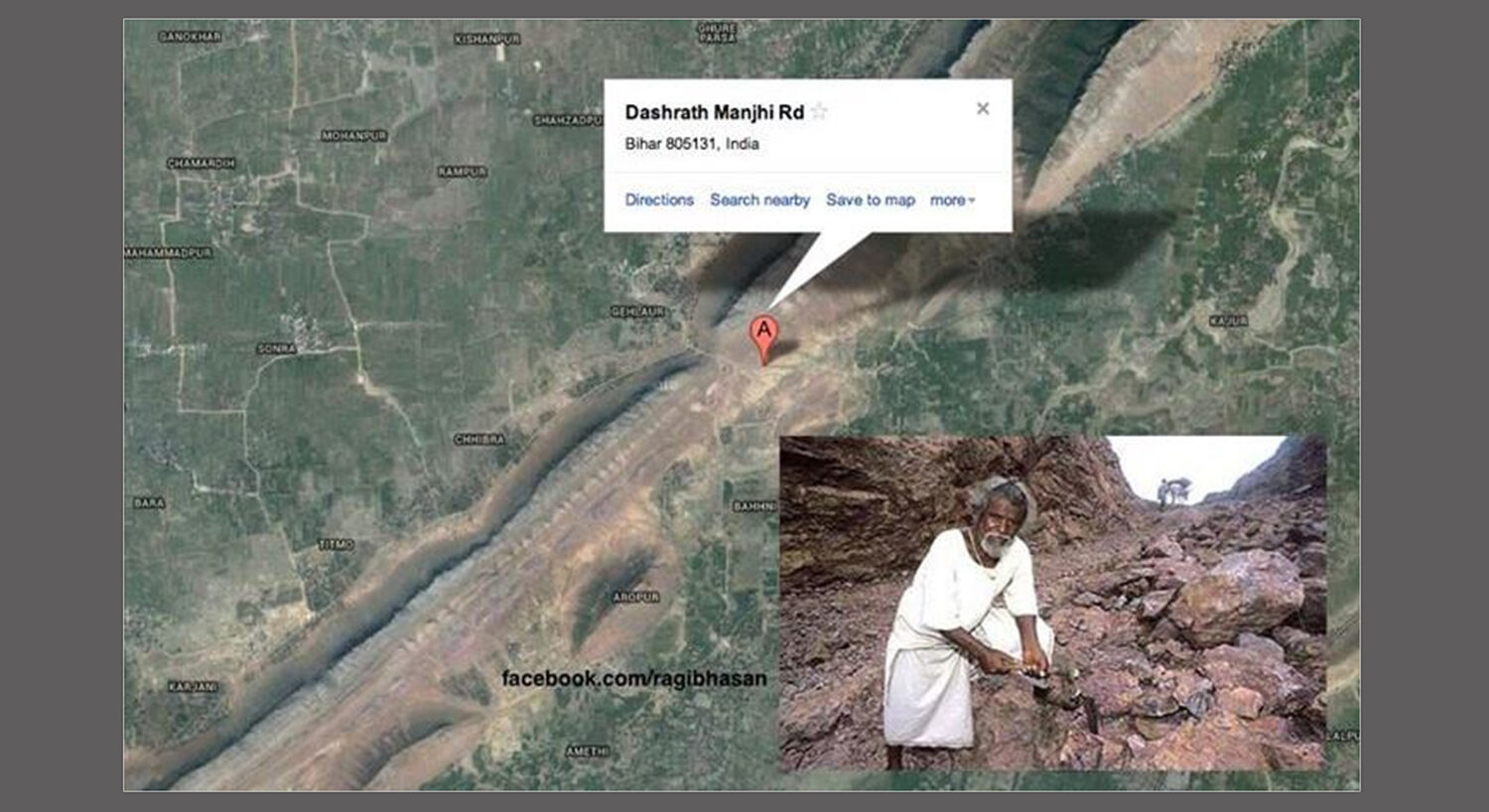
Shah Jahan vs Dashrath
The reason why a day laborer Dashrath is more deserving of honor and respect than Emperor Shah Jahan
Is it possible for a single person to bring about a mountain-like change?
The answer is – yes, it is possible. A very ordinary working man made the impossible possible and created an example.
Shah Jahan vs Dashrath: Two Forms of Love
People do so much for their loved ones. In history we see Emperor Shah Jahan built the Taj Mahal in memory of his beloved wife Mumtaz Mahal. Today it is one of the world’s wonders. But in the same Indian subcontinent there was another man, who was neither a king nor a wealthy businessman, but a simple laborer. His name was Dashrath Manjhi.
Shah Jahan built the Taj Mahal with thousands of workers paid by the people’s taxes. Dashrath Manjhi, on the other hand, broke a mountain and built a road with his own labor alone. The question is – whose love is more worthy of imitation?
We place the Taj Mahal before our minds as a symbol of love. There is no question about its architecture and aesthetics. It is world-class. My concern is – is it truly a humanitarian monument? Can it really be called a symbol of love? Can it be considered an ideal for love? Was Emperor Shah Jahan really a hero? I am only presenting the facts below, you may find the answer yourself at the end.
When his wife Mumtaz (real name Arjumand Banu Begum) died prematurely, Mughal Emperor Shah Jahan was deeply hurt. With that broken heart he built a mausoleum over her grave. That is the Taj Mahal.
The physical beauty of the 14-year-old Iranian girl Mumtaz had captivated Shah Jahan. So he got engaged to her, but did not marry her immediately. Instead, leaving Mumtaz waiting, Shah Jahan married another woman. Mumtaz was his second wife, or according to another source, his third. His total number of wives was seven. As for concubines, let’s not even mention. (Yet Mumtaz is called the symbol of his love!)
Five years after the engagement, in 1612, Shah Jahan brought Mumtaz into the palace as his second wife. Again in 1617, he married another woman, even though Mumtaz and another wife were already in the household. Within 19 years of marriage, Mumtaz became the mother of 14 children of Shah Jahan. While giving birth to the 14th child, Mumtaz died at the age of only 38. It can be said Shah Jahan himself invited her death, by making a reckless decision. He took pregnant Mumtaz with him on a military campaign. Traveling long hours on elephant back through rough roads caused her labor pains to begin prematurely. After 30 hours of labor she gave birth and then collapsed into death due to excessive bleeding. After Mumtaz’s death, Shah Jahan married Mumtaz’s own younger sister.
It is said that the designer of the Taj Mahal was Isa Muhammad. He had created a sculpture as a gift for his wife. Later, Emperor Shah Jahan liked the design and the Taj Mahal was built based on it. That man’s eyes were destroyed so that he could never create such a design again.
The construction of the Taj Mahal began in 1632 and was completed in 1653. During this time, 20,000 workers and artisans were used like slaves in its construction. It is said that after the Taj Mahal was completed, the fingers of the artisans were cut off so they could not replicate the work elsewhere, though this story is not proven true.
Shah Jahan spent 32 million rupees on the construction of the Taj Mahal. Theoretical calculations suggest that this amount is equivalent to 52.8 billion rupees or 827 million US dollars today, i.e. 643.8 crore taka. In reality, it would be even more.
Eleven years after the Taj Mahal’s construction, Shaista Khan came to Bengal as Subedar. At that time, how much rice could be bought with one taka? Eight maunds. That means the price of one maund of rice was 12.5 paisa or 0.125 taka. And today, what is the minimum price of one maund of rice? Probably between 900 and 1,000 taka.
Let’s assume 900 taka. Now dividing 900 by 0.125 gives 7,200. That means the price has increased 7,200 times compared to then. So the expenditure for the Taj Mahal in today’s terms would be 32 million x 7,200 rupees or 23,040 crore rupees, which equals 28,314 crore taka. With that money, ten universities like Oxford could have been built in India, perhaps one even in Dhaka.
All this money was extracted as tax by sucking the blood of ordinary people. Shah Jahan spent it to fulfill his personal desire of building a mausoleum over his dead wife’s grave. Would any true lover’s heart ever want to commit such a heinous injustice?
Spending such a huge amount on an unproductive sector and the oppression of people to collect that money resulted in a terrible famine shortly after the Taj Mahal’s construction. The open eyes of the dead bodies lying on the streets did not see the white marble of the Taj Mahal.
Mughal family daughters were not allowed to marry. Emperor Shah Jahan buried his daughter Jahanara’s love in a cruel way. Shah Jahan did not like the man Jahanara fell in love with. But the intelligent Jahanara remained steadfast in her love. Her lover secretly came to meet her. One day Shah Jahan managed to capture his daughter’s lover. Then, in front of his daughter’s eyes, Shah Jahan killed him by nailing him to a wall with planks and spikes — the builder of the ‘love’ Taj Mahal. At that time, construction of the Taj Mahal was ongoing by the Yamuna River.
Five years after the Taj Mahal’s construction, Shah Jahan lost the throne to his son Aurangzeb. Aurangzeb forcibly imprisoned Shah Jahan and declared himself emperor, eliminating his other brothers who claimed power one by one.
Shah Jahan spent the last eight years of his life imprisoned in Agra Fort, silently watching his sons fight over power. Surely he remembered how he himself had killed his brothers to seize power. He died in captivity.
Who was Shah Jahan’s companion in captivity? It was Jahanara, whose lover Shah Jahan had brutally killed. Jahanara voluntarily chose to remain imprisoned with her father and gave him company in his difficult times. Then who is truly great as a lover? Can Shah Jahan really be called a lover? The feelings he had for Mumtaz can only be described as infatuation, nothing more.
It is natural to be amazed by the exquisite beauty and craftsmanship of the Taj Mahal. But forgetting the cruel history associated with its construction is not natural at all. After all this, do you still think Shah Jahan loved his wife Mumtaz so much that he gained legitimacy to build a mausoleum over her grave with tax money collected by oppressing the people of the country?
The Life Story of Dashrath Manjhi
Dashrath Manjhi was born in a remote village near Gaya in Bihar. Although the aerial distance from his village to the city was not much, a huge mountain stood in between. As a result, it was not possible to reach the city directly. People had to go around the entire mountain, turning a 15-kilometer journey into nearly 70 kilometers.
In 1960, when his wife Falguni became seriously ill, Dashrath tried to take her to Gaya city for treatment. But while crossing the long distance, Falguni died without receiving medical care. Dashrath was devastated by his wife’s death. He realized that not only he, but countless villagers were suffering because of this mountain — for treatment, education, markets, everything.

The Story of Making the Impossible Possible
Dashrath went to government offices many times for help. But he received no assistance. Then he decided that if he kept waiting for others, the problem would never be solved. He picked up a hammer and chisel. Without any heavy machinery, he began breaking the mountain.
The villagers mocked him. They said it was impossible for one man to break a mountain and build a road. But Dashrath did not give up. He worked every day, sweating and laboring. After 22 years of relentless effort, he finally managed to carve a road 360 feet long and 30 feet wide through the mountain.
Result? The villagers no longer had to travel 70 kilometers around. They could reach the city in just 15 kilometers. Medical care, education, markets — everything became accessible. The lifestyle of the village changed.
Comparison: Shah Jahan vs Dashrath
- Shah Jahan: For 22 years, with 20,000 workers and the people’s money, he built the Taj Mahal — a monument of beauty.
- Dashrath Manjhi: For 22 years, alone with his own labor, he broke a mountain and built a road — which saved people’s lives.
The Taj Mahal is undoubtedly beautiful, but Dashrath’s road was necessary. Therefore, from the perspective of humanity, Dashrath’s work is more worthy of respect.
Dashrath Manjhi teaches us — if we wait for others’ help, society will never change. A single person can bring about mountain-like change. His life reminds us that love is not just emotion, it is expressed through action.
Emperor Shah Jahan became immortal in history for the Taj Mahal, but how many people know the cruel reality hidden behind it? Laborer Dashrath Manjhi, however, became immortal for humanity. He proved that true respect is earned when one changes others’ lives with love and labor. Therefore, Dashrath Manjhi is undoubtedly more deserving of honor and respect than Emperor Shah Jahan.
[ http://www.indianexpress.com/news/the-man-who-made-way-for-progress/968751/0 | http://en.wikipedia.org/wiki/Dashrath_Manjhi ]
Related Posts

Why do Islamist clerics consider Bengali cultural festivals their enemy?
This year, unlike many previous years, the major Hindu religious festival Durga Puja in BangladeshRead More
ইসলামিস্ট মোল্লারা কেন বাঙালিদের আনন্দ উৎসবকে তাদের শত্রু মনে করে?
এবার বাংলাদেশে অন্যবারের তুলনায় বেশ শান্তিপূর্ণ, উৎসবমুখর পরিবেশে হিন্দু ধর্মের বড় ধর্মীয় উৎসব দূর্গাপূজা হয়েRead More

Why do Islamist cyber‑jihadis insult, threaten, and file false reports against people with different opinions?
Maulana Azhari once advised Islamists that sharing his Facebook posts is also an Islamic act;Read More
Comments are Closed