
Punishment for rape in Islam
Under Islamic law, a rape victim’s chances of getting justice are very limited; that’s why rape statistics are low in Islamic countries
Muslims are like camels with a rope tied to their noses, who have no individual identity of their own. Islam is the owner of the lives and properties of the believers; they have nothing of their own. These are the words of Islam. There are references, I cannot provide them all right now, you can search and find them. Islam will control you 24/7/365 days from morning till night. It will dictate which foot you should put forward while walking, which dua you should recite at what time, how you should sleep with your partner—everything must be done according to Islamic rules.
In the Quran, Allah has not given any sign of anything that did not exist in the Arabia of that time. Even though figs are mentioned, there is no mention of litchi or mango from distant lands in the Quran. In the scorching desert heat where the body burns, the shade of a tree was highly desirable. That is why in Paradise, you will get miles and miles of date palm gardens. Now, what will you do with those date palm gardens? At that time, there were no phones, internet, or apps. That is why Prophet Muhammad said that if someone returns home after staying away for a few days, he should not enter the house directly. Since there was no way to inform in advance, he should wait a little before entering. This would give his wife/concubines time to shave their pubic hair. Meaning, so that the man could enjoy himself a bit after a long time. Islam, its Allah, Allah’s Quran, and Prophet Muhammad have given so much importance to this sexual act that in almost every line, there is talk of this copulation!
Anyway, in this same Islam that has so much about everything, there is no mention anywhere of rape—one of the biggest crimes in the world—its punishment, or its judgment. According to the claim of Islamists, the Quran is a complete code of life, yet there is not a single word about this. On the other hand, there are plenty of rules about disciplining the Prophet’s wives and many other things. Actually, in the eyes of Islam, women are not even complete human beings. Describing that would require another full article. So I will say, search if you are interested in knowing. If a woman is raped, Islam has 101 ways to acquit the male rapist. Islam has made such arrangements that the victim woman will not even dare to seek justice.
So does that mean there is no punishment for rape in Islam? There is, but with a lot of twisting and turning. In Islam, Zina (adultery/fornication) is given a very harsh punishment. This refers to consensual sexual relations outside of marriage. In modern law, this is not considered a crime because it is a private matter between two consenting adults. Even in Bangladeshi law, it is not a crime. If there is a partner, it may be betrayal, but it is not a legal offense. But Islam views it as a very serious crime.
Zina-e-Muhsan is when a married person commits zina, and Zina-e-Ghair-Muhsan is when an unmarried person commits zina. Rape (Zina-bil-Jabr) does not fall under this because there is no consent involved. If zina is committed, both parties are punished under Islamic law, but the severity of the punishment varies according to the type. Islamic scholars classify rape also as zina, but the difference is that since there is no consent, only one person is punished if zina is proven. However, proving rape under Islamic rules is extremely difficult. For zina or adultery, Islam has terrifying and brutal punishments which you must have seen in news, pictures, and videos. Previously in Bangladesh’s villages, fatwas were issued to whip people with lashes. In countries like Afghanistan, 100 lashes or burying up to the neck in the ground and then stoning to death by the whole village amid cheers—you can find these by searching online.
From the perspective of modern human rights and international law, giving such brutal punishments for zina/adultery is considered inhumane because it involves mutual consent between two adults. Rape is completely different—there is no consent and it is a violent crime. Yet, in the primary sources of Islam, there is no direct mention of its punishment.
As I said earlier, in Islam the punishment for zina varies according to its type. Unmarried people get some leniency; their punishment is 100 lashes instead of death. If a married person commits sexual intercourse outside marriage, the Islamic ruling for them is a horrific and inhumane death. These punishments are carried out publicly in crowded places. Ordinary people are also forced to participate in this killing with joy. You can say they are compelled to participate, as the Quran itself instructs this (Surah An-Nur 24:2). The Quran does not directly mention the punishment of stoning for married persons committing zina.
But in authentic Hadith, Prophet Muhammad (PBUH) repeatedly applied the punishment of Rajm (stoning). Although stoning is not mentioned in the Quran, since the Prophet himself carried out the punishment of stoning, all four madhhabs have accepted Rajm as a valid punishment. Shariah law is formed by combining the Quran and Hadith.
When carrying out Rajm, believing Muslims are required to be present. This is mandatory based on the principle of Surah An-Nur 24:2 in the Holy Quran. According to some madhhabs, the person is buried up to the neck in the ground, and according to others, stoned to death in an open place. The judge throws the first stone. Then groups of ordinary people throw stones. There is a rule that small pieces of stones should be thrown slowly so that death does not occur too quickly; death must be ensured gradually. Just think how inhumane, cruel, and what a great crime this is! Yet in most cases, the rapist gets away with such a heinous crime as rape.
Proving zina under Islamic law is extremely difficult. To prove zina or adultery, four adult, upright male witnesses are required who have directly seen the act of sexual intercourse (Surah An-Nur 24:4), or voluntary confession (as in the cases of Ma’iz and the Ghamidiyya woman in Hadith). Because of this strict condition, proving zina is almost impossible in reality. The four eyewitnesses for proving zina must be men. A woman’s testimony is not acceptable here—this is the unanimous opinion of all four madhhabs.
Islamic scholars consider rape (Zina-bil-Jabr) as zina, but without consent. Therefore, if rape is proven, punishment is given to only one person instead of two. There is no doubt that the punishment is extremely harsh. But just think: for a rape victim, is it possible to gather four adult male witnesses? When someone commits such a heinous act as rape, does he do it in front of others? He will surely want no one to know and will do it somewhere out of sight. Now suppose a woman is raped. When she files a complaint, the only option left for proving rape (Zina-bil-Jabr) is her own voluntary confession that the act happened without her consent. Then what happens?
If she cannot prove that the accused raped her without her consent, then the punishment for zina falls on her. According to Islamic law, even a woman lying on her deathbed cannot go to the hospital alone without permission and company of her husband or male guardian. The police will arrest her and bring her before punishment regardless of how bad her condition is—even if she is in labor pain or her throat is torn apart, it does not matter. So whether raped or anything else, there is no opportunity to seek justice! Even if somehow the case reaches court, to prove rape according to the law, four male witnesses are required. Where will a raped woman find four witnesses? Even if she finds them, the witnesses themselves face a big problem: why didn’t they protest when they saw it, and why did they watch without lowering their gaze? They too can be accused for that. So who will come forward to give testimony and get beaten? Since there are no witnesses, the arrow of the crime now points at the victim. If she is unmarried, she gets 100 lashes; if married, she gets Rajm or is buried up to the neck and stoned to death, etc. That is why you will see that in countries run by Islamic law, the official statistics of rape are very low. Yet if you just browse YouTube, you will find countless videos of sexual abuse in Saudi Arabia.
Millions of female domestic workers have returned from Saudi Arabia to their own countries and narrated their horrific experiences. They were raped daily by the house owner, repeatedly; father and son raped them together, friends raped them in groups, they faced physical and mental torture, and even the women of those families did not stop it. Thousands of Bangladeshi women returning from Saudi have raised their cries in the media; we have seen these reports in all mainstream media. Those who managed to return said that those who could not return are still living in living hell. They want to live, they want diplomatic intervention. Yet statistics show that rape is almost non-existent in Saudi Arabia. Because those incidents are not recorded as rape. Many Saudi house owners think that having sex with their maids is their right because they bought them. In Islam, there is a provision for capturing women defeated in jihad or religious war as war booty and making them sex slaves. Those women are bought and sold in markets. Prophet Muhammad of Islam also had multiple sex slaves and he himself bought and sold slaves. Remember, ISIS bought and sold Yazidi women. There is abundant information about the hellish lives, unbearable memories, and struggles of those women in various media. Many house owners in Saudi Arabia, Kuwait, etc., consider the domestic workers they buy as sex slaves. There are even online markets for buying and selling such maids. If you search online, you will find countless pieces of information.
In just the month of August 2019, 111 female domestic workers returned to Bangladesh from Saudi Arabia after being tortured, out of whom 38 alleged that they had been raped by their employers. Now calculate for 12 months. Also take into account how many women go there from India, Pakistan, Nepal, Philippines, various African countries, and how many of them become victims of such rape. Many silently endure rape due to poverty. On the other hand, in 2019, only 8 rapists were punished in Saudi Arabia on charges of rape. What a farce of Islam, just think about it.
There are many examples where the victim herself had to face punishment for filing a complaint. In Saudi Arabia, two Indonesian female domestic workers were given the death penalty, and after public protest in Indonesia, Indonesia stopped sending female domestic workers there. The story of 16-year-old Iranian girl Atefeh Sahaaleh Rajabi is one of the most brutal tales in history—she was executed under Islamic law on charges of zina. If I start giving examples one by one, this article will become very long. If you search online, you will find many such cases where after filing a rape complaint, the victim herself had to face severe punishment. That is why in countries governed by Islamic law, rape victims generally do not file complaints of rape.
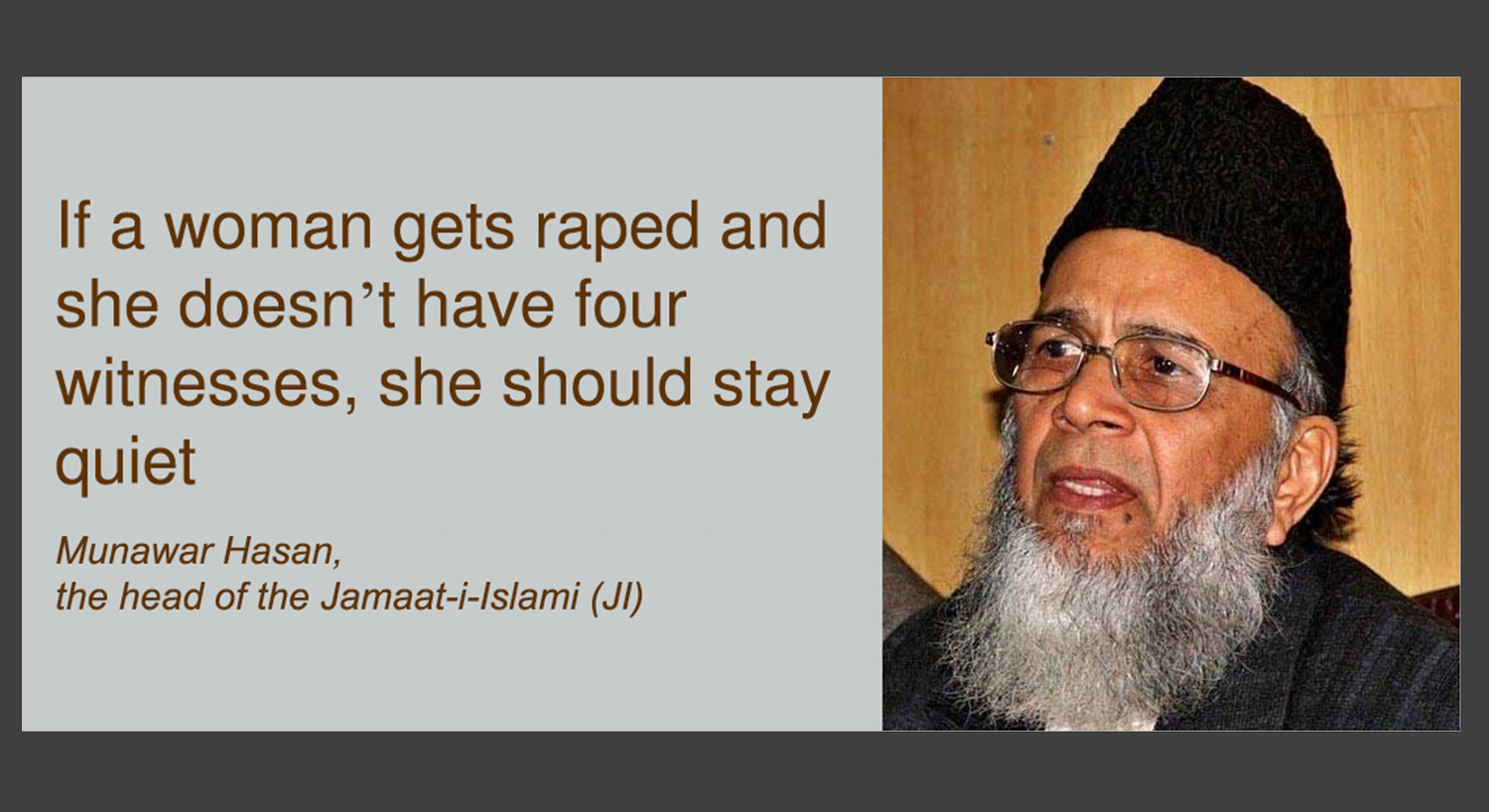
According to Munawar Hasan, the leader of Pakistan’s main Islamic party Jamaat-e-Islami, “If a woman is raped and she does not have four witnesses, then she should keep quiet.” He further said that if a woman fails to produce four eyewitnesses after accusing someone of consensual sex or rape, then there is “no problem” in convicting her. He himself added that finding four witnesses is practically impossible unless the incident happens at a crossroads. It seems the only way to get justice would be if she is gang-raped by at least five criminals—among whom four stand and watch, and later those four testify in court against the main perpetrator. The main point is—if a woman is raped and she does not have four witnesses, then she should keep quiet.
Before Sudan made some changes to its Islamic law under international pressure, there a young Ethiopian woman who was gang-raped was instead convicted of “indecent behavior.” The incident caused international outrage. Lawyers say that in Sudan, when a woman reported rape, it was often treated as a confession of adultery. Sudanese lawyer Hikma Ahmed said that previously the law was so vague that in most cases the woman who reported rape was made the accused of zina.
It is unfortunate that in many countries like Afghanistan, Pakistan, Saudi Arabia, Sudan, etc., a large number of people have permanently internalized Islamic law in their mindset. Sometimes they themselves take the burden of punishment for zina/adultery and carry it out socially. In Bangladesh too, fatwas were once common in villages to whip people with lashes, especially applied against women. Although it has decreased now, it has not completely disappeared.
You will often hear many Islamic preachers say that there is strict punishment for rape in Islam. They claim that Islam supports four adult male eyewitnesses, voluntary confession, as well as modern methods of proving rape such as injuries, CCTV footage, women’s testimony, medical examination, DNA sample testing, etc. Many say that zina/adultery and rape are different, and rape is a criminal offense. It is true that under pressure from international human rights organizations, many Islamic countries have added these to their national laws. But in original Islam, that is, according to the Quran and Hadith, these are not present. Nothing is said about rape there.
Related Posts

Why do Islamist clerics consider Bengali cultural festivals their enemy?
This year, unlike many previous years, the major Hindu religious festival Durga Puja in BangladeshRead More
ইসলামিস্ট মোল্লারা কেন বাঙালিদের আনন্দ উৎসবকে তাদের শত্রু মনে করে?
এবার বাংলাদেশে অন্যবারের তুলনায় বেশ শান্তিপূর্ণ, উৎসবমুখর পরিবেশে হিন্দু ধর্মের বড় ধর্মীয় উৎসব দূর্গাপূজা হয়েRead More

Why do Islamist cyber‑jihadis insult, threaten, and file false reports against people with different opinions?
Maulana Azhari once advised Islamists that sharing his Facebook posts is also an Islamic act;Read More
Comments are Closed