
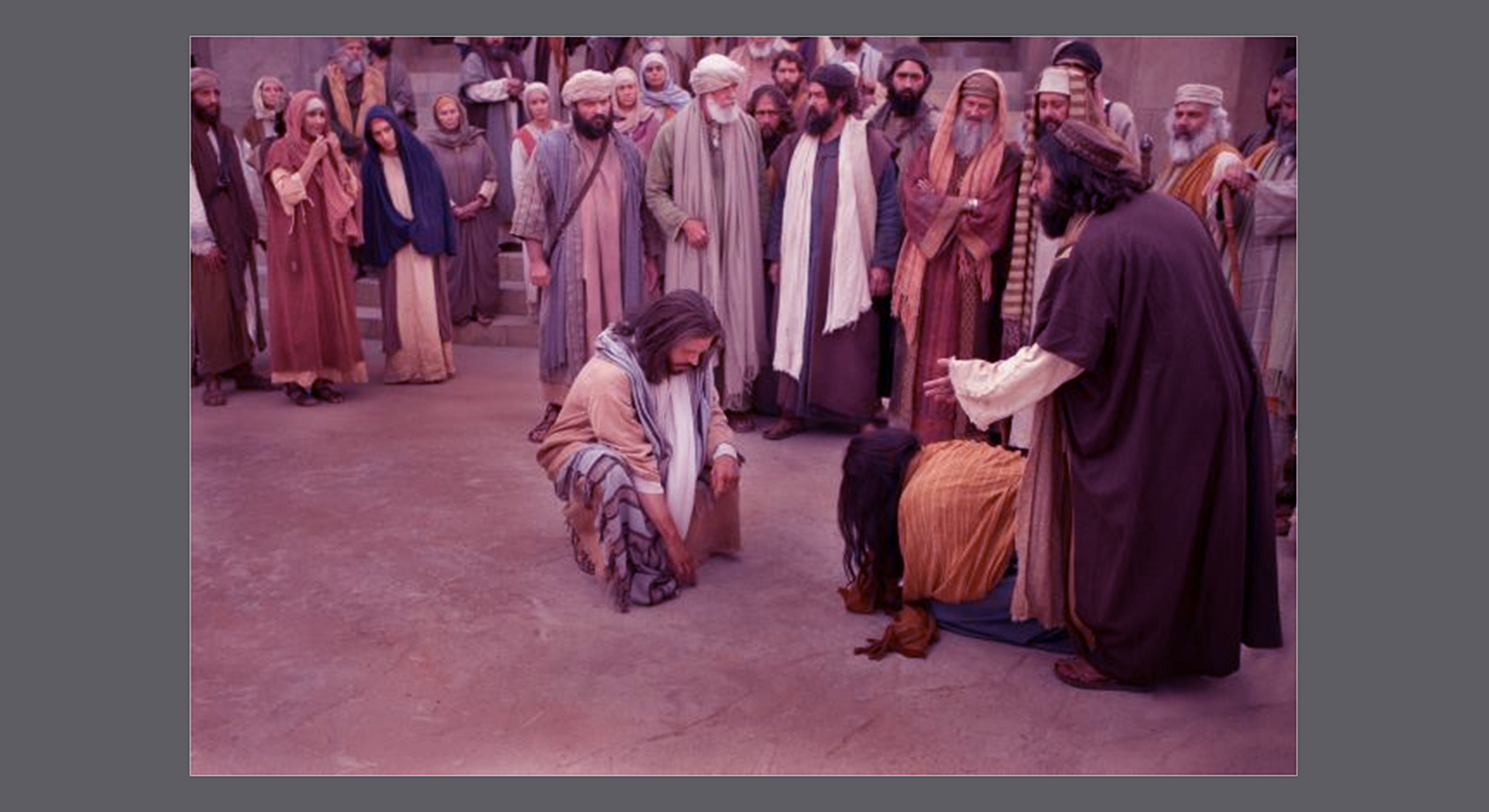
The inhumanity of Islam
Islam prescribes no punishment for rape. The penalty for zina/adultery is brutally inhumane – death by stoning
Almost all civilized and modern laws of the world consider rape a grave crime. Because it is –
⦿ An attack on a person’s body, freedom, and dignity
⦿ A serious violent crime
⦿ A criminal offense punishable by the state
⦿ In many cases, a crime against humanity, especially during times of war and conflict
Therefore, the maximum punishment is prescribed for the offender of rape. In some places, rapists are sentenced from 3 years to life imprisonment or even death. Rape is less about sexuality and more about the naked display of one’s power. But you will be surprised to know that nowhere in the primary sources of Islam is there a single word about the trial of rape. Neither in the Qur’an nor in the Hadith is there any mention of what punishment should be given for rape. Islamists claim that the Qur’an is a divine guideline for a complete way of life. The books of Hadith, written about the events, actions, words, and intentions of Prophet Muhammad’s life, are also among the primary sources of Islam without which Islam is incomplete. But in this ideology, which claims to be a complete way of life, there is no provision for punishment for such a heinous crime as rape. Yes, you heard right – there is no prescribed punishment for rape in Islam. While there are punishments mentioned for trivial matters such as what happens if women do not wear veils, use perfume, or wear pants above the ankles, there is no mention in the Qur’an or Hadith of punishment for one of humanity’s most horrific crimes – rape.
So does it mean that in countries governed according to Islam there is no trial for rape? For example – Afghanistan, Iran, Saudi Arabia, Sudan? The answer is, yes, there is. But it is not a direct trial of rape. The punishment is given under the provisions of zina or adultery described in Islam. Islamic scholars have chosen the punishment for zina or adultery as the punishment for rape. What is zina or adultery?
Before that, let us know – what is the general definition of rape?
In modern legal systems, rape is generally defined as follows:
✔️ Non‑consensual sexual penetration
Any kind of penetration –
⦿ Genital
⦿ Anal
⦿ Oral
⦿ With other body parts or objects
☛ If it occurs without the victim’s consent, that is rape.
✔️ Use of force, threats, or intimidation
If the offender –
⦿ Uses physical force,
⦿ Intimidates,
⦿ Threatens,
⦿ Makes the victim unconscious or incapacitated,
☛ Then it is also considered rape.
This is explicitly mentioned in the definition under U.S. law.
✔️ When the victim is incapable of giving consent
If the victim is –
⦿ A minor (the age of minority varies by country, e.g., 18)
⦿ Intoxicated/unconscious due to drugs or alcohol,
⦿ Asleep,
⦿ Mentally incapacitated,
☛ Then consent is invalid → it is considered rape.
✔️ Gender‑neutral definition
In modern law, rape applies equally to both men and women. In Bangladesh, many religious educational institutions, especially madrasas, where young boys are sexually abused by teachers and elders, that is also considered rape. In most laws, even sexual intercourse with one’s own spouse without consent is considered rape.
What is Zina or Adultery?
Zina (Adultery) means:
👉 Consensual sexual relations outside marriage.
That is,
⦿ Two adults
⦿ Who are not legally married
⦿ If they willingly engage in sexual relations
☛ Then it is considered zina/adultery in Islamic terminology.
It must be remembered that this happens with the consent of both parties.
According to Islamic Shariah, zina is:
✔️ Consensual sexual relations outside marriage
It is classified in two ways:
| Type | Explanation |
|---|---|
| Zina‑al‑Muhsan | If a married person commits zina |
| Zina‑al‑Ghair‑Muhsan | If an unmarried person commits zina |
Rape (Zina‑bil‑Jabr) does not fall under this category, because there is no consent. When zina occurs, under Islamic law both parties are punished, but the severity of punishment differs depending on the type, which we will discuss later. Islamic scholars also declare rape as zina, but the difference is that here there is no consent, so if zina is proven only one person is punished. However, proving rape as zina is very difficult if Islamic rules are followed, as you will learn from the writings below. For zina or adultery, Islam prescribes terrifying and brutal punishments which you may have seen in news, pictures, or videos.
Zina or Adultery in Modern Law
In modern civil or criminal law, “zina” or “adultery” is generally not a crime.
In many countries it is –
⦿ Seen as a moral/personal matter
⦿ Sometimes used as a reason for divorce
⦿ But not considered a criminal offense
⦿ In Bangladesh, India, the United States, Europe – in most countries adultery is no longer a crime.
☛ From the perspective of modern human rights and international law, imposing brutal punishments for zina/adultery is considered inhumane since it involves mutual consent between two adults.
Zina/Adultery vs. Rape – Key Differences
| Aspect | Zina/Adultery | Rape |
|---|---|---|
| Consent | Present | Absent |
| Nature | Moral/Religious offense | Serious violent crime |
| Victim | None (both are consenting) | Exists |
| In Modern Law | Generally not a crime | Serious crime |
Zina/Adultery = Consensual sexual relations outside marriage.
It is considered a crime from a religious perspective, but generally not a crime in modern law.
Rape is completely different – because there is no consent and it is a violent crime.
Punishment for Zina/Adultery in Islamic Law
As mentioned earlier, in Islam the severity of punishment for zina/adultery differs depending on the type. Here, unmarried individuals receive somewhat lesser punishment, they do not face a terrifying death. If married individuals engage in extramarital sexual intercourse, then Islam prescribes for them a terrifying and inhumane death. These punishments are carried out publicly, in crowded places. Ordinary people also participate in this killing spree with enthusiasm. One may say, ordinary people are compelled to participate, as such instructions are given in the Qur’an (Surah An‑Nur 24:2).
| Type | Explanation | Punishment |
|---|---|---|
| Zina‑al‑Muhsan | If a married person commits zina | Rajm (death by stoning) – based on Hadith |
| Zina‑al‑Ghair‑Muhsan | If an unmarried person commits zina | 100 lashes – Qur’an 24:2 |
Those with weak hearts should not watch the video. Source link here. This barbarity leaves humane people like us speechless. Yet this is the reality of the world, as these practices still survive in many places in the name of Islamic law and governance.
📘 1. Zina of an Unmarried Person – Qur’anic Punishment
📖 Qur’an 24:2 (Surah An‑Nur)
➡️ This is the punishment for zina committed by an unmarried person.
➡️ Here, there is no rajm (death by stoning).
📙 2. Zina of a Married Person – Punishment in Hadith
The Qur’an does not directly mention the punishment for zina committed by a married person.
But in Sahih Hadith, Prophet Muhammad (pbuh) repeatedly applied rajm (stoning).
Sahih Bukhari and Sahih Muslim – these Hadith collections describe incidents of rajm which are considered Islamic law.
1) Ma’iz al‑Aslami
When he confessed to zina, the Prophet (pbuh) ordered him to be stoned.
(Sahih Bukhari 6824; Sahih Muslim 1691)
2) The Ghamidiyah Woman
She confessed to zina while pregnant.
After giving birth, she was stoned.
(Sahih Muslim 1695)
3) Stoning of a Jewish Man and Woman
The Prophet (pbuh) stoned them according to the ruling of the Torah.
(Sahih Bukhari 6819)
➡️ Based on these Hadith, jurists decided:
Punishment for zina by a married person = rajm or death by stoning.
During rajm, believers or Muslims must be present. Based on the principle in Qur’an Surah An‑Nur 24:2, this is mandatory. According to some schools of thought, the person is buried up to the neck, while others prescribe stoning in an open place. The first stone is thrown by the judge. Then ordinary people collectively throw stones. There is a rule that stones should be thrown in such a way that death is not immediate, but ensured gradually, using smaller stones to prolong the process.
Just think once, how inhumane, cruel, and what a great crime this is!
Although the Qur’an does not mention rajm as a punishment, since Prophet Muhammad himself implemented rajm, all four schools of Islamic jurisprudence accepted it as a valid punishment. Shariah law is formed by combining Qur’an and Hadith.
Conditions for Proving Zina
In Islamic law, proving zina is extremely difficult. To prove zina or adultery, it requires –
✔️ Four adult, righteous witnesses
Who directly saw the act of sexual intercourse
(Surah An‑Nur 24:4)
✔️ Or voluntary confession
(Incidents of Ma’iz and the Ghamidiyah woman, Hadith)
➡️ Because of these strict conditions, in practice proving zina is almost impossible.
To prove zina, the four direct witnesses must be men.
Women’s testimony is not accepted here – this is the unanimous opinion of the four schools of jurisprudence.
Just imagine how unrealistic this is. When someone engages in sexual intercourse, would four adult men stand there watching? Is that possible?
Trial of Rape in Islam
Rape (Zina‑bil‑Jabr) is considered by Islamic scholars as zina, but here there is no consent. Therefore, if rape is proven, punishment is applied to one person instead of two. The punishment is undoubtedly very severe. But think once – how possible is it for a rape victim to gather four adult male witnesses? When someone commits such a heinous and disgraceful act as rape, would he do it publicly? He would surely want no one to know, and would commit the act in secrecy. Now imagine, a woman – she is raped. When she files a complaint, the only option left for her to prove rape (Zina‑bil‑Jabr) is voluntary confession that zina occurred without her consent. What happens then?
If she cannot prove that the accused forced her without consent, then the punishment for zina falls upon her. According to Islamic law, even a woman lying on her deathbed cannot go alone to the hospital without the permission and company of her husband or family guardian. Police will arrest her and bring her to punishment regardless of her condition – whether she is in labor pain or her throat is slit, it does not matter. So whether raped or not, there is no opportunity for justice! Even if somehow the case proceeds, proving rape requires four male witnesses according to law. Where will a rape victim find four witnesses? Even if she does, there is another problem – the witnesses may be accused themselves: why did they not protest, why did they watch without lowering their gaze? So who will testify only to be punished? Since there are no witnesses, the blame falls on the victim herself. Then, if unmarried, she faces 100 lashes; if married, rajm – buried up to the neck and stoned to death, etc. That is why you will see that official statistics of rape are low in countries governed by Islamic law. Yet if you browse YouTube, you will find countless videos of sexual abuse in Saudi Arabia.
Hundreds of thousands of female domestic workers returned from Saudi Arabia to their home countries and reported their horrific experiences. Every day they were raped by their employers, repeatedly, sometimes father and son together, sometimes groups of friends, subjected to physical and mental abuse, and even the women of those households did not intervene. Thousands of Saudi‑returned Bangladeshi women raised their cries in the media; we saw these reports in mainstream outlets. Those who managed to return said those who could not are living in a living hell. They want to survive, they want diplomatic intervention. Yet statistics claim there is no rape in Saudi Arabia – because those cases are not recorded as rape. Many Saudi employers believe having sex with maids is their right, since they bought them. In Islam, there is a provision to enslave women captured in jihad or religious wars, treating them as spoils of war and sexual slaves. Those women were bought and sold in markets. Prophet Muhammad himself had multiple concubines and engaged in buying and selling of slaves. Think about it – ISIS used to buy and sell Yazidi women. The hellish lives, painful memories, and struggles of those women are documented in countless media reports. For example, Link‑1, Link‑2, Link‑3, Link‑4, Link‑5. In Saudi Arabia, Kuwait, and similar countries, many employers treat purchased domestic workers as sexual slaves. There are even online markets for buying and selling maids. If you search online, you will find countless reports.
Even if Raped, No One Complains …
In August 2019 alone, 111 female domestic workers returned to Bangladesh from Saudi Arabia after suffering abuse, of whom 38 reported being raped by their employers. Now calculate for 12 months. Consider how many women go there from India, Pakistan, Nepal, the Philippines, and various African countries, and how many among them suffer such rape. Many silently accept rape due to poverty.
Nargis Akter Neela, coordinator of the organization “Bangladesh Working Women,” said: “Domestic workers are abused in the employer’s house. She is alone there. So she cannot protest the abuse. And if a case is filed, there are no witnesses except herself. As a result, abuse is more common here. For example, garment workers work together. So they can protest.” Link.
There are many examples where you will find that after filing a complaint, the victim herself faced punishment. In Saudi Arabia, after two Indonesian female domestic workers were executed, public protests in Indonesia led the government to stop sending female domestic workers to the Middle East. In Iran, 16‑year‑old girl Atefeh Sahaleh Rajabi became the central figure in a story of cruelty, executed under Islamic law for zina by death sentence.
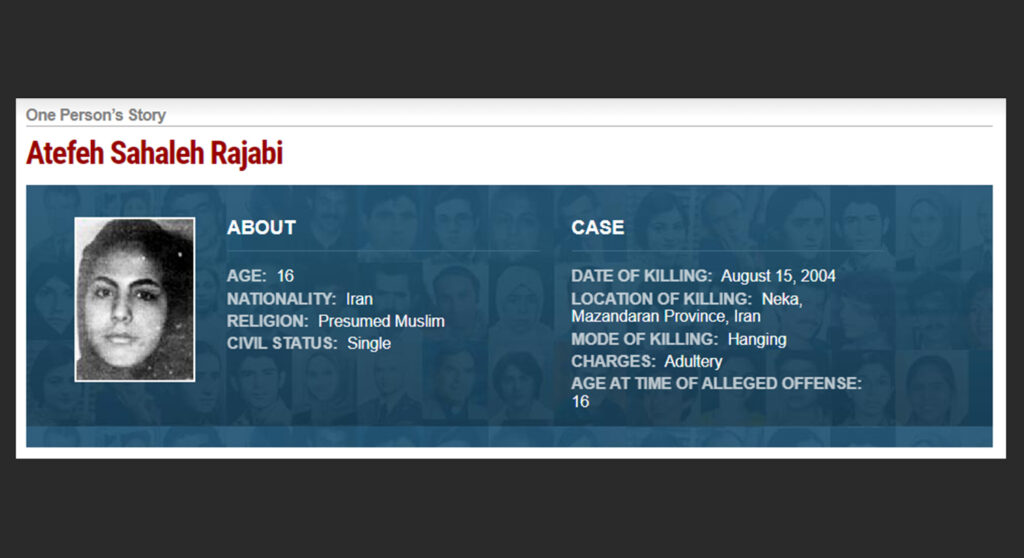
If we were to give examples of each of these cases, this article would become very long. If you search online, you will find many cases where after filing a rape complaint, the victim herself faced severe punishment. That is why in countries governed by Islamic law, rape victims generally do not file complaints.
According to Munawar Hasan, the head of Pakistan’s largest Islamic party Jamaat-e-Islami, “If a woman is raped and she does not have four witnesses, then she should remain silent.” He further stated that if a woman, after making an accusation of consensual sex or rape, fails to produce four eyewitnesses, then convicting her is “no problem.” He himself added that finding four witnesses is practically impossible unless the incident occurs in a public square. It seems that the only possibility of obtaining justice would arise if she were raped by at least a group of five criminals—four of whom stood by watching, and later those four testified against the main perpetrator in court. The main point is—if a woman is raped and she does not have four witnesses, then she should remain silent.
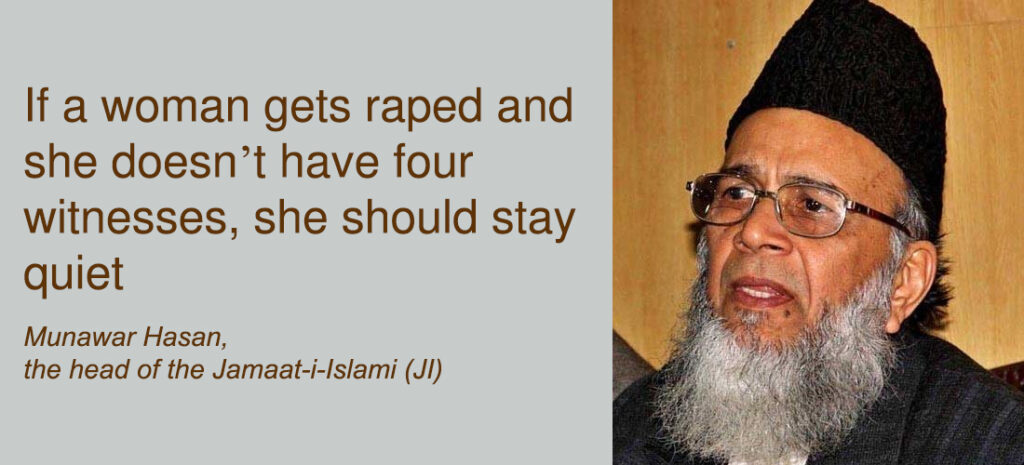
So Will This Injustice Continue in the Name of Religion?
The hopeful thing is that many Islamic countries are trying to move away from blaming the victim for rape. For example, Sudan has enacted a law to ensure that the victim does not end up punished. This change came a year after a young Ethiopian woman in Sudan was gang-raped and then convicted of “indecent acts,” which sparked international outrage. Lawyers said that in Sudan, when a woman reported rape, it was often treated as an admission of zina – sex outside marriage. The new amendment introduces a clear definition of rape as penetrative sexual activity involving physical or psychological force. Sudanese lawyer Hikma Ahmed said that previously the law was so vague that in most cases the woman who complained of rape was herself charged with adultery. The new amendment will make justice easier for rape victims and also make the work of lawyers easier. This change came after more than a decade of campaigning by local and international human rights organizations.
The sad thing is that in countries like Afghanistan, Pakistan, Saudi Arabia, Sudan, the mindset of Islamic law has become deeply ingrained in large numbers of people. Many times they themselves socially take responsibility for punishing zina/adultery and carry out the punishment. In Bangladesh too, at one time, fatwas in villages imposed punishments like lashes or flogging, which were especially applied to women. Although this has decreased now, it has not completely disappeared.
You will often hear Islamic preachers say that Islam has strict punishments for rape. They claim that Islam, in addition to requiring four adult male witnesses and confession, also supports modern methods of proving rape such as injuries, CCTV footage, women’s testimony, medical examination, and DNA testing. Some say zina/adultery and rape are different, with rape being a criminal offense. It is true that under pressure from international human rights organizations, many Islamic countries have incorporated these into their national laws. But in core Islam, that is, in the Qur’an and Hadith, these provisions do not exist. As you have seen in the various linked sources above.
Final Words
The cruel punishments under the name of zina or adultery that have been imposed on people for centuries should finally be erased from the world; because these punishments have sustained fear and oppression more than justice. And for the rape victim, justice – which is her fundamental right – should not be buried under conditions, witnesses, or inhumane evidence requirements. If society truly demands justice and humanity, it must first ensure that the criminal is punished, and that the victim can stand in court with dignity and security.
Related Posts

Palestine and Gaza merging with Israel, and all of Kashmir merging with India, would lead to greater humanitarian benefit
In modern politics, independence is often considered an almost inviolable value, where leaders aim toRead More
ফিলিস্তিন ও গাজা ইসরায়েলের সঙ্গে, পুরো কাশ্মীর ভারতের সঙ্গে মিশে গেলেই মানবতার বৃহত্তর কল্যান হবে
আধুনিক রাজনীতিতে স্বাধীনতাকে প্রায় অলঙ্ঘ্য মূল্য ধরা হয়, সেখানে নেতাদের লক্ষ থাকে দেশের নেতৃত্ব বাRead More

The Jewish claim to the land of Israel is actually connected to their historical roots
Have you heard the popular song from the 1970s ‘By the Rivers of Babylon …’?Read More
Comments are Closed