
Minority Rights in Bangladesh
Attacks by “Tawhidi Janata” in Bangladesh and Obstruction of Minority Religious Practice
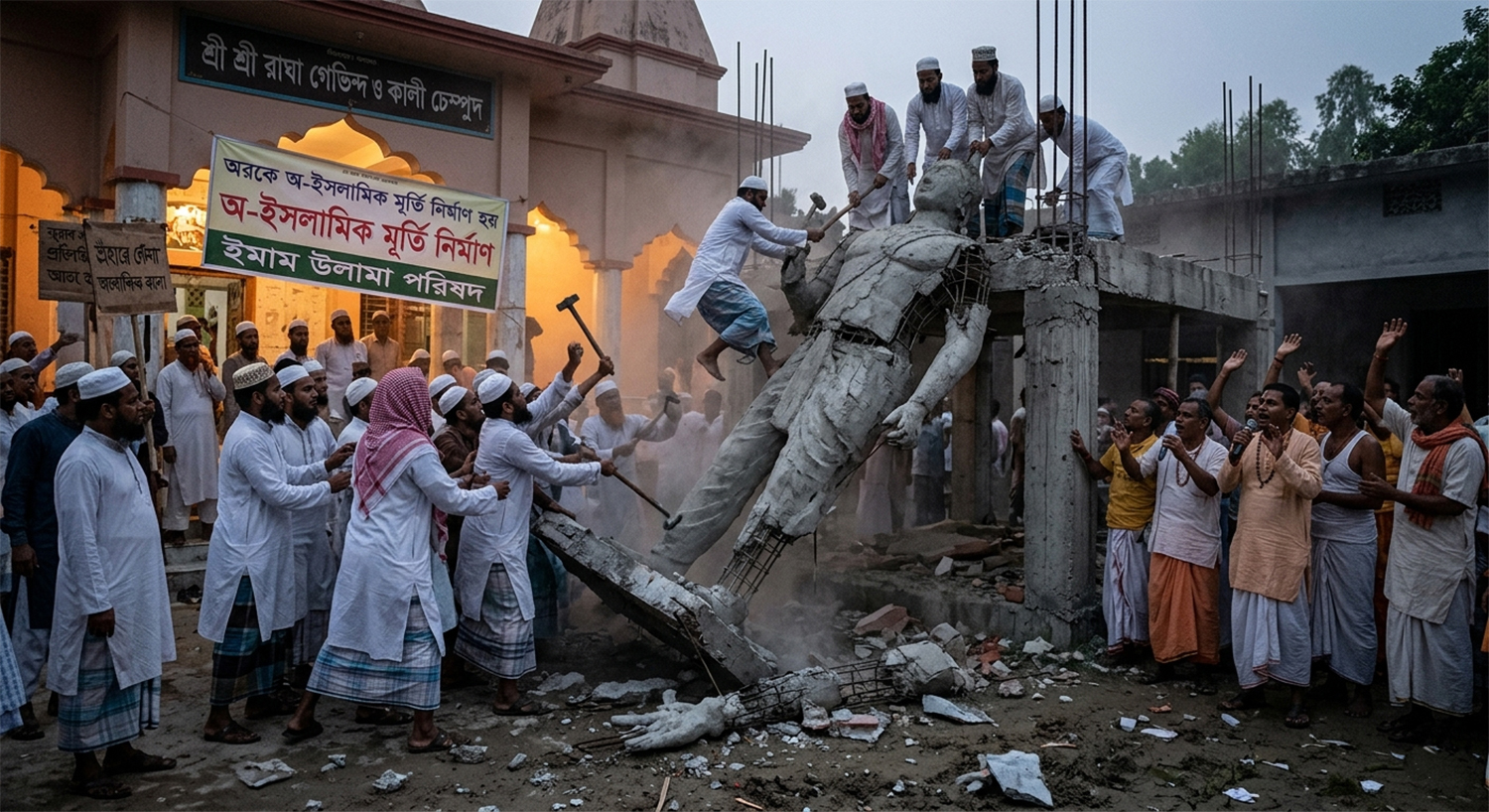
In Palashbari upazila of Gaibandha, local Sanatan (Hindu) devotees had taken the initiative to build a large statue of Lord Ram in the courtyard of the Shri Shri Radha‑Gobinda and Kali Temple. On their own land, with their own money, inside their own place of worship — this project was entirely part of their religious practice. But even this initiative did not survive. Under pressure from objections, human chains, and protest rallies by local fundamentalist groups including the Imam‑Ulama Parishad, and after criticism on social media about the project’s funding, the temple authorities were forced to “temporarily suspend” the construction in the name of “maintaining communal harmony.” This incident is not isolated — it is merely the latest addition to the long pattern of shrinking religious freedom for minorities in Bangladesh.
Practicing one’s religion freely, as long as it harms no one, is not a special privilege — it is a fundamental civic right. The Constitution of Bangladesh guarantees religious freedom. When a community installs a statue in their own temple courtyard with their own resources, there is no moral or legal basis for followers of another religion to claim their “religious feelings” have been hurt. According to someone’s personal belief, idol worship may be a sin — but that belief applies only to their own conduct, not to determining how others should worship. One person’s theology cannot define another person’s civic rights — this is the basic condition of any pluralistic, civilized society.
When someone says, “You built an idol, so I will break it,” or “I won’t allow you to build an idol,” this logic is essentially an attempt to replace someone else’s theology with one’s own — which is fascist behavior. This is not coexistence; it is domination. And if a state bows to such demands, it effectively acknowledges that the religious feelings of the majority outweigh the constitutional rights of minorities.
The Palashbari incident does not stand alone. Over the past decade and a half, Bangladesh has seen a continuous history of violence and threats over sculptures and idols. The “Balaka” sculpture in Motijheel, the Lalon Shah sculpture near the airport, the statue of the Greek goddess Themis in front of the High Court — all were removed or relocated under fundamentalist pressure. Every year during Durga Puja, reports of idol vandalism emerge from different parts of the country. In some places, preachers openly declare that destroying idols is their life’s mission. This trend is not new — the earliest Islamic historical records document idol destruction, and the demolition of the Bamiyan Buddhas in Afghanistan is often cited as a modern continuation of that tradition.
Against this backdrop, the Palashbari incident signals a qualitative shift. What was once primarily destruction — attacking something that already existed — has now expanded to preventing construction. It is no longer just “I will not tolerate your idol,” but “You cannot even build an idol.” This is a clear progression from reactive violence to pre‑emptive control. Wanting to impose one’s will through majority power is unmistakably authoritarian behavior.
After every such incident, a familiar argument appears from a section of intellectuals — that idols and sculptures are not the same; sculptures are part of art and culture and should be protected, but idols are objects of worship and therefore require special sensitivity. This distinction may have analytical value, but it dodges the real question. The question is not the definitional difference between idols and sculptures. The question is: does any third party have the right to interfere in what someone builds on their own land, with their own money, inside their own place of worship? Whether the object is a sculpture or an idol, a secular artwork or a religious symbol — the answer should be the same: no, they do not. Simple and straight‑cut.
By debating the classification of idols and sculptures, these intellectuals implicitly accept a dangerous assumption — that there may be some justification for obstructing “idols,” as long as the definition is applied correctly. In reality, such classifications should be irrelevant when it comes to fundamental rights.
Many people, including some Sanatanis, argued after the Palashbari incident that if a massive Ram statue can exist in Muslim‑majority Malaysia (at Batu Caves), then why not in Bangladesh? The comparison is factually valid and effective, but the structure of the argument contains a flaw. It implies that the legitimacy of building an idol depends on whether another Muslim‑majority country has a precedent. In other words, the right becomes something that must be proven, rather than something self‑evident.
In reality, such comparisons should not be necessary. Any group can build whatever they want on their own property, as long as it causes no physical or direct harm to others. If followers of another religion find it objectionable, that is an internal theological issue — not a matter for state law or neighborly permission. In any civilized, secular legal framework, “My belief says this is wrong, so you cannot do it” cannot be a valid argument. The very need to invoke Malaysia shows how weak the foundation of minority rights in Bangladesh has become.
Bangladeshi governments have consistently surrendered to the unjust demands of the “Tawhidi Janata.” In the Palashbari incident, the most alarming aspect is not the fundamentalists’ protest — everyone has the right to protest, even those intolerant of others. The real concern is the state’s response. Under administrative pressure, the temple authorities had to suspend their legitimate construction in the name of “maintaining communal harmony.” The language is telling — “harmony” is invoked in a situation where one side was simply exercising its rights, and the other side was obstructing those rights. Here, “harmony” becomes a synonym for compromising with injustice — and the compromise is one‑sided, because only the minority is forced to give up something.
When the state bows to such pressure, it creates a dangerous precedent: any group that can gather enough people on the streets and protest loudly enough will have state policy changed in their favor — regardless of what the law or constitution says. This is the opposite of the rule of law; it is a system where rights are determined by which side can mobilize more protesters. In Bangladesh, the “Tawhidi Janata” inevitably has the numbers.
This pattern has been seen repeatedly under multiple governments — including Sheikh Hasina’s. In cases involving the removal or obstruction of sculptures, the administration has often chosen compromise over firm action. Even when governments change, this structural weakness remains. The question persists: will the state protect the constitutional rights of minorities, or will it surrender to the loudest and most organized pressure every time?
The true test of religious tolerance occurs when followers of one religion must tolerate the rituals of another, even when those rituals contradict their own beliefs. A society is pluralistic only when people can live according to their own beliefs without needing anyone’s permission — and tolerate others living according to their beliefs without requiring their approval. The suspension of the Ram statue construction in Palashbari shows that Bangladesh repeatedly fails this test — both the state and society.
From breaking idols to preventing idols from being built — this progression proves that the problem is not a single incident but a structural trend, where the veto power of the religious majority is gradually replacing constitutional rights. Until the state clearly declares that interference in someone’s right to practice their religion on their own property with their own resources will not be tolerated — no matter how large the majority’s pressure — this pattern will continue to repeat.
Related Posts
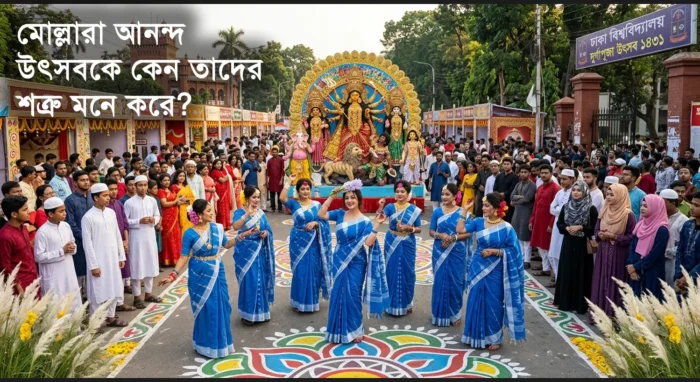
Why do Islamist clerics consider Bengali cultural festivals their enemy?
This year, unlike many previous years, the major Hindu religious festival Durga Puja in BangladeshRead More
ইসলামিস্ট মোল্লারা কেন বাঙালিদের আনন্দ উৎসবকে তাদের শত্রু মনে করে?
এবার বাংলাদেশে অন্যবারের তুলনায় বেশ শান্তিপূর্ণ, উৎসবমুখর পরিবেশে হিন্দু ধর্মের বড় ধর্মীয় উৎসব দূর্গাপূজা হয়েRead More
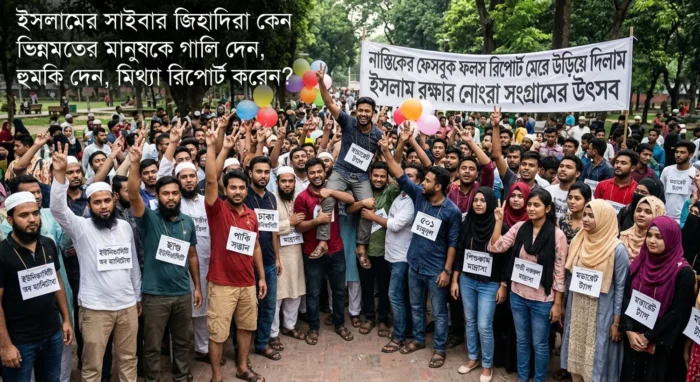
Why do Islamist cyber‑jihadis insult, threaten, and file false reports against people with different opinions?
Maulana Azhari once advised Islamists that sharing his Facebook posts is also an Islamic act;Read More
Comments are Closed