
Minorities Leave the Country
There is an invisible layer of oppression beyond the visible persecution faced by minorities in Bangladesh, which compels them to leave the country
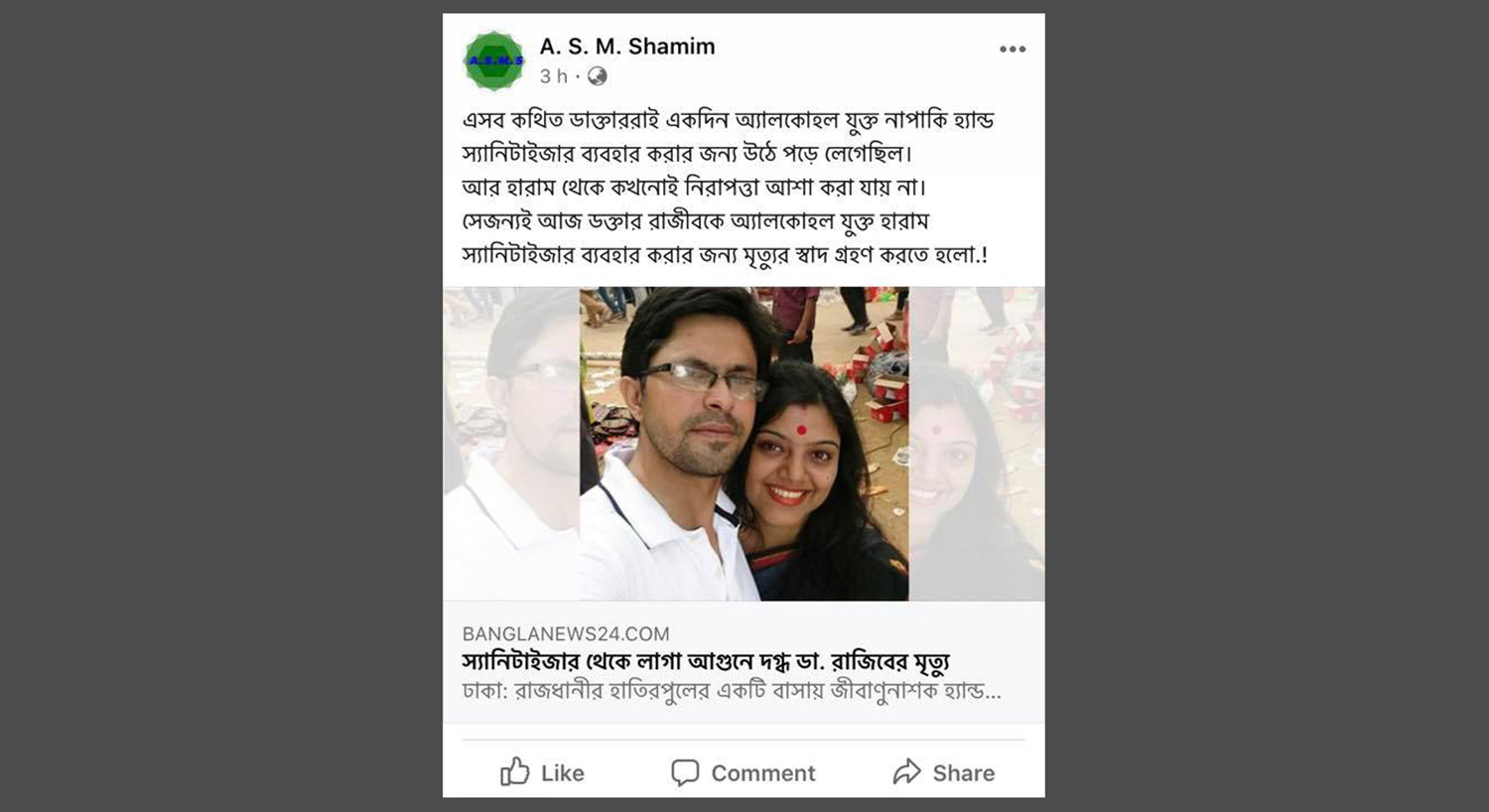
Seeing this Facebook status from July 28, 2020, you might think—what’s the big deal? Just an ignorant Islamist showing his ignorance. But the matter is not that simple. The doctor in question was a Hindu. If a Muslim doctor had died for the exact same reason, would this same individual, one Shamim, have made the same comment celebrating his death? The answer is—no.
At the beginning of the COVID-19 pandemic in Bangladesh, many Islamic clerics started spreading claims such as: there is no such thing as a contagious disease; Islam says so; if Muslims get COVID, the Quran would be proven false; COVID is God’s army sent to suppress non-believers; vaccines should not be taken; the virus will not come to Bangladesh; for us it is not a curse but a blessing; sanitizer is impure and must not be used—and so on. Mufti Ibrahim even provided a Quranic formula for protection from COVID allegedly received in a dream. Ironically, the first person in the country to die of COVID turned out to be a prominent religious scholar himself. A well-known Islamist influencer and writer, Dr. Shamsul Arefin Shakti, fled his hospital duties. Despite repeated notices, he refused to return, effectively rejecting his own claim that the Quran denies contagious disease—saying in practice that even if he loses his job, he would not go back.
But even after all this misinformation and anti-scientific religious rhetoric, did doctors stop working? No. Many carried out their duties bravely. Many doctors and healthcare workers even died while serving people. Yet the reaction from religious extremists has not been the same in all cases. This inconsistency is a defining characteristic of extremism in Bangladesh.
In July 2020, during the peak of the pandemic, neurosurgeon Dr. Rajib Bhattacharya (37) suffered severe burns in his Hatirjheel apartment in Dhaka when sanitizer ignited from a cigarette. A physician at Bangabandhu Sheikh Mujib Medical University, 87% of his body was burned. He fought for six days before passing away. His wife, Dr. Anusuya Bhattacharya (32), was also injured. It was a tragic accident. Their five-year-old daughter, Rajshree, was unharmed as she was outside at the time.
But what followed on social media after his death was even more alarming than the accident itself. A segment of Islamist users expressed joy at the death of a Hindu doctor. Celebrating a person’s death based on religious identity is not an isolated event—it is a symptom of a deep social illness, part of a broader pattern of structural oppression against minorities, especially Hindus, in Bangladesh. These forms of oppression often do not appear in legal statistics but have profound psychological impacts. If even a doctor must endure this level of hostility, who would dream of building a safe, dignified, and successful future there?
A Silent Crisis in Numbers
I have personally seen many friends, relatives, and my father’s colleagues quietly leave the country for India. Recently, in Satkhira, a Hindu mathematics teacher, Mr. Gauranga Sarkar, was harassed and handed over to police by a radical mob for saying that loud early-morning mosque announcements disturb people’s sleep. The mob even demanded that he be sent to India. These are systematic social attacks meant to send a message: don’t enter these professions, leave the country if possible—this land is not yours. Some Islamists claim Hindus earn wealth in Bangladesh but build lives in India. Is that true? Only 36% of departing Hindus go to India; the rest move to other countries.
Statistics often reveal the harshest truths. In 1901, Hindus made up over 33% of the population in this region. By 1951, after the partition, it dropped to 23.1%. In the 2011 census, it stood at 9.6%. According to the Bangladesh Bureau of Statistics in 2022, it is now only 7.95%.
Research published in Global History Dialogues identifies key reasons for this decline: the 1947 partition, the 1971 liberation war, and ongoing cycles of communal violence. An ICDDR,B study found that between 2005 and 2012, only 36% of Hindus leaving Bangladesh went to India, while the rest migrated elsewhere—indicating a broader escape from the domestic environment, not merely attraction to India. This trend is not limited to Hindus; many Muslims also seek to leave.
A report from Minority Rights Group notes a significant rise in persecution of Hindus by Islamist extremists since the early 2000s, forcing many to flee to West Bengal. The Vested Property Act—originally a 1965 Pakistani law—continues to dispossess thousands of Hindu families of their land in independent Bangladesh.
Blasphemy as a Weapon: A Systematic Tool
Blasphemy allegations have become one of the most organized and dangerous tools for persecuting Hindu minorities. According to reports from the Human Rights Congress for Bangladesh Minorities (HRCBM), at least 24 documented incidents between 2012 and 2025 involved false or disputed blasphemy claims leading to organized violence. Another report cites 71 incidents within just six months.
The pattern is consistent: a rumor or social media post accuses a Hindu individual of blasphemy, a mob gathers without verification, and law enforcement often arrests the accused “for protection,” while attackers go unpunished. Violence then spreads to entire neighborhoods, temples, and homes.
During the 2021 Durga Puja, violence triggered in Cumilla led to nationwide attacks—over 50 temples vandalized, more than 8 deaths, and over 150 injured. It was later revealed that the instigator, Iqbal Hossain, was Muslim. Yet no major protests targeted him. Had he been Hindu, the scale of retaliation would likely have been far worse. Teacher Hriday Chandra Mondal was arrested over classroom remarks; Sukumar Bagchi lost his job over unproven allegations; student Hriday Pal was attacked by mobs and detained by military personnel while attackers faced no justice; Dipu Chandra Das was beaten and burned alive by extremists.
The list is long, with more recent additions including teachers like Gauranga Sarkar and Mithu Biswas. Meanwhile, similar statements made by Islamic speakers go entirely unchallenged—highlighting a clear double standard.
This pattern is deliberate. Writer Taslima Nasrin wrote that blasphemy accusations are being used as tools for land grabbing, temple destruction, and forcing minorities to flee.
Double Standards: Unequal Application of Law
The most painful aspect of this oppression is the blatant double standard in law and societal judgment. A Hindu teacher’s remark can quickly become a blasphemy case, attracting media and mobs. Yet openly hateful remarks against Hindus by Islamist speakers often go unchecked.
This is not accidental—it reflects structural bias. Laws like the Digital Security Act (DSA) and its successor have disproportionately been used against Hindu individuals, while anti-Hindu content faces little enforcement. In late 2024, after the arrest of Hindu teenager Akash Singh, mobs attacked the Monglarghao village for two nights, burning over 100 homes and temples while families fled to forests and riverbanks.
Psychological Pressure: The Invisible Layer
Alongside physical violence, there exists a subtle yet equally destructive psychological oppression. Research shows that many middle-aged Hindu men feel alienated, prompting them to send their children abroad first, then follow later.
This pressure comes from everyday signals: lack of promotions, exclusion from contracts, hearing anti-Hindu rhetoric, seeing joy over deaths, being told to “go to India,” and constant use of slurs. Even recently, a display board in Mirpur suggested forcing Hindus to eat beef—an act that would spark outrage if directed at Muslims. These pressures cannot be addressed by formal complaints alone but gradually force people to leave.
Responsibility of State and Society
Responsibility does not lie solely with violent mobs. State inaction, arresting victims instead of attackers, and failure to ensure justice perpetuate this system. Reports show that perpetrators exist across political lines.
As Rana Dasgupta of the Bangladesh Hindu Buddhist Christian Unity Council stated: “In 1971, Hindus and Muslims fought together for independence—not for a religious state. Yet even in independent Bangladesh, they remain second-class citizens.”
Silence Is Consent
The celebration of Dr. Rajib Bhattacharya’s death is just a symptom. The real disease is a social-political system that normalizes hostility against minorities, weaponizes blasphemy accusations, and applies different standards of justice.
In a healthy democracy, the law must be neutral. If a Hindu teacher’s words constitute blasphemy, then anti-Hindu speech must be judged equally. Until this double standard ends, population decline will continue—and the stories of fear and humiliation endured before leaving will remain.
How Bangladesh treats its minorities is not just a question about minorities—it is a question about Bangladesh’s own identity.
Related Posts
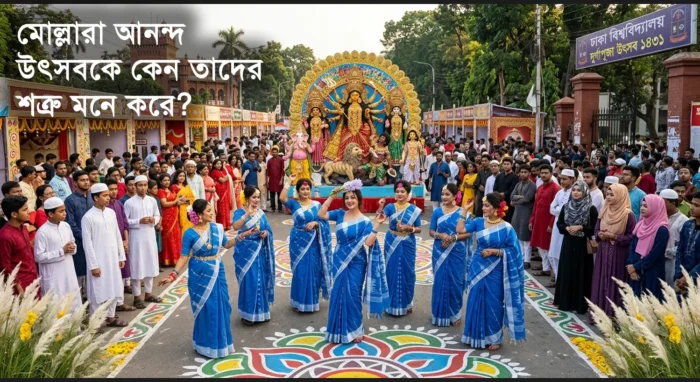
Why do Islamist clerics consider Bengali cultural festivals their enemy?
This year, unlike many previous years, the major Hindu religious festival Durga Puja in BangladeshRead More
ইসলামিস্ট মোল্লারা কেন বাঙালিদের আনন্দ উৎসবকে তাদের শত্রু মনে করে?
এবার বাংলাদেশে অন্যবারের তুলনায় বেশ শান্তিপূর্ণ, উৎসবমুখর পরিবেশে হিন্দু ধর্মের বড় ধর্মীয় উৎসব দূর্গাপূজা হয়েRead More
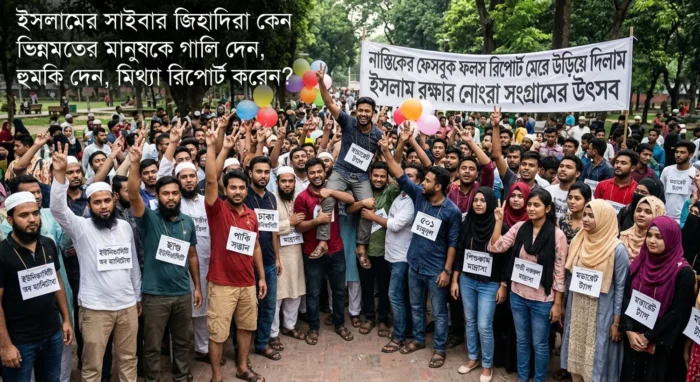
Why do Islamist cyber‑jihadis insult, threaten, and file false reports against people with different opinions?
Maulana Azhari once advised Islamists that sharing his Facebook posts is also an Islamic act;Read More
Comments are Closed