
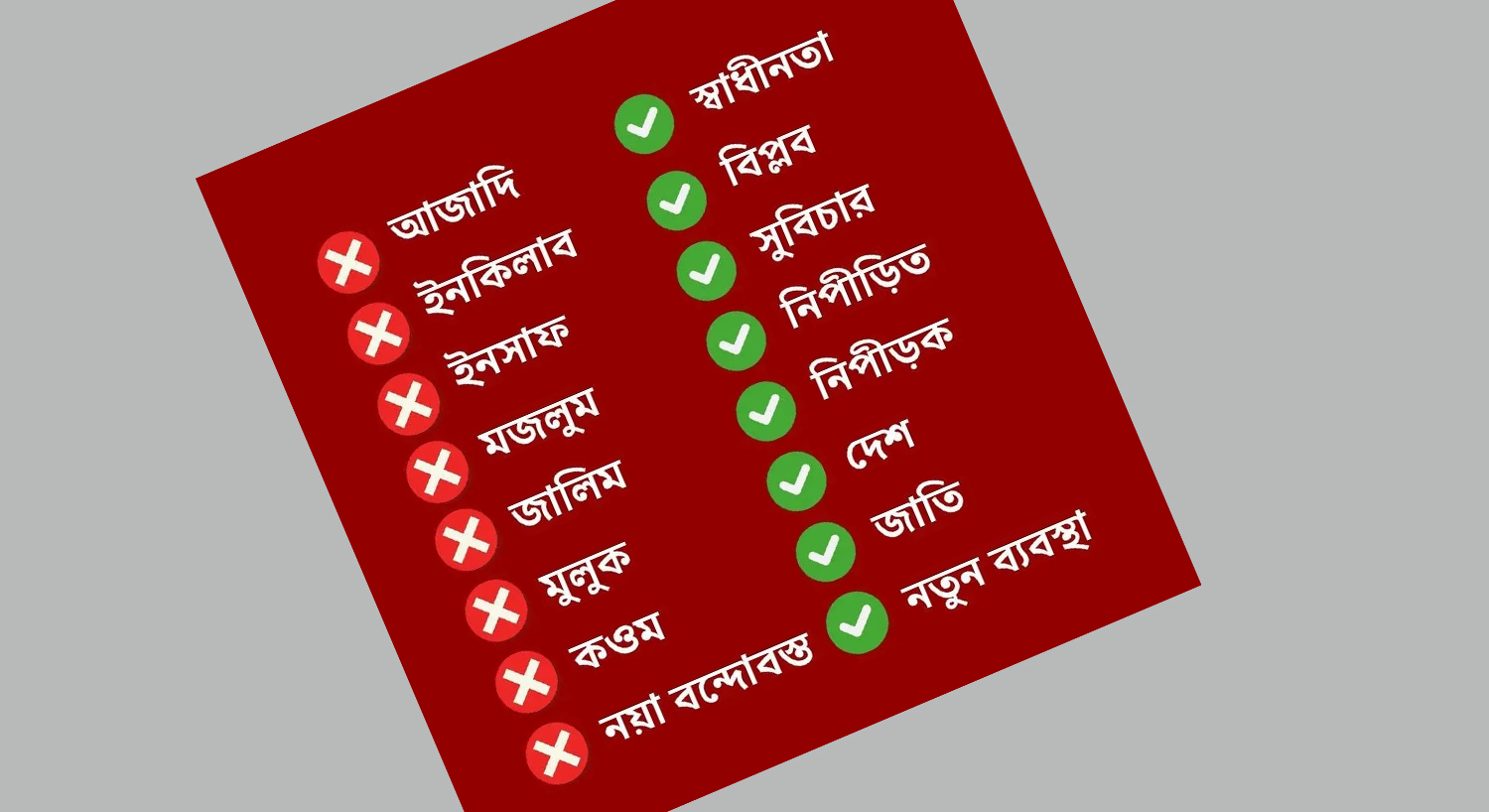
Language and Narratives
Language, Power, and the Politics of Hypocrisy: The Crisis of Elite Narratives on the Bangla
For a long time in Bangladesh, a cultural elite group has used language and nationalism as a shield to protect their own narrative. Whenever their political or intellectual defeat becomes evident, they immediately invoke the Language Movement of 1952 and the Liberation War of 1971 to create a kind of moral pressure. As if they alone possess exclusive ownership over language or patriotism. This tendency is not just intellectual dishonesty – it is a form of hypocrisy that denies the natural evolution of language.
The most common form of this hypocrisy appears when they begin lamenting over the words, slang, or foreign terms used by the new generation – “Why these words?”, “Bangla is being ruined!”, “Protect the purity of the language!”. Yet language is never pure, never static, never anyone’s private property. Language is a living entity – it changes, grows, shrinks, borrows, abandons, and is reborn again.
The Natural Evolution of Language: History Itself Is Witness
Every language in the world constantly undergoes change. This is the fundamental rule of language.
- Some words are added,
- Some words disappear,
- Some words are borrowed from other languages,
- Some words acquire new meanings through the usage of new generations.
How many Bangla speakers today can understand the Bangla of the Charyapada from a thousand years ago? Does the Charyapada even feel like Bangla to us when we read it? And what about the regional languages of Bangladesh – Sylheti, Chattgaiya, Barishali, Rangpuri, Mymensingh – are these fully intelligible to one another? Sylheti or Nagri once stood with their own script and literary tradition. So why fear linguistic change?
The Example of English: Change Is Strength
In 2025, more than 500 new words and phrases were added to the Oxford English Dictionary.
They came from –
- Information technology,
- Social media,
- Various African and Asian languages,
- The spoken language of immigrant communities,
- New cultural realities.
No English elite stood up and said –
“Don’t use these words, the purity of English will be destroyed!”
Instead, the English language demonstrated its strength –
it accepts the words that people actually use.
The list of Bangla-origin words that entered English is also long –
bungalow, loot, jute, chutney, paddy, dol – these are used worldwide today. And there are many more.
The Reality of Bangla: Borrowed Words Are Our Strength
Bangla contains words from Arabic, Persian, Turkish, Portuguese, English, Sanskrit – countless languages.
“Jol” is Bangla, and “pani” is also Bangla.
Everyone understands “chair”, but many won’t understand “kedara”.
This is the reality of language – usage gives legitimacy.
The standard form of Bangla was not determined by any university or scholar.
It emerged from the spoken language of Murshidabad and the border regions of Bangladesh.
Dictionaries follow usage; usage does not follow dictionaries.
The Language of Protest: Slurs, Slang, New Words – All Are Part of Language
When people protest, language becomes a tool of resistance.
The words that elites dismiss as “vulgar” or “uncivilized” often become powerful expressions in movements.
“Chater bal” is a political expression for today’s youth – a language of their anger, frustration, protest, and satire.
Even though the English word “genocide” has legal limitations, the Bangla word “gonohotya” captures the lived reality and pain of people. Sheikh Hasina was forced to step down from her long authoritarian rule in August 2024. Despite killings, disappearances, and repression, she could not survive the unstoppable uprising of Gen Z. Although her killing of thousands may not be termed “genocide” in the strict legal sense, in Bangla it can be called “gon-hotta” – which, in meaning, is equivalent to “genocide”.
Here, language is not just words – it is the expression of emotion, history, and struggle.
The Subtlety of Words: Insaf vs. Subichar
“Insaf” and “subichar” may appear synonymous in dictionaries, but in human experience and conceptual meaning they differ.
If you buy food with your own money and waste it, you cannot call it “injustice”, but it is not “insaf” either – because insaf means legal justice, moral justice, social justice, human justice. Subichar, on the other hand, means legal justice. If you waste food while someone beside you is starving, you may not violate any condition of subichar, but it will not be insaf.
Leaders like Shahid Osman Hadi were seen as the voice of the people because they could speak in the language of the people. He spoke of establishing “insaf”, because within that word lies people’s deprivation, anger, and moral demand.
The Elite Attempt to Control Language: Why It Fails
Those who want to keep language “pure” actually want to control language.
They want –
- Which words may be used,
- Which words are forbidden,
- Which words are “polite”,
- Which words are “impolite” –
They want authority over all of this.
But language never obeys anyone’s command. Language belongs to the people, the users – not the elites.
Language Flows, Language Is Free, Language Belongs to the People
The Bangla language today is not the gift of any single group. It is the product of thousands of years of evolution, mixing, borrowing, change, struggle, and human usage. No matter how much one tries to control language – in the end, language chooses its own path.
Those who practice hypocrisy in the name of language are not enemies of language – they are enemies of linguistic freedom. And linguistic freedom is inseparable from human freedom.
Related Posts

Actresses Shabana, Moushumi, Popy – Religious Sentiment and the Politics of the Public Sphere
In the history of Bangladeshi cinema, names like Shabana, Moushumi and Popy mark important chapters.Read More
নায়িকা শাবানা, মৌসুমী, পপি – ধর্মানুভূতি এবং জনপরিসরের রাজনীতি
বাংলাদেশের চলচ্চিত্র ইতিহাসে শাবানা, মৌসুমী কিংবা পপির মতো নাম গুরুত্বপূর্ণ অধ্যায়। তারা আশি, নব্বই ওRead More
In Bangladesh, the very meaning of the “blasphemy” law is to find a new pretext for persecuting minorities
The attack on the house, shop, and temple of Deepto Roy in Tahirpur, Sunamganj isRead More
Comments are Closed