
Many of the faithful brothers will soon be running around with long knives, shedding blood and becoming radiant in the glory of sacrifice in exchange for the blood and lives of animals. As for us, let’s just have some coffee. In the meantime, let’s talk a little about your template comments —
# Qurbani suddenly turns all of you into animal lovers.
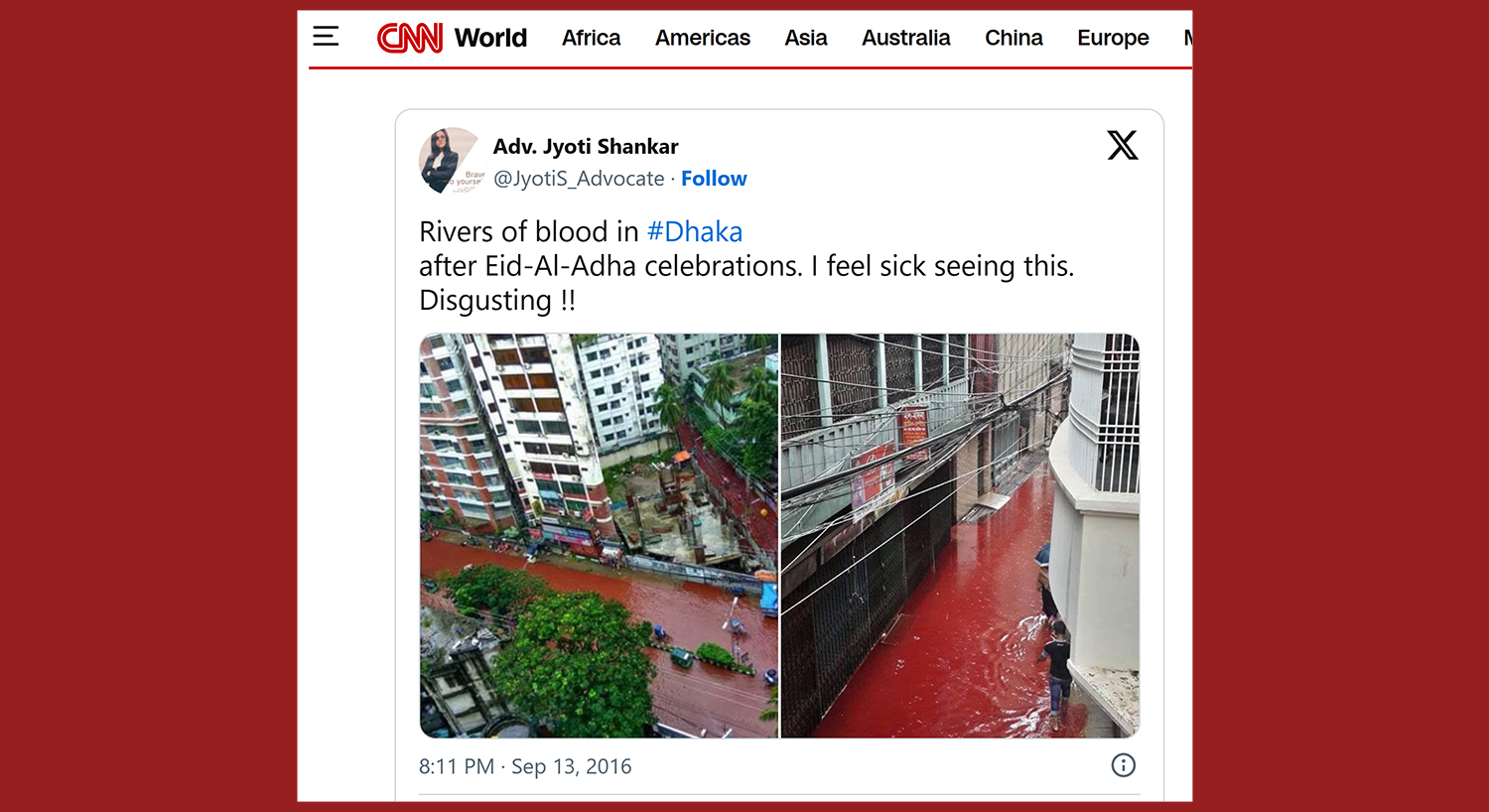
On September 14, 2016, CNN ran the headline — Bangladesh: Rivers of blood run through Dhaka after animal sacrifices. The accompanying images showed a blood-soaked scene everywhere.
Brother, humans are the most intelligent beings. Just because humans have gained the ability to control other animals, should they abandon their humanity? We also eat meat. Vegans don’t even do that—they dream of a world where no animal will be killed for meat one day. Since we do eat meat, we say: instead of slaughtering millions of animals in a single day as a celebration, buy only what you need from the market, or at least kill the animals with less suffering, slaughter them in designated places like abattoirs, keep the environment clean, and do not expose children to the scenes of slaughter and cutting. We are not stopping you from feasting. Our objection is about the method and the environment. The way millions of animals are slaughtered on streets, alleys, and under open skies in a single day in the name of a religious festival is problematic for children’s psychological development, the environment, public health, and animal welfare. That is all we are asking.
# You don’t stop eating meat yourselves, but seeing Muslims perform Qurbani makes you uncomfortable.
Everything has a “how” question. You drive a car, but you don’t drive while intoxicated—there is no inconsistency in that. Commercial slaughterhouses are not perfect, that’s true. But trained workers operate in designated, controlled environments, which is more hygienic and less painful than slaughtering animals randomly on the streets. According to animal welfare guidelines from the World Organisation for Animal Health (WOAH), the place, method, and skill involved in slaughter together determine the level of pain. None of these are ensured in street Qurbani.
# Poor people get to eat meat after a long time during this—will you buy it for them?
Brother, instead of taking 100 kg of meat for yourselves in one day, you can take only what you need. Instead of giving poor people 10 kg in one day, whenever you buy 5 kg from the market, also buy 1 kg for someone in need. Then you eat, and they eat too. They don’t have freezers; eating so much meat in one day is harmful to health. It does not improve nutrition or protein intake.
The average protein intake in Bangladesh is lower compared to other countries. That means people abroad eat more meat than Bangladeshis. But they don’t binge far beyond their needs on a single day.
# Animals do not feel pain during Qurbani; it is divine will.
This is a religious belief, not a scientific claim. From a scientific perspective, the picture is different. Cows, goats, and sheep are all advanced mammals. Their central nervous systems are complex, similar to humans. They have nociceptors—pain receptors—that send injury signals to the brain. Renowned animal scientist Dr. Temple Grandin, a leading expert in slaughterhouse design, has repeatedly stated that animals feel fear and pain before slaughter—this is measurable.
When five or six people force an animal to the ground, its cortisol and adrenaline levels rise multiple times—this is proven. That means the animal is under severe fear and physical stress.
# Islamic slaughter is the most scientific; animals feel the least pain. German scientist Prof. Wilhelm Schulze said it is the most scientific.
This claim is based on a 1978 study by Professor Wilhelm Schulze of the University of Veterinary Medicine, Hannover, Germany.
We must understand what the study actually said. Schulze’s research suggested that properly performed halal slaughter can render the animal unconscious quickly. But “properly” means using an extremely sharp knife by a highly skilled person in one swift motion to sever the trachea, esophagus, and the two main blood vessels (carotid artery and jugular vein).
There are three major issues here.
Issue one: Criticism of research quality. In later decades, researchers raised serious questions about the interpretation of Schulze’s EEG data. A 2009 New Zealand study showed that without stunning, animals can feel pain in the seconds before losing consciousness, and blood entering the airway can create a suffocation sensation.
Issue two: Ideal conditions vs reality. Studies by Dr. Grandin show that while ideal slaughter may cause unconsciousness within 5–10 seconds in cattle, a slightly blunt knife or delay can extend this to 60 seconds—during which the animal experiences pain.
Issue three: The Bangladeshi context. Are those performing Qurbani for small fees properly trained? Are their tools of international standard sharpness? The answer is clear.
What does modern science say?
The core principle of modern animal welfare science is simple—if you want to reduce suffering, animals should be rendered unconscious before slaughter so the brain cannot process pain signals.
Currently, three main methods are used.
Captive Bolt: A device strikes a specific point in the animal’s head, causing an immediate brain shock. The animal becomes unconscious in less than a second while the heart continues beating. Slaughter follows.
Electrical Stunning: A specific amount of current passes through the brain, rendering the animal unconscious for several seconds. Mainly used for poultry and sheep.
CO₂ Stunning: Animals are rendered unconscious using carbon dioxide chambers.
Importantly, many Muslim countries have adopted solutions. Halal certification boards in Malaysia, New Zealand, and Australia approve “reversible electrical stunning”—where the animal is lightly stunned (not killed) before halal slaughter. Religious requirements remain intact, and suffering is reduced. Much halal-certified meat sold in Costco or Sam’s Club in the U.S. from Australia uses this method.
# You kill thousands of bacteria when you brush your teeth; you also kill insects.
This is a classic false equivalence.
The experience of pain requires a complex central nervous system, nociceptors, and advanced brain processing. Together they produce what we call “suffering.”
Bacteria have no nervous system and no brain. Their “responses” are merely automatic chemical processes.
Insects are more complex. A 2021 study from Queen Mary University of London suggests some insects like bees change behavior after injury, indicating possible pain-like experiences. However, whether this equates to mammalian suffering remains uncertain.
For cows and goats, there is no doubt—they feel pain, fear, and stress. This is measurable and scientifically proven.
# The coffee and rice you eat—plants are alive too; they feel pain.
Coffee plants or rice plants do not feel pain like humans. This claim is not scientifically supported.
The type of nervous system and brain required for pain does not exist in plants. However, plants are not inert. When damaged, they release hormones like jasmonic acid to respond—this is a biochemical defense mechanism, not a feeling. “Being alive” does not mean “feeling pain.”
In short, the level of neural complexity required for pain is extremely limited in simple organisms and absent in plants. So while a plant reacts to damage, it does not feel pain.
# You’re Hindu—don’t you see animal sacrifices there?
First, I am not Hindu. I was born into a Muslim family and am now a humanist. When you insult my parents, remember—they are practicing Muslims like you, just not extremists, but liberal.
Second, Hindu sacrificial methods should be evaluated on the same scientific standards. A single precise strike that severs the spinal cord and major vessels can cause immediate loss of blood pressure to the brain, rendering the animal unconscious in milliseconds—this is neurologically rapid, but only if done perfectly.
If the strike is not perfect—if the weapon is blunt, the animal moves, or the first strike fails—the outcome can be worse than other methods. This risk is a major weakness.
There is also a technical difference. When the head is completely severed, the heart’s electrical system continues briefly, but pumping efficiency decreases. In Islamic slaughter, since the head is not completely severed, the heart can pump longer, aiding blood removal—beneficial for meat quality.
# Blood must be drained; otherwise it is forbidden and harmful.
Brother, in all methods the blood is drained. After stunning, the bleeding process is performed immediately. Stunning does not mean killing—it means rendering unconscious. Blood drainage is fully preserved. In fact, in many cases meat sellers inject water or blood to increase weight or make meat look fresh.
# The One who created animals gave this command.
Brother, that is your claim. You cannot do whatever you want based on that claim. Most people in the world reject it. If you still claim divine authority for religious texts, there are many contradictions, errors, inhuman and unscientific elements within them that challenge their validity. If you believe in coexistence, such rigid and exclusive claims must be reconsidered. On universal ethical issues—such as reducing animal suffering—secular reasoning is more widely acceptable.
Final words —
Insulting us is easy for you; it provides temporary relief from a fear of losing ground. But it does not benefit Islam. If instead you act more humanely, become more sensible, show greater empathy toward children, the environment, nature, and animals, respect personal freedom and freedom of speech, and stop imposing religion into people’s lives, society, and state—then it would benefit you and your faith. Criticism would lessen, and the growing global tendency to view you separately would also decline.
Related Posts

Why do Islamist clerics consider Bengali cultural festivals their enemy?
This year, unlike many previous years, the major Hindu religious festival Durga Puja in BangladeshRead More
ইসলামিস্ট মোল্লারা কেন বাঙালিদের আনন্দ উৎসবকে তাদের শত্রু মনে করে?
এবার বাংলাদেশে অন্যবারের তুলনায় বেশ শান্তিপূর্ণ, উৎসবমুখর পরিবেশে হিন্দু ধর্মের বড় ধর্মীয় উৎসব দূর্গাপূজা হয়েRead More
Why do Islamist cyber‑jihadis insult, threaten, and file false reports against people with different opinions?
Maulana Azhari once advised Islamists that sharing his Facebook posts is also an Islamic act;Read More
Comments are Closed