
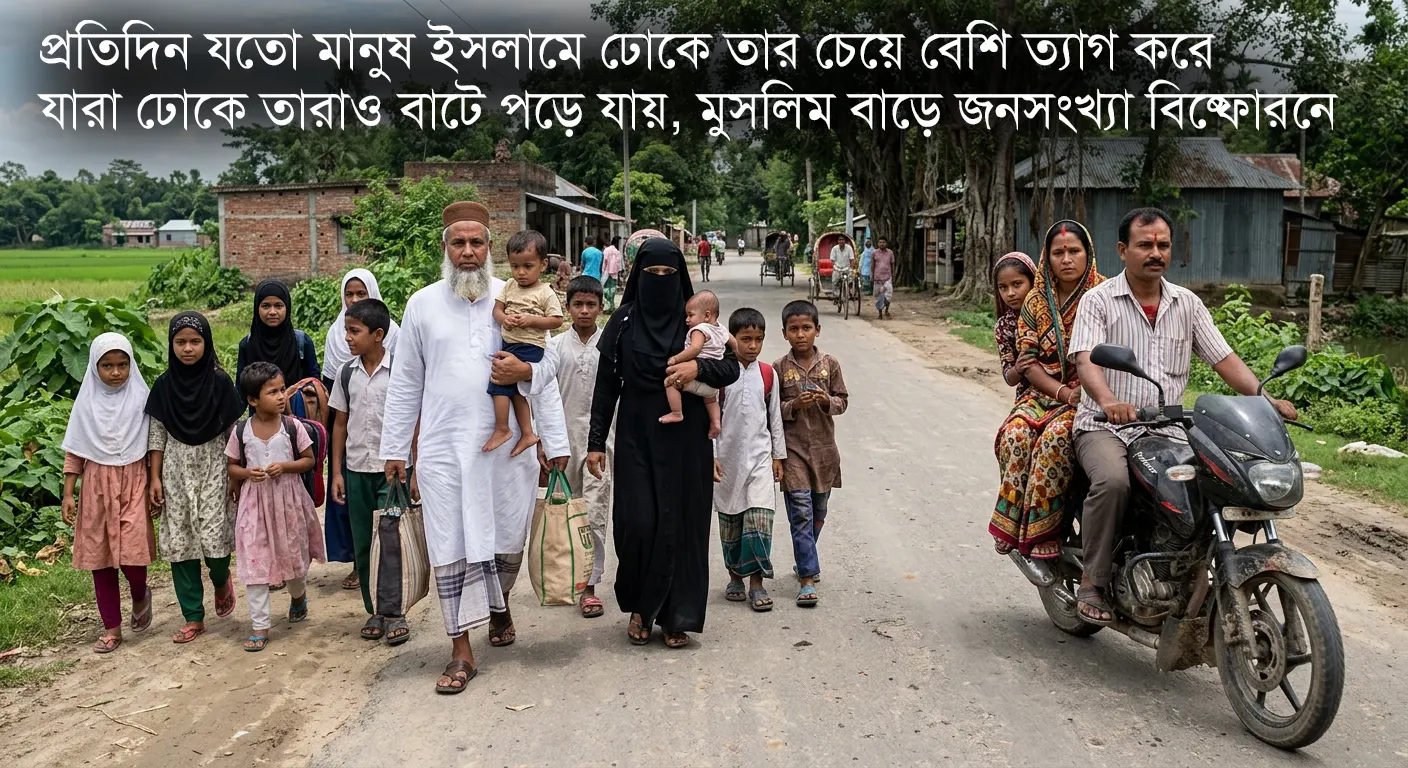
Islam is Expanding Rapidly, Really?
Islam is spreading rapidly — like many other popular Islamic myths, this too is simply a myth
A claim repeatedly arises in Islamist speeches — that millions of people are converting to Islam every day, mosques in the West are filling up, and unbelievers are flocking in groups to recite the shahada. From social media to mosque pulpits to fiery public sermons — this story is everywhere. Like many other exaggerated and often false claims of superiority, Islamists also make this claim. But what do statistics and research say? The reality is far more complex, and in many cases, directly opposite to this claim.
Celebrity Islamic preachers claim that the call to prayer can be heard on the moon, that there is a crack on the moon, that Sunita Williams saw a glowing Kaaba from space at the center of the Earth, that American engineers built massive iron bridges after reading about jinn. When celebrity and ordinary Islamists make such claims — that masses of nonbelievers are converting to Islam — it can be seen as part of their usual pattern of behavior. Islam tends to dismiss fact-checking as unimportant. For people who treat countless mythical tales — floating through the air with palaces full of people, riding a donkey into space, surviving inside a whale for 40 days, or emerging unharmed from fire — as facts, presenting real facts to them is a futile exercise. They prioritize “glory-driven illusion” above all — who cares?
The Real Reason Behind Muslim Population Growth — Births, Not Conversions
Generally, there is little opportunity to access such information. This is because in Western countries, what religion someone follows, leaves, or adopts is not a major concern for society. These factors usually have little impact on national policy or the economy. Nevertheless, some institutions collect data to provide a general understanding. In 2025, Pew Research Center published a comprehensive report analyzing data from more than 2,700 sources across 201 countries. Their conclusion is direct and clear.
“Most of the change in the number of Muslims comes from births, not from people entering or leaving the religion” — this is the report’s own wording. Between 2010 and 2020, the global Muslim population increased by about 340 million, and this growth was driven by high fertility rates and a younger age structure. New Arab
According to Pew’s 2025 report, during 2010–2015, Muslim women had an average of 3.1 children, well above the replacement level of 2.1. In comparison, Christians averaged 2.6–2.7, while Buddhists and the religiously unaffiliated were below replacement level. Vox Divini
Pew Research Center’s projection for 2050 also clearly states: “Religious switching will have little net impact on the size of the Muslim population globally.” Wikipedia (with authentic sources cited in the article)
In simple terms — the growth of Islam’s population is driven by demographics: more children. It is not evidence of religious appeal; it is the result of reproductive statistics.
Conversion Numbers: As Many Enter as Leave
An analysis of Pew Research Center’s 2017 survey in the United States shows that the number of people converting to Islam is roughly equal to the number leaving it. The net gain is close to zero. Researchers observed that about one-quarter of adults raised in Muslim families in the U.S. no longer identify as Muslim. Crossway
Pew Research Center’s 2023–24 Religious Landscape Study, surveying 36,908 adults, presents a comparative picture of people entering and leaving Islam in 13 countries. In Turkey, for example — among those raised in Muslim families (98%), 3% have left Islam, while virtually 0% have converted into it. Pew Research Center
This data indicates that even in countries with large Muslim populations, there is no reality behind claims of “conversion victories.”
Iran: The Gap Between State Claims and Reality
According to Islamist claims, Iran is a 99.5% Muslim country. However, a survey by GAMAAN (Group for Analyzing and Measuring Attitudes in Iran), a Netherlands-based research organization, presents a very different picture. GAMAAN
A 2020 survey of more than 50,000 Iranians found that only 40% identified as Muslim. Contrary to state propaganda, only 32% identified as Shia Muslim, while 9% identified as atheist, 7% as “spiritual,” and 8% as Zoroastrian. The Conversation
The survey also found that about 47% of respondents said they were religious at some point in their lives but are not anymore. Among university-educated men and women, this shift was highest at 51%. KAYHAN LIFE
In a country where apostasy can legally be punishable by death, such survey results emerging even cautiously indicates how widespread the phenomenon must be for people to overcome fear and speak honestly.
Trends of Religious Disaffiliation in the Arab World
Arab Barometer, which surveys more than 25,000 people across the MENA region, presents a complex picture through its long-term data.
According to Arab Barometer, between 2013 and 2019, the proportion of Arab citizens identifying as “non-religious” increased from 8% to 13%. During the COVID pandemic, religiosity temporarily increased, but declined again afterward. Arab Barometer
A 2025 study published in International Sociology analyzing data from 11 Arab countries found that religiosity began declining in the mid-2010s, experienced a temporary resurgence during COVID, but declined again post-pandemic across age and gender groups alike. Sage Journals
Fear of Death and Social Pressure: Millions of “Nominal Muslims”
There is little ambiguity regarding punishment for apostasy in Islam. In classical interpretations of Islamic law, the punishment for apostasy is death. While this is not formally enforced in many modern countries, social persecution, family ostracism, and threats carried out in the name of religious zeal persist, with numerous documented cases of violence.
Pew Research Center also acknowledges this issue: the prospect of punishment for apostasy discourages many from leaving Islam due to fear of losing their lives. Some former believers continue to identify as “Muslim” in name only due to fear of violence. The Gospel Coalition
In Islamic law, apostasy is not limited to converting to another religion; it also includes adopting atheism or agnosticism, or rejecting or criticizing core beliefs. Despite potentially severe and life-threatening consequences, some Muslims still leave the faith. Wikipedia (with authentic sources cited in the article)
This means that official statistics of Islam are artificially inflated — because many who have mentally left the religion are still compelled to remain “Muslim” on paper.
Conversions in the West: Numbers and Reality
Conversions to Islam do occur in Western countries. But how significant are the numbers?
Saudi Arabia’s official conversion registration office (EDC) reports around 20,000 foreign worker conversions annually. In Singapore, the number is about 600 per year. These figures are negligible in a global context — and are often influenced by social pressure or marriage rather than genuine belief. The issue of “Love Jihad” in India is also frequently highlighted. WifiTalents
Many people who converted to Islam due to emotional appeal later leave the religion, but such figures are rarely tracked. Studies show that those who leave Islam — whether converts or those raised in Muslim families — often cite the following reasons:
- Philosophical and doctrinal disagreements: Many report that over time they cannot reconcile with specific teachings or theology of Islam.
- Disillusionment with organized religion: A large portion (about 55%) of those leaving Islam do not join another religion but identify as atheist, agnostic, or secular.
- Social and cultural factors: Some convert temporarily due to marriage or relationships, but revert after those relationships end.
In short, in Western countries, the number entering and leaving Islam is roughly equal (1:1). However, in Muslim-majority countries, leaving Islam is statistically minimal. According to Pew Research, among those who left Islam in the U.S., 55% identify as religiously unaffiliated, 22% become Christian, and 21% join other religions. When asked for reasons, about 25% cited disagreement with Islamic teachings, while 19% said they lost faith in organized religion altogether. Pew Research Center
An important point: conversion has little effect on overall Muslim population growth. The number entering and leaving is roughly balanced. Wikipedia (with authentic sources cited in the article)
Decline of Religiosity Even in Muslim-Majority Countries
A 2018–2019 joint survey by BBC Arabic and Arab Barometer, covering 25,000 respondents, shows declining religiosity across the Arab world — particularly sharply in North Africa. In Iraq, trust in religious leaders fell from 42% in 2012–13 to just 12%. Middle East Eye
Turkey is also noteworthy. Often presented by Islamists as an example of “Islamic revival,” Pew’s survey found that while 98% were raised Muslim, currently 95% identify as Muslim — a net loss of 3%. Meanwhile, virtually no new converts have joined Islam. Pew Research Center
A Constricting Future: Fertility Decline and Urbanization
Birth rates in Muslim-majority countries are declining rapidly. Despite advocacy from conservative clerics, women in these countries now marry at an average age of 21.6 years, and factors such as economic development, higher education, urbanization, and widespread use of family planning are contributing to lower fertility rates. Countries like Iran, Turkey, Tunisia, and Indonesia have adopted family planning programs in line with global trends. Pew Research Center
This means that the only major driver of Muslim population growth (high fertility) is itself gradually weakening.
The Truth Hidden Behind the Numbers
The overall data presents a clear picture:
First, the growth of Islam is not driven by conversion but by high birth rates — confirmed directly by Pew Research and other international institutions.
Second, roughly as many people enter Islam as leave it. In the United States, net conversion is near zero.
Third, in countries like Iran, Turkey, and North Africa, people are gradually moving away from Islam. The real number of those leaving is likely much higher, as fear of violence and social pressure prevent many from openly renouncing the religion.
Fourth, the only factor driving population growth (high fertility) is itself declining with education and urbanization.
The claim that “Islam is spreading rapidly” is partially true — but that “spread” is not due to new believers embracing the faith. It is a result of demographic expansion. And within that expansion lies a significant number of silent departures — people who remain labeled as “Muslim” out of fear, but not in belief.
Related Posts

Actresses Shabana, Moushumi, Popy – Religious Sentiment and the Politics of the Public Sphere
In the history of Bangladeshi cinema, names like Shabana, Moushumi and Popy mark important chapters.Read More
নায়িকা শাবানা, মৌসুমী, পপি – ধর্মানুভূতি এবং জনপরিসরের রাজনীতি
বাংলাদেশের চলচ্চিত্র ইতিহাসে শাবানা, মৌসুমী কিংবা পপির মতো নাম গুরুত্বপূর্ণ অধ্যায়। তারা আশি, নব্বই ওRead More

In Bangladesh, the very meaning of the “blasphemy” law is to find a new pretext for persecuting minorities
The attack on the house, shop, and temple of Deepto Roy in Tahirpur, Sunamganj isRead More
Comments are Closed