

Dignity for All
When a state destroys human dignity, it can no longer be called civilized
On YouTube and Facebook, countless videos are circulating from Suhrawardy Udyan, Dhanmondi Lake, and other open spaces in Dhaka. In these clips, police are seen stopping people of different ages, interrogating them, laying hands on them, slapping some, and even beating others with batons. The claim is that these areas are being “cleansed of drugs.” But the question is – can a law‑enforcement agency assault anyone at will? It cannot. This is not only unethical; it is a grave violation of human rights. When an ordinary person attacks someone, it is a crime. But when the police – acting as an arm of the state – abuse an innocent person, or even someone merely accused of a crime, that wrongdoing becomes far greater and far more frightening. The abuse of state power is always more harmful than any individual offense.
In the United States, countless homeless people live on streets, bus stops, and train stations. Many of them commit various crimes; some struggle with mental illness, others with addiction. Yet the police response there is entirely different. If you file a complaint, the police will first request the person to move away, warn them not to return to that area. If the situation becomes tense, helicopters may patrol overhead to create psychological pressure and reduce the likelihood of crime. If the allegation is serious, the police arrest the person – but even then, strictly through legal procedures. They may detain them for a couple of days and then send them to court. Many Bangladeshis might secretly think, “Why not give them a few strokes of the cane?” But such a thing is unimaginable there. If someone claims that a police officer grabbed their hand too forcefully and caused injury, they receive compensation, and the officer faces charges of violating human rights. After the killing of George Floyd and the nationwide protests that followed, American police have become even more cautious and sensitive.
Human dignity is one of the most important values in the world. As a citizen, I may criticize someone or mock their behavior – that is my freedom of expression. But the state or its agencies can never insult anyone, let alone lay hands on them. The authority to punish belongs to the courts, not the police. The foundation of civilization is that justice must be delivered through law, not emotion or brute force. From the moment a person is born, the state assumes responsibility for ensuring certain basic rights and dignity. It is the duty of any civilized state to protect its citizens under the umbrella of human rights. A state agency cannot force someone to do humiliating acts, cannot degrade them with abusive language, because such behavior erodes the moral legitimacy of the state itself.
To this, another dangerous trend has been added – moral policing. Some people in society, and at times even members of state forces, appoint themselves as guardians of morality. They begin interfering in others’ personal lives – how they dress, whom they meet, how they walk, whom they talk to. The greatest harm of moral policing is that it destroys personal freedom. An adult has the right to decide where they go, whom they speak to, what they wear, and how they spend their time. But when the state or segments of society assume the role of moral guardians, they start treating these personal choices as crimes. This creates a culture of fear, shame, guilt, and self‑censorship. People begin doubting their own normal behavior, constantly wondering – Is someone watching? Judging? Recording? This fear slowly poisons society.
Another danger of moral policing is that it diverts attention from real crime. When police and social energy are wasted on trivial matters – whether a couple is sitting in a park, why someone is walking at night, why friends are chatting outdoors – real criminals, real drug dealers, and genuinely violent individuals operate more freely. The state’s focus gets stuck in the wrong place. Law and order weaken, crime increases, and ordinary people become even more unsafe.
Is a park a forbidden zone? People may go there at night for countless reasons other than taking drugs. Someone without a home may sleep there. Friends may gather to talk. Someone may simply want fresh air or a quiet walk. If you forbid people from being outside after evening, that is not civilization – it is barbarism. In 2026, such thinking is absurd and inhumane. If students waste time outside instead of studying, you may motivate them, counsel them – but you have no right to violate their human rights. The duty of the state is to provide safety, not fear; guidance, not humiliation.
Moral policing, extrajudicial punishment, and the abuse of state power – together these forces slowly drag a society toward barbarism. Respecting people as human beings is the first condition of civilization. When a state breaks that condition, no moral foundation remains. A country becomes truly safe, modern, and humane only when its state agencies learn to respect the dignity of every citizen.
Related Posts

Why do Islamist clerics consider Bengali cultural festivals their enemy?
This year, unlike many previous years, the major Hindu religious festival Durga Puja in BangladeshRead More
ইসলামিস্ট মোল্লারা কেন বাঙালিদের আনন্দ উৎসবকে তাদের শত্রু মনে করে?
এবার বাংলাদেশে অন্যবারের তুলনায় বেশ শান্তিপূর্ণ, উৎসবমুখর পরিবেশে হিন্দু ধর্মের বড় ধর্মীয় উৎসব দূর্গাপূজা হয়েRead More
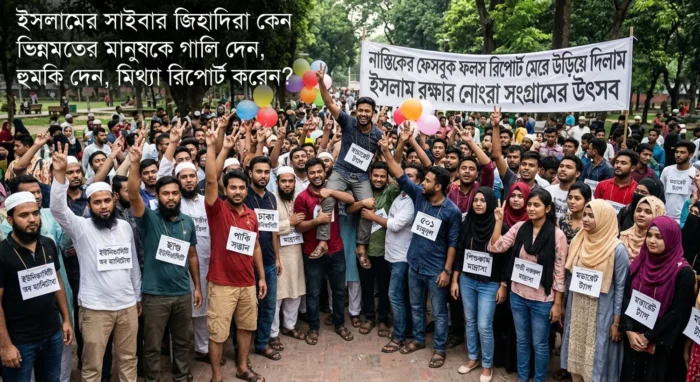
Why do Islamist cyber‑jihadis insult, threaten, and file false reports against people with different opinions?
Maulana Azhari once advised Islamists that sharing his Facebook posts is also an Islamic act;Read More
Comments are Closed