
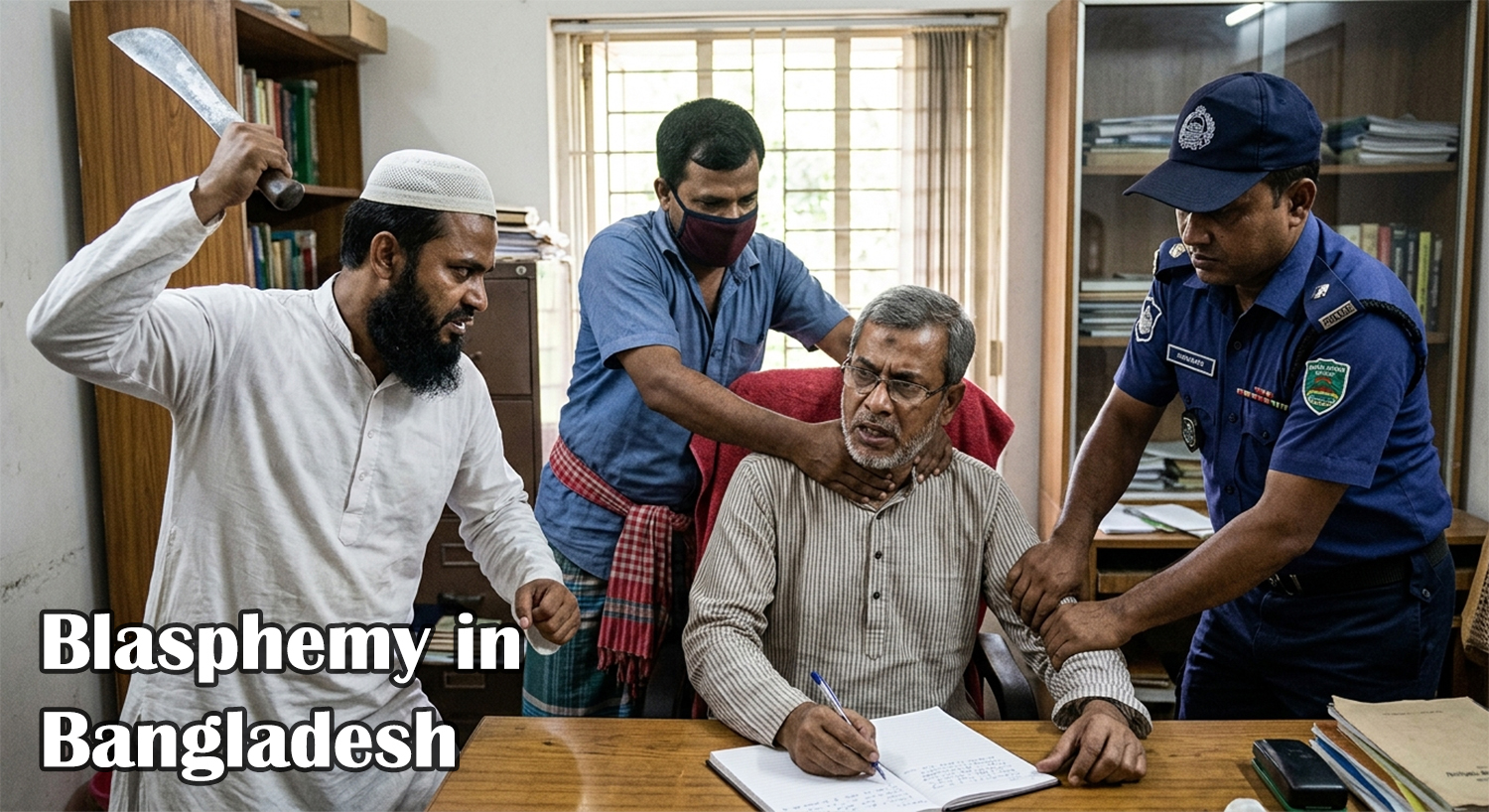
Bangladesh’s Free‑Thought Danger
In Bangladesh, freedom of thought and freedom of expression will remain nothing more than an unattainable dream
Freedom of expression is the fundamental foundation of any democratic society. Article 19 of the United Nations Declaration of Human Rights explicitly states that every person has the right to hold and express opinions. Article 39 of the Constitution of Bangladesh also guarantees freedom of thought, conscience, and speech. Yet in reality, freethinkers, writers, bloggers, and members of minority communities in Bangladesh have repeatedly faced horrific consequences when attempting to express their views.
Killings, mob lynchings, burning people alive, humiliation and degradation, exile, and imprisonment carried out under accusations of hurting religious sentiments are no longer isolated incidents in Bangladesh — they have become a distinct, recurring pattern.
The Concept of Blasphemy and Shatim-e-Rasul: A Theological and Legal Context
According to the USCIRF 2023 Update, approximately 95 countries currently have some form of blasphemy law — ranging from fines to imprisonment and, in some countries, even the death penalty. Bangladesh is also on this list. While Bangladesh has no law explicitly named “blasphemy,” Section 295(A) of the Penal Code and the Digital Security Act (later renamed the Cyber Security Act) are used to prosecute those accused of hurting religious sentiments. But beyond the legal framework, certain theological concepts lie at the root of religiously motivated violence in Bangladeshi society — concepts such as “Shatim-e-Rasul” (insulter of the Prophet), “Murtad” (apostate), “enemy of Islam,” “enemy of the Prophet,” “Kafir” (infidel), and “foe of the Messenger.” All of these are broadly viewed, both socially and legally, as forms of “hurting religious sentiments.” The most dangerous among them is “Shatim-e-Rasul” — the killing of one who insults the Prophet. Those labeled as “Shatim-e-Rasul” for criticizing Prophet Muhammad, or as “Murtad” for leaving the Islamic faith, become, in the eyes of a large portion of Bangladeshi society, deserving of death — because Islam itself prescribes that killing.
The dominant tradition of Islamic jurisprudence holds that while one who criticizes Allah may seek forgiveness through repentance, killing the one who insults Prophet Muhammad is considered Fard — an obligatory duty for Muslims — and virtually all major Islamic theological groups broadly agree that repentance cannot waive this punishment. Although mainstream Islamic scholars are rarely seen speaking openly and directly on this matter, or tend to avoid it, extremist fundamentalist groups in Bangladesh use this interpretation as a weapon to provide religious legitimacy to acts of violence and murder. Tragically, the majority of ordinary people tend to consent to this — because once someone is labeled an enemy of the Prophet, almost everyone begins to hate them, and when such a person is killed, no sense of remorse or regret stirs within the community. Islam teaches that Muslims must love the Prophet Muhammad and Allah more than their own children, parents, or even their own lives. References to authentic Hadith on this matter can be found here, where clear directives are given.
The most dangerous aspect is that the legal definition of “hurting religious sentiments” is so vague and broad that any criticism — even speaking out against fraud committed in the name of religion, or against the corruption of a religious leader — can be used to level this accusation. And upon mere accusation, the verdict and punishment are immediately carried out on the street by the crowd. Mob lynching is a very common occurrence in Bangladesh. Once someone points at another person and declares that they have insulted Prophet Muhammad or desecrated the Quran, hundreds of people can instantly gather with the intent to kill. There are countless such precedents in Bangladesh — incidents that have escalated from murders to multiple episodes of extreme lawlessness and chaos.
A Succession of Blogger Killings Since 2013: A History of Organized Terror
The Shahbagh Movement and Its Backlash
When the Gonojagoran Mancha movement began at Shahbagh in 2013 — demanding maximum punishment for war criminals from the 1971 Liberation War — fundamentalist groups launched a counter-campaign. Various organizations labeled online activists and bloggers as “atheists” and “anti-Islamic,” and called for their killings. Notably, the series of blogger killings began precisely when secular activists demanded justice for the war crimes committed by those who had gained political power in the name of religion. In other words, the true targets were the spirit of the Liberation War and the political critics of religious leaders. In 2013, the leadership of numerous Qawmi madrasas and religious institutions — many unrecognized by the state — united under the banner of an organization called Hefazat-e-Islam. During the Shahbagh movement, they branded the protesters as “atheist bloggers,” stoking fear and hatred in the public mind, and on May 5, 2013, they brought thousands of underage madrasa students from across the country to Shapla Chattar in Motijheel, Dhaka, for a massive show of force. This gathering was an open political demonstration of organized religious power, in which children were used as instruments of political demands. Their 13-point charter included calls to restrict freedom of expression, criminalize criticism of religion, and further Islamize the state — all of which were in direct conflict with the secular principles of Bangladesh’s constitution.
Under this pressure, the government at one point adopted a sympathetic stance toward Hefazat’s demands and arrested several bloggers and online writers, even though there was no evidence of any violence on their part. At the same time, content including articles on evolution and other science-based topics began to be removed from mainstream textbooks, and works by poets and writers from minority religious communities were stripped out — making the education system increasingly narrow and ideologically controlled. This trend did not merely damage free thought and scientific reasoning; it also confined Bangladesh’s intellectual space within an atmosphere of fear, self-censorship, and religious pressure. As a result, a long-term influence was imposed on the state, religious institutions, and the education system — one that remains a major challenge to freedom of expression and human values to this day.
A List of Murdered Freethinkers
Rajib Haider (Thaba Baba): In February 2013, this blogger was hacked to death with a machete in front of his home in Pallabi, Dhaka. He was an active participant in the Shahbagh movement. The killers were members of Ansarullah Bangla Team.
Avijit Roy: The rationalist writer and founder of the Mukto-Mona blog was killed with a machete in February 2015 while returning from the Dhaka Book Fair. His wife, Rafida Banya Ahmed, was seriously injured.
Washiqur Rahman Babu: In March 2015, this young blogger was killed with a machete in Tejgaon, Dhaka.
Ananta Bijoy Das: In May 2015, science writer and blogger Ananta Bijoy Das was killed with a machete in Sylhet.
Niladri Chattopadhyay Niloy: In August 2015, this blogger was hacked to death inside his own home in Goran, Dhaka.
Faisal Arefin Dipan: In October 2015, publisher Dipan was killed in his publishing office in Shahbagh, Dhaka.
In each of these killings, the same method was used — a machete attack in a public place, followed by escape. Ansar Al Islam and the South Asian branch of Al-Qaeda (AQIS) claimed responsibility for these murders.
The list of people killed or seriously injured at the hands of religious militant groups is much longer — it would not be appropriate to cover everyone in a single article. Some have also raised accusations that successive Bangladeshi governments have patronized extremist religious leaders, and over time, this pattern of extremism and violence has not diminished but grown.
Burned Alive: Lalmonirhat (October 2020)
Religious violence in Bangladesh is not limited to machete attacks — even the medieval barbarity of burning people alive has occurred here. In 2020, in Lalmonirhat district, a school worker was accused of “desecrating the Quran” and beaten and thrown unconscious into a blazing fire in front of thousands of people.
Those who participated in this killing were ordinary villagers, shopkeepers, passersby — who within moments transformed into a frenzied mob. The enraged crowd did not even attempt to hear the victim’s own account of events.
This is not an isolated incident. Some are reported in the media, others are not, and some are suppressed as killings with other attributed causes. Conducting research and collecting data on these matters in Bangladesh is extremely risky. All of these events prove that the mentality of religious violence is not confined to organized militant groups. It lies deep within society, quietly smoldering within people’s everyday thoughts and consciousness — like a dangerous volcano.
In a society where rumor, religious emotion, and mob frenzy converge — it becomes possible to instantly declare an unarmed person an “enemy” and burn them alive. Therefore, even if a single religious militant attacks an atheist, humanist, or freethinker, there is no way to resist — because in a moment, thousands of people can gather and carry out a mob lynching. As I myself experienced: on the evening of June 21, 2022, when I was attacked, I chose not to try to resist, out of fear that the militant behind me would call out to ordinary bystanders to collectively drag me out and kill me. In Bangladesh, there are many recorded instances of mosques broadcasting calls over loudspeakers to mobilize villagers to mob-attack atheists, humanists, and even ordinary people.
These brutal killings lay bare the reality of Bangladeshi society and prove that in the name of religion, a person’s life can easily become the target of a mob’s fury. These are not merely isolated incidents; they are a reflection of a deep social crisis — in which humanity, reason, and justice are defeated daily by collective madness. They show that the rule of law is weak here, and religious extremism is socially accepted. There is little proven precedent of the law enforcement agencies — namely, the police — actively working to prevent these attacks. From my own life experience, I can say that after receiving repeated death threats, when I sought the help of the police, their response was to ask why I write such things and to suggest that I leave Bangladesh and move to another country.
Utsav Mandal of Khulna: A Mob Beating Inside a Police Station (September 2024)
On the night of September 4, 2024, in Sonadanga, Khulna, a group of students seized Utsav Mandal — a student at Azam Khan Government Commerce College — over allegations of posting derogatory content about the Prophet on Facebook, and brought him to the police office. At that point, three to three and a half thousand people gathered, created disorder, and demonstrated demanding that he be publicly punished.
Police stated that Utsav Mandal had commented on a post in anger and, upon realizing his mistake, deleted it. However, several individuals had saved screenshots of the comment and circulated them, landing him in serious trouble.
Armed forces personnel arrived at the scene, but some members of the crowd entered the Deputy Commissioner of Police’s office and attacked Utsav in the presence of police and army. He was ultimately rescued alive through the desperate efforts of the armed forces. Afterwards, Utsav Mandal’s entire family fled out of fear of further attacks and has not been found since. In Bangladesh, even the police often feel helpless in the face of mob justice. It has also been observed that many police officers actively play a role in generating consent for mob justice.
The incident involving Utsav Mandal is a horrifying example of “mob justice” in Bangladesh — where, even in the presence of police and the military, thousands of people can beat a single person to near death, a mosque can broadcast a death sentence over loudspeakers, and an attacked family is forced to flee the country.
Dipu Chandra Das of Mymensingh: Burned Alive (December 2025)
On December 18, 2025, in Bhaluka, Mymensingh, Hindu garment worker Dipu Chandra Das was accused of insulting Islam at a workplace event, and was subsequently beaten, tied to a tree, and burned to death. Subsequent investigations by the authorities revealed that no evidence could be found to support the accusation. Police attempted to determine whether Dipu Chandra Das had actually said anything that could be characterized as “religiously offensive.” Yet the understanding that even if he had said such a thing, it would not justify humiliating, beating, killing, or burning him — this basic sensibility is entirely absent from the conduct of Bangladesh’s law enforcement agencies. Ordinary religious fanatics simply take it for granted that such an outcome is perfectly natural for someone accused of blasphemy.
Dipu Chandra Das was dragged out of his workplace, beaten for over a kilometer, tied to a tree by the side of a busy highway, and his lifeless body was set on fire — in front of hundreds of bystanders. This incident shows just how furious hundreds of people can become upon hearing a rumor or accusation of insulting Islam — so enraged that they can set fire to the body of an already dead man. Their message is clear: let other freethinkers, atheists, humanists, and secularists learn from this fury — let them keep their voices silenced.
The international reaction to this incident was intense. The US State Department condemned the killing as “horrific” and called for the protection of minorities. Amnesty International demanded immediate action against those responsible. India’s Ministry of External Affairs condemned the incident as a “barbaric murder.” One reason for this strong condemnation and reaction was that Dipu Chandra Das was of Hindu Sanatani heritage. He had the fierce support of Bangladesh’s 12% Sanatani population and the powerful Hindu-majority neighboring country of India protesting on his behalf. But the truth is, when killings and violence are carried out against the tiny number of atheists, humanists, and secular individuals like myself — born into Muslim families — there is virtually no one to protest on our behalf. That is the reality.
The Human Rights Congress for Bangladesh Minorities (HRCBM) has reported that from June to December 2025, at least 71 incidents of blasphemy accusations against Hindu minorities in Bangladesh were documented, spanning more than 30 districts.
Attacks on Me: A Freethinker’s Personal Experience
Due to writing on human rights, religious bigotry, women’s rights, and science education, even as a minor writer and activist, I have repeatedly been a victim of fundamentalist violence, have received countless death threats, fundamentalists have threatened to rape my elderly mother, threatened to burn down the village shelter of my elderly parents, and even after I was forced to leave the country, fundamentalists continue to attack my village home and threaten to kill me.
Continuous Threats Since 2012
Since 2012 I have had to live under death threats. On 31 March 2012, a false allegation of “religious defamation” spread over a school play staged in Fatehpur village of Kaliganj upazila in my birth district Satkhira, further inflamed by inaccurate reports in newspapers supported by local Islamist groups. The next day thousands of people organised under the banner of “Tawhidi Janata” attacked Fatehpur High School, the primary school and the homes of minority Hindu families, setting them on fire and looting them — as a result at least seven Hindu families’ houses were burned and many people fled in insecurity. Because I was involved in protesting and publicising this violence and later took a stand for the persecuted minority families through the local educated and conscious students’ online community HomeSatkhira, I received open death threats from radical religious groups, who also threatened to burn down my village home where my elderly parents lived. The entire incident is regarded as a horrific example of religious rumour, organised extremism and repeated violence against minorities in rural Bangladesh.
25 May 2017
In front of my rented house in Dhaka, fundamentalists created a mob with the intention of killing me. In the horror of that evening, my entire family including the children huddled together locked in one room in fear. Death constantly pursued us — wondering when the mob that had arrived in a procession would break the main gate of the house, climb to the third floor, break the door and kill us, or set the house on fire. Because the landlord was a police officer and influential in the area, his intervention saved me that time, but afterwards continuous death threats and the beginning of jihadi surveillance on the streets forced me into hiding, which completely stalled the startup I had built through years of hard work. I fell into severe financial hardship. People around the world who used my themes began to lose trust in me. My reputation was severely damaged. The economic loss was enormous and I have still not been able to recover from it. The nature of my work was such that once you fall behind, it is extremely difficult to regain the previous position.
21 June 2022, Kalaroa
Fearing continuous threats one after another from fundamentalists and being followed on the streets, in the hope of a somewhat less fearful life I left the capital Dhaka and returned to my native village in Kalaroa of Satkhira district. But even there I found no respite. During the difficult days of the coronavirus pandemic I became a victim of fundamentalist attack there. In this attack my hands — especially the right hand — were severely damaged; the left hand was wounded by iron rod blows and there was heavy bleeding. Although the right-hand problem improved somewhat after long therapy, I still carry that wound and pain. For months I could not sleep properly because of the pain and agony. Abroad, due to financial hardship and lack of medical insurance, I could not take treatment for a long time either.
The day after the attack, on 22 June 2022, I had to flee to India, because although I survived that day thanks to two individuals, the attacking jihadis had threatened that the next day (22 June) they would bring hundreds of worshippers from the mosque, drag me out wherever they found me, and beat me to death. They further threatened that they were many in number while I was alone, and there would be nothing I could do. It is precisely by the force of this majority that they try to justify even the violation of human rights. In India I had to live in severe financial hardship for a long time because I could not take enough money with me. After being attacked on the evening of the 21st, I had to flee towards India before the first light of dawn on the 22nd.
9 March 2025, Attack on Village Home
On the night of 9 March 2025 a group of people threw bricks and stones at my village home. They pushed the main gate of the boundary wall, abused me by name and shouted that they would “slaughter me if they caught me”. It was later learned that followers of Enayetullah Abbasi carried out this vandalism — because in my writing I had criticised the statements of Bangladesh’s self-proclaimed Grand Mufti claimant Dr Enayetullah Abbasi that encouraged and threatened the killing of atheists.
Ongoing Threats
Labelling me an enemy of the Prophet, i.e. ‘Shatim-e-Rasul’, many people continuously threaten to kill me in Facebook comments and messages. Several years ago an America-based Hindu Sanatani journalist group stirred people up against ISKCON, as a result of which attacks on ISKCON members occurred in several places in the country. When I protested this, supporters of Ilyas labelled me an ISKCON agent and threatened to beat me like a dog.
In a piece written against rapists I mentioned that the compulsory dress for women prescribed by Islam, the hijab, cannot reduce rape. Many Muslim religious leaders claim that if girls wear hijab they remain safe and are not raped. When I presented statistics against this, a follower of Maulana Mamunul Haque publicly ordered his associates to kill me. It may be noted that Maulana Mamunul Haque contested the 2026 national election from a side supported by Bangladesh Jamaat-e-Islami. He is the Amir of Bangladesh Khelafat Majlis and a top leader of the Qawmi madrasa-based radical organisation Hefazat-e-Islam. He has a record of delivering extremist speeches in the name of Islam in the country.
In March 2025 a man abused me and threatened to slaughter me in the name of Allah if he found me. I had written an article criticising some principles and actions of Islam’s founder Prophet Muhammad. In response to that he issued this threat. This is only one example among many.
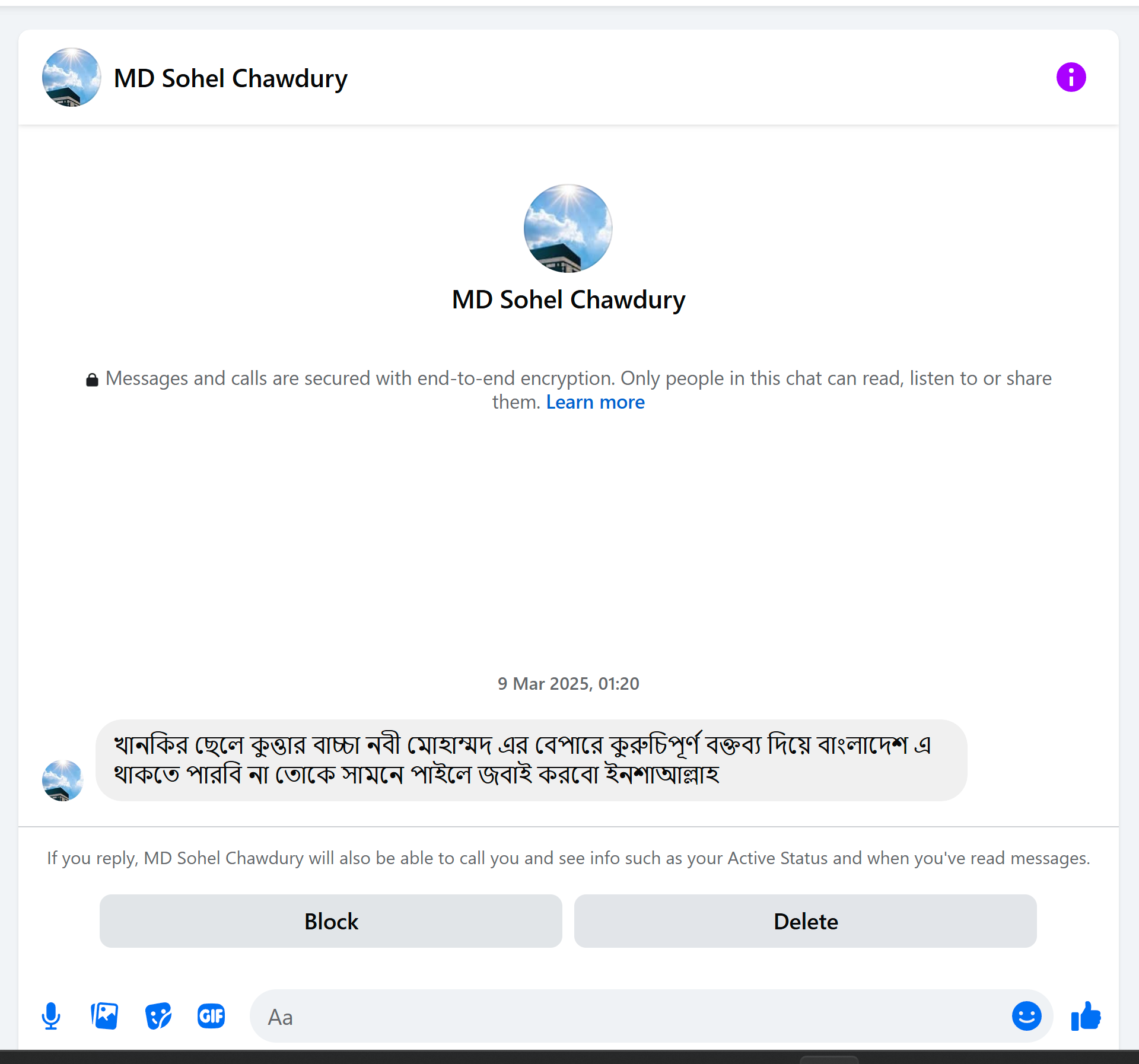
Because of criticising Iran’s hardline religious regime, I am still regularly receiving death threats on social networks. They are not content with only threatening to kill me; they are also threatening to rape my elderly mother and my sister.
I have been able to make, or am making, only a very small contribution to the development of freethinking in Bangladesh. Even for that I face so many threats and persecution! These incidents are merely a fragmentary picture of the misery of freethinkers’ lives in Bangladesh. Atheists, humanists and freethinkers are the most minority community in Bangladesh — there is no one to speak for them.
Fundamentalist Leaders’ Public Threats and the State’s Silence
Fundamentalist leader and self-proclaimed chief Mufti of Bangladesh, Dr. Enayetullah Abbasi, declared at a public rally in February 2025 that if criticizing atheists is their freedom of expression, then cutting off their heads is the freedom of fundamentalists’ hands. He publicly called upon his followers to kill anyone who criticizes Prophet Muhammad. This took place in the compound of Baitul Mukarram — the main mosque in Dhaka — in front of hundreds of people. Despite such open threats, the government took no action against him. He continues to this day, traveling by helicopter from one end of the country to the other, delivering Islamic speeches in exchange for hundreds of thousands of taka per hour.
This is not an isolated incident. Many of Bangladesh’s leading Islamic preachers are inciting extremism and jihad in this manner. Statements from many such figures circulate on social media from time to time. Mahmudur Hasan Gunbi, Maulana Mamunul Haque, Maulana Maijul Haque, Maulana Mufti Qazi Ibrahim, Abu Taha Adnan, Maulana Jasimuddin Rahmani — and over a hundred other religious leaders are on this list. Many of them were released from prison last year on government orders.
Time and again in Bangladesh, we have seen the state — instead of protecting victims — file cases against them and take various measures to appease fundamentalists. There are many examples of this. Jhumon Das of Sunamganj is a prime example. After he made a minor post on Facebook, fundamentalists attacked his community en masse with terrible violence. It was Jhumon Das himself who was arrested, and his bail was denied for a long time. Prominent Bangladeshi blogger and activist Asif Mohiuddin was attacked by fundamentalist militants in 2013 and survived by sheer fortune. Yet the government turned around and filed charges against him, sending him to prison in the same year.
While the police in Bangladesh fail catastrophically to suppress serious crimes, they act with remarkable speed when allegations of religious insult arise. Mob justice and arrests over blasphemy accusations are very common in Bangladesh. Even the mildest criticism of religion is treated as a grave offense. People believe Islam is the superior religion above all others and can contain no flaw — because it is the law given by God, Allah. In Kuliya of Debhata Upazila in my home district of Satkhira, a 25-year-old young man named Sohag was accused of desecrating the Quran, first humiliated by having a garland of shoes placed around his neck and then beaten by the mob, after which police arrested him and filed a case of religious desecration. From the photographs, it is clear that he was beaten so severely that even with the support of a police officer’s shoulder, he could barely stand.
A religious leader by the name of Ataur Rahman Bikrampur opened groups on Facebook and WhatsApp and holds formal meetings for the killing of blasphemers and apostates. Even after launching this initiative under the name ‘Anti-Shatim Movement,’ the government has said nothing to him. His followers paint graffiti on the walls of Dhaka University and Bangladesh University of Engineering and Technology, campaigning for the killing of those they label “Shatim” — anyone who criticizes the words, deeds, or views of Prophet Muhammad.
Instruments of State Repression: The Digital Security Act and the Cyber Security Act
The Digital Security Act (DSA), enacted in 2018, and the Cyber Security Act (CSA), enacted in 2023, have been extensively used to suppress free thought. Section 28 of these laws provides for up to 10 years of imprisonment for hurting religious sentiments. Human rights organizations — Human Rights Watch, Amnesty International, and the Editors’ Council — have repeatedly expressed concern over the misuse of these laws.
Bangladesh’s laws are extremely dangerous for those who criticize religion — freethinkers, atheists, humanists, and secularists. They are already labeled as criminals by society, and the country’s laws are stacked against them as well. In many cases, police preemptively arrest such individuals to protect them from mob rage, or arrest them to appease the mob that has gathered.
Even more astonishingly, the High Court Division of Bangladesh’s Supreme Court itself had recommended to the government that hurting religious sentiments be made a non-bailable offense carrying a maximum penalty of death. This opinion was delivered by a High Court bench while disposing of a bail application in a cyber security case.
Exile and Silent Departure
Beyond physical attacks, many freethinkers and writers have been forced to flee Bangladesh. Alongside myself, Taslima Nasrin, Banya Ahmed, Asif Mohiuddin, Asad Noor, Nur Nabi Dulal, Akash Malik, Azam Khan, Golam Sarwar, and many others are now living abroad and continuing their writing. Those who have remained in the country write under pseudonyms or have stopped writing altogether.
The violence against freethinkers, atheists, humanists, and progressive writers in Bangladesh is not merely a collection of isolated incidents — it is a continuous, organized, cycle of repression carried out with the quiet consent of state and society alike. Religious extremists openly compile kill lists, attack bloggers’ homes and offices, and law enforcement agencies — instead of protecting the victims — more often than not blame the victims themselves, charging them with “religious desecration.” Under repressive laws including the Digital Security Act, free thought has been criminalized — so that writing means risking arrest, lawsuits, surveillance, or the threat of being lynched by a mob. Faced with this reality, many see no option but to leave the country — because staying means putting your life, your family, and your future in front of the barrel of a death threat every single day.
International Assessment
In the World Press Freedom Index of Reporters Without Borders (RSF), Bangladesh has for many years ranked near the bottom among 180 countries. In 2024, the country was placed 165th, and while 2025 saw a slight improvement to 149th, it still falls within the category of “very serious” conditions. This index is based on political pressure, legal repression, safety of writers and journalists, censorship, and media freedom. RSF analysis shows that in Bangladesh, lawsuits, arrests, surveillance, and repressive use of the Cyber Security Act (CSA/DSA) against writers and journalists have effectively forced voices and media outlets into self-censorship. This ranking is not just a number — it shows that the state’s power structure does not allow free expression or independent journalism to function, but instead creates an environment of control and fear.
In Freedom House’s annual Freedom in the World report, Bangladesh has been consistently classified as “Partly Free” — evaluated on the basis of political rights, civil liberties, freedom of expression, and the rule of law. While the constitution explicitly mentions freedom of expression, press freedom, and civil rights, in practice these rights are frequently restricted, controlled, or curtailed through repressive legislation. Lawsuits, arrests, surveillance, and online harassment targeting journalists, bloggers, human rights workers, and freethinkers show that constitutional promises have not translated into ground-level reality. These international indices therefore do not merely show the country’s ranking — they demonstrate that a deep contradiction exists between the state’s declared values and their actual application, creating long-term risks for democracy and human rights.
Governments of several countries — particularly the United States, the United Kingdom, Canada, Germany, Norway, and the European Union — have consistently raised concerns about freedom of expression in Bangladesh. The US State Department’s human rights reports have repeatedly noted that in Bangladesh, lawsuits, arrests, surveillance, and violence against journalists, bloggers, human rights workers, and political critics remain a “serious problem.” The reports have also noted that under the previous government, “serious restrictions” were imposed on freedom of expression, and attacks on journalists, censorship, and online repression were widespread. The European Union has also repeatedly raised concerns in human rights dialogues that the Digital Security Act (DSA/CSA) restricts freedom of expression and creates a climate of fear. Amnesty International has also raised deep concerns on an ongoing basis.
International bodies such as the UN Human Rights Council (UNHRC) and ARTICLE 19 have described Bangladesh as being “in crisis” in terms of freedom of expression. ARTICLE 19’s Global Expression Report has consistently placed Bangladesh in the lowest tier, citing attacks on writers and journalists, online surveillance, censorship, and repressive laws as the primary reasons. UN Special Rapporteurs have stated on multiple occasions that in Bangladesh, impunity for the killing of journalists, political violence, and the role of both state and non-state actors in silencing critical voices have created a “profound human rights crisis.” Human Rights Watch has also stated that attacks on writers, poets, publishers, and human rights workers, as well as the filing of cases against them, are in conflict with the state’s constitutional commitments. These assessments show that within the international human rights framework, Bangladesh is regarded as a country where freedom of expression is structurally restricted and under threat.
These observations show that at the international level, Bangladesh is viewed as a high-risk country where expressing critical opinions is tantamount to endangering one’s own safety.
Conclusion
The crisis of free thought and freedom of expression in Bangladesh is not merely a collection of isolated violent incidents. It is a deliberate and structural process of suppression — in which sometimes organized militants, sometimes the enraged fury of a crowd and mob justice, sometimes state laws, all work in concert to silence alternative voices.
The effects of this dire situation are clearly visible. Once-vibrant online communities are now silent. Discussions on religion, politics, and human rights are now conducted with far greater caution by everyone. People are compelled to self-censor, out of fear of losing their lives or honor. This culture of self-censorship is undermining the very foundations of democratic discourse.
The ideal of a free, secular, and pluralist state — born at the cost of millions of lives in 1971 — is today being wounded with every machete blow, every burning tree, every unanswered death threat.
A society that fears questions is, in truth, a society that fears its own weaknesses.
Related Posts

Actresses Shabana, Moushumi, Popy – Religious Sentiment and the Politics of the Public Sphere
In the history of Bangladeshi cinema, names like Shabana, Moushumi and Popy mark important chapters.Read More
নায়িকা শাবানা, মৌসুমী, পপি – ধর্মানুভূতি এবং জনপরিসরের রাজনীতি
বাংলাদেশের চলচ্চিত্র ইতিহাসে শাবানা, মৌসুমী কিংবা পপির মতো নাম গুরুত্বপূর্ণ অধ্যায়। তারা আশি, নব্বই ওRead More
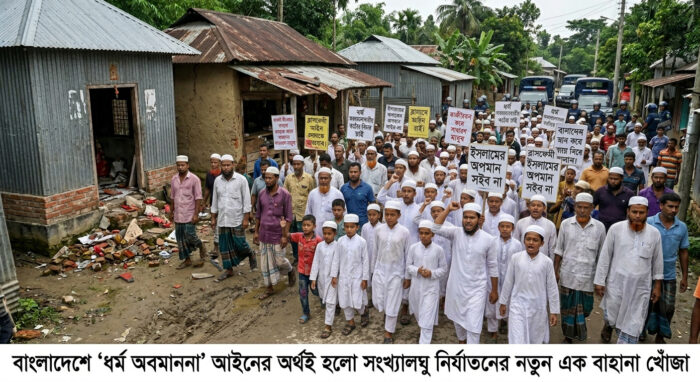
In Bangladesh, the very meaning of the “blasphemy” law is to find a new pretext for persecuting minorities
The attack on the house, shop, and temple of Deepto Roy in Tahirpur, Sunamganj isRead More
Comments are Closed