
Bangladesh’s Blasphemy Framework
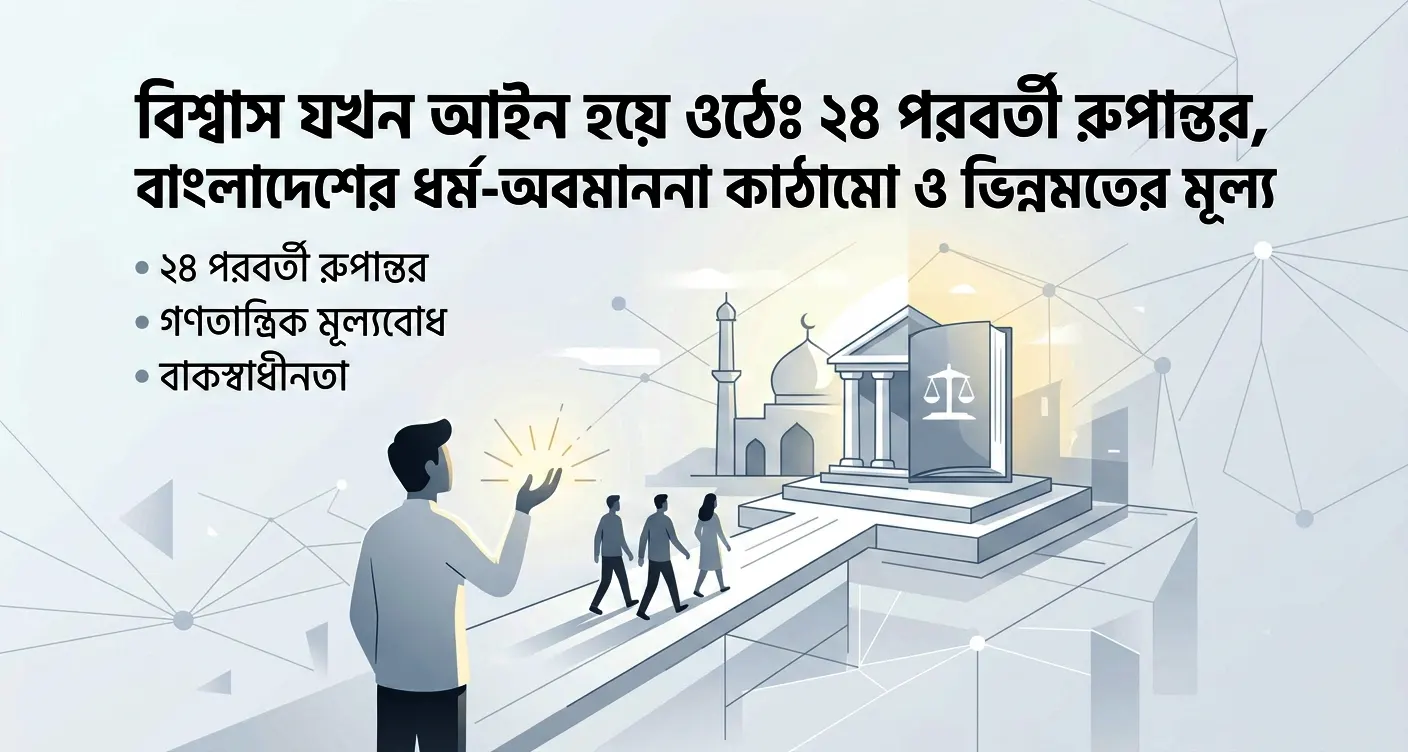
When belief turns into law: post‑24 transformation, Bangladesh’s blasphemy framework and the cost of dissent
In 1971, at the cost of many lives and indescribable sacrifices, Bangladesh was established on four fundamental principles: nationalism, democracy, socialism, and secularism. Half a century later, it appears that the country’s relationship with this last principle has become the most contentious fracture. Bangladesh’s secular writers, cultural workers, atheist bloggers, and humanist activists have come under threat from two directions – on the one hand, facing prosecution under repressive state laws concerning “religious sentiment” written in vague language, and on the other hand, becoming targets of machete attacks by Islamist militants. For a long time, Bangladesh’s legal framework has created space for these two kinds of pressure, and the post‑2024 political transformation is giving that dynamic a new shape – in the view of some, making it even deeper.
A constitution in conflict with itself
In Bangladesh’s 1972 constitution, secularism was established as a fundamental basis, but this commitment was never stable. During Ziaur Rahman’s military rule, secularism was removed from the constitution in 1977, and in 1988 the unelected parliament of autocrat Ershad went one step further and declared Islam as the state religion – even though no one had demanded this, and even the religion‑based party Jamaat‑e‑Islami spoke against it. In 2010, a Supreme Court verdict reinstated secularism as a constitutional principle, but it now exists in an uneasy coexistence alongside the status of Islam as state religion – a hybrid arrangement which, according to critics, satisfies no one fully and leaves room for selective application depending on the government in power.
Since the mass movement that toppled Sheikh Hasina’s government in August 2024, this instability has deepened further. The interim government led by Muhammad Yunus formed a constitutional reform commission, headed by Ali Riaz. In January 2025, this commission recommended that three of the four fundamental principles – secularism, nationalism, and socialism – be completely removed from the constitution and replaced with the broader concept of “pluralism.” The commission chief described secularism as a Western idea, which he believes does not fit well with Bangladesh’s context. Supporters see this as a correction to years of authoritarian rule carried out under the cover of secularism; critics – including minority‑rights activists and international monitoring bodies – warn that at a time when attacks on Hindus and other minorities are increasing, an important constitutional protective wall is being dismantled. As of mid‑2025, this proposal was still going through a political consensus‑building process, and major parties remained divided over it.
Legal framework: blasphemy law in all but name
Bangladesh does not formally have any law called a “blasphemy law,” but several laws in practice play that role:
- Penal Code sections 295 to 298 (inherited from the colonial era) – treat deliberate acts intended to hurt religious sentiment as a criminal offense.
- Section 57 of the Information and Communication Technology (ICT) Act – in force since 2013, which criminalized the publication of content that could “hurt religious belief,” and was widely used against bloggers, journalists, and critics of the government.
- The 2018 Digital Security Act (DSA) – replaced section 57 but retained its core content: up to ten years’ imprisonment for content considered to “hurt religious sentiment,” and provisions for life imprisonment for vaguely defined “propaganda” against the state. Human rights organizations and press‑freedom groups have widely criticized this law as a tool of repression rather than protection.
- The 2023 Cyber Security Act (CSA) – adopted as a reform of the DSA under continuous domestic and international pressure. According to critics, despite the new name, most of the vague religion‑related offenses remain intact.
In practice, these laws have been seen to be used more against those threatened by violent militants than against the militants themselves – secular bloggers, minority‑faith citizens whose social media accounts were hacked to post “insulting” content, and government critics whose posts were reconstructed to present them as religious offenses. Writer Mushtaq Ahmed’s death in prison in 2021 after being arrested under the DSA became a symbolic incident for critics of this law.
The violence the law could not prevent
Alongside this legal pressure, there has also been a documented pattern of violence against secular and humanist writers, which was particularly intense between 2013 and 2016 but still continues:
- Blogger and Bangladeshi‑American writer Avijit Roy was hacked to death with machetes in Dhaka in 2015; the al‑Qaeda‑linked group Ansarullah Bangla Team claimed responsibility for this killing and for the murders of several other secular bloggers and publishers that year.
- During this period, several other bloggers, publishers, and a law student who had spoken out in favor of removing Islam’s status as state religion were killed in machete attacks; some of their killers were identified as being linked to militant networks.
- In 2016, a militant attack on a café in Gulshan, Dhaka, killed many hostages, highlighting a broader militant threat – although this attack was not specifically targeted at secular writers.
Some attackers have been prosecuted, and after the café attack, large‑scale operations across the country and the arrest of thousands of suspects have reduced major deadly terrorist incidents. But many bloggers who survived attacks or received death threats – some of whom were later themselves charged by the state under the Digital Security Act – have reported living for years under police protection, in hiding, or in exile, with limited confidence that the state can consistently protect them or prosecute those who threatened them. Some hardline religious leaders and groups have, at various times, publicly called for punishment or killing of individuals accused of blasphemy, without legal consequences – a pattern documented by international human rights and religious‑freedom monitoring organizations.
Two threats, one outcome
What makes the Bangladeshi case distinctive in comparative perspective is this combination of state and non‑state pressure. A blogger accused of “hurting religious sentiment” faces the risk of arrest and trial by the state, and at the same time faces the risk of extrajudicial punishment from militants, who see the same content as justification for violence outside the courts. Legal experts and human rights researchers have argued that vague legal language such as “hurting religious belief,” “creating social unrest” not only facilitates state overreach; it also creates a kind of informal authorization, giving militants and enraged mobs a shared rationale with which they can justify violence against individuals already seen as suspects in the eyes of the law. Representatives of minority communities further note that these same laws have been used disproportionately against minority‑faith citizens – including cases where “insulting” content posted from a hacked social media account of a Hindu individual was later used as the justification for his prosecution or persecution.
Contested ground
It would not be accurate to present this issue as uncontested. Several countervailing aspects are noteworthy:
- Supporters of laws concerning religious sentiment argue that in a religiously diverse and communally tension‑prone society, these laws have a legitimate role, and that many democratic countries – including Western states – have similar “hate speech” or public‑order laws.
- The number of violent incidents, though serious, has significantly decreased compared to the peak period of 2013–2016, largely due to security operations.
- The current constitutional debate is not a straightforward expression of Islamist support – the reform commission’s stated goal is pluralism and, in their words, decentralization of power after authoritarian rule, not explicit endorsement of religious violence, and the commission chief has clearly supported the language of “pluralism” rather than completely abandoning minority protection.
- Bangladesh’s political mainstream – the BNP and the Awami League, who are fierce rivals on most issues – have historically been divided rather than united on how much support should be given to religious hardliners, which presents a picture of contested politics rather than a linear image of state complicity.
Final words
Bangladesh’s legal framework does not directly order violence against secular humanists, but its blasphemy‑adjacent laws – vague, broadly applicable, and historically used more against dissenting voices and minorities than against those who threaten them – have created an environment in which secular and humanist voices face danger from two directions at once: the courtroom and the street. The country’s ongoing constitutional restructuring, which as of mid‑2025 remains unresolved, seems likely to determine whether this dynamic will shrink or expand in the coming years. Whatever the outcome, the record of the past decade – prosecutions under speech‑related laws, killings that have remained unprosecuted for years, and public statements that have at times normalized violence against “blasphemers” – remains, in the eyes of human rights monitors, a serious and well‑documented concern, even as the political context around it continues to change.
Related Posts
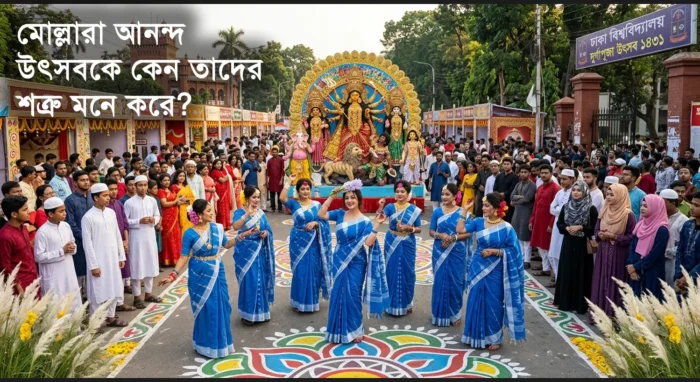
Why do Islamist clerics consider Bengali cultural festivals their enemy?
This year, unlike many previous years, the major Hindu religious festival Durga Puja in BangladeshRead More
ইসলামিস্ট মোল্লারা কেন বাঙালিদের আনন্দ উৎসবকে তাদের শত্রু মনে করে?
এবার বাংলাদেশে অন্যবারের তুলনায় বেশ শান্তিপূর্ণ, উৎসবমুখর পরিবেশে হিন্দু ধর্মের বড় ধর্মীয় উৎসব দূর্গাপূজা হয়েRead More
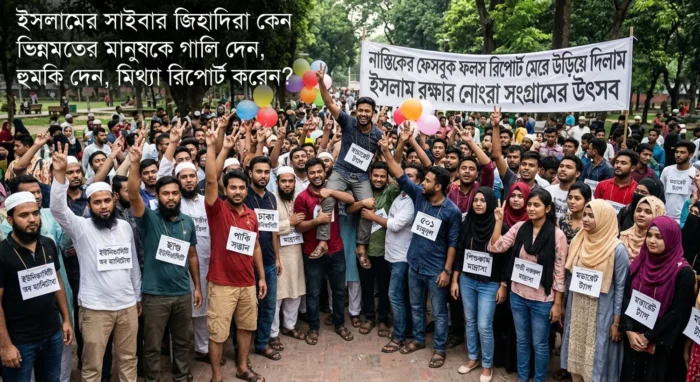
Why do Islamist cyber‑jihadis insult, threaten, and file false reports against people with different opinions?
Maulana Azhari once advised Islamists that sharing his Facebook posts is also an Islamic act;Read More
Comments are Closed