
Ancient Arab vs India
When Arabia Was in Darkness, India Was Carrying the Torch of Knowledge – So What Darkness Does Islam Claim to Remove?
What Was the “Age of Jahiliyyah” in Arabia Really Like?
The term “Jahiliyyah” is fundamentally a theological concept. In Islamic terminology, it refers to the “Age of Ignorance” before divine guidance. This does not mean that Arabs were uncivilized in every respect. Many modern historians argue that it is misleading to equate the term with a complete lack of culture or civilization. The way Islam describes it is simply a deceptive narrative. In fact, evidence and historical analysis can suggest that people in pre-Islamic Arabia, especially women, often enjoyed greater freedoms and rights. I have a detailed article on this subject here – The Deceptive Islamic Narrative of Ayyam al-Jahiliyyah and Reality.
Pre-Islamic Arabia was not uniform:
- South Arabia (Yemen): Kingdoms such as Saba and Himyar possessed irrigation systems (the Marib Dam), spice and incense trade networks, and their own script (Musnad).
- North Arabia: The Nabataean civilization (Petra), whose script later evolved into Arabic. There were also the Byzantine-allied Ghassanids and the Persian-allied Lakhmids.
- Hijaz (Mecca and Medina): A region of deserts and trade routes. The Quraysh were a mercantile tribe, and Mecca served as both a commercial and pilgrimage center.
Arabia was quite rich in literature. Poetry was its greatest art form. Poetry competitions were held at the Ukaz fair, and the famous poems known as the “Mu’allaqat” belong to this era. At the same time, traditions indicate the existence of tribal warfare, blood revenge, slavery, polytheism, and female infanticide. Thus, Arabia was not uncivilized, but it was politically fragmented and lacked a unified state structure.
What Knowledge from Arabia Was Known to the Outside World? Was Arabia Merely a “Receiver”?
It would not be accurate to call Arabia purely a receiver, but neither was it a major center of learning. Arabia’s main contributions were in the following areas:
- Trade and Communication: Arabs acted as intermediaries in the trade of spices, perfumes, and leather between the Indian Ocean, the Red Sea, and the Mediterranean.
- Astronomical and Weather Knowledge: Indigenous knowledge of using stars to navigate deserts and determine seasons.
- Language and Poetry: A highly refined oral literary tradition that later became the foundation of Arabic linguistics.
Written classical traditions in mathematics, medicine, philosophy, or astronomy were largely absent in Arabia at that time. Such knowledge arrived later, during the eighth and ninth centuries, through the translation movement. Greek, Persian, and Indian texts were translated into Arabic. Therefore, sixth-century Arabia may be described as a “knowledge-receiving region.” However, during the later Islamic Golden Age, figures such as Al-Khwarizmi, Ibn Sina, and Ibn al-Haytham radically transformed this picture, although they were not directly Arabs, nor were they truly products of Islam. Rather than encouraging them, Islam often subjected intellectuals to humiliation and persecution at every turn.
What Was the Source of Muhammad’s Knowledge?
There are two perspectives on this question, and both should be understood.
Islamic Belief: Muhammad was illiterate (ummi), and the Qur’an came to him as divine revelation. The Qur’an itself responds to the accusation that “a human being teaches him” (Qur’an 16:103).
Modern Historical Research: Scholars argue that the Hijaz was not an isolated region. Jewish tribes (especially in Medina), various Christian communities (such as those in Najran and along Syrian trade routes), and monotheistic “Hanifs” were present there. Khadijah’s cousin, Waraqa ibn Nawfal, is traditionally said to have been familiar with Christianity. Muhammad himself traveled to Syria on commercial journeys. For these reasons, scholars often discuss the presence of biblical and Arabian monotheistic traditions within the Qur’an.
For believers of the first perspective, such discussions do not alter the essential issue. For researchers of the second perspective, these are entirely normal historical questions. Religious claims cannot be proven or disproven through historical research because religious faith, by definition, is faith without evidence, where questioning is not permitted. This should be kept in mind.
Why Is Muhammad Barely Mentioned in Contemporary Great Civilizations and Empires?
The harsh and impoverished Arabian region was not particularly attractive to the surrounding great empires and civilizations. Consequently, they knew little about Muhammad’s preaching or rule. To them, it appeared as just another tribal prophet or one more ideological movement serving political ambitions. The empires were preoccupied with far more important affairs. Therefore, their records, monuments, and histories contain little to no trace of Muhammad. No one invited him, and no one attempted to conquer him. From their perspective, he was entirely insignificant.
There are several reasons for this:
- Geographical and Political Significance: The Hijaz was a peripheral region from the perspective of the Byzantine and Sasanian Empires. A religious preacher from Mecca was unlikely to attract their attention.
- The Empires Were Occupied: Between 602 and 628 CE, the Byzantine and Persian Empires were engaged in a devastating war.
- Lack of Contemporary Documentation: In antiquity, individuals generally appeared in written records only when they attracted royal or imperial attention.
However, the record is not entirely silent. The 634 CE “Doctrina Jacobi,” the Armenian historian Sebeos (c. 660s), and other Syriac Christian writers mention an Arab “prophet.” These texts were written within a few years or decades of his death. Later, once the Arabs entered the heartlands of major empires, references to them increased dramatically. The rapid rise of Islam astonished contemporary observers. Yet the writing of Islamic history itself began thousands of miles away from Arabia, in Persia rather than Arabia. None of the major compilers of hadith or authors of sira literature were Arab. Arabia itself remained largely uninterested in history, science, philosophy, and knowledge during that period.
What Was the State of Education in Arabia at That Time?
Education in Arabia was primarily oral. There were no institutional schools. Genealogies, poetry, tribal history, and traditions were preserved through memory. This is why, following that tradition, children in countries such as Bangladesh are still subjected to harsh treatment in order to memorize the Qur’an, despite the fact that hundreds of thousands of copies can now be stored on a mobile device. According to tradition, very few people in Mecca were literate. Nevertheless, writing was not entirely unknown and was used for commercial transactions and contracts. South Arabia possessed a rich epigraphic tradition. Against this background, the written compilation of the Qur’an and the later flourishing of Arabic literature are often seen as a major cultural transformation.
What Was the State of India in Civilization, Arts, and Knowledge at That Time?
While Muhammad was promoting a political ideology wrapped in religious language in order to fulfill his political and personal ambitions, India was experiencing a flourishing stream of intellectual development. During the sixth and seventh centuries, India was one of Asia’s most advanced regions in civilization, arts, and learning. From the post-Gupta period through the reign of Harshavardhana, urbanization, trade, and agriculture were highly developed. India maintained commercial connections with Rome, China, and Southeast Asia via both land and sea routes.
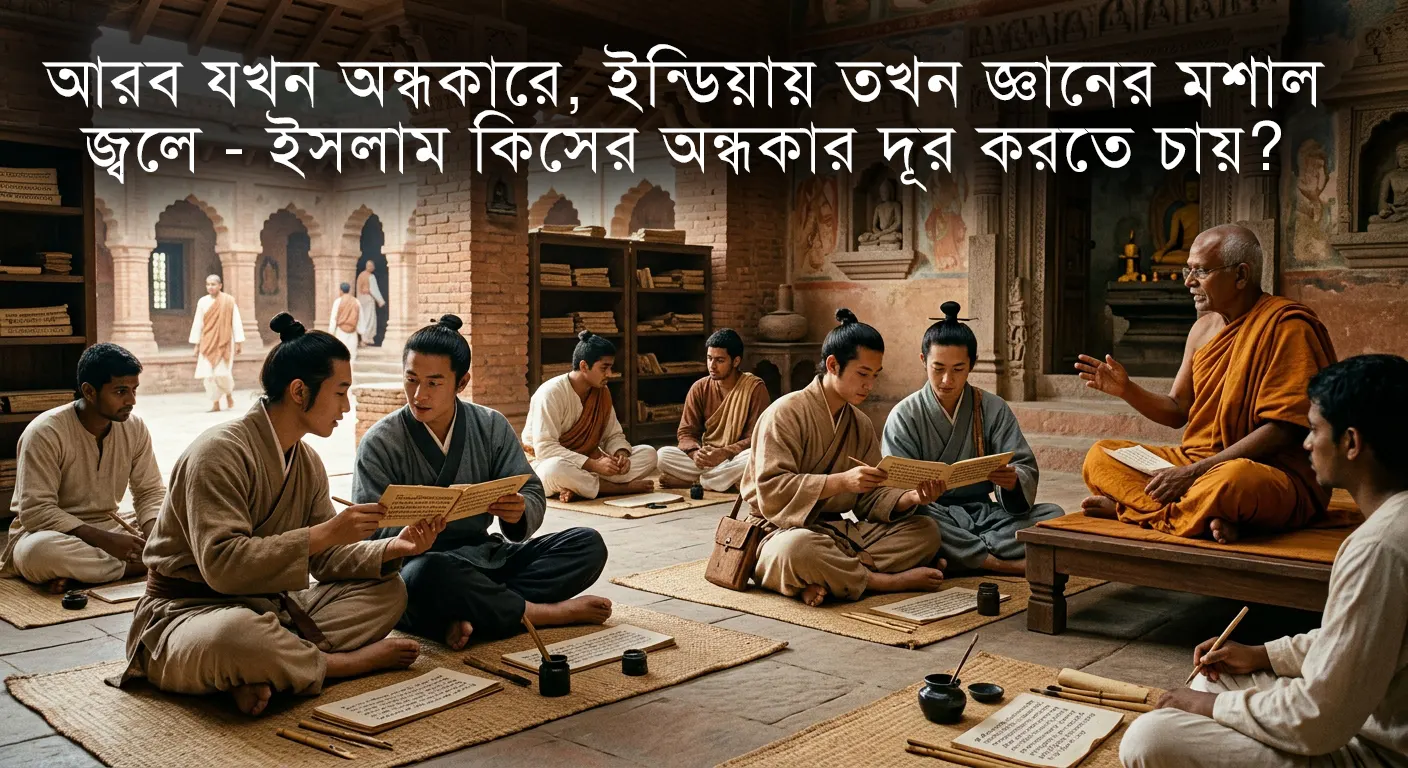
In the arts, remarkable achievements included the Ajanta cave paintings, the rock-cut temples of Ellora, Gupta and Chalukya architecture, and the famous Buddha statues of Sarnath. Literature reached great heights through poets such as Kalidasa, Banabhatta, and Bharavi. In science and scholarship, Aryabhata and Varahamihira advanced astronomy, Brahmagupta developed mathematics (including rules concerning zero and the decimal system), Charaka and Sushruta contributed to medicine, and Indian metallurgy is exemplified by the Iron Pillar of Delhi. Institutions such as Nalanda and Vallabhi cultivated philosophy, logic, and science, attracting students from China, Korea, and Tibet. However, political fragmentation, regional conflicts, and caste-based inequalities also existed, making it inaccurate to describe the era as a perfect golden age.
How and When Did Taxila and Other Institutional Systems of Education Begin in India?
- Taxila: This center of learning in the Gandhara region (present-day Pakistan) was known from around the 6th-5th century BCE. Tradition associates it with the grammarian Panini, the physician Jivaka, and Chanakya, the author of the Arthashastra. It functioned primarily as a teacher-centered system, where students studied under individual masters. Its decline began after the Hun invasions in the 5th century CE.
- Buddhist Monasteries: Under the patronage of the Mauryan Emperor Ashoka (3rd century BCE), Buddhist monastic institutions expanded widely. Monasteries gradually evolved into centers of education.
- Nalanda: It is generally believed to have been established during the reign of the Gupta Emperor Kumaragupta I (c. 427 CE).
It should be noted that Shashanka, Harshavardhana, and Banabhatta belonged to the early 7th century CE, meaning several decades after 570 CE. The Somapura Mahavihara at Paharpur was constructed even later, in the late 8th century under the Pala Emperor Dharmapala. By that time, Taxila had already declined significantly. Thus, India already possessed a long-established tradition of advanced education and culture.
Why Are India’s Monastic Institutions Called “Universities”?
Many people argue that these were among the world’s first universities, and there is substantial evidence supporting this view. The term “university” is used here in a modern sense because many of their characteristics resemble those of universities:
- Thousands of students and hundreds of teachers lived together in residential settings.
- They offered curricula in multiple disciplines, including Buddhist and Vedic philosophy, logic, grammar, medicine, mathematics, and astronomy.
- Nalanda had a rigorous entrance examination system.
- Expenses were supported through village-based endowments provided by rulers and the public.
- They maintained vast libraries, such as Nalanda’s famous “Dharmaganja.”
These details are known from the accounts of the Chinese pilgrims Xuanzang (Hsuan-tsang) and Yijing. Some scholars argue that these institutions did not match the organizational structure of medieval European universities exactly, but the comparison as ancient centers of higher learning is not unreasonable.
What Other Universities Existed in India at That Time?
The major centers included:
- Nalanda (Bihar): The most famous of all.
- Vallabhi (Gujarat): Renowned particularly during the 6th and 7th centuries under the Maitraka dynasty.
- Odantapuri and Vikramashila (under the Pala dynasty, 8th-9th centuries).
- Somapura Mahavihara (Paharpur, present-day Bangladesh).
- Jagaddala (Varendra region) and Kanchi (South India), among others.
From Which Countries Did People Come to India for Education?
The respect and influence that Bangladesh’s Atisha Dipankara still enjoys in Tibet is openly acknowledged there even today. How did the Bengali calendar spread across parts of South Asia? Questions like these reveal the extent of India’s educational influence throughout Asia during that period. Students and monks came from China (Xuanzang stayed in India from 629-645 CE and studied at Nalanda; Faxian had visited even earlier), Korea, Japan, Tibet, Sri Lanka, Central Asia, and Southeast Asia (including Sumatra and Java). Vikramashila and Nalanda played a major role in the development of Tibetan Buddhism.
What Were India’s Contributions to Science and Knowledge?
At a time when Arabia was still largely in darkness regarding science and philosophy, India was carrying the torch of knowledge. Some major contributions of that era include:
- Mathematics and Astronomy: Aryabhata (476 CE) worked on Earth’s rotation and the value of π. Brahmagupta (628 CE) recorded mathematical rules involving zero. The decimal place-value system and the use of zero developed in India before spreading through the Arabs to the rest of the world (hence the term “Hindu-Arabic numerals”).
- Medicine: The Charaka Samhita and Sushruta Samhita. Sushruta’s work contains descriptions of surgical procedures.
- Grammar and Linguistics: Panini’s Ashtadhyayi.
- Philosophy and Logic: The Buddhist logical traditions of thinkers such as Dignaga and Dharmakirti.
What Was India’s Contribution to Peace?
One noteworthy pattern in history is that, despite its internal conflicts, India did not spend centuries invading foreign civilizations beyond its cultural sphere. India was frequently invaded, but even when powerful, it generally did not pursue large-scale foreign conquests. Major contributions to the history of peace include Ashoka’s adoption of nonviolence after the Kalinga War, his promotion of the policy of “Dhamma,” and the spread of Buddhist and Jain principles of nonviolence across Asia. However, for the sake of historical balance, it should also be noted that India of that era was not free from political warfare, dynastic conflicts (such as the struggles involving Shashanka and Harsha), or caste-based social inequalities.
A Socio-Economic Comparison Between India and Arabia During This Period
| Subject | Arabia (6th-7th Century) | India (6th-7th Century) |
|---|---|---|
| Political System | Tribal society, no centralized state | Kingdoms and empires with monarchic rule |
| Economy | Trade, pastoralism, oasis agriculture | Agriculture-based economy, advanced trade and urbanization |
| Education | Oral, informal | Institutional monasteries and gurukul systems |
| Written Tradition | Limited (poetry mostly oral) | Rich literature in Sanskrit, Pali, and Prakrit |
| Social Problems | Tribal conflicts, slavery | Caste discrimination, political fragmentation |
Then Why Does Islam Claim to Have Removed Darkness?
Islamists often claim that they seek to remove darkness from the world. What darkness? Where was this darkness? If something that itself emerged from a comparatively dark intellectual environment claims to illuminate the world, the assertion appears highly questionable and simplistic. When India had already been intellectually vibrant long before Muhammad’s birth, how could Islam, emerging from Arabia with relatively limited contributions to science and knowledge at that stage, be said to have replaced darkness with enlightenment?
It is an established historical fact that in the 6th and 7th centuries, India was far ahead of Arabia in institutional education, written scholarship, and scientific development. However, two points should be kept in mind. First, “Jahiliyyah” is a religious term rather than a measure of cultural achievement, and Arabia possessed its own traditions of poetry, commerce, and language. Second, history did not end there. After the rise of Islam, parts of the Middle East absorbed Greek, Persian, and Indian knowledge and later made substantial contributions of their own, although Islam itself played no role in that process and often acted as an obstacle. Indian mathematics and medicine also reached Europe largely through those scientists and philosophers. Rather than treating civilizations as opponents, it is more productive to understand the history of knowledge exchange between them. Yet within that broader picture, there is little visible evidence for a distinct branch that can meaningfully be described as a unique civilization of Muhammad’s Arabia or of Islam itself.
Related Posts

আরব যখন অন্ধকারে, ইন্ডিয়ায় তখন জ্ঞানের মশাল জ্বলে – ইসলাম কিসের অন্ধকার দূর করতে চায়?
আরবে “আইয়ামে জাহেলিয়া” আসলেই কি ছিল? “জাহেলিয়া” শব্দটি মূলত একটি ধর্মতাত্ত্বিক ধারণা। ইসলামী পরিভাষায় এরRead More
Islam’s Circular‑Logic Fallacy
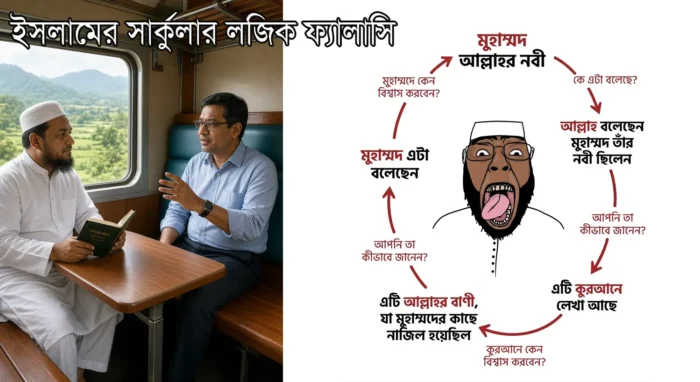
Place: Cabin of a Dhaka–Sylhet-bound trainCharacters: Maulana Abdur Rahman (a responsible member of Tabligh Jamaat)Read More
ইসলামের সার্কুলার লজিক ফ্যালাসি
স্থান: ঢাকা থেকে সিলেটগামী ট্রেনের কেবিনচরিত্র: মাওলানা আব্দুর রহমান (তাবলিগ জামাতের একজন দায়িত্বশীল) ও অধ্যাপকRead More
Comments are Closed