
9-11 and Islam
Has Islamic ideology destroyed trust among people worldwide and made life more difficult?
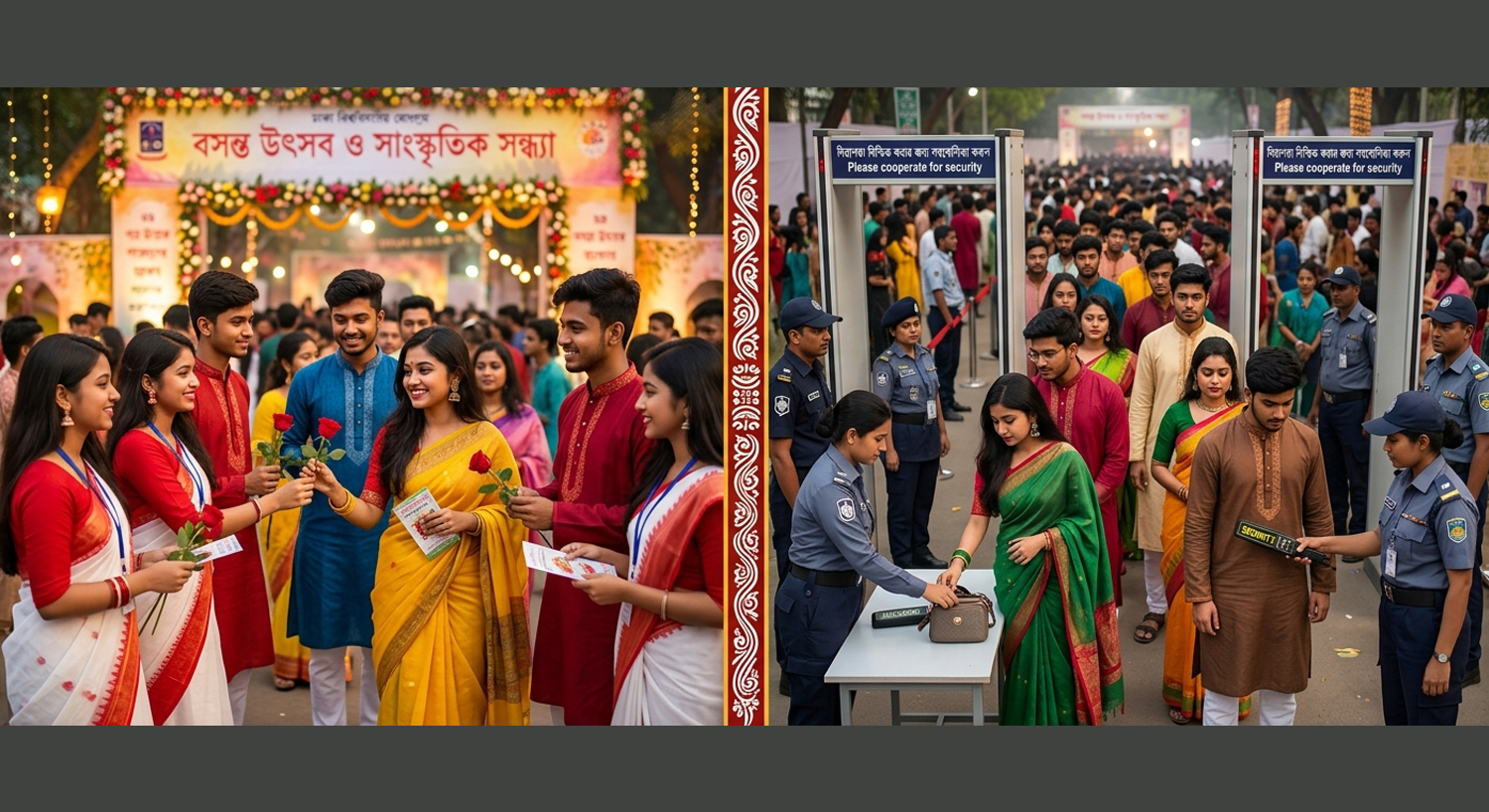
In the early 2000s, the South Plaza of the Bangladesh National Parliament Building in Dhaka was open to the public. We would go there with friends, sit on the stairs, and chat. Those bright sunny days were carefree—there were no searches, no prohibition signs anywhere. Whether at offices, courts, mills, factories, or during New Year celebrations, Puja festivals, fairs, or other events—ordinary people didn’t have to worry much about security, nor did the administration. This picture was not unique to Bangladesh; it was true for the entire world. Just think: were there such walls of security everywhere back then as there are now? Was there this much suspicion and distrust between people before?
In 1997, when my grandfather returned from Hajj, I went inside the airport with just a 20-taka ticket to receive him. There was no search of any kind, and no one asked why I had come. At that time, you could carry a water bottle while passing through the airport, you didn’t have to take off your shoes or belt. Back then, the world was built on mutual trust, faith, and respect among people. Although there were some isolated terrorist attacks worldwide, by and large, people did not suspect each other so much for the sake of security. Embassies issued visas largely on the basis of trust. There were no metal detectors, dog squads, barbed-wire walls, or layers of security personnel everywhere like now.
That world no longer exists. A single morning changed it forever.
That Afternoon at Kakoli Intersection
It was probably afternoon on September 12, 2001. I was crossing the overbridge at Kakoli Intersection when I saw hawkers shouting and selling two-page telegrams. Today’s newspapers—Ittefaq, Janakantha, Bhorer Kagoj—all had brought out extra editions with eight-column red headlines. Newspapers usually didn’t release such telegrams unless something major happened. There was only one headline: “America in Ruins, Horrific Airplane Attack!” It was mostly a way to scratch the anti-American sentiment among some Muslim masses and make some quick money.
I couldn’t fully understand what was happening. That day it was still the night of September 11 in America. Two hijacked planes had crashed into the two tall buildings in New York—the Twin Towers. Another hit the Pentagon. A fourth plane crashed in a field in Pennsylvania after passengers fought back against the hijackers. Nearly three thousand people were crushed under concrete and burned to death in the fire.
One 9/11 divided the world’s timeline into two parts—before 9/11 and after. A single beautiful morning changed the world forever. Trust, faith, and respect between people around the globe were suddenly called into question. Barbed fences were installed around important structures everywhere, including Bangladesh’s Parliament. The days of casual chats on the stairs of the South Plaza came to an end. Now people suspect one another in their daily movements—for security. But the world wasn’t this harsh before.
Who Did It and Why?
The attack was carried out by Al-Qaeda—an international terrorist organization led by Osama Bin Laden, driven by a specific political-religious ideology. Nineteen hijackers, most of them Saudi nationals, had trained for months in America posing as innocent flight students. Neighbors knew them, shopkeepers greeted them—nobody knew those familiar faces were planning death.
This is the most terrifying aspect of 9/11. Thousands of wars have happened throughout history, millions have been killed in tribal or political conflicts—but those conflicts had boundaries, battlefields, and could often be anticipated. 9/11 erased those boundaries and made it clear that even people inside your family, your neighbors, or those raised under your care are no longer safe. The attack proved that human trust, love, compassion, and openness could be weaponized.
One After Another—The Wave Didn’t Stop
Even after 9/11, this cancer of distrust and jihadist terrorism did not stop. Instead, a long, bloody chapter began.
- In 2004, the Madrid train station bombings killed 191 people.
- In 2005, explosions in the London Underground killed 52.
- In 2008, the Lashkar-e-Taiba attack in Mumbai killed 166.
- In 2015, the ISIS attack at the Bataclan concert hall in Paris killed 130.
- In 2016, a truck was driven into crowds during Bastille Day celebrations in Nice, France, killing 86.
- Bomb attacks on Pohela Boishakh in Bangladesh.
- In 2016, the attack on the Holy Artisan Bakery in Gulshan, Dhaka, killed 22 people.
There have been countless such attacks worldwide—how many should I even mention? Behind them were al-Qaeda, ISIS, Boko Haram, al-Shabaab, Tehrik-i-Taliban, Jama’atul Mujahideen Bangladesh (JMB)—all driven by the same kind of extremist political-religious ideology. Their sole goal was to establish an Islamic Caliphate. To impose 1400-year-old Islamic doctrines on the modern world. For this purpose, they do not hesitate to kill innocent, non-believing people.
ISIS occupied large parts of Syria and Iraq and committed countless atrocities in the name of establishing an Islamic Caliphate. From turning Yazidi women into sex slaves and selling them, to slitting the throats of Coptic Christians on the beaches of Egypt—they committed horrific crimes against humanity. What sane, normal, conscientious person would ever want to realize the dream of establishing such a Caliphate in the name of Islam?
Even Schoolchildren Were Not Spared
Even innocent children who knew nothing about any war in the world were not spared from these jihadist attacks in the name of Islam.
- In 2004, an attack on a school in Beslan, Russia, killed 334 people—most of them children.
In 2014, an attack on an army school in Peshawar, Pakistan, killed 149 people, including 132 children. - In 2014, Boko Haram abducted nearly 276 schoolgirls from a government school in Chibok, Borno State, Nigeria.
- In 2018, 110 schoolgirls were abducted from a school in Dapchi town.
No place or age in the world felt safe anymore.
Islamic Taqiyya: A Religious Theory of Deception in Trust Relationships
The attackers would blend into society, become familiar faces—then strike. In almost every case, no one realized that the killers were living among them, or that those who would kidnap their children were posing as helpers. In this context, the Islamic religious concept of Taqiyya (Taqiyya) is often discussed.
Religious research suggests that Islam permits lying, deception, concealment, and hiding one’s true beliefs for the sake of spreading and promoting the faith. There are many examples of this in the Quran, Hadith, and Sirah. Allah Himself has set examples of deceiving opponents through strategy, and Prophet Muhammad encouraged such deception. Extremists use this concept for the political project of establishing Islam. In that mission, they pay no heed to ethics or morality—whatever killing or destruction helps establish Islam is their target. And since they are suicidal and believe that dying makes them martyrs who will go straight to the most desirable paradise for Muslims without question, they never back down from any fear and willingly give their lives.
Let me clarify: the vast majority of the more than 1.8 billion Muslims are peaceful and are in fact the biggest victims of jihadist terrorism. They generally do not strictly follow the rigid commands of Islam or are more respectful of state and international law. This does not mean that the ideology of Islam can be absolved of responsibility for terrorism.
In Islam, befriending, helping, or wishing well for non-Muslims is strictly prohibited (Quran – 3:28, 3:118, 4:144, 5:51, 9:23, 9:24, 9:113, 9:114, Hadith – hadithbd.com/hadith/link/?id=60155). But Taqiyya provides such an opportunity that opportunistic Muslim fundamentalists and jihadists can pretend to befriend non-Muslims, attract them, and ultimately destroy them under the guise of that deceptive friendship. They first fix their strategy, then infiltrate as polite people, and when the time is right, they achieve their real objective. For many Islamic fundamentalists, trapping non-Muslim men and women in a love trap, marrying them, and converting them is also part of Taqiyya.
The Quran clearly shows examples of Allah’s deception. Surah Al-Imran 3:54 says – “And the disbelievers planned, but Allah planned. And Allah is the best of planners.” In another translation of the same verse, it is said “Allah is the best of deceivers.” Surah Al-Anfal 8:30 says, “And when the disbelievers plotted against you to imprison you or kill you… they plotted and Allah plotted, and Allah is the best of plotters.” These verses show that Allah Himself has practiced deception and that it is permitted for the sake of Islam.
Allah has also commanded secret ambush for killing people of other faiths. Surah At-Tawbah 9:5 – “Then when the sacred months have passed, kill the polytheists wherever you find them, seize them, besiege them, and lie in wait for them in every ambush. But if they repent, establish prayer, and give zakah, then leave their way. Indeed, Allah is Forgiving and Merciful.” In the explanation of this verse, Islamic scholars say it is permissible to secretly kill the disbelievers even before warning them. That is, there is no need to give any prior warning or condition such as “if you do not do this, you will be killed.”
There are examples from the time of Prophet Muhammad as well. Secret assassin teams were sent to kill two Jewish poets, and the Prophet approved the use of lies and deception. In Sahih Bukhari (sunnah.com/bukhari:6622) it is said – “By Allah’s will, if I take an oath and later find something better, I will do what I consider better and will not feel bound to fulfill the earlier oath.” There is also the example of Abu Bakr, where breaking an oath for a better deed was done and expiation was given. Another hadith says, “War is deception” (sunnah.com/bukhari/56/234-238). There are many more hadiths that speak of deception, breaking oaths, and achieving goals through lies. The Sirah books contain many such examples.
When small children are raped in many madrasas, you will see that a large portion of the clerics remain silent. Because the Quran and Hadith instruct Muslims to cover up the faults of fellow Muslims. It is also forbidden to mention to non-Muslims those aspects of Islam that will not appear beautiful to them. Once someone enters Islam, they are forced to accept all of it. Because leaving Islam makes one an apostate (murtad), punishable by death. Therefore, once someone is converted to Islam through sweet behavior and by showing only the beautiful sides of Islam—through deception and tactics—there is no way out afterward. The hadith about covering up a Muslim’s faults (sunnah.com/bukhari:2442) is interpreted as the need to hide the weaknesses of Islam from non-Muslims.
Surah Al-Baqarah 2:225 permits breaking oaths if something better is found. From these references, it is clear that Taqiyya in Islam is not just for self-defense, but is used for the expansion of Islam, the destruction of enemies, and maintaining secret positions. Extremist Islamists use this technique. They appear as polite friends on the surface but harbor plans of murder inside. They secretly advance their interests in politics and society in the name of Islam—where lying, deception, and pretense are all permissible.
Although befriending non-Muslims is prohibited, it is allowed for the sake of Islam’s interest; Muslims may even temporarily follow non-Muslim customs and practices. That is why, when Muslims are a minority in a country, many Muslim leaders demand secularism there, but when Islam becomes the majority, that demand completely changes and they call for Sharia law. In the explanation of Surah An-Nahl 16:106, scholars have clearly stated that they may blend in with other religious groups or nations, even if it involves acts of disbelief. For example, while living in India, they may even participate in puja and worship if it serves the interest of Islam.
I have a detailed article on Taqiyya. You can read it here: https://smsaif.me/taqiyya-in-islam/
Islamic Ideology Has Put Pressure on Economy and Social Relations!
Because of secret attacks in the name of Islam around the world, strict security measures are now in place everywhere—from homes to palaces, bus terminals to railway stations. Countless metal detectors, security personnel, equipment, armed police, dog squads, weapons, and technology have become necessary. Trillions upon trillions of taka are being spent on this. Where does this extra money come from? From the pockets of working people like you and me. Let’s look at a rough calculation for the two major countries—the United States and India.
Before 9/11, the world’s security systems were relatively relaxed. There was much more natural and spontaneous mutual trust between the state, institutions, and ordinary people. Entering airports, government buildings, educational institutions, or large public gatherings involved very little scrutiny. Security existed, but it was not conspicuous—rather silent and unannounced. People did not carry security as a separate worry in daily life; life moved at its natural pace.
After 9/11, security spending increased dramatically worldwide. If we consider only airports, you will see the introduction of multi-layered scanners, body checks, surveillance cameras, and biometric identification systems. Not just in the US, but in Europe, Asia, the Middle East—everywhere, a large portion of the state budget began to be allocated to security. This extra spending directly impacted development sectors such as education, health, and social welfare. In many countries, sectors directly related to public interest have been sidelined. Just imagine—if this extra security cost were spent on healthcare instead, how much more people-friendly healthcare services could have been!
The relatively silent and invisible security system of the pre-9/11 world has now reached a point where one must distrust even oneself. Before, mutual trust between the state and citizens was the main foundation of security. In the United States in 2001, just before 9/11, military and security spending was limited to about 3.2–3.5 percent of GDP, and no large separate structure called “Homeland Security” existed yet. There were no long lines, body scanners, bomb-sniffing dogs, or constant surveillance cameras at airports, government buildings, or public gatherings. The same was true in India and Bangladesh—in the 1990s and early 2000s, defense and internal security spending did not create visible pressure on ordinary people’s lives. Security was part of the system, but life was freely paced.
But after 9/11, security became one of the fastest-growing sectors in state budgets everywhere. In the United States, with the launch of the “War on Terror,” military and internal security spending rose to about 4.8–5 percent of GDP by 2010–2012—a clear jump from the pre-9/11 period. Homeland Security spending alone more than doubled. In India too, due to the global post-9/11 security reality, the Mumbai attacks, and border concerns, defense and internal security spending has steadily increased. In recent years, although India’s defense spending remains around 1.9–2.3 percent of GDP, 13–14 percent of the central budget is now allocated to overall security-related sectors—clearly much higher than in the pre-9/11 period.
The huge economic and social burden of this massive security spending ultimately falls on ordinary people. In the United States, more than 8 trillion dollars have been spent so far on post-9/11 wars and security infrastructure (according to Brown University estimates). Hundreds of billions of dollars are spent annually on airport security alone. Ordinary people’s freedoms have decreased—surveillance, data monitoring, and profiling have increased. What is called “Islamophobia” is actually the result of real events. Although most Muslims are peaceful, a minority of jihadists has caused everyone to be viewed with suspicion. The concept of Taqiyya, which facilitates the secret activities of jihadists, is partly responsible for this suspicion.
Socially, the post-9/11 world has become more divided and cautious. Suspicion and distrust between people—especially toward those of different religions, ethnicities, or geographic backgrounds—has increased. A tendency has developed to view certain people as “high-risk” at airports, borders, or public gatherings. As a result, coexistence, openness, and social harmony have suffered, and discrimination and social distance have become more pronounced in many societies.
Mentally, 9/11 has created a permanent sense of fear and insecurity in people. The thought that “something could suddenly happen” has embedded itself in the subconscious. Regular news of security threats, terrorism, or attacks in the media has increased anxiety, worry, and mental stress. No matter how strong the security systems become, mental peace often remains weak, because the fear is no longer limited to a visible enemy.
All in all, 9/11 was not just a terrorist attack; it was a major dividing line in the global sense of time. Before it, the world stood on trust; after it, the world stands on security and control. While enhanced security has reduced risks on one hand, it has left deep marks on people’s freedom, mental tranquility, and social openness on the other.
Islamophobia and Hatred of Islam
In 2014, while visiting Nepal, I suddenly had to explain to an acquaintance that even though I come from a Muslim family, I am not harmful. I had done nothing, yet a tag had already been imprinted in many people’s minds. I still remember how, upon hearing my name, an IT professional standing by Phewa Lake suddenly stepped back a little. I saw clear fear of distancing in his eyes. Many have named this mentality of fear “Islamophobia.” Even if many do not admit it openly, inside they feel this fear when they see someone in Islamic attire. This is a reality.
On the other hand, in Bangladesh, many extremist fundamentalists have coined the term “Islamophobia” (actually “hatred of Islam”), which is essentially a fabricated concept. Using this tag, they legitimize the killing of critics of Islam, freethinkers, humanists, and atheists. In its name, they have slaughtered many freethinking bloggers and writers. I am an ordinary person, yet I have to sleep every day under many such death threats. My movements—online and offline—are greatly restricted because this extremist, fanatical group does not understand the right to freedom of speech. In their view, the inhuman verses of the Quran and Hadith, and the dream of forcibly establishing Islam, are paramount. Yet the right to criticize any religion is part of freedom of speech—recognized in civilized society. Not everyone has to criticize all religions at once in the same way. Many criticize the backward and inhuman aspects of one particular religion in their own way. Others may not be affected as much, but critics of Islam face a much higher chance of attack.
Will the Lost World Return?
The stairs of the South Plaza of Bangladesh’s Parliament are still there, but no one has the right to sit on them anymore. The days of receiving loved ones at the airport with a 20-taka ticket are over. In the conflict between security and freedom, the world has chosen security—at the cost of freedom and trust.
The question remains:
Because of a few thousand jihadists, will hundreds of millions of people remain suspects for life?
Perhaps that world will never return.
But we should not stop dreaming of a society based on trust and dignity—because in a culture of distrust, the jihadists win. And it is our collective duty to fight against that ideology which encourages and instructs people to become fundamentalists and jihadists.
Related Posts
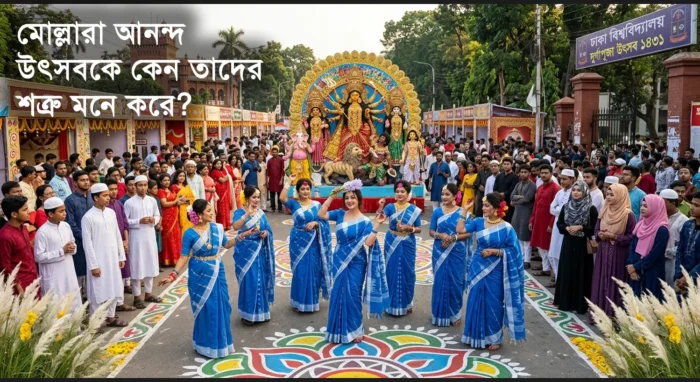
Why do Islamist clerics consider Bengali cultural festivals their enemy?
This year, unlike many previous years, the major Hindu religious festival Durga Puja in BangladeshRead More
ইসলামিস্ট মোল্লারা কেন বাঙালিদের আনন্দ উৎসবকে তাদের শত্রু মনে করে?
এবার বাংলাদেশে অন্যবারের তুলনায় বেশ শান্তিপূর্ণ, উৎসবমুখর পরিবেশে হিন্দু ধর্মের বড় ধর্মীয় উৎসব দূর্গাপূজা হয়েRead More
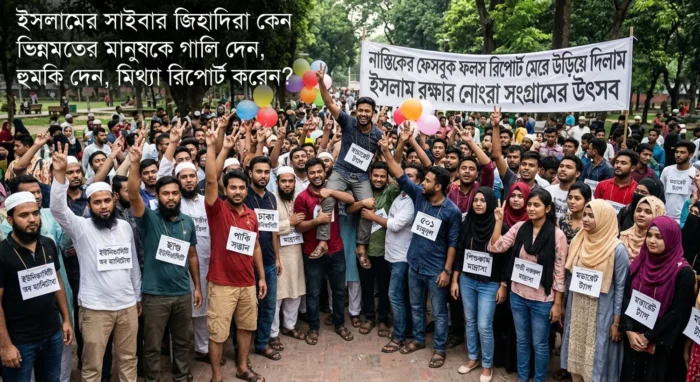
Why do Islamist cyber‑jihadis insult, threaten, and file false reports against people with different opinions?
Maulana Azhari once advised Islamists that sharing his Facebook posts is also an Islamic act;Read More
Comments are Closed