
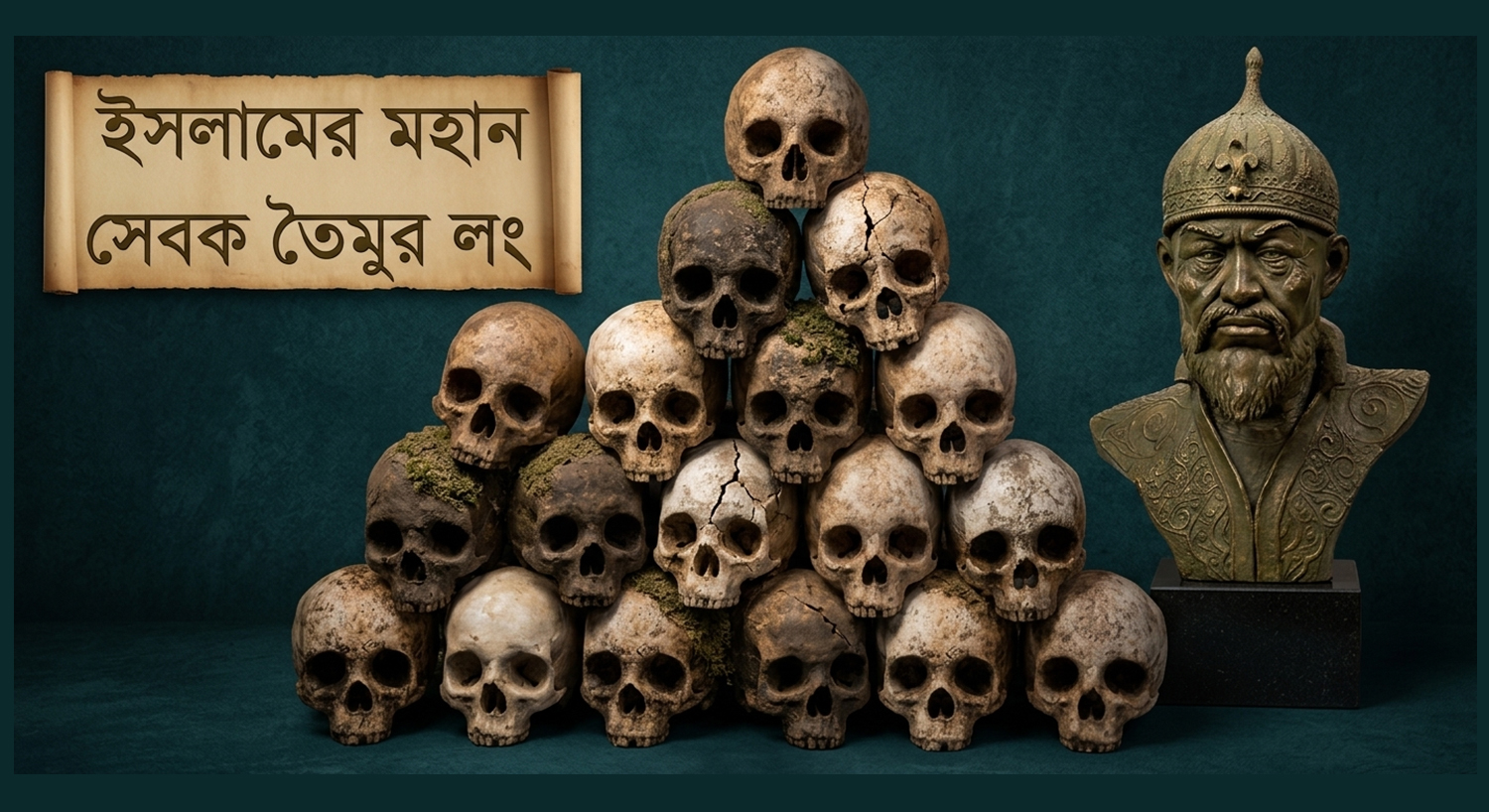
Timur Lang’s Delhi Massacre
Islam’s warrior Timur Lang killed 100,000 Hindus in Delhi in a single day
Timur Lang was a merciless Muslim military ruler from Central Asia whose path of empire-building left countless cities in ruins. During his invasion of Delhi, India, in 1398, Timur’s forces massacred nearly one hundred thousand Hindus in the Loni area in a single day. This was a calculated pre-war slaughter designed to prevent any rebellion or resistance from behind his lines. Afterwards, he first resorted to Islamic taqiyya (deception) and, to demonstrate the “magnanimity” of Islam, publicly declared “forgiveness” towards the Hindus. However, when his soldiers began widespread looting and assaults on women, the people of the city rose up in resistance. Enraged, Timur ordered a five-day organized massacre. His troops turned the entire city into a wasteland. Historical accounts describe how soldiers moved neighborhood by neighborhood, killing anyone who resisted, looting homes, and then setting them on fire. Delhi became a ghost town. In total, between 150,000 and 200,000 people were killed.
Timur’s invasion marked one of the most horrific chapters in the decline of the Delhi Sultanate. He used the contemporary Muslim sultan, Nasiruddin Mahmud Tughlaq, as a pretext. According to sources including Britannica, Timur claimed that the sultan was “excessively tolerant” towards Hindus. In his view, the Delhi sultans had failed to eradicate idolatry and were showing undue leniency to idol-worshippers. Using this excuse, he marched from Central Asia to Delhi and unleashed rivers of blood. In his own autobiographical work, the Malfuzat-i-Timuri (later compiled), he wrote that he received a “sign” from a Quranic verse to carry out the massacre. The verse was from Surah Al-Fath (48:29): “Muhammad is the Messenger of Allah, and those with him are severe against the disbelievers…”
Timur was born around 1336 in Transoxiana (near present-day Uzbekistan) as Amir Timur bin Taraghai. He belonged to the Barlas tribe, which had Turkic-Mongol origins. In his youth, he suffered severe injuries to his right leg and hand in battle. As a result, he walked with a limp for the rest of his life and came to be known as “Timur-i-Lang” or “Timur the Lame.” In Persian, this name led to his fame in Europe as “Tamerlane.” Although he claimed descent from Genghis Khan, there was no direct blood relation. To gain political legitimacy, he married a princess from Genghis Khan’s lineage and adopted the title “Gurgan” (son-in-law of Genghis).
By around 1370, Timur had gained control over the western part of the Chagatai Khanate and went on to build a vast empire. His campaigns were extraordinarily brutal. In Persia, Iraq, Syria, Anatolia, Central Asia, and India, his armies left trails of destruction. Many historians estimate that Timur’s conquests resulted in the deaths of approximately 5% of the world’s population at the time — roughly 10 to 17 million people. His soldiers built “skull towers” or pyramids of human heads in many cities. Thousands of severed heads were stacked into towering piles as symbols of terror. These acts were carried out, according to historical sources, in the name of spreading Islam and subduing the “kafirs” (infidels).
The events in Delhi were particularly horrifying. In late 1398, Timur crossed the Indus River and advanced into India. After destroying places like Tulamba and Multan, he moved towards Delhi. Before the main battle at Loni, nearly one hundred thousand captives were slaughtered. After defeating the sultan’s forces, he entered Delhi and initially promised peace. But when his troops began looting and the locals resisted, he gave orders for a general massacre. For days the killing continued. Piles of corpses filled the streets, and the city reeked of death. Many artists and craftsmen were taken captive and transported to Samarkand, dealing a severe blow to Delhi’s economy and culture. The Delhi Sultanate never fully recovered from this devastation.
Timur was not only a warrior but also a ruthless ruler. His campaigns involved the destruction of cities, mass killings, the rape of women, enslavement of children, and widespread atrocities. Yet he also acted as a patron of arts and culture in his court. He made Samarkand his capital and commissioned magnificent architecture. After his death, the Timurid Empire fragmented, but his descendants played a significant role in history. His descendant Babur defeated Ibrahim Lodi in the First Battle of Panipat in 1526 and founded the Mughal Empire in India. Babur proudly identified as a Timurid, and the Mughals long carried the “Timuri” identity.
In the modern context, controversy around Timur continues. Celebrities like Kareena Kapoor and Saif Ali Khan have named their son Taimur. To many, this monstrous mass murderer appears as a great historical hero. In certain Islamic traditions, those who commit atrocities in the name of the faith are often celebrated as heroes. Timur remains an idol for radical Islamists. Stories of his bravery, strategy, and victories still inspire many. However, from a neutral historical perspective, he was a destroyer. His campaigns claimed millions of innocent lives and pushed back civilisation.
Timur died in 1405 while on his way to invade China. He fell ill in Otrar and passed away. His body was buried in the Gur-e-Amir mausoleum in Samarkand. After his death, internal conflicts tore the empire apart. Nevertheless, the Timurid period is sometimes called the “Timurid Renaissance” due to advancements in architecture, literature, and the arts. But this progress came at the terrible cost of countless innocent lives.
Timur’s story teaches us how the lust for power can turn a man into a monster. Wars and massacres waged in the name of religion are not new phenomena. Reading his biography makes it clear that history is not only the tale of victors but also carries the cries of the defeated. Even today, when a child is named Timur, it raises uncomfortable questions: Which history are we honouring? That of a mass murderer or of those who stood for humanity? It is essential to remember these dark chapters of history so that such tragedies are not repeated in the future.
Timur’s empire expanded rapidly but proved short-lived. His strategy relied on fear and destruction. Before attacking a city, he often slaughtered prisoners to boost his soldiers’ morale and entice them with prospects of loot. After Delhi, he advanced further east but had to turn back due to problems in the west. His invasion destabilised the political landscape of the Indian subcontinent and inadvertently paved the way for the later Mughal arrival.
Modern researchers debate the cause of Timur’s death — some cite old-age illness, others malaria or other diseases. Excavation of his tomb revealed he was tall with Mongoloid features. Despite his physical disability, he rose as an extraordinary military leader. His life stands as both an example of courage and leadership and the ultimate symbol of barbarity.
These events remind us that blindness in the name of religion, ethnicity, or power is harmful to human civilisation. Figures like Timur have appeared repeatedly throughout history, bringing destruction in their wake. Therefore, it is crucial to accept historical truths and educate future generations accordingly.
Related Posts
Operation Entebbe – the story of one night, and the Islamic execution suffered by Nazrul Islam and Sweety Akter
What can a state do to save the lives of its citizens abroad? Are thereRead More
অপারেশান এন্টেবে – এক রাতের গল্প এবং নজরুল ইসলাম ও সুইটি আক্তারের ইসলামি হত্যার শিকার হওয়া!
একটি রাষ্ট্র বিদেশে তার নাগরিকদের জীবন বাঁচাতে কী করতে পারে? এর কোন টেক্সটবুক উদাহরণ আছে?Read More
A random page from Muhammad’s self‑made book Qur’an and its unscientific statements
Sometimes I flip through random pages of Muhammad’s self‑made book Qur’an, and today this pageRead More
Comments are Closed