
Ongoing Islamic Aggression
From Somnath to Joypurhat – The Shadow of a Thousand‑Year‑Old Destruction Still Exists Today
The first blow
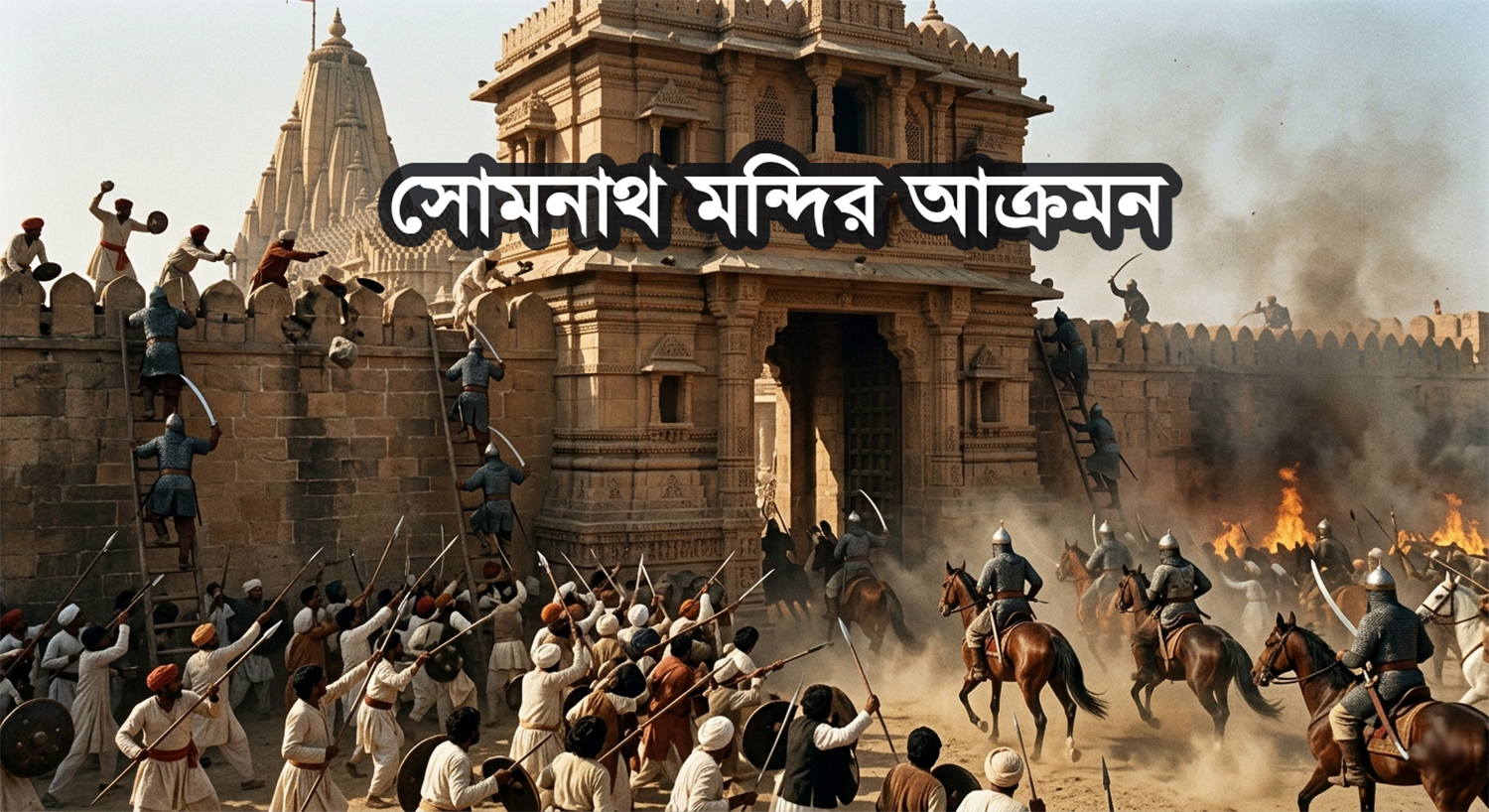
On the Saurashtra coast of Gujarat, where the waves of the Arabian Sea crash against the rocky shore, stood one of India’s most ancient and holiest Shiva temples to the people—Somnath. Legend says this temple was built many times—first with gold, later with silver and sandalwood. In actual history too, this temple was a center of immense wealth and devotion, where thousands of pilgrims came from various parts of western India.
In 1025, Mahmud of Ghazni—who had already carried out sixteen campaigns in India—set out with a huge army towards Somnath. Crossing the desert and traversing difficult paths, his forces reached the temple premises. History says local Hindus leapt to defend the temple—around five thousand people gave their lives in that resistance. But in the end, they could not save it. In January 1026, the temple fell into the hands of the sultan. The idol was broken, the temple was looted, and Sultan Mahmud took away nearly two crore gold coins along with countless treasures.
Looting behind the logic
Among historians there is a long debate about the true purpose of this campaign. Contemporary and later Persian historians presented it as a “holy war to destroy idolatry” commanded by Islam—as if it were purely a religious duty. But a large section of modern historians, such as researchers like Muhammad Habib, have shown that the main driving force behind this campaign was economic greed—the lure of Somnath’s legendary wealth. Religious rhetoric here functioned as moral justification for plunder, which at the same time inspired the soldiers and allowed the campaign to be recorded in history as a “pious deed.”
This duality is important—because it shows how religious sentiment and political-economic interests have repeatedly become intertwined in history, and how later only the religious explanation has survived in memory, while the looting has been covered up under the “glory of victory.” For centuries after the destruction of Somnath, this event has been used to construct two opposing narratives—on one side it became a symbol of “Islamic valor,” and on the other it remained in Hindu society as the memory of a deep cultural wound, which did not fade even after the temple was rebuilt multiple times.
The birth of a pattern
Somnath was not alone. Across medieval India—in Kannauj, Mathura, and later during the Delhi Sultanate and under some Mughal rulers—countless incidents of temple destruction, idol breaking, and looting are documented. However, to be fair to history, it is also necessary to remember that in this same subcontinent many Muslim rulers funded temple repairs, protected Hindu temples, and in some cases even helped rebuild them after destruction. History is never linear. But what cannot be denied is this: a specific pattern has repeatedly returned—when the victorious power destroys the most sacred symbol of the defeated, it is not just about seizing wealth; it is a deliberate blow to the defeated people’s identity and morale. Destroying temples or idols was therefore never merely “religious purification”—it was a symbolic language of power, meant to show the defeated that even their gods could not protect them.
A millennium later: same language, new faces
Today, almost a thousand years after the attack on Somnath, the same language—the language of idol-breaking—is still alive, only its form has changed. Instead of state forces, now it is carried out by scattered extremist groups or individuals; instead of royal armies, it is thugs descending under cover of night, frenzied monsters under the banner of “Tawhidi Janata.” But the structure has remained astonishingly unchanged.
In Pakistan this pattern is long-standing and well known. Since Partition, the Hindu population there has steadily declined, and a large portion of the few hundred temples that remained have been vandalized, occupied, or left abandoned. In Sindh province, temple vandalism has occurred multiple times, and human rights activists have repeatedly reported that in the decades after independence, hundreds of temples in Pakistan have either been destroyed or taken over.
This trend has not stopped in Bangladesh either—rather, in recent times it seems to be surfacing even more frequently. In 2025 alone, numerous incidents of idol vandalism took place across the country—at a Kali temple in Haluaghat, in Pabna, Sirajganj, at the Radha-Govinda temple in Elenga, on Radha-Krishna idols in Nagarkanda, on a Lakshmi idol in Sirajdikhan—the list is long. And even in June 2026, just a few days before I was writing this, news came of idols being vandalized in three temples at once in Mokamtola of Bogura. Before that, a thousand-year-old Shiva linga in Joypurhat was burned and smashed with hammers.
The same structure, on a smaller scale
There is a vast difference in scale between these two types of events—on one side, an organized military campaign by state power; on the other, a few individuals with hammers or fire in the dead of night. But the underlying logic remains the same. In both cases, it is assumed that followers of one religion have the right to destroy the symbols of another. In both cases, the message is the same—your object of worship has no security, because it is unacceptable to my belief. In both cases, for the victimized community, the incident is not just the loss of an idol—it is a message that they are not safe, that their places of worship can be attacked at any time, and that the state or society is either unable or unwilling to protect them.
When the thousand-year-old Shiva linga of Joypurhat is shattered by hammer blows, it carries the echo of Somnath’s destruction—the same arrogance, the same assumption that Islam grants the right to destroy others’ sacred objects in the name of its own belief. The only difference is this—one thousand years ago, this was done by the state’s army in broad daylight, with open celebration of glory; today it happens under cover of darkness, with hidden identities or frenzied mobs under the name of “Tawhidi Janata,” and often ends in complete impunity.
A continuity that must be broken
The history of Somnath’s destruction reminds us how old and deeply rooted the logic of destruction and seizure under religious justification is. But this pattern cannot be dismissed as mere “history,” because it is still alive today—in villages across Bangladesh, in Pakistan’s Sindh province, every year during the Puja season.
The responsibility of a civilized state is to break this continuity—to properly investigate every incident of idol vandalism, identify and punish the perpetrators, and most importantly, to make it clear that no religious sentiment can be an excuse to deprive others of their right to worship. As long as this responsibility is not fulfilled, the shadow of that thousand-year-old devastation at Somnath will continue to stretch anew over the broken Shiva linga of Joypurhat and the shattered idols of Bogura.
I have no special fascination with religious places of worship—whether temple, mosque, church, pagoda, or synagogue. They are significant mainly because of their historical, cultural, and anthropological value; so if in some distant future they are transformed into libraries or laboratories for the pursuit of knowledge for human welfare, that would be a unique advancement of human civilization—that is what I would like to see. However, in present reality, as long as their followers hold ownership of these structures and as long as they do not become a threat to human life and humanity, no party has the slightest right to destroy or damage these historical and emotional monuments.
Related Posts

অপারেশান এন্টেবে – এক রাতের গল্প এবং নজরুল ইসলাম ও সুইটি আক্তারের ইসলামি হত্যার শিকার হওয়া!
একটি রাষ্ট্র বিদেশে তার নাগরিকদের জীবন বাঁচাতে কী করতে পারে? এর কোন টেক্সটবুক উদাহরণ আছে?Read More
A random page from Muhammad’s self‑made book Qur’an and its unscientific statements
Sometimes I flip through random pages of Muhammad’s self‑made book Qur’an, and today this pageRead More
মুহাম্মদের বানানো কোরআন বই এর একটা র্যান্ডম পৃষ্ঠা ও সেখানকার অবৈজ্ঞানিক বক্তব্য
আমি মাঝে মাঝে মুহাম্মদের বানানো কোরআন বই এর র্যান্ডম পৃষ্ঠা উল্টাই, আজ এই পৃষ্ঠা হাতেRead More
Comments are Closed