
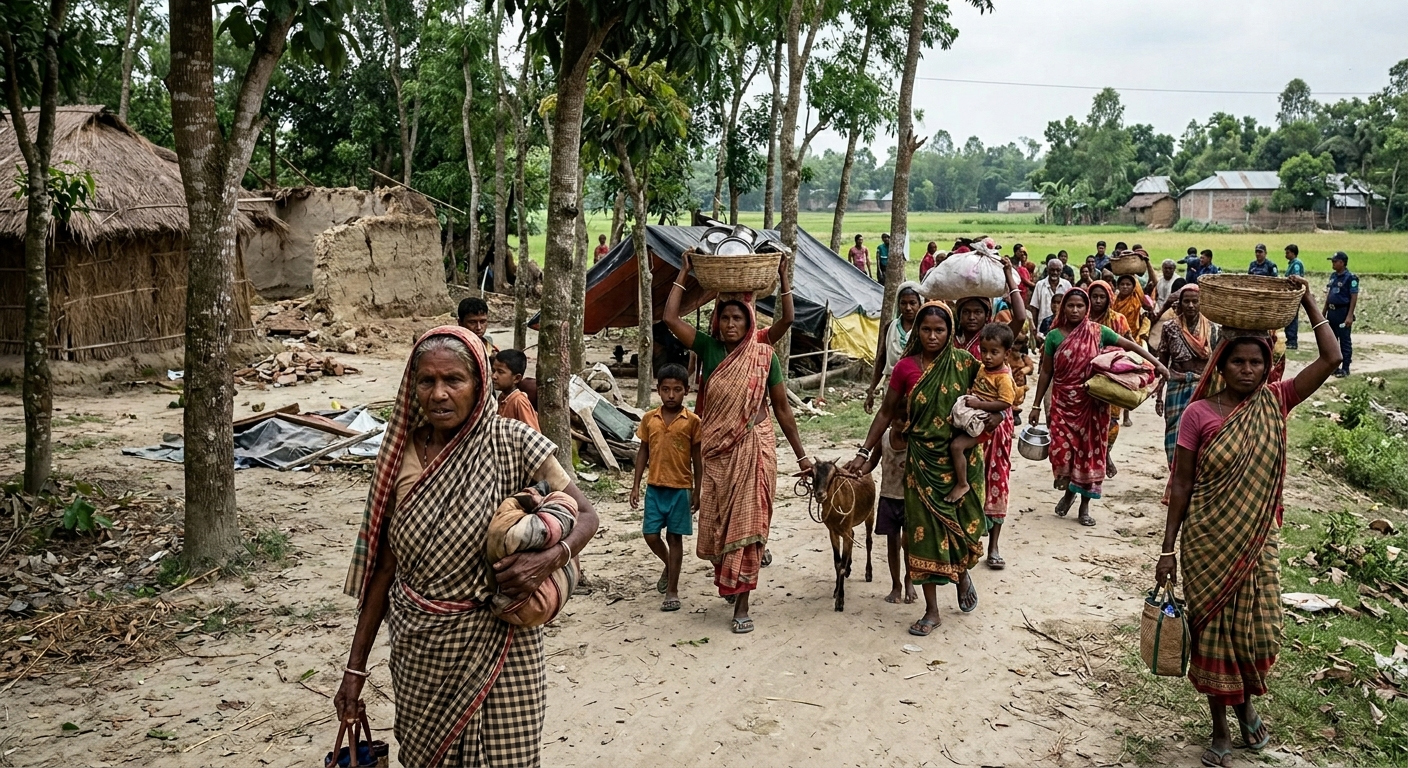
Minor indigenous groups are in distress
The Santhals of Gobindaganj want to leave the country — this is a disgrace for a state!
Human beings, or Homo sapiens, are by nature a species that loves fighting, violence, and quarrels—always eager to seize others’ hard‑earned income, land, and resources. Many in today’s world may claim to be civilized, but Americans, for instance, are descendants of Europeans who forcefully occupied the lands of the native inhabitants known as the Red Indians and subjected them to oppression. Similar patterns exist in Australia, Europe, Africa—everywhere. If we assume the average human lifespan to be 60–100 years, that period may seem long, but in the continuous evolution of civilization, 100 or even 1,000 years is nothing.
According to the “Out of Africa” theory, the first group of modern humans to arrive in the Indian subcontinent belonged—by older anthropological classifications—to the Negrito race (Negrito meaning “Negro outside Africa”). According to this theory, a small group of modern humans crossed the Red Sea from Africa about 60–80 thousand years ago, traveled through the Levant (Israel–Palestine–Syria) and the Zagros region of Iran, and entered India around 55–70 thousand years ago. Thereafter, Australoid peoples established themselves across India and South and Southeast Asia.
There is disagreement among anthropologists regarding whether the Australoids originated in India or southern China. However, there is little dispute that present‑day Indian indigenous groups—such as the Munda, Dravidian, and Indo‑European language‑speaking tribes like the Santhal (remember this name), Ho, Kharia, Mal Paharia (Munda), Chenchu, Lodha, Irula, Kota (Dravidian), Kol, Bhil (Indo‑European), and many others—are descendants of the Australoid racial stock.
Later, Dravidian language and culture became established among these peoples (though whether Dravidian language and culture originated inside India or outside remains highly debated). From roughly 3,500 years ago onward, Indo‑European‑speaking groups began entering India in waves—the Aryans first, then the Shakas, Huns, Greeks, and others. Through prolonged interaction, conflict, and synthesis with earlier Indian populations, the foundations of modern Indian peoples and culture were formed. One mysterious chapter in this process remains the Indus Valley Civilization.
The people who later migrated continuously into India from Central Asia, Iran, and Afghanistan were not anthropologically very different from the earlier Aryan and other Indo‑European speakers; the main differences lay in religion, language, and culture.
Even if we judge by the age of languages, Dravidian dominance in the Indian subcontinent becomes evident. Tamil has been recognized as one of the world’s longest‑surviving languages. While historical records trace it back to around 300 BCE, its origin is believed to be around 2500 BCE. Today, approximately 78 million people speak Tamil worldwide. It is primarily spoken in southern India and Sri Lanka. Tamil literature is more than 2,000 years old, and its written form has changed very little over time. Some believe Tamil to be 5,000 years old. Its literary corpus is vast, diverse, and well preserved.
There exists a major source for understanding the identity of the earliest inhabitants of the Indian region—and even of humans 70,000 years ago globally. The inhabitants of North Sentinel Island in the Bay of Bengal belong to such a group, remaining virtually unchanged for 70,000 years. They are believed to be the only truly uncontacted tribe in the world. While contact has been established with the Jarawa people of the Andaman Islands, all attempts to contact the Sentinelese have failed.
During British rule, a few Sentinelese children were once taken to Port Blair, but they died shortly afterward. Lacking immunity to common germs that modern humans routinely survive, they can die even from ordinary cold and cough viruses. Respecting their desire to remain isolated, the Indian government has banned entry to the island. A Christian missionary who illegally attempted to preach there was killed and reportedly eaten; they are extremely hostile. Yet their existence helps us understand human history—particularly the nature of indigenous peoples in India.
The tribes whose names I asked you to remember earlier are, in fact, the original inhabitants of the Indian subcontinent, living there for thousands of years. By that measure, all land and property in the subcontinent should rightfully belong to the Santhals and other such indigenous groups. The rest of us are migrants or hybrids of different groups—our skin color alone proves this. I mention all this because a recent issue has become widely discussed: conflicts involving the Santhals over sugarcane harvesting. Reports—both rumors and verified—of injuries and deaths are appearing in the media.
Only a few thousand members of these ancient tribes remain in India—people who should have been the rightful owners of the lands that now form India and Bangladesh. Even if we cannot give them a prosperous life, our civilization, culture, and history impose upon us a moral obligation to at least protect them, so they can live in their own way with what little they have. The Santhals are the true indigenous people of this land. Our ancestors came as outsiders and took shares in their agriculture, livestock, and resources. Though this process spans thousands of years, protecting them remains our ethical responsibility.
Why do they have no wealth? Why are they deprived of education? Why must they be oppressed and persecuted? Why must they abandon their birthplace just to survive?
After the attack on November 6, 2016, in Gobindaganj, Gaibandha, Santhal families began considering migration to India due to demands for justice and extreme insecurity. They rejected government relief as protest and demanded guarantees for returning to their ancestral homes and punishment of the attackers. They accused local administration and influential groups of forcing them into exile. Such allegations by members of a tiny ethnic group are deeply shameful for a state. The news headline “Santhals in Gobindaganj want to leave the country” (Bonik Barta) is enough to shake the foundation of any nation.
In the hill regions, small ethnic groups who have lived there for centuries are gradually declining. Bengali settlers, due to uncontrolled population growth, are rapidly becoming the majority. Indigenous peoples who lived in close harmony with nature and biodiversity for centuries are now being pushed into corners. This is not a good sign for any country.
Recently, reports have emerged of mosques, madrasas, and militant training camps being established in remote hill areas. If everything continues to be taken over in the name of religion and others are forced to convert, this will be a curse—not only for a nation, but for humanity itself.
Homo sapiens exterminated other contemporary human species such as Homo neanderthalensis, Homo erectus, and others. Eventually, to ensure survival, humans formed social contracts and moved toward civilization. Yet today, in the name of religion, nationality, and ethnicity, different groups continue the same practices of domination. Humanity has advanced in science, knowledge, and economics—but humans have failed to shed the primitive, animalistic genetic traits buried deep within. Examples of this are everywhere.
Related Posts
Spending the night in Umm Hani’s house and then meeting Allah in the heavens – he named it Mi’raj
Mi’raj is a central event in Islamic belief. On the night of Mi’raj, the ProphetRead More
উম্মে হানির ঘরে রাত কাটিয়ে মহাকাশে আল্লার সঙ্গে সাক্ষাত – নাম দিয়েছেন মিরাজ
মিরাজ ইসলামি বিশ্বাসের একটি কেন্দ্রীয় ঘটনা। মিরাজের রাতে নবী মুহাম্মদকে পাওয়া যাচ্ছিল না। সাহাবীরা চিন্তায়Read More

The 72 full‑breasted, personality‑less houris of Paradise vs. the personality‑rich cherished women of the world! What do you want?
It is said that in Paradise a believing servant will receive 72 exquisitely beautiful houris;Read More
Comments are Closed