
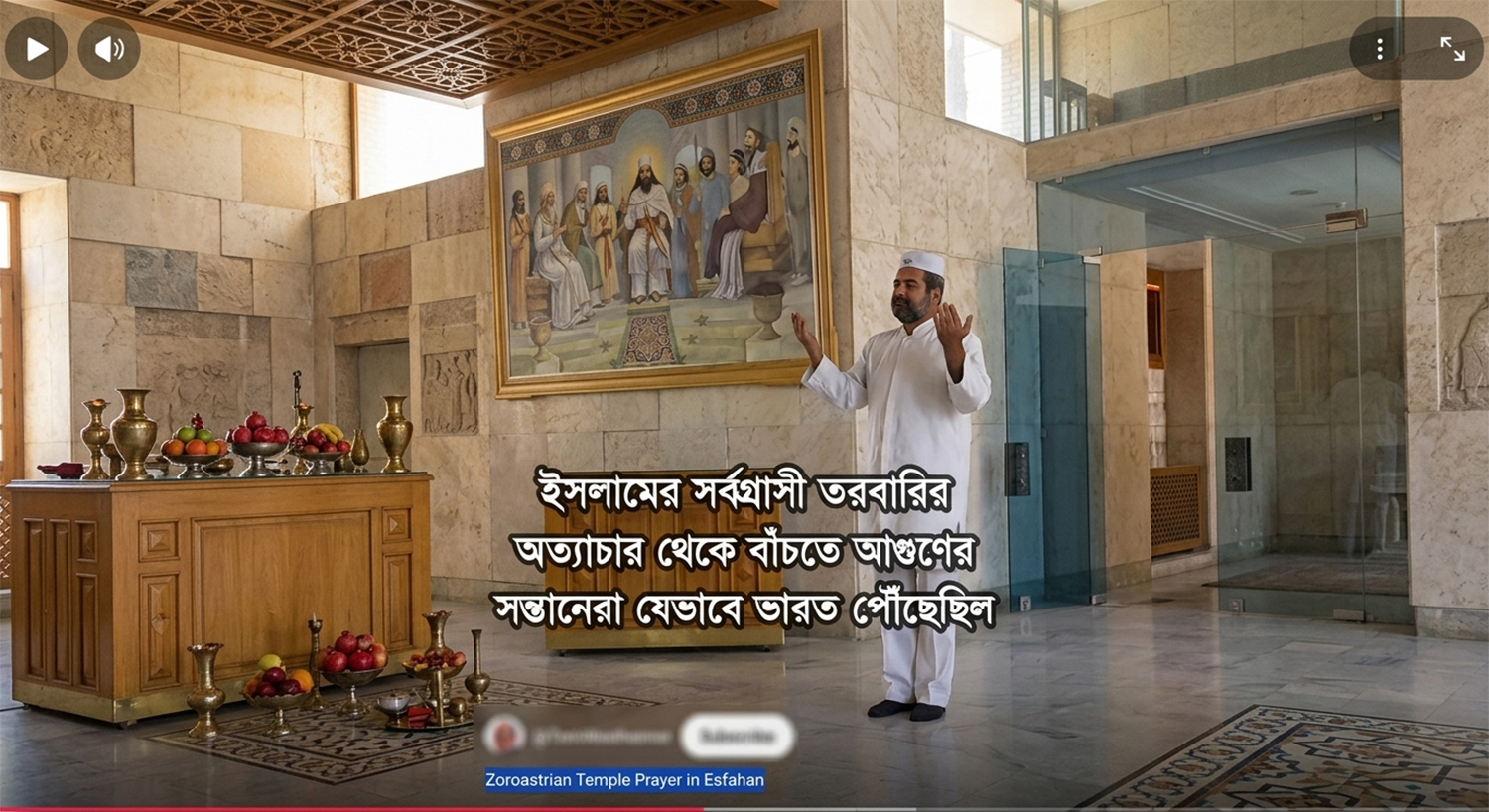
The Aggression of Islam
How the Children of Fire Reached India While Fleeing the All‑Consuming Sword of Islamic Oppression
When the sea was roaring in the darkness of night, several ships dropped anchor near the port of Sanjan in Gujarat. From inside the ships came down hundreds of people—emaciated, exhausted, with fear in their eyes and an indomitable resolve in their hearts. They had come from distant Persia, leaving behind burnt fire temples, murdered loved ones, and a homeland forcibly taken away.
News reached the court of the local king, Jadi Rana. According to legend, instead of welcoming them, the king sent them a pot of milk filled to the brim—the message was clear, there is no more space in our kingdom. But the leaders of the Parsi group were not disheartened. They mixed a spoonful of sugar into that pot and sent it back. The message was poetic yet firm—we will not cause the milk to overflow, we will only make it sweeter.
After this incident, Jadi Rana granted them permission to stay, but on one condition—they had to learn the Gujarati language and wear local clothing. The refugees gladly agreed. From that day began a new chapter of the Parsis on the soil of India.
The fall of Persia under the sword of Islamic aggression – how this journey began
In 652 CE, the Arab Muslim army defeated the Sasanian Empire. The Sasanian Empire was the bearer of Persia’s glorious civilization—an empire that nurtured Zoroastrianism as the state religion, whose banner carried the undying flame of Ahura Mazda.
After the fall began the politics of pressure. During the Umayyad and Abbasid rule, jizya tax was imposed on Zoroastrians, attempts were made to forcibly convert them, and fire temples were destroyed. The lives of those who refused to accept Islam became unbearable. Many took refuge in the mountains and began secretly preserving the sacred fire. But the repression kept intensifying.
After taking shelter for some time on the island of Hormuz in the Persian Gulf, a group of Parsis set out for India by sea. The first group consisted of an estimated eighteen thousand people. They carried with them their sacred fire—Iranshah—which, to them, was the living presence of God.
Upon reaching Sanjan in Gujarat, these refugees received asylum from the Hindu king Jadi Rana. There they established a fire temple and began a new life. Since they had come from Persia, the people of India called them “Parsi”—from “Pars,” the land of Persia. From then on, 17 November has been observed as “Sanjan Day,” the day on which the Parsis are believed to have arrived in India.
Sugar dissolves into milk – the rise of the Parsis in India
On Indian soil they did not merely survive; they put down deep roots. When the doors of trade opened during the British era, the Parsis advanced rapidly. Their entrepreneurial spirit, honesty, and interest in education set them apart.
From Jamsetji Tata to Ratan Tata—the largest industrial empire in India still carries that Parsi legacy. Artists, scientists, lawyers, writers—the contribution of Parsis in every layer of Indian civilization is extraordinary. Small in number, but immense in influence.
Islam copied many things from Zoroastrian doctrine …
Here lies the most fascinating thread of history. From the very religion whose persecution the Parsis fled, within that Islam itself are hidden deep shadows of Zoroastrianism. The Prophet Muhammad copied and pasted many elements from this religious ideology into Islam under the name of Allah.
Namaz and Gah – the mystery of the five times
The similarities between Islamic namaz and the Zoroastrian “gah” or “namaz” are astonishing. The original Middle Persian word “namaz” means “worship at a fixed time”—it is also connected to the Sanskrit “namas.” In both religions there are five daily prayers, and the times are determined according to the movement of the sun. In both religions there are rules of attaining purity before prayer. The movements of prayer, wearing a cap, placing hands on the chest, sermon (khutba), supplication (munajat)—almost everything matches exactly. Those who do not know about the Zoroastrians, if shown this, would think it is Muslims praying. You will find many videos on YouTube; you can see for yourself.
Mi’raj and Arda Viraf – two stories of heavenly journeys
Arda Viraf Namag was a Zoroastrian religious text from the Sasanian era, originally written in Middle Persian. It narrates the story of the afterlife dream-journey of the virtuous priest Arda Viraf. The book is divided into five chapters—introduction, journey to heaven, paradise, hell, and conclusion.
There are extremely striking similarities, down to very fine details, between the Islamic story of Mi’raj and the Zoroastrian afterlife journey of Arda Viraf. In both stories, a virtuous person travels through heaven and hell, witnessing the rewards of the righteous and the punishments of the sinners.
Many say that the Prophet Muhammad already knew this story of Arda Viraf. After spending the night at the house of his childhood crush and cousin Umm Hani in the absence of her husband, and then being caught by the companions in the morning, he concocted this story.
Monotheism, heaven-hell and the triangle of morality
Zoroastrianism is one of the oldest monotheistic beliefs in the world. Ahura Mazda is the supreme God; the eternal struggle between good and evil, the concept of heaven and hell, the reckoning on the Day of Judgment—these ideas exist in Islam as well as in the three Abrahamic religions. Many researchers believe that these concepts entered the Semitic religions through Persia.
The word “ferdous” (paradise) originally comes from the Persian “pairi-daeza,” meaning a walled garden. That same word became “Paradise” in English. Many elements of Islam are borrowed from this Zoroastrian tradition.
The fire has not gone out
The very Parsis who crossed the sea clutching the sacred fire to their chests in the face of Islamic aggression— that fire still burns in the fire temples of India today. In the 2011 Indian census, the Parsi population was only 57,264—significantly down from 69,001 in 2001. This community, shrinking in number almost to the point of extinction, still has an undimmed story.
When a people abandon everything and set out upon an unknown sea to save their faith, and when a country receives those refugees and blends them into itself like sweet sugar—that is the most beautiful story of human civilization. The mixing of sugar into Jadi Rana’s pot of milk was not just a diplomatic move—it was a pledge that has, for centuries upon centuries, helped define the pluralistic character of India.
Related Posts

Operation Entebbe – the story of one night, and the Islamic execution suffered by Nazrul Islam and Sweety Akter
What can a state do to save the lives of its citizens abroad? Are thereRead More
অপারেশান এন্টেবে – এক রাতের গল্প এবং নজরুল ইসলাম ও সুইটি আক্তারের ইসলামি হত্যার শিকার হওয়া!
একটি রাষ্ট্র বিদেশে তার নাগরিকদের জীবন বাঁচাতে কী করতে পারে? এর কোন টেক্সটবুক উদাহরণ আছে?Read More
A random page from Muhammad’s self‑made book Qur’an and its unscientific statements
Sometimes I flip through random pages of Muhammad’s self‑made book Qur’an, and today this pageRead More
Comments are Closed