
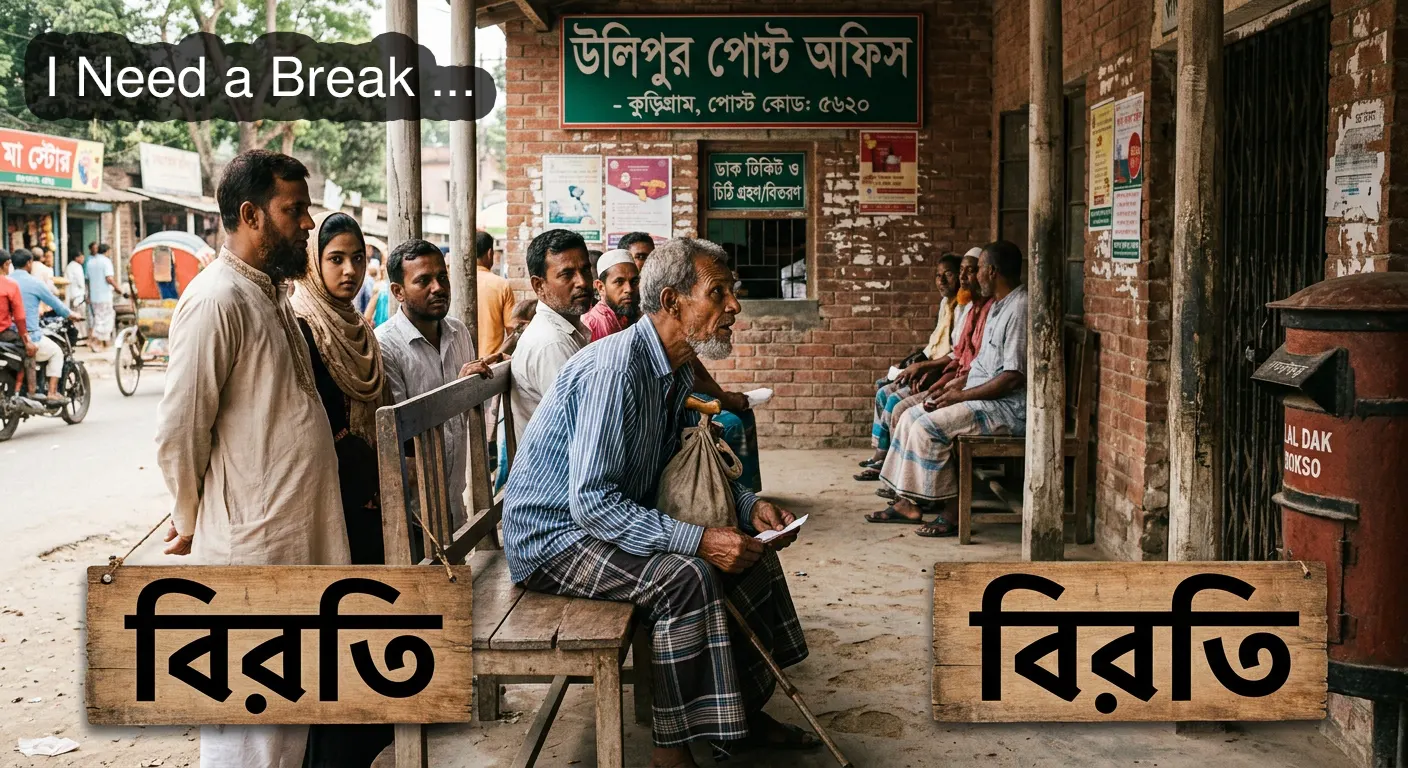
Story - I Need a Break
A Break
1
When the morning sun falls on the tin roof of the Ulipur post office, the place slowly wakes up. The red letter box hanging in the corner of the veranda is now almost rust-peanut colored. In front of it, every day at ten in the morning, a man comes and stands. Age sixty-two–sixty-three, silver streaks in his hair, a washed but old floral shirt on his body. People in the area call him Mad Sabuj. He hears this name and pretends not to.
Postman Rahim Mia shakes his head as soon as he sees him. Before he speaks, Sabuj understands.
“Still not today, Sabuj bhai.”
“Alright,” Sabuj smiles. “Maybe it will come tomorrow.”
He has been nurturing this word “tomorrow” inside his chest for thirty-five years.
2
It was the year 1991. Sabuj was then twenty-seven, teaching at a small school. At the end of the day he returned along the dust-covered road, and lived for one day of the week. On that day a letter came from Zakiganj.
Blue envelope, bold letters, on top written “Dear Sabujda”.
He had never seen Tanu. Yet he knew her handwriting better than the lines of his own hand. In which letter she wrote about the rain, in which about the evening across the Surma river, in which only this much: “Today I have nothing to write, I just wanted to let you know that I am well, and I want to know how you are.”
For five years, one letter every week. In a relationship bound by such routine even storms are afraid to enter.
Then one day Tanu wrote, “We need to meet once. I no longer wish to remain only a person of letters.”
That day Sabuj did not write any reply. He sat by the window all night.
A few days later a big envelope came by post. Inside was a photograph. On the backdrop of some studio curtain, a forest of kans grass was painted, above a blue sky, and under that artificial sky stood a young woman in a white sari. Someone might have thought, the background is fake. Sabuj felt, even under a fake sky a person can be so true, as if some princess floating away on a raft of clouds paused for a moment and looked at him.
On the back of the photo was written: “Waiting for your picture.”
Sabuj looked at the photo for a long time. Then he went and stood in front of the mirror.
In the mirror there was an ordinary face, a slightly wider forehead, tiredness in the eyes. He remembered his college days. The girls in class giggling quietly, one of them throwing a remark, “Don’t you ever look at yourself in the mirror?” Those words had been buried under the soil all these years. Today they returned.
He wondered, if Tanu saw this face would she still find the Sabuj of the letters? Would the palace built over five years collapse under the weight of a single photograph?
Days passed. Weeks passed. Tanu’s urging came again, and then again. Sabuj wrote, “I’ll send it, give me a little time.” Finally Tanu’s last offended letter arrived: “Do you not trust me?”
His chest trembled reading that letter. He did trust Tanu. In truth, he was afraid of himself.
The next day he went to Rangpur town and had his photo taken at a studio. The photographer said, “Smile a little.” He could not smile. The smile that came out was the pleading smile of a frightened man.
The photo went by post.
3
After that Tanu wrote a couple of letters. Short letters, polite letters, from which the warmth inside seemed to have been carefully removed. Sabuj read them again and again, searching between every word for some meaning, some hint.
Then silence.
Sabuj kept writing. Every week, just like before. He asked whether it was raining in Tanu’s town, whether the river’s water had risen, how her health was. No reply came. His letters went into some dark abyss, no one knows where.
At last one day he wrote: “I am coming to Zakiganj. To your address.”
This time a reply came, quickly, short.
“Sabujda, I am tired of writing. I want a little break in our relationship. Please don’t come.”
This was the last letter.
Sabuj read it once. Then folded it and put it in his breast pocket. That night he did not cry, nor did he get angry. He only made a silent pact with himself.
The next day he wrote, “Alright. I will wait for your break to end.”
There was no reply to that letter.
4
Years passed. The earthen roads of Ulipur were paved with asphalt. A TV shop came to the market, then a mobile tower. Boys and girls began to spin the world on their fingertips. Sabuj’s students grew up, got jobs and went to Dhaka, went abroad, some came back and saw that sir still stands at the post office.
“Sir, now there are phone numbers, there’s Facebook. With a little search…”
Sabuj smiles gently. “She asked for a break. To go searching without asking would be an insult to what she asked for.”
The students did not understand. In this era no one waits for someone like this.
People said, the man’s head is not right. The old man in the shop next door said, “He spent thirty-two years in love with five years of letters, is that normal?”
Sabuj listened. He said nothing.
He knew, whatever people do not understand, they call madness. But waiting has a taste too, which only the one who has housed it inside knows. Every morning when he steps onto the veranda of the post office, the slight tremor that rises in his chest, What if it has come today!, that tremor is his last thread of life. What remains if that snaps?
5
Now it is autumn. The sky is blue, and along the riverbanks kans flowers have bloomed.
On his way to the post office in the morning, Sabuj stopped. On the riverbank, rows of white flowers swayed in the breeze. He had not come this way in so long, because whenever he saw kans flowers he remembered a studio curtain, and the face of a young woman standing in front of that curtain.
Today he stopped. He kept looking for a long time.
He said in his mind, Tanu, do you know kans flowers still bloom? Just as you stood in the photo, they stand like that.
Then slowly he walked towards the post office.
Rahim Mia retired long ago. The boy who delivers the mail now is new, modern, with a smartphone in his hand. He looked at Sabuj with a little irritation, a little pity, and said, “Uncle, you came again today?”
“Again today,” said Sabuj. “Any letter?”
The boy flipped through the bundle of letters. Electricity bills, bank notices, some government forms. No blue envelope.
“No, uncle.”
“Alright,” said Sabuj, smiling just the same. “Maybe it will come tomorrow.”
He turned back. As he stepped down from the veranda of the post office, he put his hand in the breast pocket of his shirt. There was a folded, yellowed piece of paper, its ink faded, its folds on the verge of tearing. He has carried it with him every day for thirty-two years.
“I want a little break in our relationship.”
A little break. He has been living holding on to these two words. Whether it really was “little”, or whether it was a soft lie of politeness, he has wondered many times. He has not had the courage to know the answer. Because once he knows the answer, the waiting ends, and without waiting, who is he?
Maybe Tanu got married long ago. Maybe she has grandchildren. Maybe she has never thought that in a post office in Ulipur a man has taken her small sentence as a vow of life. Maybe she is not even alive.
Sabuj does not want to think of any of these “maybes”. To him Tanu is still nineteen, still standing in a forest of kans flowers, still floating away on some raft of clouds.
In the evening he returned home, took a sheet of paper and a pen. He wrote:
Dear Tanu,
Today the autumn sky is very blue. Kans has bloomed by the river. I hope you are well. I am well. Just wanted to let you know.
Yours, Sabuj.
He put it in an envelope and wrote the address, Zakiganj, Sylhet. He affixed a stamp.
This letter he will not drop in the mailbox. In his table drawer are arranged thousands of such letters, from every week of thirty-two years, every season, every silent evening. They could not be sent, because she had said “Please don’t come”, and Sabuj has never disobeyed her words.
Closing the drawer, he sat by the window. Evening was falling outside. Somewhere in the distance someone started singing, the tune of a bhatiali floated in on the wind.
Tomorrow morning will come again. On the veranda of the post office a man will stand again, with that small tremor in his chest.
What if it has come today!
Even if no one else knows, if that girl standing in the kans field exists somewhere, she might, on some autumn afternoon, pause for no reason. She might feel an unfamiliar pull in her chest, as if from far away someone is calling her name, silently, endlessly.
But she does not know the address of that call.
And Sabuj? He knows, some loves are not meant to be completed. Some loves are most complete only within waiting.
Tomorrow again dawn will break on the veranda of the post office.
Related Posts
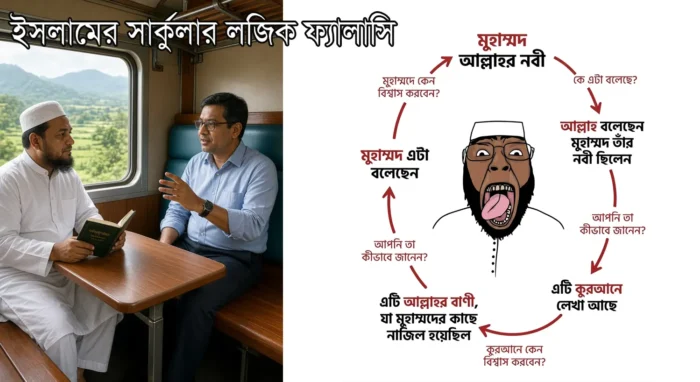
Islam’s Circular‑Logic Fallacy
Place: Cabin of a Dhaka–Sylhet-bound trainCharacters: Maulana Abdur Rahman (a responsible member of Tabligh Jamaat)Read More
ইসলামের সার্কুলার লজিক ফ্যালাসি
স্থান: ঢাকা থেকে সিলেটগামী ট্রেনের কেবিনচরিত্র: মাওলানা আব্দুর রহমান (তাবলিগ জামাতের একজন দায়িত্বশীল) ও অধ্যাপকRead More
Comments are Closed