
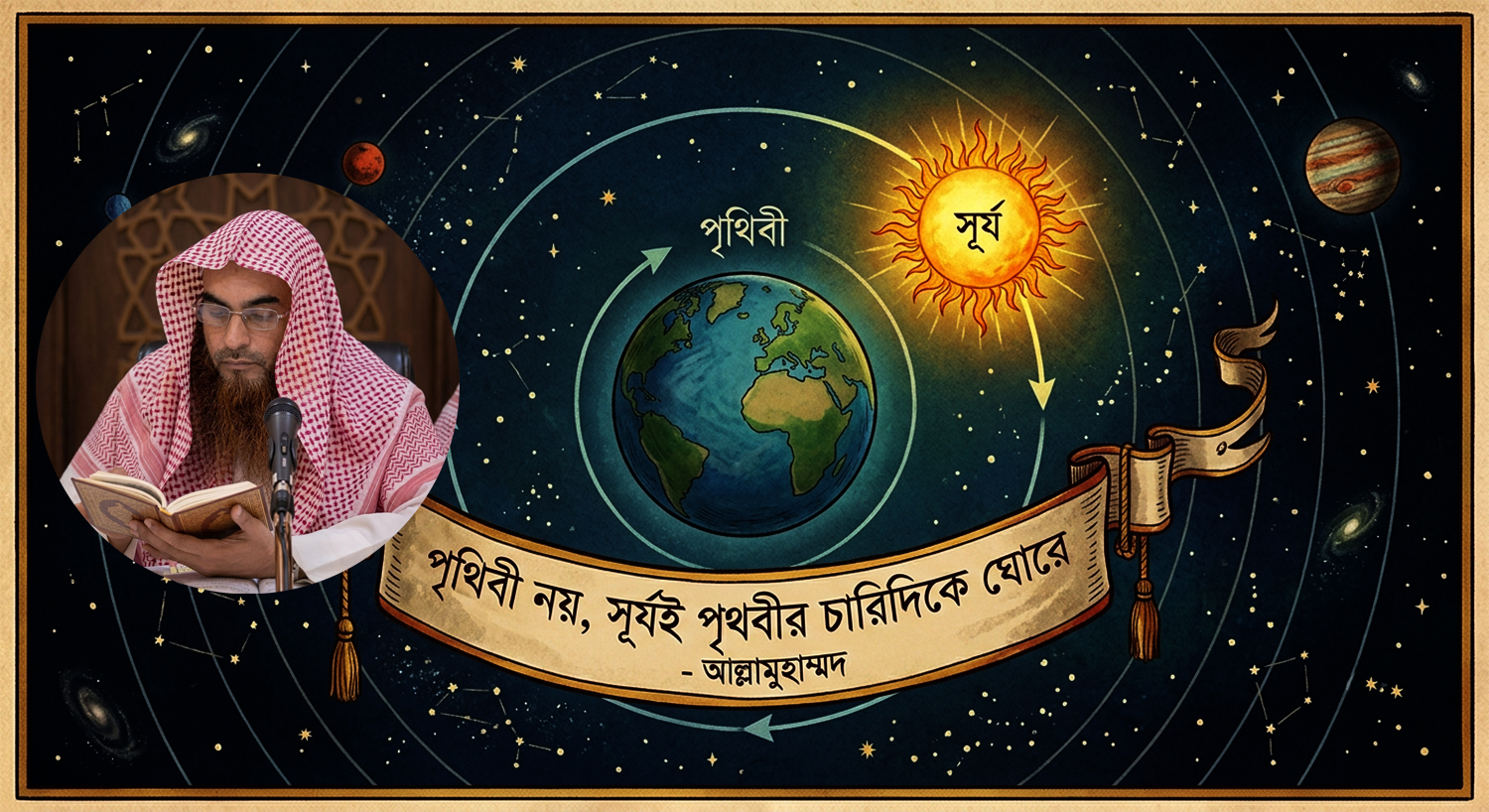
Scientific Errors of Islam
According to Islamic sources, many Islamic preachers still continue to preach that it is not the earth, but the sun that moves!
After I learned to read, I used to see that there was a book in my father’s family library – “The Earth Does Not Move, The Sun Does” written by one Nurul Islam BSc. He wanted to prove the rationality of Islam’s claims by proving that it is not the earth, rather the sun itself that moves around the earth. His home was in Chittagong, and there were some descriptions of his own knowledge in the book. If you have faith in a bizarre thing called Islamic Science, then you too must accept this, there is no way out.
“The earth moves around the sun” – this information is today one of the most fundamental, well-established and tested truths of science. It is in the first-grade school textbooks. Satellite technology, GPS, space missions – everything stands upon this truth. On the other hand, almost all interpreters of the Qur’an up to a certain time used to say that it is the sun that moves around the earth, and even now, in this very era, a significant portion of Islamic scholars in various parts of the world directly deny this scientific truth, some even openly. For example, see in this video https://youtu.be/qIkuo7ZcP1s the famous scholar Mr. Matiur Rahman Madani is making the same claim – that it is the sun that moves around the earth. Watch the video, otherwise you might again claim that we are lying. He is simply saying what the Qur’an and Hadith have taught him.
There is no unique knowledge in the Qur’an beyond what was known to the Arabs of the seventh century – rather it is merely a compilation of some ancient Greek philosophy, prevailing myths, Zoroastrianism, Judaism and Christianity. To reconcile it with modern scientific discoveries (such as the heliocentric model or evolution), apologists constantly change the tone of Qur’anic interpretation. They point out that mainstream traditional scholars still propagate a geocentric doctrine based on the literal meaning of the text, that the sun moves around the earth. The presence of these cosmological claims in Islam – that the sun moves around the earth and that the earth was created before the universe – which contradict modern science, refutes the claim that Allah, Muhammad and the Qur’an are divinely perfect; because if there is even a single objective error or inconsistency in any text that claims to be divine, then its entire claim to divinity logically becomes false, and even if other statements in it are correct, they no longer hold up.
The scientific truth
Copernicus in the sixteenth century proposed the heliocentric model. Galileo proved it through observations with a telescope. Kepler gave the laws of planetary orbits. Newton explained the whole picture with the theory of gravitation. Einstein’s theory of relativity refined it even more subtly.
Today we know:
The earth completes one revolution around the sun in about 365.25 days. Because of this revolution, the seasons change. At the same time, the earth rotates once on its own axis in about 23 hours 56 minutes – this rotation causes day and night.
The sun does not move around the earth. Relative to the earth, the sun is almost stationary. In reality, the sun itself moves around the center of the Milky Way galaxy, but that takes about 250 million years for one orbit, and it has no relation to the earth’s day and night.
These facts are no longer “theories” – they are measured, verified, and used in technology as truths.
What is actually in the Qur’an?
The verses that repeatedly come to the center of the debate need to be looked at neutrally.
Surah Al-Anbiya, verse 33: “He is the One who created the night and the day and the sun and the moon. All of them float in an orbit.”
In the Qur’an, “all of them” is meant to refer to the sun and the moon. But in reality, day and night do not occur because the sun and the moon move in their orbits. If, for the sake of argument, we accept that “all of them” also includes the earth, even then day and night are not possible because of the earth’s movement in its orbit. Day and night occur when the earth, like a ball, rotates on its own axis. The earth’s movement in its orbit causes the change of seasons. The verse would have been scientifically accurate if it were like this:
“He created the sun and the moon. They move in their own orbits. Not only that, the earth also moves in its own orbit. But even then you would not have day and night if Allah did not make the earth rotate on its own axis. Surely Allah is great and full of science.”
Surah Ya-Sin, verses 38–40: “The sun runs on to its appointed resting place; that is the decree of the Almighty, the All-Knowing. And for the moon We have determined phases… It is not for the sun to overtake the moon, nor does the night outstrip the day; each floats in an orbit.”
Surah Ibrahim, verse 33: “He has subjected the sun and the moon to serve you, both constantly moving along their courses. And He has subjected the night and the day to serve you.”
The sun does not revolve, obediently, for us to have day and night. Even if the sun did not move, day and night would still occur. Rather, the earth is obediently rotating so that we have day and night. To the universe, humans are nothing; even if all humans were destroyed, nothing would happen to the earth, the sun, or the universe, there would be no harm. For day and night to occur – either the sun has to move around the earth, or the earth has to rotate on its own axis. Then day and night are possible. Whenever the Qur’an mentions day and night, it says that the sun and the moon all move in their orbits. But nowhere does it say that the earth rotates.
Surah Ya-Sin, verse 33: “The sun cannot overtake the moon, nor can the night precede the day. Each glides in its own orbit.”
The Qur’an is trying to convey that day is due to the sun and night is due to the moon – this is what can be understood from this verse, right? If the sun could overtake the moon, then day would also overtake night. Day and night would merge together.
Surah Al-Baqarah, verse 258: “Allah causes the sun to rise from the east. So you cause it to rise from the west if you can.”
In this verse, the rising of the sun from the east provides clear evidence that the sun revolves over the earth.
Surah Al-Kahf, verse 86: “Until, when he reached the setting place of the sun, he found it setting in a spring of murky water…”
Not only the Qur’an, but the authentic Hadith also contains similar descriptions –
Sahih Muslim (Islamic Foundation), Hadith number 296: “…The sun continues to travel and goes to its resting place beneath the Throne (‘Arsh) of Allah. There it falls down in prostration. Then when it is said to it, ‘Rise and return to where you came from!’ it returns and rises from its appointed place of rising. It again continues to travel and goes to its resting place beneath the Throne. There it falls down in prostration. Then when it is said to it, ‘Rise and return to where you came from!’ it returns and rises again from its appointed place of rising …”
There are many more such verses of the Qur’an and Hadith. From reading these verses and Hadith, several things become clear:
- First, nowhere does the Qur’an directly say “The sun moves around the earth.” This statement, in its literal wording, is not in the Qur’an.
- Second, the Qur’an describes both the sun and the moon as moving in orbits. There is no mention of the earth rotating on its own axis.
- Third, in the context of day and night, the movement of the sun and the moon is mentioned – the rotation of the earth is not mentioned.
- Fourth, it is said that Allah causes the sun and the moon to rise and set for the benefit of humans and the earth; this is His mercy for humans.
Now the question is whether these verses are written from the perspective of the people of seventh-century Arabia (that is, a description of what people see), or whether they are scientific claims.
The word falak (Falak/فلك) that appears in Qur’an 21:33 and 36:40 is borrowed from ancient Greek concepts. Arab traders used to travel for trade to regions like Syria or Yemen. The region of Syria was once part of the Byzantine (Eastern Roman) Empire, where there was some influence of Greek culture. From there, many Greek ideas came into Arabia. Ancient Greek astronomy was primarily geocentric. That is, they believed that the earth was stationary at the center of the universe and that the sun, moon, and all other planets and stars revolved around it. The Greek astronomer Claudius Ptolemy established this idea in his famous work Almagest (this name was given in the Arabic translation). In Greek, the concept used to describe the heavenly circular paths or spheres centered on the earth was later expressed in Arabic by the word ‘falak’ (فلك). Its plural is ‘aflak’ (أفلاك).
The evolution of Qur’anic interpretation and the “sun moves” doctrine
Until the time of Copernicus, almost all Islamic mufassirun (Qur’an commentators) assumed that the sun moves around the earth. This was the prevailing scientific belief of that time – not only of Islam, but of all humankind.
The problem began when science proved that it is the earth that moves. Then two paths were open:
The first path: To acknowledge that the Qur’anic verses were written in the language of the experiences of seventh-century people, not as scientific claims.
The second path: To reject scientific discoveries and cling to the literal interpretation of the Qur’an.
One group chose the first path. Another group remained on the second path.
Even today, many conservative scholars in Saudi Arabia, Pakistan, and other countries, citing specific verses of the Qur’an and Hadith, claim that it is the sun that moves around the earth. The former Grand Mufti of Saudi Arabia, Sheikh Abdul Aziz bin Baz, issued a famous fatwa in 1966 in which he denied the motion of the earth. Later, in 1985, when Saudi astronaut Sultan bin Salman went to space, he softened this position, but did not formally withdraw it.
This incident is particularly noteworthy – when a Muslim himself saw the earth rotating from space, a religious doctrine itself had to retreat.
The trap of “Islamic Science”
From the late twentieth century, a new trend has emerged which many call “Ijaz al-Ilmi” or “scientific miracles.” According to this view, all modern scientific discoveries are already mentioned in the Qur’an – one only needs to interpret it correctly to understand them.
The problem with this method is that it essentially works backwards. Science first discovers something, then a Qur’anic verse is sought and matched with it. If science later changes that theory, the interpretation also changes.
One example: at one time it was claimed that the “Big Bang” is mentioned in the Qur’an. Now it is being claimed that evolution is mentioned in the Qur’an. Fifty years ago, the scholars who used Qur’anic evidence to support the sun’s rotation around the earth were the same ones who claimed that the Qur’an is scientific.
The Qur’an’s claim and the standard of reasoning
If any text claims to be divine, then the presence of clear scientific errors or inconsistencies in that text weakens that claim – this is a logically consistent position.
There is no mention in the Qur’an of the earth rotating on its own axis. In the explanation of day and night, the movement of the sun is mentioned. In the order of creation, it is said that the earth was created before the heavens, which is contrary to modern cosmology.
The problem arises when religious institutions or preachers themselves begin to claim that the Qur’an makes scientific statements. If it is said that “The Qur’an is scientific,” then the door is opened for testing it by the standards of science.
Those who have taken a different path
Within Islam, those who accept science and still practice religion are not few in number. Many Muslim scientists, philosophers and theologians, whom Islamists claim as Muslim scientists, have said:
The language of the Qur’an was the language understandable to the people of seventh-century Arabia. To those people, it visually appeared that the sun was moving. This is a description from that perspective, not a scientific claim.
This argument is honest and logically consistent – if it is truly believed that the Qur’an is not a book of science.
Related Posts

Humans cannot even see 1% of the beauty and colors of Earth and the universe! Are humans really the best of creation?
The human eye can generally detect visible light or color in the wavelength range ofRead More
পৃথিবী ও মহাবিশ্বের সুন্দর জিনিসের ১% সৌন্দর্যের রঙও মানুষ দেখতে পায় না! মানুষ কি সৃষ্টির সেরা?
মানুষের চোখ সাধারণত ৩৮০ থেকে ৭৪০ ন্যানোমিটার (nm) তরঙ্গদৈর্ঘ্যের (wavelength) দৃশ্যমান আলো বা রঙের রেঞ্জRead More

Why does Allah show such preference for women with large breasts and large buttocks? Do men feel the same way? Does this give women any advantage?
If you leave Prophet Muhammad in Pattaya’s Walking Street and Beach Road after evening, inRead More
Comments are Closed