
Story
Everything is a Gift from Allah …
The day of bride-seeing in a Bengali household is like an unwritten stage play—where every line of dialogue, every gesture, is predetermined, yet each time that old play is performed anew. From dawn there is a festive bustle in the yard; inside the house the women are busy arranging trays of sweets, dropping ice chips into glasses of sherbet, and the elders are busy whispering among themselves, scrutinizing the groom’s family background, religious practice, and social status. The bride is adorned as if she were a living idol—her own wishes seem less important there than the family’s honor and society’s gaze.
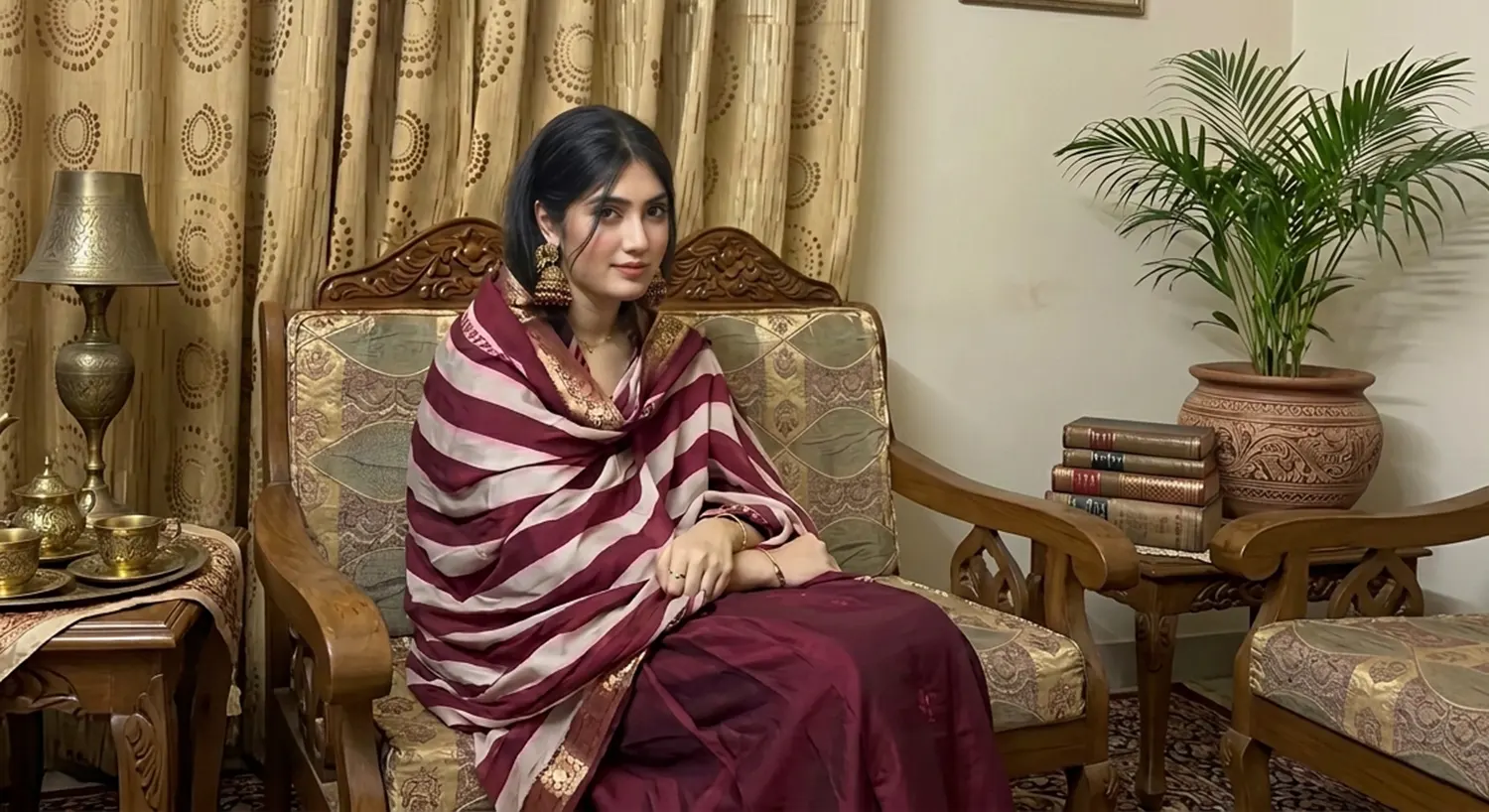
A shiny red car came and stopped in the yard, kicking up the loose dust of the road. According to the age-old social ritual of bride-seeing, Ankita was dressed today in a maroon sari, a carefully placed scarf over her head, no bindi on her forehead, and only a light touch of henna on her hands. After the groom’s side arrived, the exchange of greetings, the serving of sherbet and sweets, the elders’ pleasantries in the sitting room, Ankita’s entry into the room with bowed face and tray in hand, and upon request a short supplication or recitation of a Qur’anic verse—all the stages ended as usual in a noisy yet awkward formality mixed with stiffness.
The groom’s party took their leave. Seeing the layer of the village’s dirt settled on the groom’s shiny car, the younger brother exclaimed—
Little brother: Apa, what a car the groom has! It was shiny like a mirror, yet look, in the village dust the poor car has turned completely gray. It feels as if a black coating has wrapped itself around it.
Ankita: (smiling faintly, but with a strange depth in her eyes) A car can be washed, you know; a little water and cloth is enough. But once dust settles on the mind, wiping that off is a much harder task. Come on, let’s go inside, it’s getting late.
The next morning, three hours after dawn broke, a sudden “ting” message tone rang on Ankita’s phone—“Recharge of 500 taka successful.” Ankita was still asleep; after many days she had gotten a chance to rest a little, having returned to her parents. At first she couldn’t understand anything; rubbing her eyes, she read the message again. She checked the balance—indeed, 500 taka had been added. Someone must have sent the money by mistake, she thought. Shortly afterward a call came from an unknown number—the ringtone seemed to shatter the stillness of the room with an unfamiliar anxiety.
Foysal: (in an unusually low and mysterious voice over the phone) Assalamu alaikum… are you listening?
Ankita: (a bit cautious) Walaikum assalam. Who is speaking?
Foysal: You won’t know me. Did you receive a message? I’m talking about a matter of five hundred taka.
Ankita: (a bit cautious) Yes, a recharge message did come. But who are you, and how did you know that I received that message?
Foysal: (with a strange hint of laughter in his voice, but dodging the question) I’ll tell you that later. First tell me, what was the first thing that came to your mind when you got the money? Many people don’t admit it, but you did.
Ankita: (somewhat surprised) What a strange question! Why wouldn’t I admit it? I’m not the owner of that money, so I’m not the type to claim it. I can’t say what others are like. I was thinking maybe someone made a mistake, I would return it. But I don’t understand why a stranger is calling and asking these things like this—is that money yours?
Foysal: When people suddenly receive something unexpected, that’s when their true nature comes out, Ankita. Some hide it, some think of returning it, and some… well, let’s leave that for another time. This isn’t the moment to talk about those things.
Ankita: (startled upon hearing her name) How did you know my name? I didn’t say my name!
Foysal: (evading) Not every answer can be obtained in a single breath. Some things become clear only when the time comes. For now, just know this much—every decision you make at this moment is extremely important, and even more important than that is your honesty.
Ankita: (with a clear mix of irritation and worry in her voice) What exactly are you trying to say? Please speak plainly! If you talk in riddles like this, I can’t understand anything, and to be honest, I’m getting a little scared.
Foysal: (suddenly changing his tone to almost normal, though a trace of laughter remained) All right, all right, don’t be afraid. Let me tell you the real matter then. The shopkeeper mistakenly sent a Flexiload of 500 taka to your number. Could you please return the money?
Ankita: (breathing a sigh of relief, though a prickling unease remained in her mind) Oh, so that’s it! I was wondering who suddenly sent so much money, and on top of that, listening to your words was making my skin crawl. Anyway, I never load that much money at once for myself. Of course I’ll return it, but how should I send it? Should I send it via bKash?
Foysal: It would be great if it’s bKash. But… won’t it be difficult for you? In the village you won’t find a bKash shop just anywhere.
Ankita: (smiling a little, but with firmness in her voice) No, no, why would it be difficult? Is your number the bKash number?
Foysal: (suddenly bursting into open laughter) You won’t have to go to any trouble, Ankita! Let me tell you the real truth then—I’m actually the groom who came to see you yesterday, Foysal. That red car you saw, I was in that one.
Ankita: (stunned, her voice initially choked) You! Then all this time, these mysterious words you were saying, almost scaring me—what did that mean? What was the point of calling under a different identity and staging this drama of mistaken money?
Foysal: I was testing you! You understand, don’t you, what the world is like nowadays. Without knowing or recognizing someone, people swallow 500–1000 taka just like that, without saying a word. I wanted to see whether my future wife is greedy or honest, and along with that I wanted to see how steady you can remain under pressure. I’m truly impressed by both your honesty and your courage!
Ankita: (suppressing mild annoyance, but with a cool sharpness in her voice) Wow, you came to see the bride yesterday, you saw her, and today you put me through a test of honesty and courage—that’s quite the reversal of roles! So this dramatic idea of taking such a ‘test’, did it come from your own head, or did your whole family sit together and plan it?
Foysal: Why are you so angry? One has to be realistic, Ankita; living in a dream won’t run a household. To run a household, trust is necessary, and trust can’t be built without verifying it.
Ankita: That’s true. Anyway, now tell me, how would it be convenient for you to get the money back? I’ll send it today; I don’t feel good keeping someone else’s money with me like this.
Foysal: (hesitating a little) Oh, leave it, what’s the rush! Whether it’s with you or with me, it’s the same thing.
Ankita: (a bit surprised inwardly, though outwardly remaining normal) All right, I’ll send it today, it’ll just take a little time, that’s all. Anyway, let me ask you something in the meantime? Baba was saying you have your own car, and a flat built on more than three bighas in a project in Dhaka. I heard you’ll give me 30 bhori of jewelry. For a government assistant engineer to build all this property at such a young age is no small feat. You must be very capable?
Foysal: (with slight hesitation in his voice, as if wanting to avoid the topic) About that… let it be, Ankita, these things aren’t for talking about over the phone. We’ll talk face to face later. It’s all by Allah’s will.
Ankita: (gently pressing the point, yet in a polite tone) No, no, I just asked casually, not to think anything bad. You must be a very hardworking person, so I wanted to know a little.
Foysal: (pausing briefly, then in a serious tone) Look, Ankita, it’s not right to ask too many questions about sustenance. Whatever there is, it’s all a gift from Allah. Not a single leaf moves without His will, so how could so much wealth come about just like that? It’s all His mercy.
Ankita: (slightly taken aback, yet in a soft voice) Alhamdulillah, of course Allah’s mercy is above everything. But Allah provides His servants with sustenance through lawful means, doesn’t He? So it would be good if you explained through which path in your work so much blessing came.
Foysal: (laughing a little, diverting the topic) Oh, what’s the use of so much calculation! Whatever has happened to me, will be yours too. The fact that I have all this and it will be yours—that can also be called a blessing from Allah, right? You understand, where I work—there everyone…
Ankita: (though a suspicion arose in her mind, she kept her face normal) Hmm, I see. So do contractors or others often give you things out of happiness?
Foysal: (with a faint tone of pride, yet cautious) Sometimes they do, indeed! It’s not like I stretch my hand out to anyone; people themselves happily show respect. Now there’s no need to talk too much about these things; the duty of a believer is to show gratitude for whatever Allah has given. When you come, you’ll live like a queen, there will be no lack or complaint in life, inshaAllah.
Ankita: (her voice gradually grew more serious, and a shadow of unease began to gather in her mind) All right, I understand. I’ll hang up now; I’m heading to the bKash shop, I’ll send the money right away.
Without waiting to hear Foysal’s last words, Ankita hung up. Later, even though Foysal called several times, Ankita didn’t receive the calls anymore. Her mind simply wouldn’t settle. His dodging of questions, diverting the topic in the name of sustenance, what he really meant by saying “people give out of happiness”—all these questions kept circling in Ankita’s head. Her hand trembled while sending the money via bKash, not because of the money, but because of an unknown discomfort.
That afternoon a neighbor aunt came and casually mentioned that in Foysal’s office people practically stand in line to get files signed quickly, and if they don’t give him money, files remain stuck for months. Hearing this, a cold current flowed through Ankita’s chest. Foysal’s evasive answers, his turning the conversation toward “rizq” (sustenance), and this neighbor’s words—all together began to form a clear picture before her eyes. No one had told her anything directly, but the real truth seemed hidden in the silence and evasion.
At night, when her father happily said at the dinner table that the matter of the nikah would be moved forward next week, Ankita could no longer remain silent.
Ankita: Abba, I think we need to think a bit more about this marriage.
Father: (surprised) Why, my child? The boy has a government job, his own car and house. Such a match is not something to let slip away!
Ankita: Abba, when I was talking to him on the phone and asked about his wealth, he didn’t give any direct answer. He only said that everything is a gift from Allah, and that it’s not right to ask too many questions about sustenance. And he said that returning what people give out of happiness is disrespectful. Hearing all this, I feel something is off.
Mother: (with a worried face) But my child, saying “it’s Allah’s gift” doesn’t necessarily mean anything bad. People talk like that all the time.
Ankita: Amma, Allah has promised lawful sustenance, not unlawful. If someone earns through honest means, they can say it without hesitation, even proudly. But he avoided the questions, diverted the topic, and today Rahima aunty also said that in his office, work doesn’t get done unless money is given for file signatures. When you put all this together, it’s clear there’s no honest path behind this wealth. I don’t want to spend my life with someone like that.
Father: (serious, but with doubt in his voice) Are you really making such a big decision just based on a neighbor’s words and a few evasive answers, my child?
Ankita: Abba, I don’t have hard proof, that’s true, but when a person repeatedly uses Allah’s name to avoid questions about his earnings, then you have to understand there’s something there to hide. An honest person doesn’t hide his lawful earnings; rather, he proudly speaks of them. This hide-and-seek itself is the biggest proof.
Mother: (with tears in her eyes, yet in a soft voice) You’ve grown up, my child, you understand with your own judgment. But if such a good match slips away, what will people say in society?
Ankita: Amma, I don’t care what people say. But if I accept someone as my husband whose income might be built on haram, then my own household will become devoid of blessings. The Messenger of Allah (ﷺ) said that a body built on haram will not enter Jannah. I don’t want to build my life on a foundation where every brick is filled with suspicion of haram.
Father (letting out a long sigh, but with a new kind of respect in his eyes for his daughter): What you’re saying makes sense, my child. Alright, I’ll go myself and look into it more. If there really is something like this, then we won’t proceed with this proposal either — trusting in Allah alone.
Ankita smiled softly and held her father’s hand. Outside the window, the evening adhan was floating in from the distant mosque. The dust blowing through the village air was slowly settling onto the ground — just like the clouds of doubt and uncertainty clearing away, allowing the light of truth to emerge little by little, guided by patience and wisdom. Ankita picked up her phone, drafted a text, edited it several times, and then sent it to Faisal.
“Mr. Faisal, you were testing my honesty, but you unknowingly revealed your own dishonesty. A man who builds his palace with haram and bribery money is nothing but a thief, no matter how high his government rank or how shiny his car may be. It is impossible for me to marry a thief and a corrupt man like you. I cannot proceed with this marriage. Please forgive me.”
Related Posts

Humans cannot even see 1% of the beauty and colors of Earth and the universe! Are humans really the best of creation?
The human eye can generally detect visible light or color in the wavelength range ofRead More
পৃথিবী ও মহাবিশ্বের সুন্দর জিনিসের ১% সৌন্দর্যের রঙও মানুষ দেখতে পায় না! মানুষ কি সৃষ্টির সেরা?
মানুষের চোখ সাধারণত ৩৮০ থেকে ৭৪০ ন্যানোমিটার (nm) তরঙ্গদৈর্ঘ্যের (wavelength) দৃশ্যমান আলো বা রঙের রেঞ্জRead More

Why does Allah show such preference for women with large breasts and large buttocks? Do men feel the same way? Does this give women any advantage?
If you leave Prophet Muhammad in Pattaya’s Walking Street and Beach Road after evening, inRead More
Comments are Closed