

Religious Opportunism
Actresses Shabana, Moushumi, Popy – Religious Sentiment and the Politics of the Public Sphere
In the history of Bangladeshi cinema, names like Shabana, Moushumi and Popy mark important chapters. They are among the most popular and influential actresses of the eighties, nineties and the two-thousands—earning the love of millions of viewers and countless awards. When their presence on the silver screen began to decline after the peak of their careers, some of them spoke publicly about turning toward a religious way of life, expressed regret about certain aspects of their acting careers, and described acting as sinful from an Islamic perspective—though in all cases these statements or their interpretations are contested; for example, Popy herself has claimed that some reports about her did not accurately reflect what she said.
This phenomenon is not limited to Bangladesh—across the subcontinent many familiar faces from the worlds of acting, dance or music have turned toward religious life as they grow older—this is a recognized social pattern, not only in Bangladesh. Many people with less popularity or visibility are also on this list, whose names are not discussed as much.
Accusations of opportunism
One common and forceful criticism is that these changes coincide precisely with the time when their commercial demand declines. According to this line of reasoning:
- As long as cinema provided money, fame and social status, no religious hesitation about acting, dance or music was expressed.
- After their popularity wanes, religious discourse creates a new kind of visibility—in Bangladesh’s increasingly religion-oriented public taste, this brings renewed sympathy and acceptance.
- On social media, such statements often generate widespread discussion and go viral, which indirectly recreates visibility and commercial opportunities.
From this perspective, critics say this is a kind of “capitalizing on religion”—where the public declaration of faith simultaneously becomes a strategy for reconstructing one’s personal image.
Alternative explanations
However, in contrast to this one-dimensional explanation, there are other considerations that should not be ignored:
- Changes in age and worldview: Upon reaching middle age or old age, many people—not just stars, but ordinary individuals too—begin to think anew about the meaning of life, death and the hereafter. This is a well-known psychological tendency across all cultures and religions, and explaining it solely through commercial interests may be an oversimplification.
- Social pressure: In Bangladesh’s social environment, those who withdraw from the entertainment world often face an unwritten expectation at family and social levels to adopt a religious lifestyle—this may not be mere opportunism, but rather an effort to adapt to social realities.
- The inner world of a person is inaccessible: Whether someone’s religious belief stems from genuine repentance or from strategy—it is almost impossible to answer this question with certainty from the outside. Even from a religious perspective, the authority to judge the intention of a person’s heart is generally not given to human beings.
Mass media, algorithms and the economy of visibility
An important structural aspect of this debate is the incentive system of mass media and social media. “The star now prays,” “Called cinema sinful”—headlines like these generate a huge number of clicks and shares—this is the result of the media’s own commercial interests, which is a process independent of the star’s personal intentions. As a result, the language or context of reports can often become distorted—as Popy claims happened in her case, according to her own statement.
The boundary between religion and commerce: a big question
The broader question raised in your statement—whether religious sentiment is sometimes used as commercial or social capital—is not unfounded at all. Around the world there is sociological research on religious marketing and “faith branding,” and this is not limited to the entertainment industry—it is also seen in politics, business, and even charitable activities, where religious emotions are leveraged. However, structural criticism of this kind and making a judgment about the sincerity of any particular individual’s inner faith—these are two different things. The first is a legitimate subject of social analysis; the second always remains dependent on conjecture.
Religion?
In Islam, music, cultural practices, acting, cinema, drama—all are haram, sinful. Drawing pictures, taking photographs, recording videos—all are haram acts, sins. Supporting these, watching them, patronizing them, earning through them—all are haram, sins. Even so, followers of Islam engage in these activities. Many people earn their livelihood through them. Shabana, Moushumi or Popy became millionaires and popular through these very things, and one day they call for abandoning them. The question is: why in declining youth, and not in full youth?
The turning points in the lives of stars like Shabana, Moushumi or Popy may, on the one hand, reflect Bangladesh’s growing religious public taste and media economy, and on the other hand, may also be a genuine spiritual transformation of an individual. It is difficult to definitively choose one of these two possibilities, because it depends on an inner world that is never fully open to an external observer. Rather, a more fruitful question for us arising from this discussion might be: how do the incentive structures of mass media and social media blur the boundaries between religion, fame and personal belief, and how should we, as viewers and readers, critically examine and filter these controversial statements before accepting them?
Related Posts

নায়িকা শাবানা, মৌসুমী, পপি – ধর্মানুভূতি এবং জনপরিসরের রাজনীতি
বাংলাদেশের চলচ্চিত্র ইতিহাসে শাবানা, মৌসুমী কিংবা পপির মতো নাম গুরুত্বপূর্ণ অধ্যায়। তারা আশি, নব্বই ওRead More
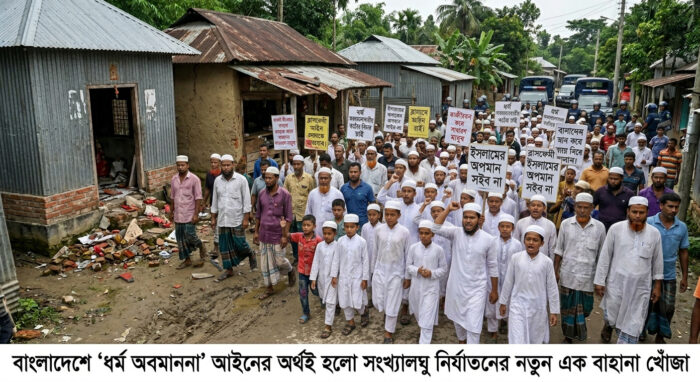
In Bangladesh, the very meaning of the “blasphemy” law is to find a new pretext for persecuting minorities
The attack on the house, shop, and temple of Deepto Roy in Tahirpur, Sunamganj isRead More
বাংলাদেশে “ধর্ম অবমাননা” আইনের অর্থই হলো সংখ্যালঘু নির্যাতনের নতুন এক বাহানা খোঁজা
সুনামগঞ্জের তাহিরপুরে দীপ্ত রায়ের বাড়ি, দোকান ও মন্দিরে হামলার ঘটনা নতুন কিছু নয়। এটি একটিRead More
Comments are Closed