
Religious ignorance and killings
India’s first killing in the name of Islam for the ‘crime(!)’ of expressing free opinion, and the account of Rangila Rasul
Muslims’ religious sentiments are such an issue that because of it, jihadist-minded Muslims have killed a huge number of people over the ages. Among these, the highest number of killings have occurred due to insulting the Prophet, under the tag of “Shatim-e-Rasul”. Prophet Muhammad himself had initiated this trend; he had sent people to assassinate many who made even the slightest criticism of him. He also established the rule that if anyone shows even the slightest disrespect towards him, that person becomes a Shatim-e-Rasul, and there is no chance of forgiveness for him; it is the duty of Muslims to kill him.
First Murder in the Indian Subcontinent: Kolkata, 1924
The first murder in the Indian subcontinent due to writing and for hurting religious sentiments took place in Kolkata in 1924. Although the capital was shifted from Kolkata to Delhi in 1911, Kolkata always remained the literary, intellectual, and cultural capital of India. He was a small publisher in Kolkata who used to publish translations of foreign books. His name was Narendranath Chakraborty.
The published book was a Bengali translation of an English work. The original book was a Western research work on the history of the Middle East and Islam. The book contained some critical comments about Prophet Muhammad – which created controversy in a section of Muslim society. Religious fanatics and mollahs, as always, became extremely agitated over criticism of the Prophet. Prophet Muhammad himself had instructed to kill those who criticize him. No detailed discussion was held at the time about what the book actually said or how objectionable it was. Tension spread among the public based on the allegations. In this context, a publisher named Narendranath Chakraborty was murdered.
The first incident of murder in the Bengal region as well as in the entire Indian subcontinent due to writing and in the name of religious sentiment occurred in Kolkata in 1924. The killer was a pimp from a brothel. One day, while a protest procession was passing by his area, out of curiosity he came to know that a publisher had translated a book in which objectionable comments about Prophet Muhammad were allegedly made. He knew nothing about what the book was or what was actually written in it. But upon hearing the words “insult to religion”, he looked for an opportunity, went to the publisher’s shop, and murdered him while disguised as a gentleman.
This person, who never practiced any religious behavior, was overnight praised as a “defender of religion”. In today’s Bangladesh, there are hundreds of thousands of blind followers like him – moderate Muslims, imams, shopkeepers, teachers, students, employees, businessmen, criminals – everyone unites in the name of religious sentiment. In the 1920s in the Indian subcontinent, religious identity politics rose significantly. Hindu-Muslim relations were becoming increasingly tense – especially centered around publications, speeches, and religious debates.
Lahore, 1929 Murder and Jinnah’s Hypocrisy
In the 1920s, a fierce religious conflict arose in Punjab between the Muslim community and the Hindu Arya Samaj. It started when some Muslim writers published a pamphlet in which they portrayed the Hindu goddess Sita in a derogatory manner. In response, a follower of Arya Samaj founder Swami Dayanand, Krishna Prasad Pratap – under the pseudonym ‘Pandit Chamupati Lal’ – wrote a pamphlet titled “Rangila Rasul”. In it, he highlighted Prophet Muhammad’s marriage to the young Aisha and his multiple marriages.
This book was printed in 1923 by Lahore publisher Rajpal. Immediately after the book hit the market, strong reactions emerged in Muslim society. A case was filed against Rajpal in court. The first court found him guilty, and the verdict was upheld on appeal as well. Eventually, Rajpal went to the High Court, and the High Court ruled that his work did not constitute an offense under Section 153 of the Indian Penal Code. This verdict created immense anger in Muslim society. Amid this tension, on April 6, 1929, 19-year-old son of a carpenter, Ilmuddin, while passing by Wazir Khan Mosque, heard an inflammatory speech by Maulana Ataullah Shah Bukhari. The speech called for action against those who insulted the Prophet. Influenced by the speech, Ilmuddin bought a knife for one rupee and that very day went to Lahore’s Urdu Bazaar and stabbed Rajpal to death. Notably, Ilmuddin himself had never read the book.
Ilmuddin considered this murder his religious duty and did not want to hire any lawyer. But London-returned Qaid-e-Azam Muhammad Ali Jinnah stood by his side. Jinnah was educated in the West, culturally an Englishman, wore suits and ties, regularly drank alcohol, kept dogs at home, and had pictures and paintings of animals everywhere. He had married a non-Muslim. His only child, Dina, had also married a non-Muslim. Dina did not go to Pakistan after leaving India. None of Jinnah’s grandchildren or their descendants are Muslim. Jinnah did not pray or fast, performed no religious rituals, was an atheist, yet in the name of religion he stood in court in defense of this murderer, stroking Muslim sentiments. A thorough atheist who had not a drop of religion in his life also incited people in the name of religion.
Some Historical Religious Murder Attempts
When the assassin of former Egyptian President Anwar Sadat was asked in court,
– “Why did you kill Sadat?”
The killer replied, “Because he was secular.”
The judge asked, “What does secular mean?”
He said, “I don’t know.”
When the attacker on Nobel laureate writer Naguib Mahfouz was asked,
– “Why did you attack him?”
He said, “Because he wrote the anti-religious book ‘Children of Gebelawi’.”
The judge asked, “Have you read the book?”
Answer – “No.”
When the killer of Egyptian writer Farag Foda was asked,
– “Why did you kill him?”
He said, “Because he has no faith.”
The judge asked, “Which book did you read to understand that?”
The killer admitted, “I don’t know how to read or write.”
And the condition of Bangladesh’s Facebook religious “kutubs” (preachers)…
Those who come to Facebook to distribute religious knowledge, want to prove religion as supreme, call us fools, and lecture us to read the Quran and Hadith – many of them have never read the Quran, Hadith, Sirat, or Tafsir. They simply repeat what they have heard from others and copy-paste arguments found online. No matter how much you try to take them to different topics, they will keep playing the same cassette over and over.
In Bangladesh, most of the killers of writers, bloggers, and intellectuals who have been attacked have never read the victims’ writings. They jump into jihadi frenzy just by hearing “so-and-so said”. You will find such people everywhere, especially their flooding is noticeable on Facebook. They try to prove Islam supreme by lying, issuing death threats, and abusing people’s parents. Yet if, as followers of Islam, they showed polite and civilized behavior, willingness for knowledgeable discussion, and a desire to learn, much of the anger towards Islam as a religion would have been somewhat pacified.
Hatred never spreads through knowledge – hatred spreads through ignorance. Society pays the price for ignorance, and pays even more for keeping people ignorant.
Therefore, before making any negative comment or notion against someone, it is essential to ask oneself – “Do I really know the subject? Do I know it with evidence?”
Was the Prophet Really Not “Rangila” (Colorful/Libertine)?
Pedophilia is a terrible mental perversion. When an adult feels sexual desire towards a child, it must be understood that he is a pedophile. Prophet Muhammad not only married the child Aisha at the age of 6 and had sexual relations with her at the age of 9, but he also expressed his desire to marry another child after seeing her in her mother’s lap when she grew up. This is found in the writings of one of the four Imams of the four schools of Islam, Imam Ahmad ibn Hanbal – tinyurl.com/ueh9xhp7
Prophet Muhammad, in the name of Allah, made a rule for Muslims that they could not keep more than 4 wives at a time, but this rule did not apply to him. Apart from 11 or 13 wives, the Prophet also had multiple sex slaves. He also traded in slaves. As long as Khadija was alive, Muhammad did not get the opportunity to marry others. Khadija was wealthy and influential, and Muhammad respected that because he had no income of his own. After Khadija’s death and after the age of 50, he married all the others. Except for Khadija and Sauda, all were young. After Khadija’s death, he married the elderly Sauda to look after the children. He married the 6-year-old child Aisha and consummated the marriage when she was 9 years old.
On the night of Mi’raj, to gain the power to travel to the upper heavens, the Prophet Muhammad ate honey in the house of his childhood crush Umm Hani. Umm Hani was the Prophet’s cousin. Once upon a time, the Prophet liked her. He proposed marriage to her through her uncle, but the proposal was rejected because Muhammad had no profession or social status. Umm Hani states that on that night, i.e., the night of Mi’raj, the Prophet was in her house! (Ibn Hisham, Volume 1, pages 77-78). This is a bombshell statement! Because Umm Hani was another man’s married wife. That night, her husband was not at home. When the Prophet’s companions could not find him, they searched and found him in Umm Hani’s house! What was he doing there? The seriousness of the matter can be understood from Umm Hani’s panicked words. As soon as the Prophet left, she told her maid, “Quickly go and see what people are saying after hearing his (the Prophet’s) words!” (Ibn Hisham, Volume 2, page 77). Umm Hani testifies that on that night the Prophet had prayed Isha in her house and was lying down. (Ibn Hisham, Volume 2, page 77). If one has a little intelligence, one can understand where the Prophet Muhammad actually was and what he was doing that night under the pretext of narrating the Mi’raj story.
On the very day Prophet Muhammad killed Safiyya’s father, brother, husband, and other members of her tribe, he became mad with lust for Safiyya’s beauty and youth, made her a sex slave, and consummated with her that same day.
One night, after running a marathon race through the rooms of all his wives and slaves, he would take a single bath. All this is mentioned in the Quran and Hadith. Apart from the Quran, Hadith, and Sirat, there is no other neutral, reliable history of Islam’s merciful Prophet. He supposedly had the sexual power of 30 horsepower! If he saw a woman on the road, he would get excited and go to his wives, taking them to bed no matter what state they were in. Do you know all this? Even if the wife is on a camel, if the husband wants, she must undress and be ready; the wife’s wish or unwillingness has no value – he established such a rule. The things I said were not written by any historian; I said them according to information obtained from the Quran and authentic Hadith.
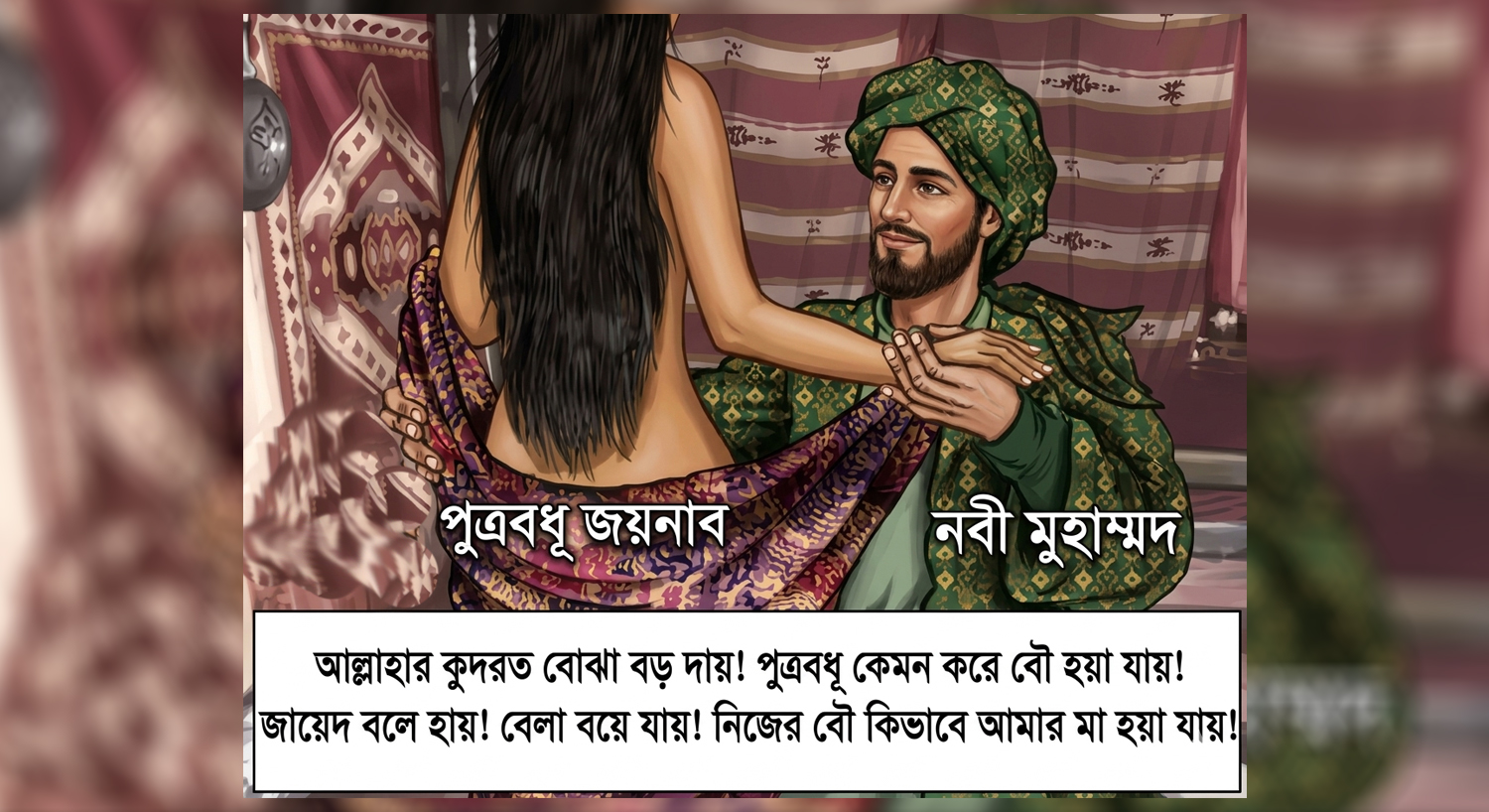
Prophet Muhammad had an adopted son named Zayd. He had truly declared him as his own son. In front of the Kaaba, taking an oath and keeping the people of Mecca as witnesses, Prophet Muhammad recognized him as his son, after which his name became Zayd bin Muhammad. The Prophet had the Quran reveal a verse (Surah Al-Ahzab: 36) to marry him to his cousin Zaynab. A verse had to be revealed because Zaynab was initially unwilling to marry Zayd. One day, while looking for his adopted son, the Prophet saw Zaynab in her nightclothes and became attracted to her. Then the sexually eager Prophet Muhammad started making various plans to get Zaynab, i.e., his adopted son’s wife, for himself. The easy way was to get verses revealed from the Quran. He revealed Surah Al-Ahzab 33:37, Surah Al-Ahzab 33:50, Surah Al-Ahzab 33:4 and made his adopted son’s wife his own wife.
Muhammad had divorced his second wife Sauda at one point. Sauda then cried and begged Muhammad not to divorce her. In response, Muhammad said he was willing to keep her as his wife for life, but on one condition. The condition was that Sauda must give up her right to share the bed with Muhammad and hand over her allocated day and night turns to Aisha. Sauda did not delay in agreeing to this condition, out of fear that Muhammad might refuse to take her back as a wife. After Sauda agreed to the condition, Muhammad withdrew the divorce and took her back as his wife, but after that he never went to Sauda’s room again and never allowed her to come near him for the rest of his life.
The king of Egypt had sent two slave girls as gifts to Prophet Muhammad: Shirin and Maria the Copt. The Prophet kept Maria the Copt for himself. In the womb of the slave girl Maria the Copt, Prophet Muhammad had a son named Ibrahim, although he did not live long.
The most difficult time in the lives of the Prophet’s wives was the period after Prophet Muhammad was caught red-handed having sexual intercourse with the sex slave Maria the Copt in Hafsa’s room. At that time, out of shame, Muhammad vowed that he would no longer have sexual relations with Maria the Copt. He also tempted Hafsa by saying that if she did not tell Aisha about this, her father Umar would become the Caliph of the Islamic state after Abu Bakr. The Prophet specifically instructed Hafsa not to tell this incident to the other wives, especially Aisha. Aisha was a very outspoken girl who sometimes spoke back to the Prophet directly. That is why the Prophet particularly emphasized that this incident should not be told to Aisha.
But at that time, there was a surge of lust for Maria in the Prophet’s mind. He could not stay without having sexual relations with Maria. From various sources, it is known that Maria the Copt was extremely beautiful and the Prophet was very eager to have intercourse with her. So even after vowing not to have sexual relations with Maria, the desire to have intercourse with her arose again in the Prophet’s mind. Meanwhile, the Prophet’s wives were very happy thinking that the Prophet was no longer having sexual relations with Maria and had made Maria haram for himself. But the Prophet could not restrain himself and had sexual relations with Maria again. Because of breaking the vow and having sexual relations with Maria again, a section of the Prophet’s wives rose up against him. As a result, the verses of Surah At-Tahrim were revealed to the Prophet. The Prophet threatened to divorce all his rebellious wives at once. In fact, it was Allah who gave this threat by revealing the Surah. It goes without saying that Allah was extremely displeased that the Prophet could not have sex with Maria the Copt.
Anyway. After that, the Prophet went to Maria the Copt’s residence and stayed there for a full month. Extremely angry, the Prophet remained firm in his threat to divorce all his wives at once during this time. As always, Allah was on the Prophet’s side; He continued to reveal verses encouraging the Prophet to have sex with the slave girl.
Anyway, there are many more stories. Narrating them all would exceed your reading patience. So I will not go further. Now you tell me whether Prophet Muhammad’s life was really “Rangila” (colorful/libertine) or not.
Related Posts

Spending the night in Umm Hani’s house and then meeting Allah in the heavens – he named it Mi’raj
Mi’raj is a central event in Islamic belief. On the night of Mi’raj, the ProphetRead More
উম্মে হানির ঘরে রাত কাটিয়ে মহাকাশে আল্লার সঙ্গে সাক্ষাত – নাম দিয়েছেন মিরাজ
মিরাজ ইসলামি বিশ্বাসের একটি কেন্দ্রীয় ঘটনা। মিরাজের রাতে নবী মুহাম্মদকে পাওয়া যাচ্ছিল না। সাহাবীরা চিন্তায়Read More

The 72 full‑breasted, personality‑less houris of Paradise vs. the personality‑rich cherished women of the world! What do you want?
It is said that in Paradise a believing servant will receive 72 exquisitely beautiful houris;Read More
Comments are Closed