
Ramadan restraint, for many, is just hypocrisy
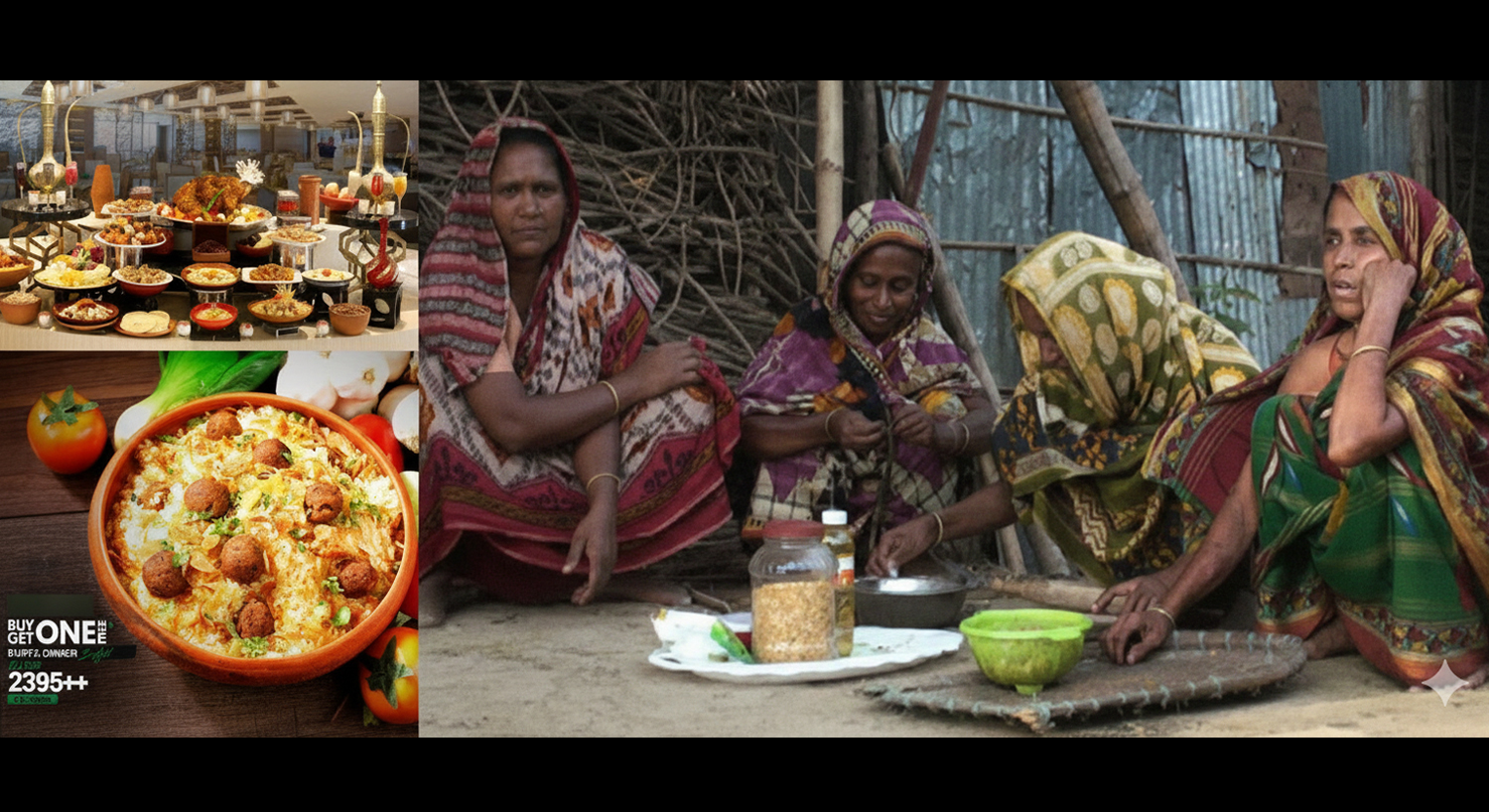
A 2500‑taka iftar! Meanwhile, for sehri it’s burnt chili with watery rice, and for iftar just bread and leafy greens
In childhood, I was taught that if you cannot share your food with someone, it is not right to eat openly in front of them. Imagine someone hungry sitting before you, and you are gulping down delicious food! In the age of social media, we see this all the time. On Facebook and across the internet, I see advertisements and reviews of lavish iftar menus. Some cost 2500+ taka per person, some 500+ taka—pure luxury for someone like me. You may say, “It’s my money, I’ll eat what I want, show my friends if I want—what’s your problem?” We ordinary people could never afford such things, still can’t. Yet we have to see them constantly; they appear right in front of us. Many of the buyers are on my friend list too! Among so many wealthy friends, I feel like a small person crushed in the crowd.
Believe me, I grew up in a village—I didn’t even know that iftar meant piyaju, beguni, chickpeas and all that until I came to the city. During the scorching summer, the most we saw was someone bringing a one-taka ice ball from the upazila town. Iftar meant mainly flattened rice, puffed rice, molasses, coconut, khichuri, rice, vegetables—one or more of these. How backward I must seem, right? Rice three times a day was our staple. Roti or paratha in the morning, or snacks in the afternoon—those were rare luxuries. At best, a glass of milk or rice with milk and mangoes in the afternoon, and that too only occasionally. And I’ve already told you how Ramadan used to be.
I have a few Facebook friends from the Gulshan–Banani area. They upload dozens of photos every day. Almost all are party and food pictures. One day at someone’s house, another day at some restaurant—so many arrangements. They never forget to post them daily. Showing everyone seems to be their greatest joy! Sometimes I wonder—don’t they have to work for a living? Where does all this money come from? Every day, wearing new clothes, going in groups to this restaurant or that one! Parties at each other’s houses! They even give names like “So-and-so’s Palace”!
Look at the first picture—an iftar offer. All together, your cost will be over 2500 taka for one person for one meal. Why does Facebook show these things to people like us—poor, struggling folks who sweat through our shirts every day just trying to manage 50 taka?
How much longer will we tolerate this irony? A huge number of people in the country have lost their dream harvests—livestock, fish, ducks, chickens, vegetable fields—all destroyed by untimely floods. Thousands lost their homes in cyclones. While you go to new restaurants every day for iftar, thousands of others are saying: “For sehri we ate burnt chili and watery rice, for iftar we’ll eat roti and leafy greens. There’s no other way. No rice in the granary, no fish in the haor, no work anywhere. Don’t even ask about the market.” These exact words appeared in the news. These are the same people who grow crops all year so that you and I can eat. Today, untimely floods have left them in agony!
Surjya Banu is a housewife from a lower-middle-class family. She cultivated paddy on 7 kear of land beside the haor with great effort. But the early floods of Chaitra submerged the unripe paddy. Now there is no means left to run the household. Ramadan has arrived in the midst of this. But even before Ramadan, Surjya Banu and her family were living in severe hardship. That hardship continues. As a result, they are fasting after eating burnt chili and watery rice for sehri, and breaking their fast with roti and leafy greens. Thankfully, some wild greens are still available in rural areas.
The cost of one elite iftar gathering for 5 people could feed 200 struggling families for a day! Just do the math! Through our five senses—sight, taste, smell, sound, and touch—we humans experience the vibrancy of life. Through these senses we chase all forms of pleasure, trying to satisfy the demands of the six inner enemies (shadripu). Ramadan comes to teach us ‘self-restraint’, to train our senses so that we can suppress these six enemies throughout the year and lead a beautiful, healthy life.
The words ‘Siyam’ or ‘Roza’ originate from the Arabic word ‘Saum’; ‘Roza’ is originally a Persian word. Saum means abstinence. The foremost teaching of Siyam is to control desires and inspire the body and mind toward sacrifice. We all know that a normal human has five senses—ear, nose, tongue, eyes, and skin. And there are the six enemies—lust, anger, greed, attachment, pride, and envy. The core teaching of Ramadan is to destroy these six enemies by controlling the five senses.
But what is happening in reality? For many of us, ‘Ramadan’ has become nothing more than spending the whole day hungry and then indulging in a feast at sunset. Are we truly embracing the lessons of restraint and sacrifice that Ramadan teaches?
Related Posts

Why do Islamist clerics consider Bengali cultural festivals their enemy?
This year, unlike many previous years, the major Hindu religious festival Durga Puja in BangladeshRead More
ইসলামিস্ট মোল্লারা কেন বাঙালিদের আনন্দ উৎসবকে তাদের শত্রু মনে করে?
এবার বাংলাদেশে অন্যবারের তুলনায় বেশ শান্তিপূর্ণ, উৎসবমুখর পরিবেশে হিন্দু ধর্মের বড় ধর্মীয় উৎসব দূর্গাপূজা হয়েRead More

Why do Islamist cyber‑jihadis insult, threaten, and file false reports against people with different opinions?
Maulana Azhari once advised Islamists that sharing his Facebook posts is also an Islamic act;Read More
Comments are Closed