
Prophecies of Muhammad
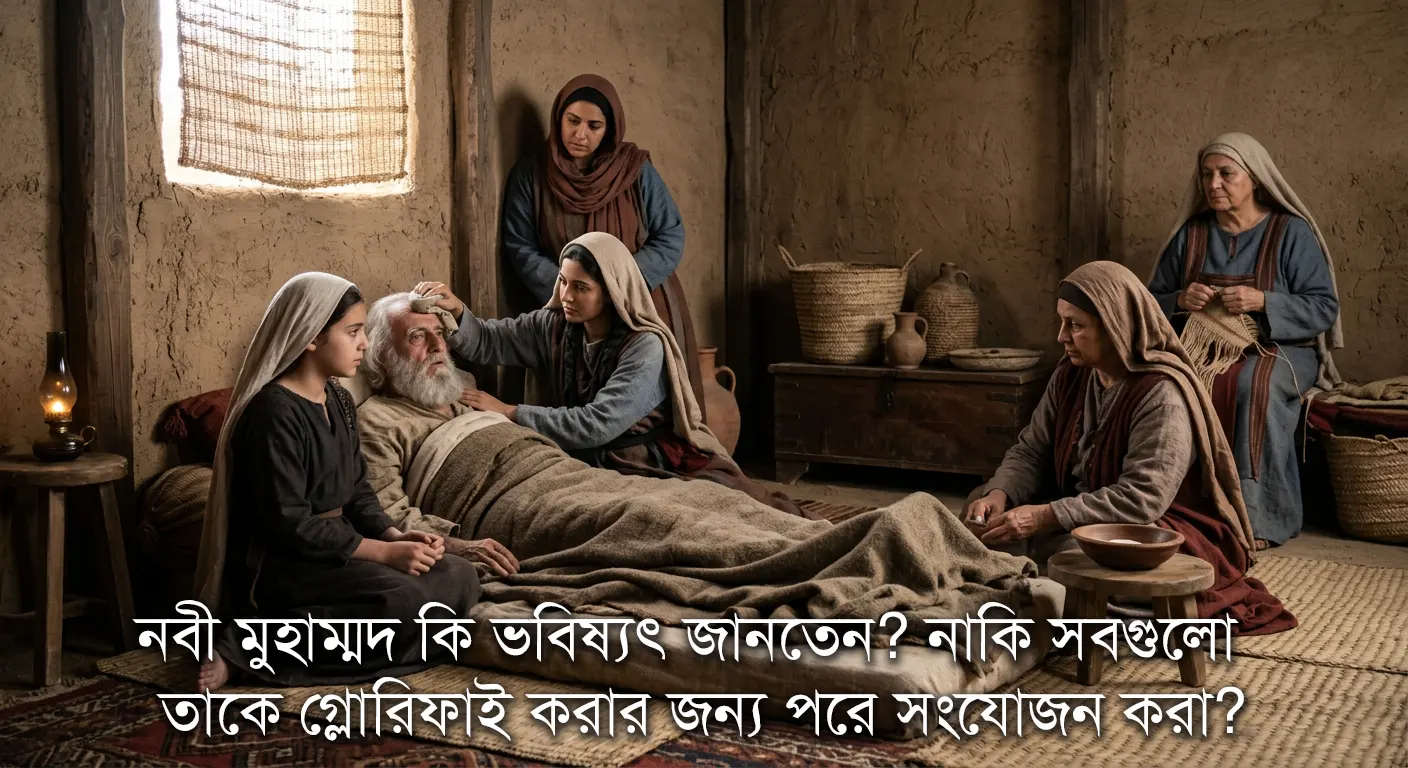
Did Prophet Muhammad Know the Future, or Were All These Stories Added Later to Glorify Him?
A well-wisher sent a message saying –
” I am leaving aside my exam studies and reading the history of your name. Every piece of writing pricks the conscience. It compels one to think anew.
I have some questions. Did Prophet Muhammad (PBUH) understand his own final time was near? He gave the Farewell Pilgrimage sermon and said that it was his last Hajj. After that, he could not attend in that manner again. Is that a coincidence?
Then Hazrat Umar came with an unsheathed sword to kill him. When everyone became afraid and wanted to give him a safe exit, he refused and said that Allah had accepted Umar for Islam. And indeed Umar surrendered his sword and accepted Islam. How did he know beforehand that the hot-tempered extremist Umar had come not to kill him but to accept Islam?
He told his daughter Fatimah from his deathbed not to grieve excessively because after his death, Fatimah would be the first to reunite with him. And indeed Fatimah died. How is that possible?
My information may not be 100% authentic. However, there are several other such matters concerning him. Are these merely coincidences? When trying to think freely, confusion arises regarding such issues, and they cannot be discussed with just anyone. “
Neither I nor he is the only free-thinking person who thinks this way. Many people have similar questions in their minds.
Before answering the questions, let me share some of my personal experiences.
When I was in high school, I used to come first every year in essay competitions held during Eid-e-Milad-un-Nabi celebrations. I also came first at the upazila, district, and divisional levels in competitions organized by the Islamic Foundation. We had some books at home for reading Muhammad’s biography, one of them being Golam Mostafa’s ‘Bishwanabi’ (The World Prophet). In that book, Muhammad’s birth was glorified in a fairy-tale-like manner. His mother Amina and relatives supposedly saw soothing rays of light descending from the sky, blah blah… Did these things really happen? Absurd!
My grandmother died at over 90 years of age. About 10 years before her death, she would say that if I did not visit her this month, I might not see her alive the next month, and so on. Now if she had died at any point during those 10 years, it could have seemed as though she had sensed that her death was near.
Now before getting to the answer, let us know a little more. From childhood, people become so accustomed to religious teachings, etiquette, and ideals through family, society, and culture that these become part of their identity, security, and moral framework. Cognitive biases, social pressure, fear (of the afterlife, curses, or rejection), and emotional attachment create obstacles to questioning these things. As a result, doubting with an open mind feels to many like personal betrayal or an existential crisis. Even those who manage to question the religious beliefs inherited from their family often construct counterarguments themselves and imagine the superiority of their religion. Cognitive bias refers to systematic errors or prejudices of the mind, where people judge information not rationally but through pre-existing beliefs, emotions, or mental shortcuts.
Our brains process enormous amounts of information every day. Since it is impossible to analyze everything deeply, they use heuristics (mental shortcuts). These shortcuts help make quick decisions, but often lead to mistakes or one-sided conclusions.
- Selecting information: People give greater importance to information that supports their prior beliefs (Confirmation Bias). Contradictory information is ignored or dismissed.
- Influences memory and perception: Events that are easy to remember or emotionally powerful receive greater importance (Availability Bias). As a result, incorrect assumptions are formed about real probabilities.
- Impact of first information: Whatever is heard or seen first becomes the benchmark (Anchoring Bias). Later information is judged according to that benchmark.
- Group and identity protection: People tend to regard ideas consistent with their own group, religion, culture, or identity as correct (In-group Bias). Different views are seen as threats.
- Emotion and self-interest: Fear, hope, shame, or personal advantage can distort reasoning. People prefer to avoid uncomfortable truths.
These biases evolved because rapid decision-making was necessary for survival in ancient times. In modern complex societies, however, they often lead to misconceptions, superstition, and stubbornness. It is difficult to escape them without consciously asking questions, hearing opposing views, and verifying evidence.
Now let us come to the life of Prophet Muhammad. The issues above are either mere coincidences or parts of later religious narratives; they are not historically verifiable “prophecies” or examples of supernatural knowledge. From a historical-critical perspective, they do not glorify Islam or Muhammad. Different preachers narrate these stories in different ways. For example, it is said that Prophet Muhammad urinated in a bowl at night and left it in the room, and a companion mistakenly drank it thinking it was water and considered it the finest beverage. You hear such hadiths and stories on YouTube, where various speakers embellish them differently. The events of the Prophet’s life are much the same; different people have narrated them according to their own interests. But our task is to examine them through the lens of reason, evidence, and science.
1. The Farewell Pilgrimage and Calling It the “Last Hajj”
In hadith and sira literature, Muhammad says, “I do not know whether I will meet you again in this place after this year,” or “Learn the rites of Hajj from me, for I do not know whether I will perform Hajj again next year.” This occurred in 10 AH (632 CE), and he died a few months later.
Critical explanation:
Several years before his death, the meat-loving Muhammad ate poisoned meat from a Jewish woman at Khaybar. Afterward, he allegedly suffered severe agony for years. He often feared that he might die. In the final stage of his life, especially during his terminal illness in 11 AH (632 CE), the pain from that poisoning supposedly became extreme. He described the severity of this suffering to his child wife Aisha.
According to Sahih al-Bukhari 4438, Aisha narrated that during his final illness the Prophet would say: “O Aisha! I still feel the pain from the poisoned food I ate at Khaybar. And now I feel as though my aorta is being cut because of that poison.”
He also experienced certain mental and physical issues resembling short-term memory loss. Due to superstition, however, he believed these were caused by magic. Sahih Bukhari 3175 states that Muhammad had been bewitched. Because of the magic, he allegedly became confused and suffered memory problems. Surah Al-Furqan verses 8-9 also describe Muhammad as someone thought to be under the influence of magic.
Muhammad already assumed that he could die at any time. The average lifespan of Arab men at that time was around 30-35 years. Muhammad was over 60, and enduring a long life in the harsh Arabian climate was extremely difficult. Considering the average life expectancy and his physical condition, realizing that one’s end might be near would be entirely normal for any person and would not require supernatural powers.
Therefore, it can be assumed that this was not any specific prophecy. A 63-year-old man who had endured many wars, poisoning (the Khaybar incident), and constant political pressure saying “perhaps we will not meet again” is a perfectly normal human estimation. Many leaders and religious figures give such farewell speeches in their final years. The term “Farewell Pilgrimage” was applied later. The Qur’an itself repeatedly states that he was an ordinary human being (3:144, etc.). The speech contains no specific date or detailed prophecy, merely uncertainty. After his death, later narrators presented it as though he “knew.” This is a self-fulfilling or ordinary life prediction.
The Farewell Pilgrimage sermon was not recorded immediately. Rather, it was written down through various narrators and hadith compilers over a century after Muhammad’s death. It is very common in later historical writings for “prophecy”-like language to be added, a phenomenon widely discussed in textual criticism.
2. Umar’s Conversion to Islam and Coming with a Sword
Umar accepted Islam around the sixth year of prophethood, meaning about six years after the beginning of Islam, when the number of Muslims was approximately forty.
Popular story: Umar set out with a sword to kill Muhammad. On the way, he learned that his sister Fatimah and her husband had accepted Islam. He went to their house, assaulted them, then read the Qur’an and converted. He then went to Dar al-Arqam and accepted Islam. Some narrations claim that Muhammad or the companions already “knew” or had prayed for this.
Critical explanation:
There are many versions of this story, and they contradict one another (who stopped him on the road, how many people were in the house, which surah was read, whether the sword was drawn, etc.). Many sources are weak or disconnected (munqati’, da’if). In Bukhari’s chapter on Umar’s conversion, this dramatic assassination plot is not found. Even the earliest sources, such as Ibn Ishaq, have problems.
In reality, Umar was a powerful and hot-tempered young man of the Quraysh. The Muslim community was growing, and members of his own family were converting. It would have been entirely normal for him to know about this. Carrying a sword was common in Arab society. Even if the incident happened, there is no contemporary evidence that Muhammad “knew beforehand.” This is a later religious narrative in which Umar (later a caliph) was glorified. Umar’s conversion was advantageous for Islam, so the story was dramatized and given miraculous features. No modern historian accepts it as a reliable prophecy.
In the first six years of Islam there were only about 40 followers, around 100 after ten years, and perhaps 300 after thirteen years. Who were these followers? Aside from some professional individuals such as Khadijah, most were vagabonds and desert raiders. Their primary occupations involved theft, banditry, and raiding trade caravans. They were drawn to Islam largely because of such attractions. Did Umar accept Islam because of its great beauty? In reality, he joined Islam in hopes of benefiting from plunder, women acquired through warfare, and wealth gained through jihad-related campaigns. That is the reality.
When the companions who had joined Muhammad’s group began asking where the prosperity they had been promised was, Muhammad reportedly stated that his livelihood was under the shadow of his sword. Their sustenance would come through the sword. By “sword” was meant attacks in the name of jihad against non-Muslim tribes and raids on trade caravans traveling to distant settlements. Here is the link to Sahih Bukhari; see page 108 (PDF page 109), point 88. Before attempting to explain it away, check footnote 1 below, where it explicitly says that Muhammad’s source of livelihood was war booty or spoils. This plundered wealth was supposedly a gift from Allah to them. Banditry and raiding were the primary occupations of Muhammad and his early team. If you disagree, then tell us what their occupation actually was!
3. Telling Fatimah She Would Be the “First Reunion”
According to narrations in Sahih Bukhari and Sahih Muslim from Anas and others, a man once asked the Prophet, “When will the Day of Judgment come?” The Prophet looked at a small boy (named Malik ibn Anas or another child, depending on the narration) and said: “If this boy lives, he will not grow old before the Hour comes upon you.” Yet more than 1,400 years have passed since both Muhammad and that boy died. Many believe that criticism of religion today is a sign of the approaching Day of Judgment, just as some think women wearing less clothing is a sign of it. Hundreds of people have claimed to be Imam Mahdi throughout history because Muhammad reportedly said that Imam Mahdi would come. Religions contain countless such nonsensical future statements. However, a person’s personal insight and experience can allow many things to be inferred, especially regarding oneself and one’s family.
According to Aisha’s narration in Bukhari and Muslim, Muhammad secretly told Fatimah while ill that he would die from this sickness (and Fatimah cried), then told her that she would be the first among his family to join him (and Fatimah smiled). Fatimah did in fact die a few months later (commonly said to be six months).
Critical explanation:
This may seem like the strongest case, but it too has problems.
- Fatimah was a young woman (18-27 years old) and was deeply affected by her father’s death. Shia sources mention injury and miscarriage; Sunni sources cite grief. Either way, the rapid death of a young family member after a parent’s death is not unusual (grief, malnutrition, infection, childbirth complications, all common in 7th-century Arabia).
- The term “first” is vague and was reported as fulfilled afterward. Other family members (his wives, Ali, Hasan, Husayn) died much later. Thus, if any young woman died first, she would naturally become “the first.”
- The hadiths were compiled long after Muhammad’s death. They often serve later political or religious purposes (such as increasing Fatimah’s status). One could call this a Retrospective Prediction. There is no such specific prophecy in the Qur’an.
When history was written (long after the events), narrators added the narrative that “the Prophet had already foretold it” in order to make the matter appear miraculous. In history this is known as Post-hoc ergo propter hoc (determining a cause after the event).
Overall Critical Perspective
Such stories are found in the biographies of founders of almost all religions, including Jesus, Buddha, and others: “knowing the end in advance,” “recognizing someone beforehand,” or “knowing who would join them first after death,” etc. These are generally:
- Constructed or exaggerated by later generations (hagiography).
- Vague or conditional statements later claimed to have been fulfilled.
- Human predictions, political advantages, or narratives designed to satisfy the emotional needs of a community.
- Unsupported by contemporary neutral (non-Muslim) sources. Even the earliest Islamic sources were written centuries later and controlled by believers.
From a free-thinking perspective, these are not “miraculous” but rather common techniques of religious narrative. Muhammad was a politically skilled, war-oriented religious leader who centralized power in the Arabian Peninsula. His biography contains many real events (wars, treaties, inhumanities, social reforms, superstitions, vengeance, and hostility). But claims that he “knew beforehand” or made specific personal prophecies do not survive historical scrutiny. They hold emotional value for believers, but critical history does not accept them as evidence.
The information is not 100% authentic and is to a considerable extent a later construction. Confusion is natural in free inquiry because there is often a gap between religious narratives and historical reality. The first step is to think independently about whether such things are really possible. Then verify through other sources, although apart from Islam’s own books there are no neutral sources for knowing Muhammad. If Muhammad truly knew the future, then he would also have known that he would die after suffering severe pain from poisoning caused by eating meat, and that his companions would leave his body for days while arguing over who would become the caliph. In that case, the first thing he would have instructed would have been that he should be buried before his body began to decay and emit an odor.
Related Posts

Ayisha and Arpita: A Story of Free Expression and Honesty Between Two Sisters, One Muslim and One Hindu
Ayisha and Arpita’s parents had dated for several years before marrying under Bangladesh’s Special MarriageRead More
আয়িশা ও অর্পিতা – মুসলিম ও হিন্দু দুই বোনের মুক্তবাক ও সততার গল্প
আয়িশা ও অর্পিতার বাবা-মা কয়েক বছর প্রেম করে বাংলাদেশের বিশেষ বিবাহ আইনে বিয়ে করেছিলেন। কেউRead More

Operation Entebbe – the story of one night, and the Islamic execution suffered by Nazrul Islam and Sweety Akter
What can a state do to save the lives of its citizens abroad? Are thereRead More
Comments are Closed