

Play a role in preventing suicide
Showing sympathy for suicide is not right; may everyone’s life be safe and joyful
A confident person has no reason to take their own life. There is no place for supporting or showing sympathy for suicide. No matter how successful someone is, if they end their own life, they cannot be considered a role model. In Bangladesh, people take their lives for many different reasons—failure in love, scolding from parents, a partner’s infidelity, a partner’s neglect, unintended pregnancy from unprotected sex, lack of irrigation water in farming, poor exam results, unemployment, not getting a fair price for crops, inability to repay loans—there are countless reasons. Some even take their entire family with them, including newborn children; some abandon their children in danger and then end their own lives.
Recently, the suicide of a woman named Ikra has drawn a lot of sympathy on social media. Her husband, Niamat Ullah Bhuiyan—who also calls himself Zaher Alvi—is an actor. It is said that her relationship with her husband had not been healthy for the past three years. Continuing such a toxic relationship is not possible for a self-respecting woman. And the idea that someone would fall in love with a man like Alvi—an actor of poor reputation—and give up her life for him is absurd. This same Alvi defended mass killings just a year and a half ago. For a woman like Ikra to deprive her child and end her life for such a man cannot make her a role model in any sense.
Society and religion both consider suicide a grave wrongdoing. If someone encourages another person to take their life, it is a serious crime and deserves punishment. But taking one’s own life out of hurt feelings, neglect, or betrayal is a misguided act. Ending your life for someone who is ungrateful or disloyal only gives more power to their negative traits. In Bangladesh, women often take their lives in such situations. Society does not teach women to be confident and independent, which creates emotional, social, and economic dependence on men. This dependence is unhealthy, yet society reinforces it. Women must learn that they can walk alone, live with dignity and confidence, and build a better life than the deceitful man who once harmed them. This is the lesson we must teach our women.
In my view, very few women in Bangladesh have faced a socially devastating situation like Sadia Jahan Prova—the woman in the picture. As you know, because of her involvement in the media, when an intimate video with her former partner was leaked, it became a national scandal. Yet no one held the deceitful ex-partner accountable. Because she was a woman, Prova had to endure all the storms. She may have broken down temporarily. Then came her divorce from Apurba. Despite everything, she stood strong and rebuilt her life. Looking at her daily life now—her smiling face—you would never guess what she went through. I believe that those who feel suicidal can take inspiration from Prova—she is a living example of how to stand tall after unimaginable hardship.
Many people live with severe illnesses. Doctors often tell them they don’t have long to live, yet they fight with hope that the doctors may be wrong. Many people are born without certain organs. A blind person never sees the world, a deaf person never hears its melodies, a mute person cannot enchant others with their voice. Many lose limbs in accidents or illness, yet they still want to live.
People struggle every second to breathe the air of this world, to see a child’s smile, to hear their children’s success, to feel the happiness of loved ones. In the ICU, you will see people fighting for just one more minute of life. Newborn babies in the NICU struggle to survive. People burned in fires or injured in accidents fight desperately to stay alive. On freezing nights, people sleep on the streets; many eat from garbage bins out of hunger. Everyone has one goal—survival. In that world, taking one’s own life is a tragic act.
In a civilized society, even threatening suicide is considered an offense. If someone says, “If this doesn’t happen, I have no choice but to kill myself,” they can be imprisoned. It is a crime, and instead of sympathy, the law holds them accountable. Because such behavior is a form of emotional manipulation.
☘ Your partner cheated on you or was unfaithful—so what? Leave them and build your own life. If someone breaks a promised trust, hold them legally accountable for fraud or deception. Ending your own life to “teach them a lesson” or to gain society’s sympathy would only destroy your life, not theirs. Instead, achieve something so meaningful that the unfaithful partner burns in regret and remorse when they see your success. Your life and your dignity are far greater than success or failure in love and relationships.
☘ Loneliness cannot be a reason for suicide. In today’s highly capitalist world, everyone is essentially alone, and no one has much time for others—that’s normal. The advantage of loneliness is that you don’t have to carry everyone’s burdens or responsibilities, and you can live your life with complete freedom. Learn to enjoy solitude. Loneliness often creates new opportunities in life.
☘ Some people take their lives due to poverty. Being born poor may be the fault or misfortune of one’s parents, but dying poor is one’s own responsibility. With effort and honesty, poverty can be overcome.
☘ Trouble with money matters? Friends betrayed you financially? Lending money to friends is a huge mistake. If possible, help friends by giving money without expecting it back, but don’t lend. When doing business with friends, always use written agreements and joint bank accounts. Don’t hand over your hard-earned money out of shame or emotional pressure; if you must give it, follow proper legal procedures. And if a friend still cheats you out of large sums?
Make yourself so financially or emotionally strong that being cheated feels like someone took a glass of water from your ocean of wealth. But never give a betrayer a second chance.
☘ In Bangladesh or the Indian subcontinent, anyone over sixty is considered “old.” Reject this mindset. Sixty is when real youth begins. It’s the age for parties, art, sports, music, dancing, romance, world travel, and enjoying the fruits of your lifelong labor. If you think of yourself as old because of age, you are dying a little every day. If you fall in love, live together, or marry at sixty, society will gossip and trolls will mock you online. Who cares? You must live in a way that makes you happy. What does society do for you? Why should their comments matter? If a sixty-year-old and a twenty-year-old marry willingly and with consent, that is their right and their decision. Others’ opinions are irrelevant.
☘ Never sacrifice everything in life for your children. When your child turns eighteen, encourage them to study, train, and work to earn their own money. No job is small. Buying unnecessary gadgets with your hard-earned money and then feeling hurt in old age because your child doesn’t appreciate it—that’s not right. Even the daughters of former U.S. President Barack Obama worked in restaurants after turning eighteen to learn how to earn. Don’t cripple your children mentally by saying, “This job is beneath our family,” or “Our status doesn’t allow this work.” Because of this toxic mindset, many remain unemployed for years, drowning in frustration. This creates unhealthy dependence on parents, and in old age you may boast about what you did for them, but you won’t escape your own helplessness.
☘ Don’t depend on family or society—depend on yourself. Understand that every person is different; someone may take responsibility for you, or may not, but no one is obligated to. Keep your time, money, and resources for your own needs. Plan your future and support your adult children accordingly. In many countries, grandparents are paid to care for their grandchildren. You may think it’s strange or harsh, but they reached this system through real-life experience. There is nothing inhumane about it.
☘ Imagine you fall seriously ill in old age. The people around you may not be trained to handle your needs. They may not understand your requirements, and their busy lives leave little time for you. A good-quality retirement home can be a better option, where trained staff can care for you. You can socialize with friends your age, enjoy conversations, and stay cheerful. Even in old age, you may want to watch a bold movie or have lively conversations—something you may not get in a traditional family setting.
Many people in our country think retirement homes are bad. In reality, they are not. I don’t know if high-quality retirement homes exist here, but in developed countries they are like heaven for the elderly. Governments provide pensions, and with that money they live comfortably. Even if you want them to live with you, they often prefer independence. Some even travel to Thailand, Africa, or Indonesia for long stays and to fulfill personal needs. This is not a joke.
☘ You must live well. Instead of worrying about what society thinks, focus on living happily without violating anyone’s rights. Look at Safuda—living alone abroad, living life on his own terms. Many people live alone in apartments, on the road, in shops, or as travelers climbing mountains. When we expect too much from others, we lose the ability to expect from ourselves. Escaping emotional dependency is a success. Life may lose a bit of its “red color,” but you’ll avoid much suffering—and you can always add some pink or green yourself. Feel emotions, but avoid becoming addicted to them.
“Having eyesight but no vision is worse than being blind.” — Helen Keller
☘ Your five senses—eyes, ears, tongue, nose, skin—are they all functioning? If so, look again. Are you still hopeless? Still sitting in despair because you haven’t succeeded yet? Then listen to the story of someone whose three senses didn’t work. She was blind, deaf, and mute. What did she do? She became a writer, politician, lecturer, social worker, and traveler. She lost her ability to see, hear, and speak at just 19 months due to illness. She became the first blind–deaf–mute person in the world to earn a bachelor’s degree. She traveled 40,000 kilometers and set records. Her name was Helen Keller. She knew nine languages and understood songs by placing her hand on a singer’s throat.
Now compare that to us. We give up because of small obstacles. We grow bitter toward life. But if we think of Helen Keller—who overcame unimaginable barriers—we realize how much more we can do. What exactly is the obstacle to your success? Is it truly an obstacle, or is your lack of confidence the real barrier? From today, reject destructive laziness and hopelessness, and build a confident life. Suicide is never the answer.
Related Posts

Why do Islamist clerics consider Bengali cultural festivals their enemy?
This year, unlike many previous years, the major Hindu religious festival Durga Puja in BangladeshRead More
ইসলামিস্ট মোল্লারা কেন বাঙালিদের আনন্দ উৎসবকে তাদের শত্রু মনে করে?
এবার বাংলাদেশে অন্যবারের তুলনায় বেশ শান্তিপূর্ণ, উৎসবমুখর পরিবেশে হিন্দু ধর্মের বড় ধর্মীয় উৎসব দূর্গাপূজা হয়েRead More
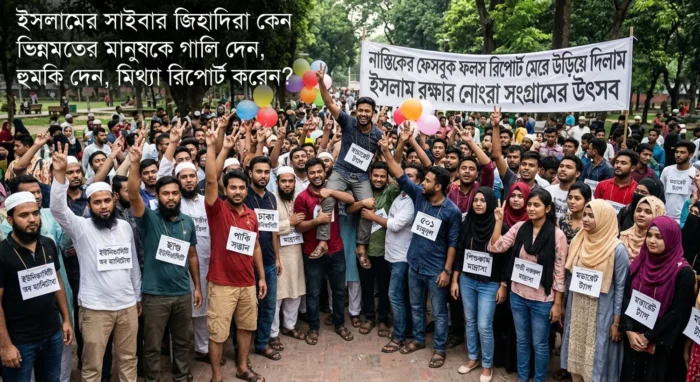
Why do Islamist cyber‑jihadis insult, threaten, and file false reports against people with different opinions?
Maulana Azhari once advised Islamists that sharing his Facebook posts is also an Islamic act;Read More
Comments are Closed