
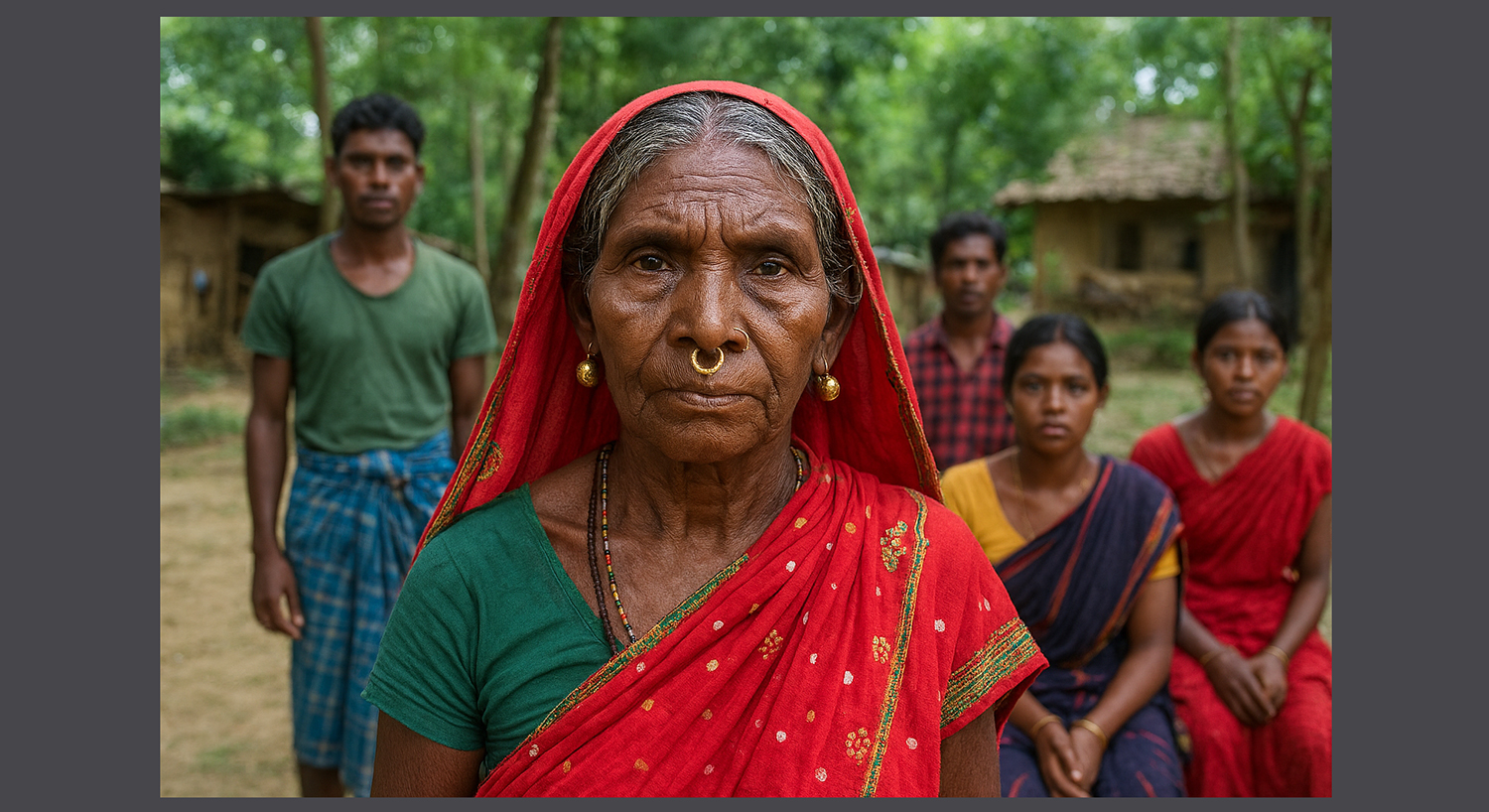
Our responsibility as a civilized society
Homo Sapiens: Primal Instincts, the History of Migration, and Our Moral Responsibility Toward Indigenous Communities
Humans claim themselves to be “civilized.” We take pride in our advanced technology, knowledge, science, economy, and governance. But if we look deep into human history, we find that the species called Homo sapiens is fundamentally conflict-prone, dominance-seeking, and resource-grabbing. No matter how polished the veneer of civilization, the genetic memory of humans still retains that primal instinct – to seize others’ resources, assert dominance through power, and displace weaker communities to secure one’s own position.
In this article, we will analyze the issue in three layers –
1) The biological-primal instincts and history of violence in humans
2) The Out of Africa theory and anthropological explanation of human migration into the Indian subcontinent
3) Our moral responsibility toward the indigenous communities of the subcontinent, including the Santals
1. Humans: Primal Instincts of Violence and Dominance
Homo sapiens is not the only human species in world history. Alongside us were Homo neanderthalensis, Homo erectus, Denisovans, and several other human groups. But today, only one human species survives on Earth – us. Anthropologists believe there were two main reasons behind this:
(a) Competition and Conflict
Homo sapiens were highly adaptable, organized, and capable of hunting and fighting in groups. Though Neanderthals were strong, they were fewer in number and had relatively weaker social organization. As a result, they could not survive the competition.
(b) Tendency to Seize Resources
Human brain evolution taught us – “Resources mean survival.”
This instinct is still evident in human behavior. In statecraft, nationalism, religion, and economics – we see powerful groups seizing the resources of the weak.
Historical Examples
- European colonizers seized the lands of Native Americans and committed genocide.
- The British nearly wiped out the Aboriginals of Australia.
- European powers looted Africa’s resources and maintained dominance for centuries.
- Spanish conquistadors destroyed the civilizations of the Incas and Aztecs in South America.
These events prove that the history of human civilization is essentially a history of violence, conquest, and dominance.
2. Out of Africa Theory and Human Arrival in the Indian Subcontinent
Human origins lie in Africa. Around 60–80 thousand years ago, a small group of modern humans migrated out of Africa. This theory is known as the Out of Africa Theory.
(a) First Arrival: Negrito Communities
Anthropologists believe that the first modern humans to arrive in the Indian subcontinent were Negrito communities. They crossed the Red Sea, passed through the Levant and Iran, and entered India.
(b) Second Phase: Australoid Communities
Next came the Australoids – whose origin lies either in India or southern China – this remains debated.
Many of today’s tribal communities in India are descendants of these groups, such as:
- Santal
- Ho
- Kharia
- Malpahari
- Chenchu
- Lodha
- Irula
- Kota
- Kol
- Bhil
– All of them are descendants of the Australoid macro-race.
(c) Third Phase: Dravidian Communities
There is strong scholarly opinion that Dravidian languages and culture originated in India. They established powerful civilizations in southern India.
(d) Fourth Phase: Indo-European (Aryan) Arrival
About 3,500 years ago, Indo-European language-speaking groups migrated from Central Asia into India.
Among them were:
- Aryans
- Shakas
- Huns
- Greeks
- Kushans
They merged with earlier populations to form the foundation of the modern Indian nation.
3. Who Are the True Indigenous People of the Indian Subcontinent?
From an anthropological perspective, the true indigenous people of the Indian subcontinent are –
- Santal
- Ho
- Kol
- Bhil
- Lodha
- Irula
- Malpahari
- Chenchu
They have been living on this land for thousands of years.
We – Bangladeshis, Indians, Pakistanis – who claim ourselves to be “locals,” are actually descendants of many migrant groups. So who are the true owners of the land?
If we consider the depth of history, then –
The true owners of this subcontinent are the indigenous communities, including the Santals. Our ancestors – Aryans, Dravidians, Turks, Afghans, Mughals, British – each arrived at different times and settled on this land.
4. The Present Condition of the Santals: Why Are They Marginalized?
Today, the Santals are –
- Landless
- Deprived of education
- Economically weak
- Socially marginalized
- Lagging in state protection
Is this their fault? – No. This is the result of a long history of dispossession.
(a) History of losing land
During British rule, Santal lands were seized through the zamindari system. Even after independence, they did not get their land back.
(b) Deprivation from education
Their language, culture, and history have no place in the state education system. As a result, they cannot enter the mainstream.
(c) Economic exploitation
Their labor is cheap, their land fertile – so outsiders seize their resources.
(d) Social discrimination
They are labeled “uncivilized” or “backward” – which is entirely wrong and discriminatory.
5. The Sugarcane Conflict: A Repetition of History
The recent conflict with the Santals over sugarcane cutting shows –
The primal instincts of humans have not changed.
The community that has owned this land for thousands of years is now being driven out. News reports say – Santals of Gobindaganj now want to leave the country. Their resources, land, crops – outsiders covet everything. This is a repetition of history –
- Just as Europeans drove out the Native Americans
- Just as the British nearly wiped out the Aboriginals
- Just as Africa’s resources were plundered
Similarly, today the resources of the Santals are being seized.
6. Our Moral Responsibility: Why Protecting Them Is Essential
If we claim ourselves to be “civilized,” then we have certain responsibilities.
(a) The debt of history
Our ancestors seized their land. We can never repay this debt, but we can protect them.
(b) Preserving cultural diversity
The language, songs, dances, and agricultural knowledge of the Santals are treasures of human civilization.
(c) Human responsibility
They are human – just like us.
They too have rights –
- To land
- To education
- To safety
- To dignity
(d) State responsibility
The state should –
- Protect their land
- Ensure education
- Provide healthcare
- Eliminate discrimination
7. Has humanity been able to shed its primal brutality?
Humans have advanced in science, technology, and economics. But in the genetic memory of humans, there still remains –
- Greed
- Possessiveness
- Violence
- Dominance
Even today we see –
- War
- Genocide
- Ethnic cleansing
- Resource grabbing
- Religious conflict
- Racial discrimination
These prove that –
humans have not yet fully shed their primal instincts.
Conclusion
The history of Homo sapiens is a history of –
- Migration
- Conflict
- Conquest
- The struggle for survival
But at the same time, it is also a history of –
- Compassion
- Cooperation
- Humanity
as well.
Today, indigenous communities like the Santals place before us a fundamental question –
Have we truly become civilized?
Or are we still slaves to our primal instincts?
If we truly want to be civilized, the first task is –
to protect the true inhabitants of this land.
To ensure their dignity, rights, education, and safety.
To acknowledge their history.
To protect their existence.
Because a civilization becomes truly civilized –
only when it can protect the weak.
Related Posts

Spending the night in Umm Hani’s house and then meeting Allah in the heavens – he named it Mi’raj
Mi’raj is a central event in Islamic belief. On the night of Mi’raj, the ProphetRead More
উম্মে হানির ঘরে রাত কাটিয়ে মহাকাশে আল্লার সঙ্গে সাক্ষাত – নাম দিয়েছেন মিরাজ
মিরাজ ইসলামি বিশ্বাসের একটি কেন্দ্রীয় ঘটনা। মিরাজের রাতে নবী মুহাম্মদকে পাওয়া যাচ্ছিল না। সাহাবীরা চিন্তায়Read More

The 72 full‑breasted, personality‑less houris of Paradise vs. the personality‑rich cherished women of the world! What do you want?
It is said that in Paradise a believing servant will receive 72 exquisitely beautiful houris;Read More
Comments are Closed