
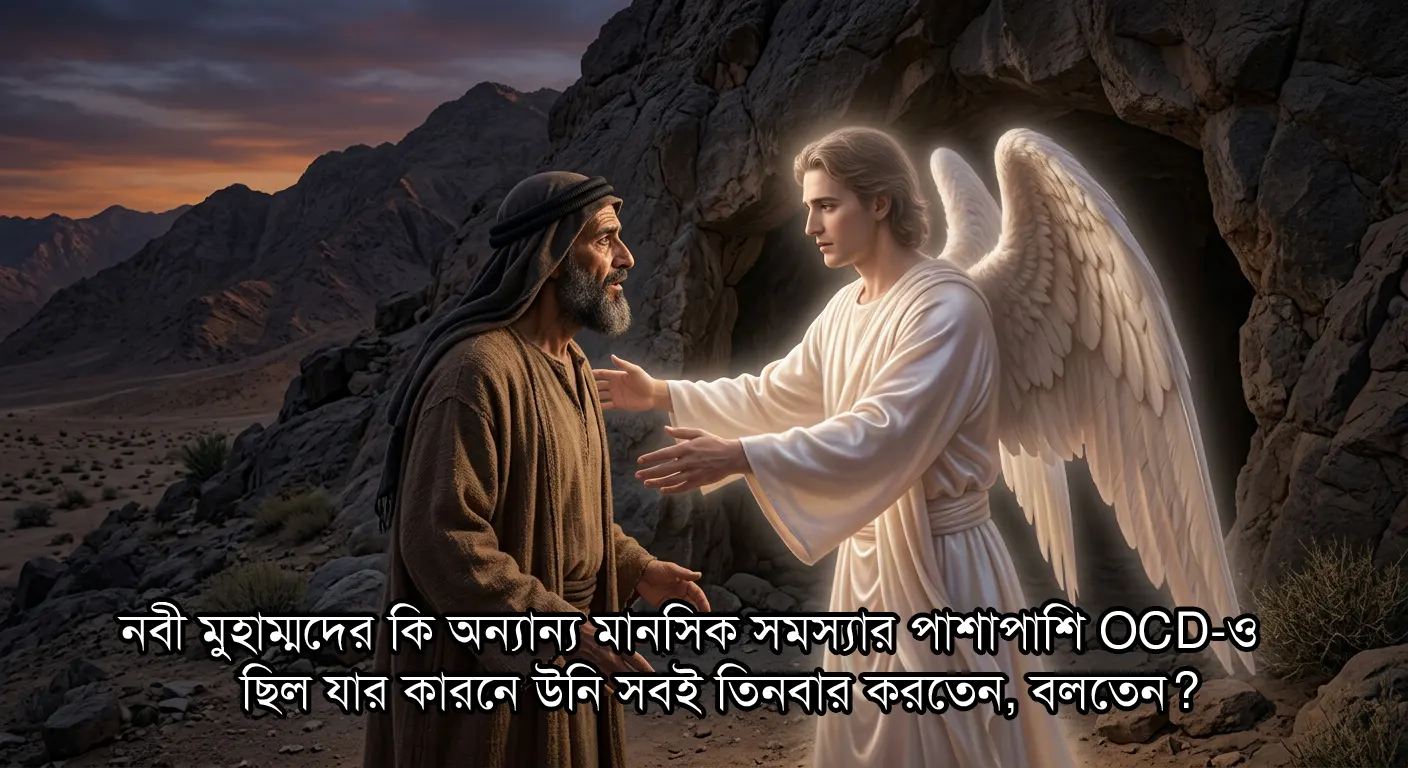
OCD and Prophet Muhammad
Did Prophet Muhammad have OCD along with other mental issues, which is why he used to do and say everything three times?
In Islamic rituals and practices, a clear pattern of three or odd numbers can be observed. Washing each limb three times during wudu, reciting tasbih three or thirty-three times in prayer, ending the witr prayer with an odd number of rak‘ahs, throwing pebbles seven times at each of the three pillars during the stoning ritual, and in hadith it is directly stated—“Indeed Allah is odd (witr), and He loves the odd” (Sahih al-Bukhari, Sahih Muslim). This pattern is so consistent that it does not seem to be a mere coincidence. The question is—what is the source of this tendency? Critics of Islam and some Orientalist researchers have offered various historical, social, and psychological explanations for this, which are discussed below. First, it needs to be made clear—most of these explanations are speculative, not supported by archaeological or medical evidence, because Islam does not have such archaeological relics and there is no consensus among historians on these issues. Some even think this is the result of a mental illness like OCD in the founder of Islam and the author of the Qur’an, Prophet Muhammad.
Roots of numerology in pre-Islamic Arab culture
A large group of critics argue that this interest in three and odd numbers was inherited from pre-Islamic Semitic and Middle Eastern cultures. In the ancient Babylonian, Phoenician and South Arabian Sabaean civilizations, numerology was an integral part of religious and magical practices. The number three was considered in those cultures as a symbol of completeness and divine balance—beginning, middle and end; or birth, life and death. In many ancient cultures, odd numbers were seen as “living” or “dynamic” and even numbers as “static” or “dead”, because odd numbers cannot be divided into equal parts—there remains a kind of “surplus” or mysterious element.
Followers of the Greek philosopher Pythagoras also considered odd numbers to be masculine, active and auspicious, and even numbers to be feminine, passive and less auspicious—critics believe that this way of thinking spread along the Mediterranean and Middle Eastern trade routes. Since Mecca was an important trade center in the desert for nomadic Bedouins and a meeting point of many cultures, they speculate that these ideas may have blended into the local Arab culture.
Folk beliefs and practices against magic
Some anthropological researchers (such as those in the tradition of the Orientalist Ignaz Goldziher) believe that in pre-Islamic Arabia, odd numbers were a folk-belief-based method of protection from the evil eye and malevolent forces. Repeating an action three times is seen in many folk traditions (not only in Arabia, but also in various cultures of South Asia, Africa and Europe) as a kind of “confirmation” or “seal”—once may be a mistake, twice may be a coincidence, but three times means it is “true” or “complete”. According to this reasoning, the threefold repetition in Islamic rituals is an institutionalization of this ancient folk psychology, which later gained religious legitimacy through the hadith literature.
Psychological hypothesis: The question of OCD or similar behavior
This is where the most controversial part of the question arises—did Muhammad’s personal mental state play any role behind this pattern? Some critics, especially in online Islam-critical circles and among some psychoanalytic writers, present the argument that the instruction to repeat actions three times in wudu or other rituals resembles a symptom of Obsessive-Compulsive Disorder (OCD)—particularly the well-known clinical pattern in OCD of “contamination obsession” (fear of impurity) and the resulting tendency to repeatedly wash hands or to repeat an action a specific number of times (checking/counting compulsion).
Muhammad had some mental illnesses—there are many signs of this in the descriptions of the Qur’an and hadith. When he started composing the Qur’an, the people of Mecca used to call him mad, and he often tried to commit suicide by jumping from mountains (Sahih al-Bukhari 6982, modern edition–6498, Islamic Foundation–6511). At those times, his imagined Gabriel would console him through verses of the Qur’an, telling him that he was not mad. The word “majnun” (mad/insane) appears a total of 16 times in the Qur’an—all of them refer to the people of Mecca calling Prophet Muhammad mad, and in response Allah, that is, Gabriel, refutes that accusation and consoles him. Read for yourselves—68:2, 15:6, 44:14, 7:184, 54:9, 26:27, 51:39, 51:52, 37:36, 52:29, 23:25, 23:70, 51:53, 2:275, 69:41, 81:22. When revelation came to Muhammad, he would lose consciousness; some even consider this a symptom of schizophrenia.
Sahih Muslim 162c states that Gabriel split open Muhammad’s chest, took out his heart, washed it with Zamzam water, and then put it back inside. In this way, the satanic portion was removed from Muhammad’s heart. There was even a companion who witnessed this event. Now, if you consider these to be characteristics of a normal human being, then nothing more can be said. According to Islam, the center of human knowledge, intellect, memory, sorrow, pain and joy is the heart, not the brain. Anyway, for many such reasons, many critics believe that Prophet Muhammad had OCD, which is why he would do or say the same thing three times. Even now, many religious scholars, such as Abdur Razzaq bin Yusuf, when they say something important, say it three times—you may or may not have noticed.
However, proponents of this argument also point out that in the hadith literature, using excessive water (four or more times) in wudu has been prohibited (described as “excessiveness”), which they believe indicates that even in that society, the tendency toward excessive repetition was a noticeable issue, and setting this limit may have been an institutional attempt to keep that tendency “under control”.
However, this hypothesis has important limitations, which must be mentioned in any intellectually honest analysis:
1. The problem of retrospective diagnosis – Giving a clinical diagnosis of the mental state of a person who died fourteen hundred years ago, and about whom the only source of information is religious literature (hadith) written by later generations, is methodologically problematic. Modern psychiatric diagnostic standards (DSM-5, etc.) rely on direct observation, interviews and long-term behavioral monitoring—which are completely absent in this case.
2. The historical reliability of hadith – Most hadiths were compiled 150–250 years after Muhammad’s death, through oral transmission. Therefore, whether any specific behavioral description truly reflects the personal habits of the historical Muhammad, or whether it was constructed later for theological or legal purposes, is a matter of deep scholarly debate within the field of Islamic studies (for example, the hadith-critical research of Ignaz Goldziher, Joseph Schacht and others).
3. Mistaking cultural patterns for personal symptoms – Since the fondness for three and odd numbers is not limited to Arab or Islamic culture alone, but is also present in Hindu rituals (Trimurti, circling three times), Christian theology (Trinity), Jewish tradition and many indigenous cultures, many researchers consider it more methodologically sound to view this as a universal human cultural pattern rather than as a symptom of a single individual’s mental condition.
Muslim theological explanations: The opposing perspective
Muslim scholars offer a completely different explanation of these practices. According to them—
- The preference for odd numbers is a symbolic expression of Allah’s oneness (tawhid)—Allah Himself is “one” (the root of odd numbers), so odd numbers are considered similar to Allah and believed to contain blessing (barakah).
- They interpret the instruction to repeat actions three times as a symbol of spiritual alertness and certainty—a practical method to increase focus and concentration in worship, not a symptom of illness.
- They present the hadith prohibiting the use of water more than four times in wudu as an argument in the opposite direction—this proves, they say, that Islam discourages excessiveness (extremism/waswasa) in religious practice and instead teaches a kind of balance.
In Islamic jurisprudential literature, there is a recognized concept called “waswasa” (whispering or excessive doubtfulness), which is somewhat similar to modern OCD—but in Islamic texts it is explained not as a disease, but as satanic whispering, and instructions are given to resist it (for example, not going beyond the prescribed number of repetitions).
Historical-social context: Mnemonic techniques in an oral culture
A less discussed but important explanation is that seventh-century Arabia was primarily an oral culture, where written records were rare. In an oral tradition, number-based repetition (saying something three times, doing something three times) worked as an effective technique for retaining information in memory and transmitting it verbatim across generations. In an era when poetry, genealogies and customs were preserved orally, numerical structures may have developed as natural mnemonic devices—which later entered religious rituals as well.
Conclusion
Overall, the most coherent historical explanation behind the prominence of three and odd numbers in Islamic rituals seems to be a combination of pre-Islamic Semitic and Middle Eastern numerology, folk beliefs and mnemonic techniques of an oral culture, which were later transformed into theological meanings. The hypothesis that some critics present regarding Muhammad’s personal mental state may be a thought-provoking observation, but due to the lack of verifiable historical data, it is not an established conclusion—rather, it is a conjecture that cannot be tested against the standards of impartial historiography. Instead of trying to reach a final verdict on this issue, it is more prudent to place the different explanations side by side and evaluate them together.
Related Posts
A random page from Muhammad’s self‑made book Qur’an and its unscientific statements
Sometimes I flip through random pages of Muhammad’s self‑made book Qur’an, and today this pageRead More
মুহাম্মদের বানানো কোরআন বই এর একটা র্যান্ডম পৃষ্ঠা ও সেখানকার অবৈজ্ঞানিক বক্তব্য
আমি মাঝে মাঝে মুহাম্মদের বানানো কোরআন বই এর র্যান্ডম পৃষ্ঠা উল্টাই, আজ এই পৃষ্ঠা হাতেRead More

The Iranian court sentenced them to death solely because they became Christians!
2009. Two young Iranian women, Marziyeh Amirizadeh and Maryam Rostampour, were sentenced to death byRead More
Comments are Closed