

Brutal Imam Mahdi in Iran
Thousands of people have been killed in Iran in the name of the Child Imam Mahdi, who disappeared around 1,200 years ago
The Islamic Republic of Iran is one of the rare states in the modern world whose power structure is centered on the concept of an absent and invisible Imam. According to Twelver Shia belief, the Twelfth Imam, Muhammad ibn Hasan al-Mahdi, was born in 255 AH (around 868 CE). At the time of the death of his father, the Eleventh Imam Hasan al-Askari, he was only about five years old. He then disappeared from public view, an event referred to as Ghaybah or occultation. During the first phase, which lasted about seventy years, it is believed that he communicated with his followers through four representatives. Around 941 CE, after the death of the last representative, the Greater Occultation began. By that calculation, more than eleven centuries have passed since his disappearance, although in popular language it is often described as “about twelve hundred years.” Shias believe that one day he will return and fill a world overwhelmed by injustice with justice.
For much of history, the dominant current among Shia scholars was one of political quietism or a policy of waiting. Many held that until the Imam returned, no human government could be fully legitimate, and therefore the role of the clergy was to provide religious guidance, not to govern the state. This idea was overturned by Ayatollah Ruhollah Khomeini. In a series of lectures delivered in exile in Najaf, Iraq, in 1970, he presented the theory of “Wilayat al-Faqih,” or the Guardianship of the Islamic Jurist. The argument was that society could not be left in the hands of un-Islamic rulers during the Imam’s absence; rather, a qualified and righteous jurist should assume the responsibility of governance on behalf of the Imam. After the 1979 Revolution, this theory became institutionalized as state doctrine.
After the revolution, a referendum overwhelmingly approved the establishment of the Islamic Republic, and a new constitution was adopted in late 1979. The preamble and Article 5 of the constitution explicitly state that during the occultation of the “Wali al-Asr,” or the Lord of the Age, the Twelfth Imam, the responsibility of leadership belongs to a just, pious, and qualified faqih. This faqih serves as the Supreme Leader, or Rahbar. After Khomeini’s death in 1989, Ali Khamenei assumed the position and retained it for nearly thirty-seven years. The Supreme Leader serves as commander-in-chief of the armed forces, appoints the head of the judiciary, and directly or indirectly influences the appointment of part of the Guardian Council. This council also has the authority to vet candidates for parliament, the presidency, and the Assembly of Experts. As a result, although elections are held, the boundaries of competition are determined in advance.
The religious significance of this structure is profound. Since the Supreme Leader is presented as the representative of the Hidden Imam, loyalty to him is framed not merely as a political obligation but as a religious duty. The inevitable consequence is that opposition to the ruler can easily be portrayed as opposition to religion itself. In Iranian law, charges such as “moharebeh” (waging war against God), “efsad fil arz” (corruption on earth), or “insulting the Leader” are legal expressions of this logic. The presence of Mahdi-centered belief is also evident in state culture. The Jamkaran Mosque in Qom is famous as a center of devotion to the Mahdi, and during Mahmoud Ahmadinejad’s presidency, the anticipated return of the Mahdi was frequently mentioned in official speeches. It should be noted, however, that not all Shia clerics accept the doctrine of Wilayat al-Faqih. Many influential scholars inside and outside Iran are critical of the theory.
The history of suppressing dissent has accompanied the Islamic Republic since its founding. In the first years after the revolution, thousands of members of opposition groups, including leftists and the Mujahedin-e Khalq, were imprisoned and executed. In 1988, after the end of the Iran-Iraq War, large numbers of prisoners were executed following secret proceedings, an event that human rights organizations have described as comparable to a massacre, with several thousand victims according to their estimates. Subsequent movements, including the 1999 student protests, the 2009 Green Movement, the 2017–18 economic demonstrations, the 2019 fuel-price protests, and the 2022 “Woman, Life, Freedom” movement following the death of Mahsa Amini, were all met with harsh state repression.
The protests of January 2026 became one of the bloodiest chapters in that continuing pattern. According to activists, thousands of people were killed and several thousand others arrested during the crackdown. Execution statistics are also alarming. According to a joint report by Norway-based Iran Human Rights and Paris-based ECPM, at least 1,639 people were executed in 2025, including 48 women. In the first three months of 2026 alone, 656 executions were documented, although the actual number may be higher because Iran was largely offline in March. A report published around April stated that seven people had already been executed in connection with cases related to the January protests, while at least 26 others had received death sentences, and hundreds more faced prosecution. Human rights organizations allege that these trials were rushed, conducted without due process or access to independent legal counsel, and relied on confessions obtained through torture as evidence. Woman among four more Iranians sentenced to death over protests +4
Against this backdrop came the case of the Tehran couple Mohammadreza Majidi-Asl and Bita Hemati. Branch 26 of the Tehran Revolutionary Court, under Judge Iman Afshari, sentenced them and two other detainees, Behrouz and Kourosh Zamaninejad, to death, five years’ imprisonment, and confiscation of all their property. The charge carrying the death penalty was “active cooperation on behalf of the hostile American government and hostile groups.” Other reports stated that they were accused of throwing concrete blocks at security forces from a residential building, and that they themselves were residents of the same building. Hemati is believed to be the first woman to receive a death sentence in relation to the protests. However, subsequent developments offered some hope. According to HRANA, Iran’s Supreme Court overturned the couple’s death sentences and referred the case to a parallel branch for retrial, while the death sentences imposed on the Zamaninejad father and son were also overturned. Bita Hemati remains imprisoned in the women’s ward of Evin Prison, while HRANA was still investigating the whereabouts of Majidi-Asl at the time of reporting. A retrial means that the risk has not entirely disappeared. Tehran Revolutionary Court Sentences Four Protest Detainees to Death +6
Meanwhile, dramatic changes have taken place at the highest levels of power in Iran. On February 28, 2026, the United States and Israel launched a joint attack on Iran, during which Supreme Leader Ayatollah Ali Khamenei was killed. On March 8, the 88-member Assembly of Experts declared his 56-year-old son, Mojtaba Khamenei, the new Supreme Leader. The selection has been controversial because the 1979 Revolution rejected hereditary rule, yet this appointment has effectively taken on the appearance of dynastic succession. According to one analyst, Mojtaba does not possess the same political and religious influence as his father, and decision-making power has become dispersed among multiple centers. On April 8, Iran and the United States agreed to a two-week ceasefire, although tensions remain high. Thus, the claim of representing Imam Mahdi now rests on another individual’s shoulders, and under the pressures of war the state may become even more security-conscious and more repressive. Live Updates: War returns to Iran with Israel, US strikes – DAWN.COM +4
However, it would be incomplete to explain the policy of repression solely through Mahdist doctrine. The interests of the Islamic Revolutionary Guard Corps (IRGC), the judiciary, and intelligence services, along with economic crisis, sanctions, and fears of regime collapse, all play significant roles. Tehran itself generally describes protesters as agents of foreign powers or terrorists, relying more on the language of “national security” than on religious doctrine. Nevertheless, where religious legitimacy is woven into the foundations of the state, political dissent naturally comes to be seen as dangerous, because it challenges not only the government but also what is portrayed as a sacred duty. The fate of people such as Bita Hemati and Majidi-Asl is therefore not merely the story of two individuals; it is a reflection of the long struggle between a belief-based state and its citizens’ aspirations for freedom. The outcome of their retrial will remain under close scrutiny from the international human rights community.
Related Posts

১২০০ বছর আগে হারিয়ে যাওয়া শিশু ইমাম মাহদীর নামে ইরানে হাজার হাজার মানুষকে হত্যা করা হয়
ইরানের ইসলামি প্রজাতন্ত্র আধুনিক বিশ্বের এমন এক বিরল রাষ্ট্র, যার ক্ষমতাকাঠামোর কেন্দ্রে একজন অনুপস্থিত, অদৃশ্যRead More
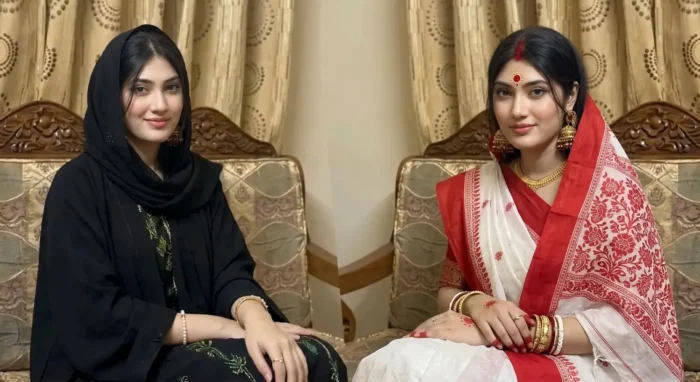
Ayisha and Arpita: A Story of Free Expression and Honesty Between Two Sisters, One Muslim and One Hindu
Ayisha and Arpita’s parents had dated for several years before marrying under Bangladesh’s Special MarriageRead More
আয়িশা ও অর্পিতা – মুসলিম ও হিন্দু দুই বোনের মুক্তবাক ও সততার গল্প
আয়িশা ও অর্পিতার বাবা-মা কয়েক বছর প্রেম করে বাংলাদেশের বিশেষ বিবাহ আইনে বিয়ে করেছিলেন। কেউRead More
Comments are Closed