

Morality vs Religion
Morality in the Name of Religion: Why Hiring 9,000 Religious Teachers Is a Failed Plan
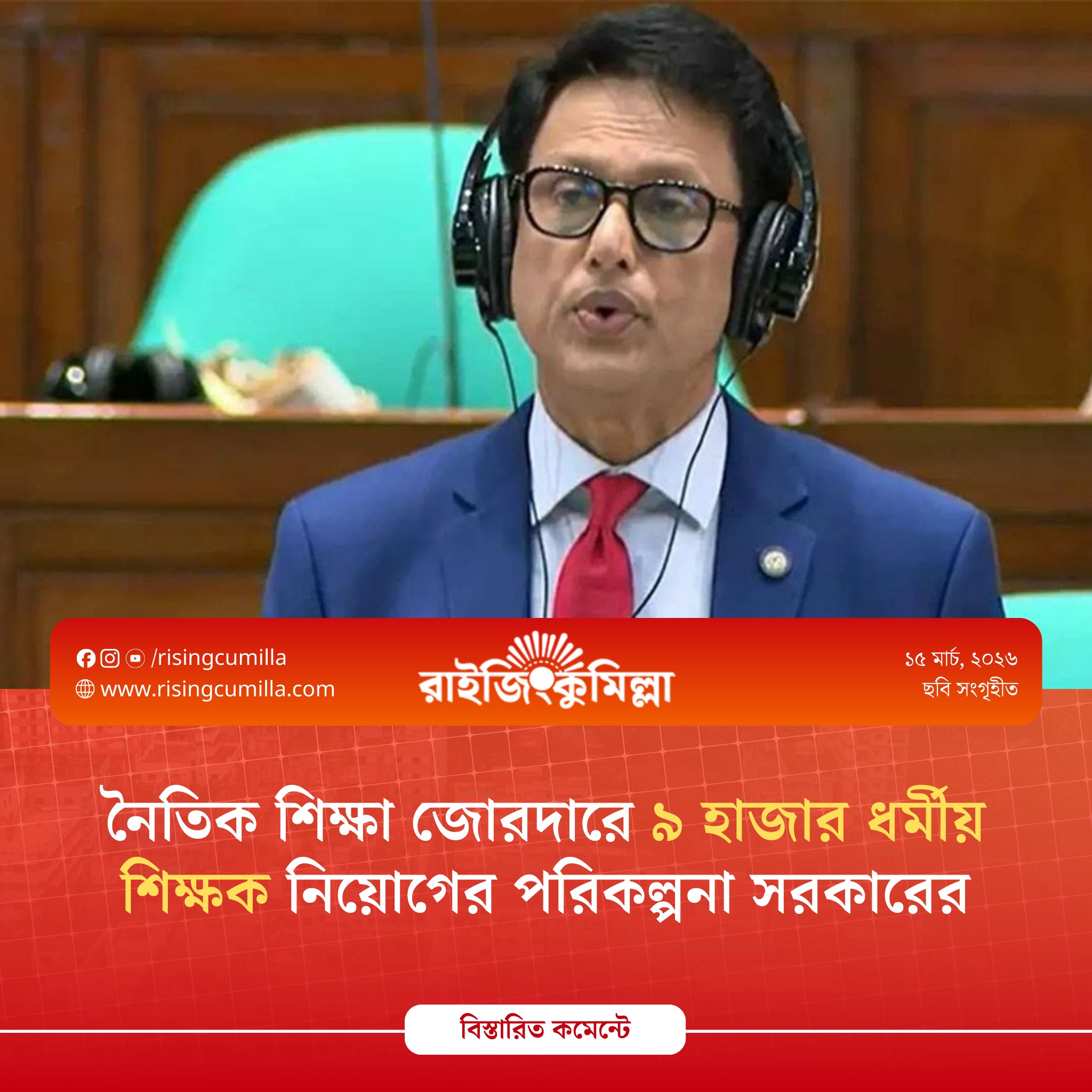
On March 15, 2026, at a session of the National Parliament, Bangladesh’s Education Minister A N M Ehsanul Haque Milon announced that 9,000 religious teachers would be appointed across the country to curb the decline of moral education. His argument was: injustice is increasing day by day in society, religious sentiment has weakened, therefore morality must be restored through religious education.
The question seems simple, but the answer is extremely complex. Because hidden behind this proposal is a fundamental misconception — that religion and morality are synonymous, and that increasing religious education improves society’s moral standards. History, sociology, and comparative research have repeatedly proven this notion false.
In this essay, we will attempt a comprehensive review — from the origins of religion to the experience of the modern world — to examine why this initiative will not work, and what actually needs to be done to establish genuine morality in society.
The Origins of Religion — Why and How?
To understand the emergence of religion, we must return to the dawn of human civilization, when people had no scientific tools to explain the mysteries of nature.
The Psychological Foundations of Religion
Evolutionary psychologist Pascal Boyer, in his influential work Religion Explained (2001), argued that religion emerged from certain fundamental cognitive capacities of humans — particularly from the human tendency toward “agency detection,” or the inclination to seek intention. Primitive humans looked for some “will” behind thunder, floods, or droughts. This cognitive process gradually gave birth to gods, spirits, and religious belief.
Anthropologist Edward Tylor (1871) proposed that the most primitive form of religion is “animism” — the imagination of life or spirit in every object of nature. From this, polytheism and monotheism gradually developed.
Social and Political Causes
The development of religion was driven not only by psychological factors, but also by social and political ones. Émile Durkheim, in The Elementary Forms of Religious Life (1912), showed that religion is fundamentally a social phenomenon — it holds society together, creates collective beliefs, and functions as an instrument of social control.
Karl Marx stated even more starkly: “Religion is the opium of the people.” In his view, religion has been used as a tool to make the oppressed forget their earthly suffering and to legitimize the power of the ruling class.
In summary: Religion emerged from the combination of human ignorance, fear, the need for social bonding, and the politics of power. Religion was not born to establish morality — morality is a social evolutionary process older than religion itself.
Which Came First — Religion or Morality?
This is an ancient philosophical question — Plato raised it in his Euthyphro dialogue.
Anthropological and evolutionary evidence says — morality came first.
Even among primates, we observe empathy, a sense of fairness, and mutual aid — where there is no religion. In primitive human societies, the notions of “do not harm others” and “share with one another” developed first out of necessity for group survival. Religion came later and gave these moral instincts structure, narrative, and sanctity.
Religion’s contribution was to codify morality, spread it across larger groups of strangers, and provide a supernatural reason to adhere to it.
Which Religion Has Lasted the Longest on Earth?
The longevity of a religion is not evidence of moral superiority; rather, it is a testament to the survival of social and political structures.
The oldest living religious tradition on earth is considered to be Hinduism or Sanatan Dharma, with roots going back at least 4,000–5,000 years to the Indus Valley Civilization. However, most remarkable are the animist and shamanist traditions — without ever taking institutional form, these have persisted in human societies for more than 40,000 years.
Judaism is approximately 3,500 years old. Buddhism and Jainism are more than two and a half thousand years old. Christianity is about 2,000 years old and Islam is about 1,400 years old.
What is notable is that throughout this long history, every religion has been involved in countless wars, persecutions, and injustices in the name of morality. Longevity is not a measure of moral success. Although religions have persisted for thousands of years, there are no historical or practical examples of them building morality in the societies they inhabited. On the contrary, almost every religion contains countless amoral directives, rituals, and examples of violence.
Which Is the Most Influential Religion?
By numbers, Christianity is the largest religion in the world today — with approximately 2.4 billion followers. Next is Islam — approximately 1.9 billion. Hinduism is third — approximately 1.2 billion.
But influence is not measured by numbers alone. Islam is the most discussed in today’s world politics, because it is a religion that seeks to directly intervene in matters of state, law, and social governance. Buddhism has had an unparalleled influence in the fields of philosophy and psychology.
But the important question is: when a religion becomes influential, does the society of its followers become the most moral? The data says — no. Religious influence plays no role in creating morality in society. Morality is a concept larger than religion; it is universal.
Why Did Europe Break Free from Religious Rule and Walk the Path of Civilization?
The history of Europe offers us the most important lessons.
The Darkness of the Middle Ages
In medieval Europe, the Catholic Church held supreme power. Thousands of people were killed in the name of the Inquisition. Galileo was imprisoned for speaking scientific truth. Rivers of blood were shed in the name of the Crusades.
Historian Barbara Tuchman, in A Distant Mirror (1978), showed that in medieval Europe, the greater the religious authority, the greater the violence, corruption, and ignorance in society.
The Renaissance and the Age of Enlightenment
Change came through the Renaissance (14th–17th centuries) and the Enlightenment (17th–18th centuries). Immanuel Kant declared: “Sapere aude!” — “Dare to think for yourself!” John Locke, Voltaire, Rousseau — these thinkers established that the foundation of morality is not divine command, but human reason and mutual social contract.
The French Revolution of 1789 separated religious authority from the state.
The American Constitution established the separation of church and state.
What Were the Results?
Sociologist Phil Zuckerman, in his research Society Without God (2008), showed that the Scandinavian countries — which are the least religious in today’s world — are also the least crime-prone, the happiest, and the most corruption-free.
Denmark, Sweden, Norway, Finland — only 20–30% of people in these countries consider themselves religious. Yet these countries consistently rank at the top of Transparency International’s Corruption Perception Index.
In contrast, the countries where religious practice is highest — Nigeria, Pakistan, Bangladesh, Afghanistan — rank highest in corruption and social instability.
Why Does Religious Discipline Fail to Build a Foundation of Morality?
This is the central question of this essay.
1. Fear-Based Morality vs. Conscience-Based Morality
Religious morality is fundamentally fear-based. People remain honest out of the fear of “punishment in the afterlife.” But psychologist Lawrence Kohlberg, in his theory of moral development, showed that morality arising from fear of punishment is the lowest level — it is “pre-conventional morality.”
Higher morality is that which a person practices from their own conscience, from a sense of responsibility toward fellow human beings — not out of fear of being seen or unseen. This morality develops through education, critical thinking, and the practice of empathy.
2. The Collapse of Morality in the Absence of Surveillance
Religious morality virtually always relies on the concept of divine surveillance. But research shows that when people believe no one is watching, they do not follow religious commands. Corrupt officials in Bangladesh also pray and fast — but do not stop taking bribes. Because their religious education has not changed them from within — it has only taught them external codes of conduct.
3. The Disconnect Between Religion and Morality
Philosopher Plato raised this question in his Euthyphro dialogue: “Is something good because God wills it, or does God will it because it is good?” If the first is true, then morality is arbitrary and dependent on the will of God. If the second is true, then morality has an independent foundation that existed even before divine command.
This “Euthyphro Dilemma” demonstrates that morality is not dependent on religion.
4. Religion Itself Is in Moral Crisis
The widespread instances of child sexual abuse in the Catholic Church, the epidemic of rape in madrasas, Islamist terrorism, the persecution of minorities in the name of Hindu nationalism — religious institutions themselves are victims of moral bankruptcy. How can a society be purified through institutions that claim to teach morality but are themselves repositories of immorality?
So Much Religion in Muslim Countries — Why So Much Instability?
This is a difficult but indispensable question.
Transparency International’s 2024 Corruption Perception Index shows that a large portion of the most corrupt countries are Muslim-majority: Somalia (repeatedly at the bottom), Syria, Yemen, Libya, Sudan, Afghanistan. Bangladesh, Pakistan, and Indonesia are also among the countries at the bottom.
Is Islam the cause? No. The reasons run deeper:
First: The Colonial Legacy. Most Muslim-majority countries were exploited for centuries under British, French, or other colonial powers. This exploitation left behind institutional fragility, poverty, and dysfunctional governance.
Second: Institutional Weakness. Without an independent judiciary, a free press, and a strong civil society, corruption will grow in any society — regardless of how much religion there is.
Third: The Absence of Accountability. Daron Acemoglu and James Robinson, in Why Nations Fail (2012), showed that what determines a nation’s rise or decline is whether its institutions are “inclusive” or “extractive” — not religion.
Fourth: Religion as a Political Tool. In Muslim-majority countries, religion is often used as a tool to legitimize rulers and distract the population. Saudi Arabia’s royal family loots billions of petrodollars, but buys moral legitimacy by pouring money into mosque construction.
In summary: the problems in Muslim-majority countries are not caused by Islam, but by the absence of institutional structures that hold people accountable. Religion cannot fill this void.
What Does Religious Education Look Like in Developed Countries?
Before British rule began in the Indian subcontinent, Hindus had many religious schools called Tols. A Tol is a learning center where Sanskrit was taught to produce priests and ritual performers. After India’s independence, these Tols were officially abandoned by the government. After the British arrived, Indian Hindu intellectuals expressed the view that studying Sanskrit in these Tols, without learning modern knowledge and science, would lead nowhere. Vidyasagar, one of Bengal’s great heroes, directly opposed the Tols and urged everyone to pursue the education system introduced by the British.
Nadia was once famous as a factory for producing Hindu scholars. That district, covering nearly 4,000 square kilometers and home to 5.2 million people, has seen its Tols dwindle to just 25. These Tols receive no government grants or special support. Hindus abandoned the Tols and progressed greatly in education and learning through the blessings of modern schooling.
On the other hand, in Bangladesh, not only have religious educational institutions multiplied one after another, the government now provides significantly more patronage. And now the Education Minister announces that even this is not enough — 9,000 religious teachers will be appointed in regular schools.
In the countries considered advanced in education, science, morality, economics, and the rule of law, there are no religious textbooks in the education system. In many countries, even wearing clothing or symbols that carry religious identity is prohibited in schools.
| Country | Status |
|---|---|
| United States | Religious education in public schools is constitutionally prohibited |
| France | Strict Laïcité policy — no religion in public schools |
| Japan | No religious education in public schools |
| Finland | “Religion and Ethics” is taught — comparatively and non-doctrinally, not from any specific religion’s textbook |
| Germany | Optional religious classes exist, but alternative ethics courses are also available |
| Norway/Sweden | Comparative study of all religions — no single religion is imposed |
| India | Under Article 28 of the Constitution, religious education in government-funded schools is prohibited |
The key difference is: Developed countries treat religion as a personal matter. The state teaches morality, critical thinking, and citizenship — not the truth of any particular religion.
The bottom line: Societies that have kept religious education separate from the state generally show stronger educational standards, greater social trust, and higher moral indicators — this is a notable statistical trend.
Why Will Appointing 9,000 Religious Teachers Not Work?
Now let us turn to the central question.
1. Confusion of Cause and Effect
The Education Minister’s argument is: religious education has declined, therefore immorality has increased. But this is a reversal of the causal reading. In Bangladesh, the quantity of religious education has never declined — the number of madrasas, the number of waz mahfils, the number of mosques — all have only grown. And yet corruption has increased, violence has increased, and people’s freedom of speech and personal liberty have diminished. This data itself proves that increasing religious education does not increase morality.
2. Who Are the Teachers? — A Crisis of Qualification
The Education Minister himself has acknowledged that there are complications with recognizing the certificates of Qawmi madrasa students. This complication means that the teachers who will be appointed will have received their core education through rote memorization of Arabic texts and religious rituals. Critical thinking, moral philosophy, and civic education were not part of their curriculum.
How will those who are not themselves skilled in critical moral thinking teach morality to children?
3. Whose Morality? — A Clash of Values
Morality is a contested domain. Will religious teachers teach that women have equal rights? That people with differing opinions must be treated with respect? That obeying the laws of the state is a moral obligation that goes beyond religion? Many religions contain elements that contradict the laws of modern states. Bangladesh itself has countless laws that run counter to religious norms. Will religious teachers prioritize those laws over religious teachings?
In most cases, religious education provides narrow, group-centric perspectives in answer to these questions — not universal human values.
4. What Does the Research Say?
Gregory Paul’s 2009 study “The Chronic Dependence of Popular Religiosity upon Dysfunctional Psychosociological Conditions” — published in the Journal of Religion and Society — showed that high religiosity has a positive correlation with social problems (crime, poverty, inequality), not a negative one. That is, countries with greater religious influence also have greater social problems.
5. A Waste of Resources
The real crisis in Bangladesh’s education system is: there are insufficient science teachers, no ICT infrastructure, substandard textbooks, inadequate teacher salaries, no quality teacher training, many teachers who are not sufficiently skilled, and no beautiful or ideal environment for children’s education. Appointing 9,000 religious teachers without addressing these fundamental crises will be a clear waste of limited resources.
6. Political Motives
The political calculation behind this decision by the BNP government is clear. Such steps are taken to appease religious voters and madrasa-based political establishments — not for the genuine moral advancement of society. This is populist politics.
What Actually Needs to Be Done to Improve Society’s Moral Standards?
So what is the right path?
1. Build Accountable Institutions
The most effective driver of morality is accountability. An independent and strong anti-corruption agency, a robust judiciary, a free press, and an active civil society — when these exist, people remain aware of the consequences of acting immorally.
Corruption is low in Finland or Denmark because if you commit corruption there, you are almost certain to be caught and punishment is inevitable — not out of the “fear of God.”
2. Teach Critical Thinking
Finland’s education system is the best in the world because it teaches children to ask questions, not to memorize. Bangladesh’s education system must seriously incorporate critical thinking, ethics, civic education, and philosophy.
3. Reduce Economic Inequality
Research shows that inequality drives crime and unethical behavior more than religion or irreligion does. Richard Wilkinson and Kate Pickett, in The Spirit Level (2009), proved that in unequal societies — whether religious or not — social problems are greater.
Ensuring fair wages, social protection, and equality of opportunity in Bangladesh is far more effective than religious education.
4. Civic Education and Social Responsibility
In Japan, Germany, or Canada, civic education is a fundamental subject. Children learn that they are part of a society, and that their behavior affects others. This empathy-based, socially conscious education builds a far deeper morality than religious commands.
5. Raise the Status and Salaries of Teachers
In Finland, teaching is one of the most prestigious professions. Teachers are well-paid and socially respected. In Bangladesh, due to inadequate salaries and low social status of primary school teachers, talented individuals do not want to enter the profession. Before appointing religious teachers, improve the conditions of existing teachers.
6. Political Will Against Corruption
Most importantly — change must come from the top. If ministers, members of parliament, and bureaucrats commit corruption and get away with it, then no religious education will be able to inspire ordinary people to remain honest. “A fish rots from the head down” — this proverb is always true.
Conclusion
Bangladesh’s religious population believes that the Education Minister’s proposal to appoint 9,000 religious teachers is undoubtedly made with good intentions. But good intentions walking the wrong path yield no results. History, sociology, and comparative research all say the same thing: there is no positive relationship between the quantity of religious education and the moral standards of society.
Morality is born from accountability, empathy, education, justice, and economic security. Without building these foundations, increasing the number of religious teachers will be — like pouring more water into a broken vessel.
Philosopher Bertrand Russell said: “The good life is one inspired by love and guided by knowledge.” A good society is similar — inspired by love and empathy for others, and guided by knowledge and reason. An evolving religion can be a fellow traveler on this path — but as a guide, it has repeatedly failed.
The opportunity before Bangladesh is to build a modern, scientifically minded, humane, and accountable state — where every citizen remains honest not out of fear, but out of conscience. To reach that goal, what is needed is not religious teachers, but honest politicians, independent judges, talented educators, a nurturing environment for children, the spread of scientific inquiry, and a just society.
Bibliography and References
- Boyer, Pascal. Religion Explained: The Evolutionary Origins of Religious Thought. Basic Books, 2001.
- Durkheim, Émile. The Elementary Forms of Religious Life. 1912.
- Tylor, Edward B. Primitive Culture. 1871.
- Kohlberg, Lawrence. The Psychology of Moral Development. Harper & Row, 1984.
- Zuckerman, Phil. Society Without God: What the Least Religious Nations Can Tell Us About Contentment. NYU Press, 2008.
- Acemoglu, Daron & Robinson, James. Why Nations Fail. Crown Publishers, 2012.
- Paul, Gregory. “The Chronic Dependence of Popular Religiosity upon Dysfunctional Psychosociological Conditions.” Journal of Religion and Society, 2009.
- Wilkinson, Richard & Pickett, Kate. The Spirit Level: Why Equality is Better for Everyone. Penguin, 2009.
- Tuchman, Barbara. A Distant Mirror: The Calamitous 14th Century. Knopf, 1978.
- Russell, Bertrand. What I Believe. Routledge, 1925.
- Plato. Euthyphro. (399–395 BC)
- Kant, Immanuel. What is Enlightenment? 1784.
- Transparency International. Corruption Perception Index 2024.
- Bangla Tribune, Desh Rupantor, and other Bangladeshi news outlets — March 15, 2026: News reports regarding “Appointment of 9,000 Religious Teachers.”
Related Posts
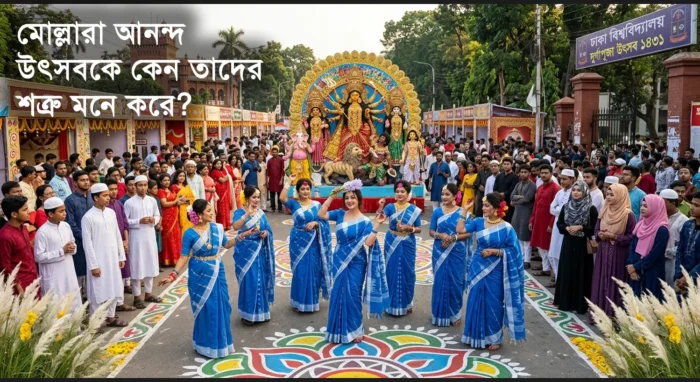
Why do Islamist clerics consider Bengali cultural festivals their enemy?
This year, unlike many previous years, the major Hindu religious festival Durga Puja in BangladeshRead More
ইসলামিস্ট মোল্লারা কেন বাঙালিদের আনন্দ উৎসবকে তাদের শত্রু মনে করে?
এবার বাংলাদেশে অন্যবারের তুলনায় বেশ শান্তিপূর্ণ, উৎসবমুখর পরিবেশে হিন্দু ধর্মের বড় ধর্মীয় উৎসব দূর্গাপূজা হয়েRead More
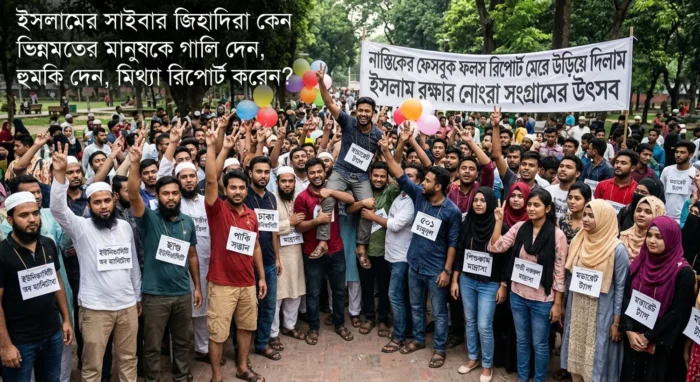
Why do Islamist cyber‑jihadis insult, threaten, and file false reports against people with different opinions?
Maulana Azhari once advised Islamists that sharing his Facebook posts is also an Islamic act;Read More
Comments are Closed