
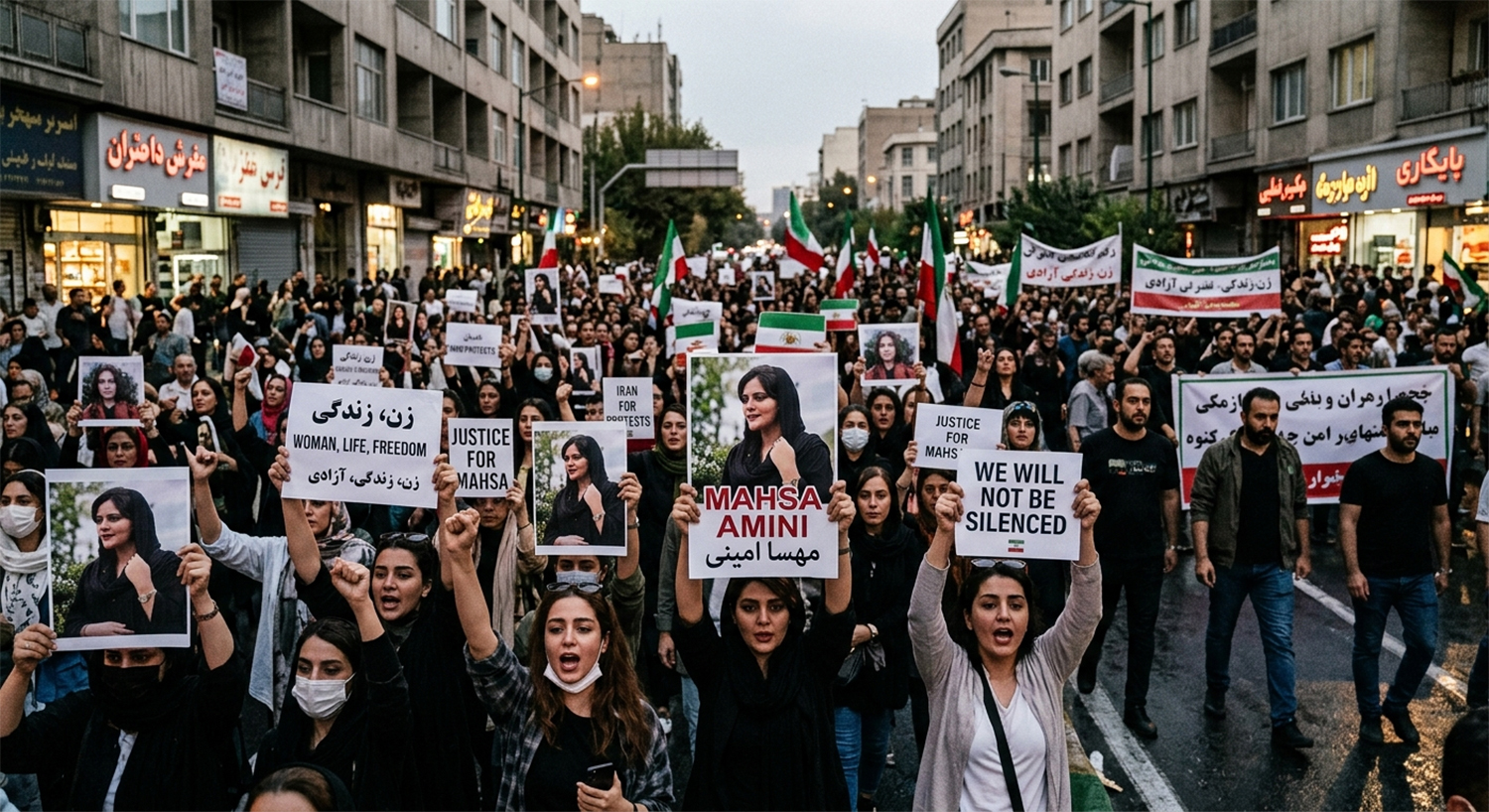
Mahsa Amini
Mahsa Amini – a witness to ‘Woman, Life, Freedom’ and a protest
A protest on February 11, 2023 — a protest march and rally encountered along the way. Nearly all of the thousands of people gathered here are Iranian.
I was walking down the street when suddenly I saw a flood of people. Banners, slogans, tears in their eyes — but those same eyes held a fierce, unwavering fire. Out of curiosity, I fell into step with them. Within moments I understood — this was not merely a march. This was the heartbroken cry of a nation, a collective human protest against the barbarism of religious despots ruling over a historically magnificent civilization.
Mahsa Amini — A Name, A Movement
Mahsa Amini was a young Kurdish woman from Iran. Just twenty-two years old. An ordinary girl, living with ordinary dreams. But in 2022, she died in the custody of Iran’s morality police — and that death was no longer just a death. It became a symbol of resistance for hundreds of millions of people around the world.
September 13, 2022. In Tehran, the morality police — known in Iran as the “Gasht-e-Ershad” — detained Mahsa. The charge? Not wearing her hijab properly. On this single charge alone, she was taken away in a police van. Eyewitnesses reported that she was beaten inside the van. Within hours she lost consciousness and was admitted to the hospital.
September 16, 2022. Mahsa never came back.
The Iranian government said — heart attack. Mahsa’s family said — we handed over a healthy daughter to the police, and received a corpse in return. Hospital photographs spread across social media — the marks of head injuries clearly visible.
“Woman, Life, Freedom” — The Fire Spread Across the World
After Mahsa’s death, millions of people took to the streets of Iran. Women publicly removed their hijabs and cut their hair. Young people set fire to morality police vehicles. The slogan rang out — “Zan, Zendegi, Azadi” — Woman, Life, Freedom.
This movement was not merely against the hijab. It was against decades of state oppression, against the control of women’s bodies and minds in the name of religion — an explosion from a nation exhausted by it all.
The movement spread to every corner of the world. Europe, America, Canada, Australia — wherever Iranian diaspora communities exist, the torch of protest blazed. I was part of one of those marches that day.
In One Corner of the March — Khamenei’s Mask and a Satanic Verses Banner
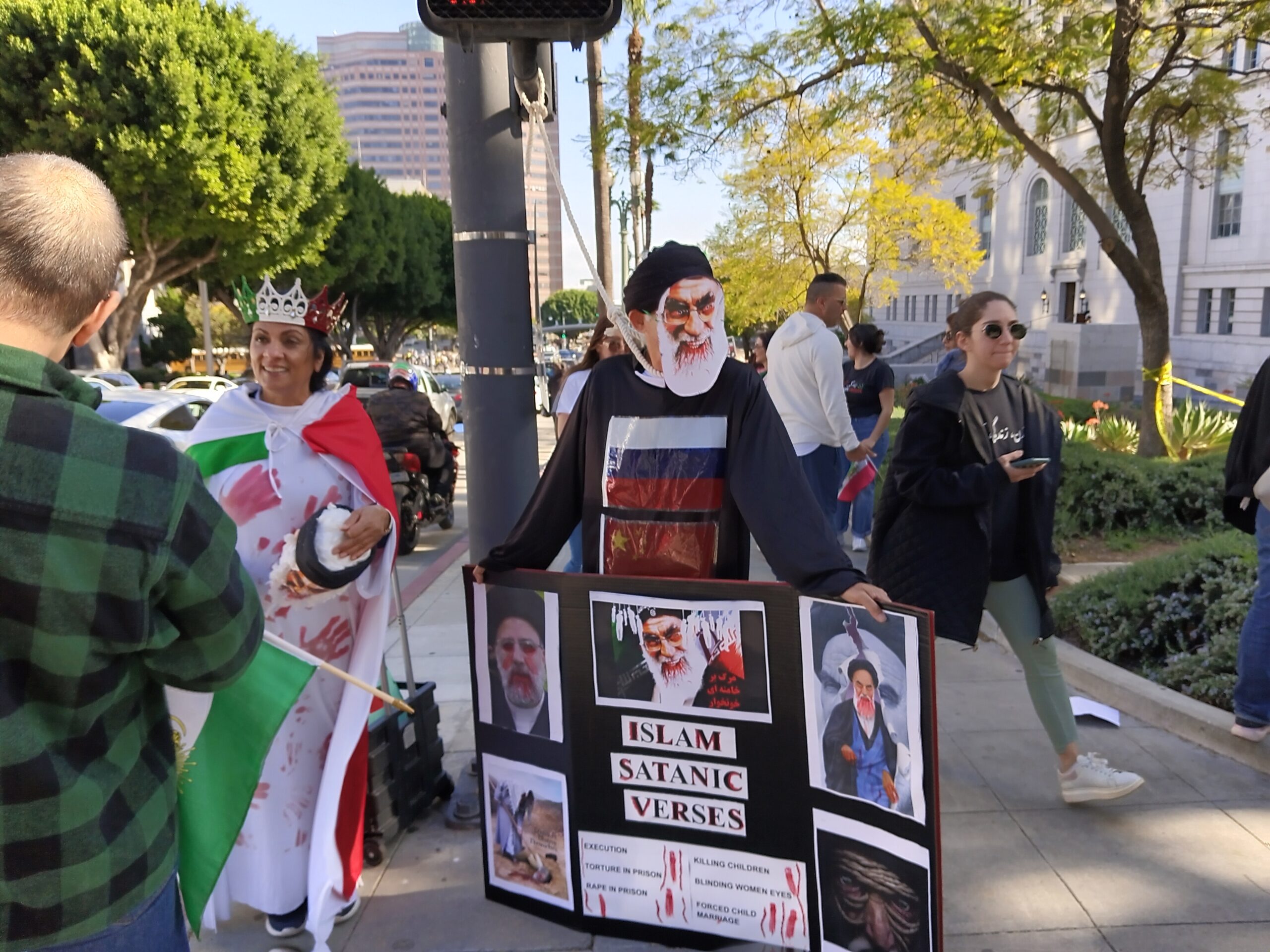
Standing in one corner of the march was a man. On his face — a mask of Iran’s Supreme Leader Ali Khamenei, worn mockingly, symbolically. His banner read — “Islam Satanic Verses“.
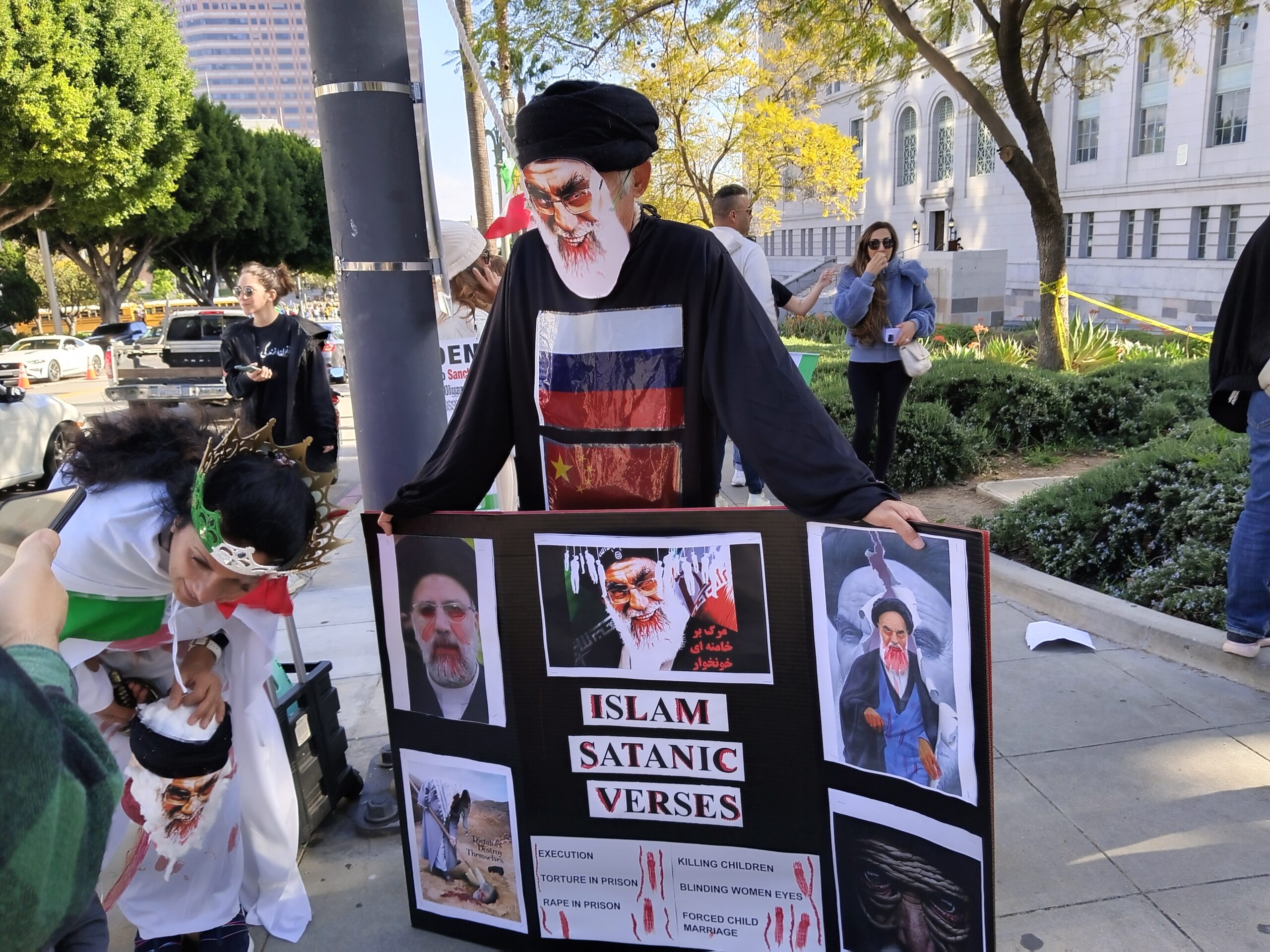
For those who may not know — “The Satanic Verses” is a novel by Indian-born British author Salman Rushdie, published in 1988. Shortly after the book’s publication, Iran’s then-Supreme Leader Ayatollah Khomeini issued a fatwa against Rushdie — announcing a bounty of millions upon his head. That fatwa remains in effect to this day.
From that point on, Salman Rushdie’s life became one of torment — years in hiding, a life surrounded by security guards. In August 2022, at a literary event in New York, he was gravely wounded in a stabbing attack by a Muslim extremist. He lost one eye. This was the price paid for writing a single book.
Are There Really “Satanic Verses” in the Quran?
Here an important historical question arises.
Many sources from early Islamic history — including prominent Muslim historians such as Ibn Ishaq and al-Tabari — mention that at one time the Quran contained certain verses that acknowledged three of Mecca’s principal goddesses: Lat, Uzza, and Manat. It was later claimed that Satan had deceived the Prophet into receiving those verses. They were consequently revoked.
Muslim theologians reject this account entirely. Many argue it is a fabricated story invented by enemies of Islam. But the question that lingers is this — is the Quran an immutable, unaltered text? Or is the history of its compilation and editing far more complex than commonly acknowledged?
History tells us — during the caliphate of Uthman, various versions of the Quran were burned and a single standardized version was established. The copies of the Quran held by different companions of the Prophet did not always agree with one another. This reality is acknowledged by Muslim scholars themselves.
In Salman Rushdie’s novel, this very historical question was presented through a literary lens. His “crime” was asking a question. Writing a book.
The Questions That Remain
Walking through the march that day, I kept thinking — how courageous these people are. If they returned to their own country, they would face imprisonment, torture, even death — and yet here they are, on the streets. For Mahsa. For their mothers. For their sisters. For the thousands still imprisoned in Iran.
Mahsa Amini’s death has left us with questions — does any state have the right to police the cloth on a girl’s head? How much power can a government claim in the name of religion? And when someone speaks out against that power — a writer, a woman, a movement — is silencing them the answer?
History tells us — fire cannot be suppressed forever.
Mahsa Amini’s death was a spark. That fire is still burning.
“Zan, Zendegi, Azadi” — Woman, Life, Freedom.
Iran — the land of the once-glorious Persian civilization, a civilization that gifted the world with mathematics, medicine, poetry, and priceless architectural heritage — today the people of that land are prisoners of a peculiar religious despotism. The system of governance that has ruled Iran since the 1979 revolution is not grounded in any modern concept of statesmanship. Rather, its legitimacy rests upon the awaited return of an Imam who disappeared as a child over fifteen hundred years ago — Imam Mahdi. A state is being governed in the name of representing someone no one has ever seen, whose existence lives only in the depths of belief. Behind this illusory foundation, the control of women’s bodies and minds continues unchecked, dissenting voices are suppressed, and generation after generation, a brilliant nation is kept shackled in fear and subjugation.
The history of human civilization bears witness — when power, wielded in the name of religion, tramples upon the fundamental dignity of human beings, the fall of that power becomes inevitable. Mahsa Amini’s death, the Iranian women who cut their hair in the streets in protest, the thousands of young people imprisoned — each of them is a herald of that inevitable change. To all those around the world who believe in humanity, there is today one single prayer — may the people of historically rich Persia find freedom, may the machinery of a state run under the guise of religious barbarism come to an end, and may humanity one day truly know the face of freedom.
Related Posts
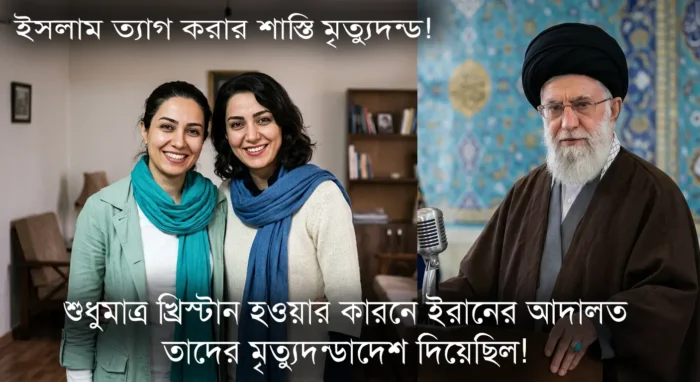
The Iranian court sentenced them to death solely because they became Christians!
2009. Two young Iranian women, Marziyeh Amirizadeh and Maryam Rostampour, were sentenced to death byRead More
শুধুমাত্র খ্রিস্টান হওয়ার কারনে ইরানের আদালত তাদের মৃত্যুদন্ডের আদেশ দিয়েছিল!
২০০৯ সাল। ইরানের দুই তরুণী মারজিয়েহ আমিরিজাদে ও মরিয়ম রোস্তামপুরের বিরুদ্ধে ঝুলিয়ে ফাঁসি দেওয়ার রায়Read More
Spending the night in Umm Hani’s house and then meeting Allah in the heavens – he named it Mi’raj
Mi’raj is a central event in Islamic belief. On the night of Mi’raj, the ProphetRead More
Comments are Closed