
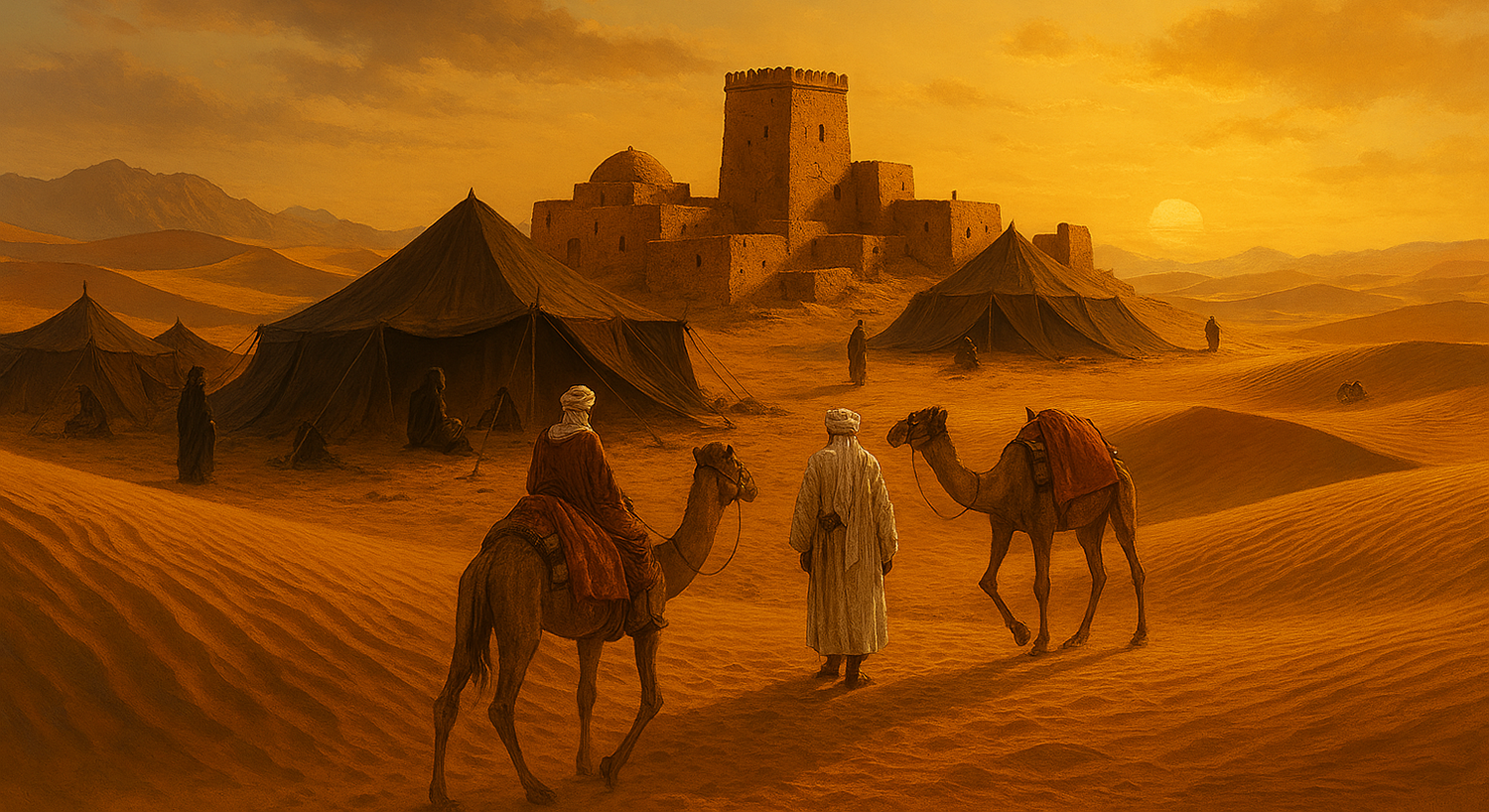
Islam’s falsehoods in the name of the Jahiliyyah era
The Deceptive Narrative of “Ayyam al‑Jahiliyyah” and the Historical Reality
The Muslim propaganda about the “Age of Ignorance” (Ayyam al-Jahiliyyah) is actually a form of historical distortion. They present the matter in such a way that it seems as if the entire world was plunged into darkness before the arrival of Islam, and that there was no trace of knowledge, science, or civilization anywhere. But the reality is completely different. Islam emerged only about 1,400 years ago, yet centuries before that, knowledge, philosophy, science, literature, and civilization had already flourished in various parts of the world. In Greece, Rome, Egypt, the Indian subcontinent, and China – everywhere – the light of knowledge had already spread.
In Greece, philosophers and scientists like Socrates, Plato, Aristotle, Pythagoras, Hippocrates, and Democritus were born long before the birth of Prophet Muhammad. They had worked on topics such as the spherical shape of the Earth, the reflective nature of moonlight, geometry, medical science, philosophy, and politics. Universities, schools of philosophy, and medical colleges had already been established in Greece at that time. Later, Muslims translated these Greek texts and enriched their own repository of knowledge with them. In other words, Islam did not create any new knowledge; it simply borrowed from the knowledge of previous civilizations.
Islamists often cite a verse from the Quran – “He made the sun a shining light and the moon a derived light…” (Surah Yunus 10:5) and “He made the moon a light and the sun a lamp” (Surah Nuh 71:16) – to claim that the Quran, or Prophet Muhammad, stated 1,400 years ago that the moon has no light of its own. They ask: Did anyone know this before? The Quran does not explicitly say “the moon reflects the light of the sun,” but it clearly highlights the difference in the nature of the light of the sun and the moon. The reality, however, is that nearly a thousand years before the birth of Prophet Muhammad, the idea that the moon has no light of its own was already established in philosophical knowledge. This concept was first clearly explained by the ancient Greek philosopher Anaxagoras (Anaxagoras, 500–428 BCE). He stated that the moon reflects the light of the sun. Anaxagoras was the first to argue that the moon does not produce its own light but reflects sunlight, and he also mentioned that the moon has mountains and valleys.
A similar picture can be seen in the Indian subcontinent. Aryabhata worked on astronomy, Baudhayana gave mathematical formulas, and Charaka and Sushruta made groundbreaking contributions to medical science. Sushruta mentioned surgery and plastic surgery in his texts. All these works were completed many centuries before the birth of Prophet Muhammad. Later, Ibn Sina (Avicenna) translated these texts into Arabic and made them available to Muslim physicians. Thus, pre-existing knowledge became the foundation for Muslim scholarship.
At that time, Prophet Muhammad did not say anything that the people of contemporary Arabia did not already know. In fact, the philosophers and scholars of Arabia were, in many respects, more advanced in thought, consciousness, philosophy, literature, and music than Muhammad. In comparison, the Prophet was quite backward, rigid, and opposed to literature and culture. Because through the Quran and Hadith, he prohibited cultural activities, singing, music, and literature. Apart from intimacy with wives and slave girls, horse riding, and archery practice, he forbade almost all other forms of games and sports.
In pre-Islamic Arab society, poets, singers, and musicians were considered people of high social status. According to historical sources, some advanced string instruments (lyres) had reached Arabia from Persian and neighboring regions. Music was mainly the melodious recitation of poetry, which Arabs regarded as “singing.” The most common instruments were the flute and the daf (tambourine). Music served as a medium for expressing all kinds of emotions – tribal festivals, motivation before war, love, and grief.
The most advanced art of the pre-Islamic Arabs was poetry. It was called “Diwan al-Arab” – the repository of Arab history. Poetry served as a record of history, genealogy, wars, love, and desert life. The poet (sha’ir) was the spokesperson and propagandist of the tribe, sometimes enjoying a status akin to a prophet. Famous pre-Islamic poets included Imru’ al-Qais, Umayya ibn Abi al-Salt, al-Nabigha, and al-A’sha. However, after the arrival of Islam, Prophet Muhammad began to view poetry as his enemy, because poets criticized his regressive way of thinking. Islam instructed that literature and poetry should only praise Prophet Muhammad and Allah. Could any self-respecting artist or poet accept this? That is why in the biographies of the Prophet by Ibn Ishaq, Ibn Hisham, Tabari, and in authentic Hadith, there are accounts of poets being killed. These sources cite criticism of the Prophet or incitement against Muslims as the reason. There are narrations that Muhammad sent secret assassins to kill poets. The list of such killings includes Ka’b ibn al-Ashraf, Abu Afak, Asma bint Marwan, and others.
In pre-Islamic southern Arabia, particularly in Yemen, there existed advanced civilizations centered on trade and architecture. Northern Arabia was more nomadic, where poetry and music were the primary arts. Visual arts were limited to inscriptions and rock carvings. There is plenty of historical evidence and proof in support of this. Can you provide any neutral historical evidence in favor of the Islamic narrative during this period?
Music was a well-established art in pre-Islamic Arabia. The musical instruments used were part of the broader musical tradition of the Middle East. String instruments such as the oud, rebab, and lyre; percussion instruments like the daf/duff and drums; and wind instruments such as the mizmar/flute and other aerophones were very popular in Arabia. According to research, for thousands of years in the Arabian Peninsula, a large proportion of musicians were women. Female singers (singing girls) were central figures in the musical world.
Now the question arises: Was the entire Arabian Peninsula really plunged into darkness before Islam, as Islamists call it the “Age of Ignorance” (Jahiliyyah)? History says no. There may have been backwardness in some regions, but it is incorrect to label the entire Arabia as Jahiliyyah. Even before Islam, there was interest in literature, poetry, medicine, astronomy, and philosophy in Arabia. Poets such as Imru’ al-Qais, Tarafa ibn al-Abd, Ka’b ibn al-Ashraf, and Asma bint Marwan (whom I mentioned earlier) existed, and their poetry is often compared to the language of the Quran. Many researchers have even argued that parts of the Quran were written in imitation of pre-Islamic poetry – and there is sufficient evidence to support this claim.
The physician Harith ibn Kalada, who was a cousin of Prophet Muhammad, was a famous doctor even before Islam. He was invited to the court of the Persian emperor. It is from his knowledge that Muhammad learned about Galen’s theories on embryology. Yet later, during Islamic rule, he was killed.
In Egypt too, the light of knowledge was burning before Islam. Hypatia was the world’s first known female mathematician and philosopher. The Library of Alexandria was one of the greatest repositories of knowledge in the ancient world. But it was destroyed during Islamic rule. As a result, in many places, the light of knowledge was extinguished rather than kindled after the arrival of Islam.
Another common propaganda is that before Islam, Arabs used to bury their female infants alive. However, there is no neutral historical evidence for this claim. It is found only in Islamic sources. In reality, some tribes may have killed their daughters out of fear of war, so that they would not be captured by enemies and raped. As you know, even before Islam, it was a common practice in Arabia to capture women from defeated tribes in war, treat them as booty, and rape them for years. They were also sold in markets. This horrific custom was not only continued but religiously sanctioned and upheld by Islam and Allah. In that context, some parents may have killed their daughters to protect their honor and the tribe’s dignity. But this was extremely rare, not the general picture. On the other hand, a religion that claims to be divine came and legalized the rape of war captives, treating women as spoils of war – how should we view this? In those days, Arab men practiced polygamy. As you know, how many wives did Prophet Muhammad and his companions have? If female infants were being buried alive in large numbers, where did they get so many women for marriage? Are there examples of hundreds of men remaining unmarried due to a shortage of women?
Muslims claim that before Islam, women had no status or rights. But history says otherwise. Khadija was an independent businesswoman who took responsibility for Muhammad’s life by marrying him. Hind bint Utbah was an influential woman who lived independently. Asma bint Marwan was a poetess. Sulafa and Hubba were entrusted with the keys of the Kaaba. The pagans worshipped female goddesses – Al-Lat, Al-Uzza, and Al-Manat. This shows that there was respect for women. Yet Islam came and confined women to the home, stating that women were created only to serve their husbands and raise children. In Islamic law, a woman’s testimony is not fully acceptable, and women are described as the most harmful thing for men – called a bad omen, horse, devil, dog, etc. In other words, Islam does not consider women as complete human beings.
In pre-Islamic Arab society, the social position of women varied by tribe, but in many regions, women enjoyed relatively greater freedom according to various historical sources. In some tribes, women could marry multiple times, had the right to divorce their husbands, engaged in trade, were known as poets and leaders, and even participated in wars. Women like Khadija, Hind, and al-Khansa played important roles in trade, poetry, and tribal leadership. After the arrival of Islam, new rules were introduced regarding family structure, inheritance, marriage, and gender roles. Many researchers argue that these changes restricted some of the freedoms that existed in pre-Islamic Arab society and established a more patriarchal structure. In particular, the reduction of women’s power in divorce, permission for men to have multiple wives, and the legalization of using slave women – these changes are interpreted by many historians as a reorganization of social power in favor of men.
Additionally, Quran 4:34 gives husbands permission to “discipline” their wives in cases of “nushuz” (disobedience), including beating them – which in later interpretations has been used both in mild and harsh ways. Critics say this ruling gives religious legitimacy to male authority and weakens the idea of women’s physical safety and equal dignity. Slavery existed in pre-Islamic Arabia, but Islamic law maintained the permission to use female slaves as sexual partners, thereby establishing women’s bodies as part of male ownership. Although Islam provided some limited protections for women after its arrival, overall, the social structure became more strongly patriarchal, and women’s freedoms were curtailed compared to certain pre-Islamic tribal customs.
All in all, the world before Islam was not plunged into darkness. On the contrary, in Greece, India, Egypt, China, and Arabia – everywhere – knowledge, science, literature, philosophy, medicine, mathematics, and astronomy had developed. Islam did not create anything new; it borrowed from previous civilizations. By borrowing some knowledge, mixing in stories and superstitions, Islam actually pushed humanity further backward in many respects. Women’s rights were comparatively greater before Islam. Therefore, the Muslim propaganda about the “Age of Ignorance” is nothing but historical distortion. Before Islam, people were knowledgeable, civilized, and culturally rich. Islam, in many ways, restricted freedoms, took away women’s rights, and extinguished the light of knowledge.
Related Posts
Ayisha and Arpita: A Story of Free Expression and Honesty Between Two Sisters, One Muslim and One Hindu
Ayisha and Arpita’s parents had dated for several years before marrying under Bangladesh’s Special MarriageRead More
আয়িশা ও অর্পিতা – মুসলিম ও হিন্দু দুই বোনের মুক্তবাক ও সততার গল্প
আয়িশা ও অর্পিতার বাবা-মা কয়েক বছর প্রেম করে বাংলাদেশের বিশেষ বিবাহ আইনে বিয়ে করেছিলেন। কেউRead More

Operation Entebbe – the story of one night, and the Islamic execution suffered by Nazrul Islam and Sweety Akter
What can a state do to save the lives of its citizens abroad? Are thereRead More
Comments are Closed