
Islamic Sharia and Justice
Is it truly possible to ensure women’s rights and achieve modern justice under Islamic Sharia law?
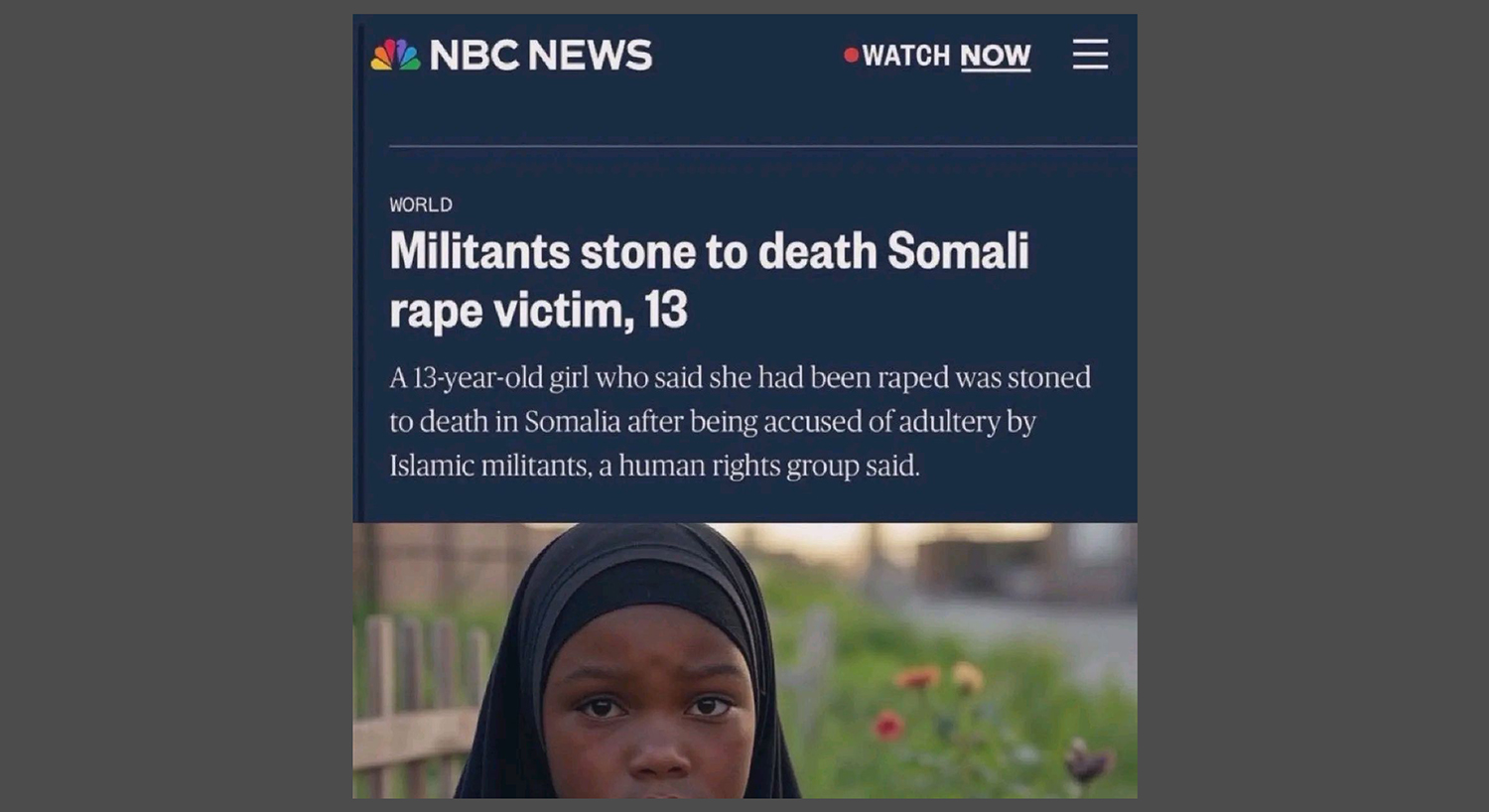
The brutal killing of 13-year-old Aisha Ibrahim Duhulow in the city of Kismayo, Somalia, in 2008 was not an isolated incident; rather, it was a horrifying manifestation of systemic flaws in religious fundamentalism and medieval Sharia law. When a child who is a victim of gang rape seeks justice but is instead accused of “adultery” or “zina” and is stoned to death (rajm) before thousands of people, it profoundly shakes the conscience of modern civilization. This incident compels a deep re-evaluation of women’s status under Islamic Sharia law, the judicial process for rape, and its fundamental contradictions with modern human rights.
Below is an analysis of Aisha Duhulow’s case and various structural aspects of Sharia law, presenting the Islamic perspective:
Legal Confusion Between ‘Rape’ and ‘Zina’ and the Complexity of Evidence
In traditional Islamic Sharia law, ‘rape’ is often not defined as an independent or separate crime; rather, it is viewed as a forced form of ‘zina’ (adultery or illicit sexual relations). Due to this conceptual framework, the woman seeking justice risks being treated as the offender herself.
- Requirement of Four Male Witnesses: Under Sharia law, proving zina or forced zina requires four adult, upright Muslim male witnesses who directly witnessed the act. In modern reality, no rapist commits the crime in front of four eyewitnesses.
- Rejection of DNA and Modern Forensics: In many conservative Sharia courts, DNA tests, medical reports, or forensic evidence are not accepted as sole or definitive proof. At best, they are considered circumstantial evidence (Qarina), which is insufficient to enforce the most severe punishments (hudud).
- Punishing the Accuser (Qazf): If a woman brings a rape allegation but fails to produce four male witnesses, it may be treated as ‘qazf’ (false accusation of adultery) or even interpreted as her own confession of zina. As a result, the rape victim herself may face flogging or death by stoning.
Institutional Discrimination and Victim Blaming
Within Sharia-based judicial and social systems, there is often a systemic tendency to place blame for rape on the woman.
- Blaming Dress and Mobility: It is often argued that a woman failed to observe proper hijab or modesty, thereby “provoking” the man. Additionally, leaving home without a male guardian (mahram) is sometimes viewed as misconduct, and rape is framed as a consequence of a woman’s “disobedience.”
- Statistical Illusion: Lower reported rape rates in Sharia-governed or conservative Muslim societies are often due to lack of legal and social protection. In contrast, modern Western societies recognize marital rape and enforce strict consent-based laws. Under Sharia systems, women often avoid reporting crimes due to fear of social stigma and the risk of being punished themselves.
Slavery, War Captives, and the ‘Double Standard’
Critics of Islam argue that in classical Sharia law, the concept of sexual consent is not universal and conflicts with modern human rights principles.
- Ownership of the Right Hand (Concubinage): According to historical Islamic law and traditional interpretations, sexual relations with female slaves or war captives (referred to in the Quran as “those whom your right hands possess”) did not legally require their consent.
- Child Marriage: Sharia law permits the marriage of girls before reaching puberty, and allows conjugal relations after marriage, which modern international law considers child abuse and statutory rape.
The Modern World vs. Sharia Law: A Crisis of Capability
In the 21st century, Sharia law has failed to demonstrate its capacity to build an equitable society. A key reason is that these laws were formulated within the tribal and cultural context of 7th-century Arabia.
| Comparative Aspect | Modern Secular Law | Traditional Sharia Law |
| Foundational Basis | Human rights, gender equality, and individual consent. | Religious prescriptions, patriarchal guardianship. |
| Evidence | DNA, forensic science, psychological evidence, and victim testimony. | Four eyewitness male witnesses or confession. |
| Marital Rape | A punishable offense. | The fulfillment of a husband’s sexual desire is considered a religious obligation of the wife. |
| Type of Punishment | Imprisonment, rehabilitation, and institutional correction. | Stoning to death (rajm), flogging, or amputation. |
Islamic Sharia Law Is Not a Solution …
The case of Aisha Ibrahim Duhulow was not merely a judicial error; it was the logical consequence of a flawed legal philosophy. When a legal system prioritizes a victim’s clothing, character, and gender over the perpetrator’s crime, justice becomes impossible.
Unless the sources of Islamic Sharia law (Quran, Hadith, and Fiqh) are fully reformed or discarded to suit the modern age, innocent women like Aisha will continue to fall victim to such cruelty in the name of religion. To build a civilized, humane, and progressive society, there is no alternative but to move beyond rigid religious legal frameworks and adopt a secular legal system based on universal human rights and gender equality.
Related Posts

Why do Islamist clerics consider Bengali cultural festivals their enemy?
This year, unlike many previous years, the major Hindu religious festival Durga Puja in BangladeshRead More
ইসলামিস্ট মোল্লারা কেন বাঙালিদের আনন্দ উৎসবকে তাদের শত্রু মনে করে?
এবার বাংলাদেশে অন্যবারের তুলনায় বেশ শান্তিপূর্ণ, উৎসবমুখর পরিবেশে হিন্দু ধর্মের বড় ধর্মীয় উৎসব দূর্গাপূজা হয়েRead More
Why do Islamist cyber‑jihadis insult, threaten, and file false reports against people with different opinions?
Maulana Azhari once advised Islamists that sharing his Facebook posts is also an Islamic act;Read More
Comments are Closed