
Islam, Indonesia and Bangladesh
Indonesia, Bangladesh, and Islam: Does Islam allow peace anywhere?
On the 11th, the day before yesterday, a friend of mine (and later my friend Abu Saeed’s) came to Dhaka from Indonesia. Elen is a few years older than me. She has been my social media friend for a long time. Her colleague Suri came with her. Elen is Christian, Suri is a hijabi Muslim — dressed like Muslim women in Indonesia usually dress. They are government officials of Indonesia, transport planners of Jakarta City. They came to Dhaka for a UN‑organized training on transport.
As usual, foreigners visiting Bangladesh typically go to Aarong. I and a former colleague went to Gulshan Aarong to meet them. Because of Dhaka’s traffic, we reached long after the meeting time.
Elen was talking to someone on the phone, saying — Dhaka is like Jakarta was 30 years ago. Hearing this, I was a bit shocked. Such an observation in just one day? But since she has the eyes of an urban planner, there is no way to avoid it. For me, it was embarrassing — the capital of a comparatively less developed economy is 30 years behind their capital in terms of management? She is staying in the elite Baridhara diplomatic zone. But because she traveled through Bashundhara City, Aarong, and traffic, she realized Dhaka today is like Jakarta 30 years ago. Jakarta is Indonesia’s capital, and Dhaka is Bangladesh’s. I watched several videos of Jakarta from different times on YouTube. In the 1980s, Jakarta’s traffic was like Dhaka’s, but now it is not. But our Dhaka? Traffic congestion has increased 20–30 times, yet management quality keeps getting worse. They are moving forward while we are falling behind. If you watch videos from 50–60 years ago, you will see that in many regions of Indonesia, women did not wear any clothing above the waist. Yet today Indonesia has surpassed Bangladesh in wealth, systems, and development by several multiples. This video is Jakarta in 1986 — https://fb.watch/HA27OTtKwm/.
Since a long‑time friend came from a distant country, Bengali hospitality had to be offered. The next day, yesterday, the plan was to show them various spots in Dhaka, and they would have lunch at my home. I asked the house cook to prepare mustard hilsa and a few other dishes. Dhaka University was the meeting point, then Dhakeshwari, Lalbagh Fort, New Market, Gausia, Tajmahal Road, Tokyo Square — by the time we returned home, lunchtime was over! My father, being curious and religious, had already started chatting with Suri, the Muslim woman — asking how Muslims live in Indonesia, what they do, how they do it. When I went to the washroom and came back and asked them to eat, Suri said she was on her period and would not take a bath now. Perhaps she didn’t fully understand the English. But I realized one thing — they can openly say they are on their period in front of anyone.
This is where Islamic cultural differences appear between countries like Bangladesh and Indonesia. A very regular biological factor for women is not a taboo for them. In Bangladesh, it is a hidden matter. Women cannot say at the office, school, college, university, workplace, or transport that they need extra safety or care; they silently endure discomfort because of society’s mindset. A woman cannot directly ask for sanitary pads at a pharmacy; she cannot ask for her safety equipment; she usually has to rely on someone else. And if she asks for a little extra convenience in a bus, train, office, or educational institution, some men immediately say — don’t women want equal rights? Then they should go or work exactly like men. But they fail to understand that women carry this additional biological burden for the continuation of the human species.
Although Christian Elen and Muslim Suri have an excellent relationship, Islamic extremism is also rising in Indonesia. Indonesia is the world’s largest Muslim‑majority country, but constitutionally it is a secular state recognizing six major religions (Islam, Protestantism, Catholicism, Hinduism, Buddhism, and Confucianism). The national motto is “Unity in Diversity” (Bhinneka Tunggal Ika). In recent years, conservative Islamic influence has increased. Some hardline groups show intolerance toward people of other religions and toward minority Muslim sects (such as Shia or Ahmadiyya).
Because religion remains influential, problems also remain. The country has a controversial blasphemy law. Critics argue that this law is often used as a political tool to silence religious minorities or dissenters. The biggest example was the imprisonment of Jakarta’s former Christian governor ‘Ahok’ (Basuki Tjahaja Purnama), which caused international uproar. During the 2017 governor election campaign, Ahok said on an island near Jakarta that some people were misleading Muslims by using Qur’an 5:51 for political gain, which says Muslims should not take non‑Muslims as leaders. This small comment offended Islamists.
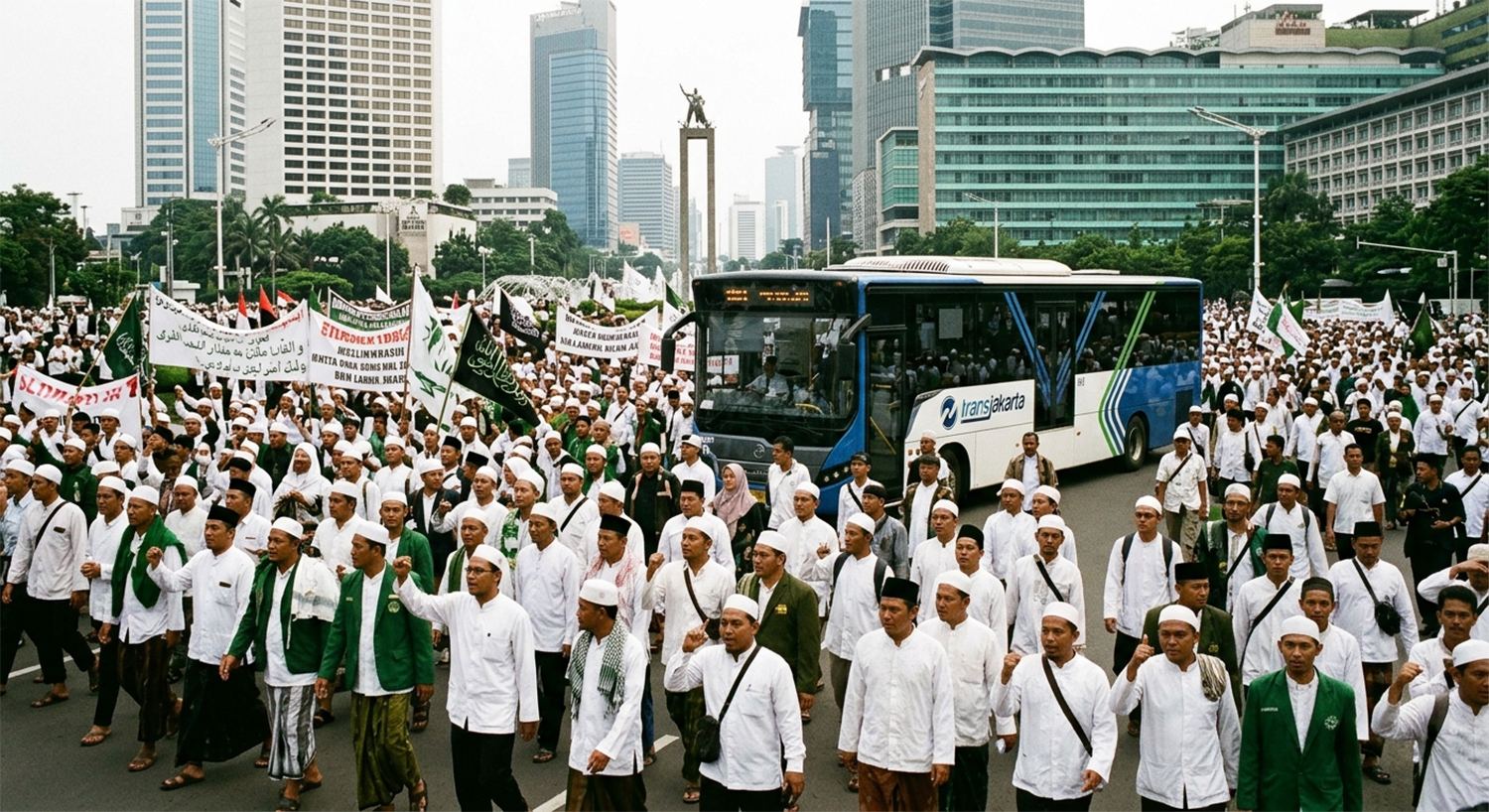
After the video spread, hardline Islamic groups — especially the Islamic Defenders Front (FPI) — launched massive protests across the country. • On December 2, 2016, one of the largest demonstrations in Jakarta’s history took place, known as the “212 Movement.” More than 200,000 Islamists took to the streets demanding Ahok’s arrest and trial. The movement was so intense that it put huge political pressure on President Joko Widodo’s government. This religious and political polarization directly affected the governor election. Despite his popularity, Ahok lost by a large margin in April 2017. A few weeks later, on May 9, 2017, an Indonesian court convicted him under the blasphemy law and sentenced him to two years in prison. He was taken directly to jail after the verdict. Indonesia may appear to be a liberal democracy, but when strong religious sentiment exists, it inevitably influences politics.
To build a new church or temple in Indonesia, a large portion of local residents must sign approval and the government must issue a special permit (PBM). For minority Christian or Hindu communities, obtaining this permission is often difficult, and sometimes places of worship are shut down illegally. Minority Muslim sects like Ahmadiyya and Shia are sometimes labeled “deviant,” facing social and legal pressure. In some areas, their mosques have been vandalized or they have been forced to leave.
Although the country as a whole runs under secular law, the Aceh province has special autonomy where strict Sharia law is enforced. There, punishments such as public caning for gambling, drinking, or homosexuality are practiced, which are often criticized as violations of human rights and religious freedom. This province also has one of the highest rates of sexual violence. Under Sharia law, the burden of proving rape often falls on the victim, and if she fails, she may be punished — there are numerous such records.
Related Posts
Humans cannot even see 1% of the beauty and colors of Earth and the universe! Are humans really the best of creation?
The human eye can generally detect visible light or color in the wavelength range ofRead More
পৃথিবী ও মহাবিশ্বের সুন্দর জিনিসের ১% সৌন্দর্যের রঙও মানুষ দেখতে পায় না! মানুষ কি সৃষ্টির সেরা?
মানুষের চোখ সাধারণত ৩৮০ থেকে ৭৪০ ন্যানোমিটার (nm) তরঙ্গদৈর্ঘ্যের (wavelength) দৃশ্যমান আলো বা রঙের রেঞ্জRead More

Why does Allah show such preference for women with large breasts and large buttocks? Do men feel the same way? Does this give women any advantage?
If you leave Prophet Muhammad in Pattaya’s Walking Street and Beach Road after evening, inRead More
Comments are Closed