
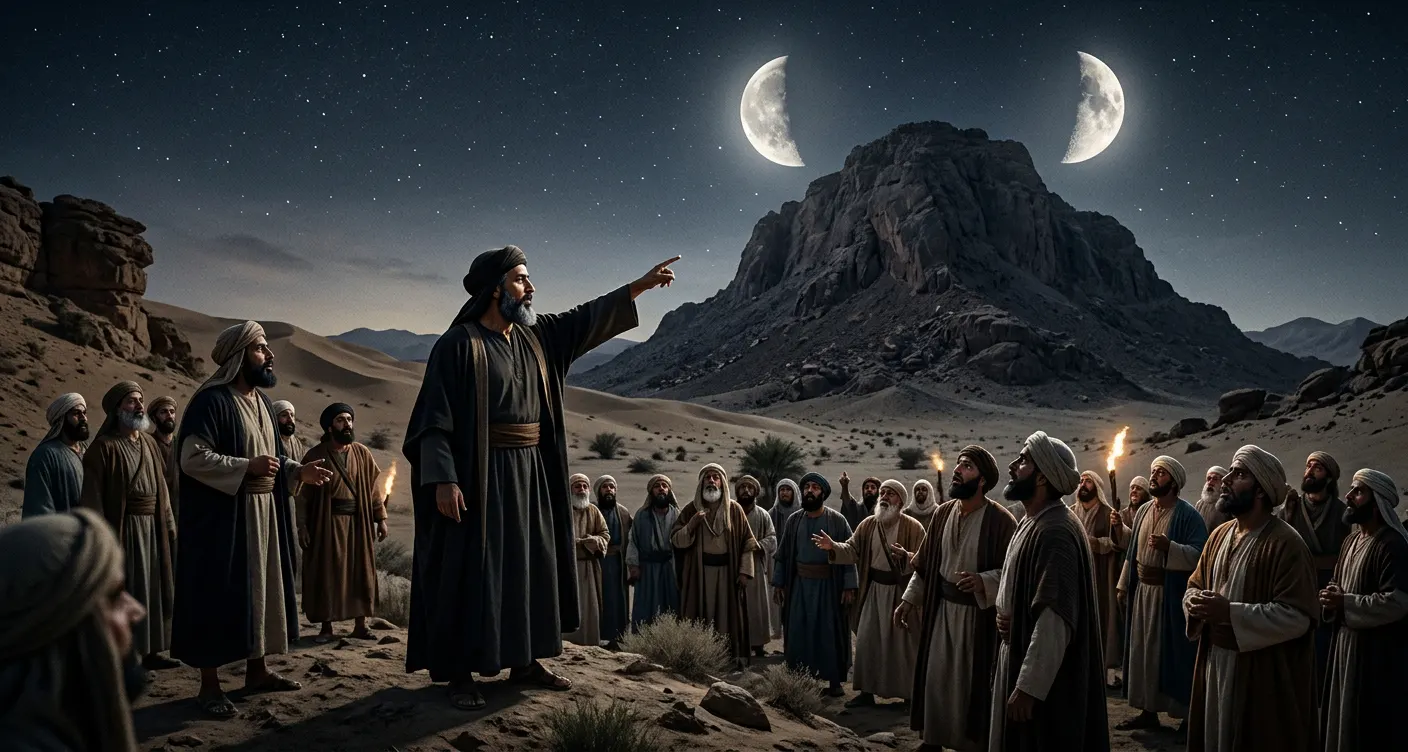
Islam and the Moon
People knew that the Moon has no light of its own more than 1,150 years before the births of Muhammad and Allah; the story of the Moon splitting in two is a fanciful myth
Islam’s interest in the Moon seems endless. Months, days, dates, acts of worship, Eid, and fasting are all centered around the Moon. Some followers even claim to have seen Islamic figures such as Saidi or Dewanbagi on the Moon. Others promote the story that Neil Armstrong heard the call to prayer and saw a crack on the Moon during the Apollo mission, then returned to Earth and converted to Islam, even though these are simply myths. One popular Islamic apologetic claim is that people did not know before modern science that the Moon has no light of its own and shines only by reflecting sunlight. The Qur’an, they say, stated this 1,400 years ago, and an illiterate Muhammad could not possibly have known it, so the Qur’an must be divine. Many people are unaware of how often Islamic preachers present such stories and claims as established facts.
When Did Humans First Know This?
It is impossible to point to a single day or person who first discovered this. The knowledge developed gradually across many civilizations. What written sources show, however, is that this idea existed at least a thousand years before the Qur’an.
Greece (6th–5th century BCE): Ancient sources state that Parmenides (around 500 BCE) described the Moon’s light as “borrowed light.” The idea is also attributed to Thales in later sources, though that attribution is less certain. The clearest and most famous source is Anaxagoras (c. 500–428 BCE), who taught in Athens that the Moon is a rocky body like the Earth and is illuminated by the Sun’s light. For this and for describing the Sun as a fiery stone, he faced charges of impiety.
Greek geometry and observation: Aristotle (4th century BCE) explained the phases of the Moon and lunar eclipses through the Earth’s shadow. Aristarchus (3rd century BCE) attempted to calculate the relative distances of the Sun and Moon using the geometry of the half Moon. That calculation depends on the idea that the illuminated portion of the Moon faces the Sun. Hipparchus and later Ptolemy (2nd century CE) refined this knowledge further. Plutarch also discussed the Moon as an Earth-like body illuminated by sunlight.
Babylon: Babylonian astronomers kept systematic records of solar and lunar eclipses for centuries and mastered methods of predicting them through the Saros cycle. They understood the relationship between eclipses and the positions of the Sun, Earth, and Moon.
India: Aryabhata (born 476 CE) explicitly stated in his Aryabhatiya that the Moon and planets shine by reflecting sunlight. Varahamihira (6th century CE) said the same. Both lived about a century before the Qur’an was revealed (610–632 CE).
China: Jing Fang (1st century BCE) wrote that the Moon and planets have no light of their own and are illuminated by sunlight. Later, Shen Kuo (11th century CE) explained the lunar phases by comparing the Moon to a sphere lit from one direction by the Sun.
Even by the most cautious estimate, the idea was clearly recorded in writing in Greece by the 5th century BCE, about 1,000–1,100 years before the Qur’an. The claim that “people did not know this before modern science” is historically false. It is ancient knowledge.
What Do the Qur’anic Verses Actually Say?
Islamic apologists usually cite the following verses:
- 10:5: God made the Sun a diya (radiance) and the Moon a nur (light).
- 25:61: He placed in the sky a siraj (lamp) and a qamaran munira (shining Moon).
- 71:15–16: He created the seven heavens in layers and placed the Moon therein as a nur and the Sun as a siraj.
Their argument is that the Qur’an distinguishes between the Sun as a diya/siraj (a luminous source) and the Moon as a nur/munir (light), implying that the Sun’s light is intrinsic while the Moon’s is reflected. The weaknesses in this argument are discussed below.
(a) No verse says that the Moon reflects sunlight
No verse explicitly states that the Moon receives light from the Sun and reflects it back. The verses merely say that God made the Moon a light. The idea of reflection is supplied by modern interpreters.
(b) The word “nur” does not mean reflected light
In the Qur’an, nur simply means “light.” The Qur’an also calls Allah the “light of the heavens and the earth” (24:35), describes the Torah as a light (5:44), and speaks of a light that moves before believers (57:12). None of these refer to reflected light.
(c) The word “munir” itself creates problems for the claim
Munir derives from anara (“to illuminate”). It is an active adjective, meaning something that gives light. More importantly, the Qur’an (33:46) describes Muhammad as sirajan munira, a “radiant lamp.” Here munir is used together with siraj, the same term used for the Sun. This shows that the Qur’an does not use these words to distinguish between intrinsic and reflected light.
(d) Different terminology does not prove scientific knowledge
In Arabic poetry and usage, nur and diya are often interchangeable. In 78:13 the Sun is called sirajan wahhaja (“a blazing lamp”), but this does not demonstrate that the speaker understood that the Moon shines by a fundamentally different process.
(e) Classical tafsir does not interpret the verses this way
Mainstream Qur’anic commentators of the early centuries did not present these verses as scientific statements about reflected light. This interpretation became prominent mainly in modern times, after the scientific explanation was already known.
(f) What about the broader cosmology of the surrounding verses?
In 71:15–16 the Moon is placed “within” the seven heavens as a light, reflecting an ancient layered-cosmos model. In 36:38–40 the Sun runs to a resting place and both Sun and Moon “swim” in their orbits, imagery that fits a geocentric worldview. Hadith literature (such as Sahih al-Bukhari) states that the Sun prostrates beneath the Throne after setting. There is a selective bias in treating statements about moonlight as science while dismissing other cosmological details as metaphor.
(g) Similar language exists in the Bible
Genesis 1:16 refers to both the Sun and Moon as “lights” (ma’or): a greater light and a lesser light. The Qur’an’s wording follows a broader Semitic tradition and does not imply reflected light.
So How Could Muhammad and the Arabs Have Known?
The question is not really “How could they have known?” because the Qur’an does not present a new scientific discovery. Nevertheless, the historical answer is fairly straightforward.
1. Naked-Eye Observation
The Arabs of the desert were highly skilled observers of the night sky. They used the Moon’s 28 stations (manazil al-qamar) and star-based seasonal systems (anwa). Anyone who regularly observes the Moon notices that:
- At the new Moon, it is close to the Sun and invisible;
- At the full Moon, it is opposite the Sun;
- The illuminated side of a crescent always faces the Sun;
- During a lunar eclipse, the Moon loses its light when it enters the Earth’s shadow.
From these observations, ordinary people can infer that the Moon’s light is related to the Sun. No telescope or divine revelation is required.
2. Trade, Religion, and Cultural Exchange
Arabia was not isolated. The Quraysh traded with Syria, Yemen, and Abyssinia. The Lakhmid court at Hira was influenced by Sassanian Persia, and the Ghassanids by Byzantium. Christian communities existed in Najran, while Jewish tribes lived in Medina. Through Syriac Christians, Greek science circulated in translation, and the Sassanian academy at Gundeshapur became a center where Greek, Persian, and Indian knowledge interacted. Scholars have identified many examples of narratives shared across traditions and appearing in the Qur’an, such as the story of Dhul-Qarnayn, which many researchers associate with Syriac legends of Alexander.
3. The Absence of Surprise
There is no record of the Qur’an’s audience reacting with amazement or objection to these descriptions. This suggests either that the connection between moonlight and sunlight was not unfamiliar to them, or that the verses were not understood as scientific claims in the first place.
4. Evidence from Later History
Muslim astronomers of the Abbasid era, such as al-Khwarizmi, al-Farghani, al-Battani, al-Biruni, and Ibn al-Haytham, learned the theory of reflected moonlight through translated Greek and Indian astronomy. They did not discover it from the Qur’an.
Conclusion
Whether Muhammad composed the Qur’an himself is a separate debate. Even without entering that discussion, nothing miraculous appears in the Qur’anic wording regarding the nature of moonlight. The subject was already within the realm of ordinary observation, common knowledge, and cultural exchange. Believers may, of course, accept it as revelation, and that belief is not a matter of historical analysis. However, the claim that “the Qur’an stated it before science” does not withstand historical scrutiny.
The Intoxicating Tale of the Moon Splitting in Two
What Does the Tradition Say?
Surah al-Qamar (54:1–2) begins with the words: “The Hour has drawn near, and the Moon has split. Yet whenever they see a sign, they turn away and say, ‘This is persistent magic.’”
Several hadiths in Sahih al-Bukhari and Sahih Muslim state that the Moon split into two parts during Muhammad’s lifetime in Mecca. In Ibn Mas‘ud’s narration, one part appeared on one side of a mountain and the other part on the opposite side. (Hadith numbering varies by edition.) Later biographies and tafsir literature added further details, including the Quraysh demanding a sign and Muhammad allegedly splitting the Moon with a gesture of his hand or finger. This specific gesture is not explicitly found in the core Bukhari narration but appears in later sources.
Most classical commentators accepted the verse as referring to a historical event. However, some exegetes interpreted it as a future sign of the Day of Judgment rather than a past occurrence. In Arabic, future events are sometimes expressed in the past tense to emphasize certainty.
Historical Problems
- Single-source problem: At any given time, more than half of the world can potentially observe the Moon. Yet no Chinese, Indian, Byzantine, or Persian historical or astronomical records mention the Moon splitting. Chinese astronomers carefully documented comets, novas, and eclipses. For an event of such magnitude, not a single contemporary external record exists.
- Eyewitness issues: Some narrators, such as Anas ibn Malik and Ibn Abbas, were either children or possibly not even born at the time of the alleged event, which occurred a few years before the Hijra. Their reports therefore depend on hearsay rather than direct observation.
- Internal tension within the Qur’an: In several passages, when the Quraysh ask Muhammad for signs, he is instructed to reply, “I am only a human messenger” (17:90–93). Verse 17:59 also states that miraculous signs were withheld because previous peoples had rejected them. For this reason, some scholars understand 54:1 as referring to a future event rather than a past miracle.
- The “NASA proved it” story: Long grooves on the Moon’s surface, known as lunar rilles, are often presented as evidence of the Moon having split apart, with the claim falsely attributed to NASA. NASA has never made such a claim. These features were formed by volcanic and tectonic processes and are hundreds of millions to billions of years old. The legend of the Malabar king Cheraman Perumal witnessing the event is likewise unsupported by reliable contemporary sources.
From the Perspective of Physics: What Would Happen If the Moon Split?
Facts about the Moon: Mass ≈ 7.35 × 10²² kg (about 1/81 of Earth’s mass), radius ≈ 1,737 km, average density ≈ 3,344 kg/m³, average distance from Earth ≈ 384,400 km.
1. Energy requirements: The Moon’s gravitational binding energy is approximately (3/5) × GM²/R ≈ 1.2 × 10²⁹ joules. In other words, completely tearing the Moon apart and dispersing the fragments to infinity would require this amount of energy. For comparison:
- About two quadrillion times the energy of the Hiroshima bomb (≈ 6 × 10¹³ joules);
- About 200 million years worth of humanity’s annual energy consumption (≈ 6 × 10²⁰ joules per year);
- Roughly five to six minutes of the Sun’s total energy output (≈ 3.8 × 10²⁶ joules per second).
Even merely splitting the Moon into two stable halves would require an immense quantity of energy. The obvious question is: where would that energy come from?
2. The two halves would not remain separated: The Moon’s own gravity is what keeps it together. If split into two major pieces, each half would be pulled back toward the other. The Moon’s free-fall timescale is only about twenty minutes. If the fragments dispersed instead, enormous quantities of rock and dust would be produced and some would likely enter Earth-crossing trajectories.
3. The “mountain on either side” description: The Moon’s angular size in the sky is only about half a degree. For two halves to appear on opposite sides of a terrestrial mountain, they would have had to separate by thousands of kilometers, significantly altering the Moon’s orbit.
4. Consequences for Earth: If all or part of the Moon fell toward Earth, then even at Earth’s escape velocity of 11.2 km/s, the Moon’s kinetic energy alone would be on the order of 4–5 × 10³⁰ joules. Earth’s outer layers would melt, the oceans would vaporize, and the atmosphere would become intensely heated. Such an event would resemble the colossal impacts thought to have formed the Moon in the first place, as proposed by the Giant Impact (Theia) hypothesis.
5. Even if it merely shifted position: The Moon plays a crucial role in Earth’s environment.
- Tides: The Moon is the primary cause of ocean tides. Even modest changes in its mass or orbit can significantly affect coastal ecosystems.
- Axial stability: The Moon helps stabilize Earth’s axial tilt (about 23.4°). Research by Jacques Laskar suggests that without the Moon, Earth’s tilt could vary chaotically, producing far more extreme climate changes.
- Length of day and rotational evolution: These are also connected to the Moon’s gravitational influence.
Therefore, if the Moon had physically split apart through natural processes, the survival of Earth’s biosphere would be highly unlikely. Yet there is no geological, climatic, or astronomical evidence of such an event. The Moon remains essentially as it always has. No trace of a global “rejoining” event exists in its structure or composition. Samples returned by the Apollo missions and subsequent studies show lunar crustal ages exceeding four billion years, with no indication of a Moon-wide catastrophe occurring in the 610s CE.
The Believers’ Position
A believer may argue that this was a miracle and that God, being omnipotent, could split and restore the Moon without any of the expected physical consequences. That position exists outside the scope of science and belongs to the realm of faith. However, once that argument is adopted, the event can no longer be presented as scientific evidence. Many Islamic apologists simultaneously point to verses about moonlight as examples of scientific foreknowledge while dismissing scientific objections to the Moon-splitting narrative by appealing to miracle. This double standard is the issue. Wherever science appears to agree, the claim becomes “the Qur’an already knew it”; wherever science does not agree, the claim becomes “it was miraculous.” Such a framework may be unfalsifiable, but its evidentiary value becomes negligible.
So What Is the Conclusion? Are the Islamists’ Claims Correct?
1. The idea that the Moon shines by reflected light is first found in surviving written sources from 5th-century BCE Greece (Parmenides and Anaxagoras), around a thousand years before the Qur’an. It was later recorded in India (Aryabhata and Varahamihira) and China (Jing Fang) as well.
2. The Qur’an describes the Moon using terms such as nur and munir, meaning “light” or “illuminating.” These words do not explicitly refer to reflected light, nor was that interpretation standard in classical tafsir. Reading modern science into them is a later development.
3. Through astronomical observation, eclipses, and interaction with neighboring civilizations, Arabs were fully capable of knowing such ideas. No supernatural explanation is required.
4. The story of the Moon splitting in two is incompatible with ordinary physical processes. It would require on the order of 1.2 × 10²⁹ joules of energy and would threaten the stability of life on Earth. Yet there is no geological or astronomical evidence for such an event, nor any contemporary record from other civilizations.
Religious faith is ultimately a personal and philosophical matter. But if a religious text is to be presented as a book that “revealed scientific facts before science,” those claims must withstand scrutiny from history and evidence. In this case, the claim does not pass that test.
Related Posts
মুহাম্মদ ও আল্লাহর জন্মেরও ১১৫০ বছর আগেই মানুষ জানতো চাঁদের নিজস্ব আলো নেই, চাঁদ দ্বিখণ্ডিত হওয়ার কেচ্ছা গাঁজাখোরি
চাঁদ নিয়ে ইসলামের আগ্রহের শেষ নেই। মাস, দিন, তারিখ, ইবাদত-বন্দেগী, ঈদ, রোজা সব চাঁদ কেন্দ্রিক।Read More

Humans cannot even see 1% of the beauty and colors of Earth and the universe! Are humans really the best of creation?
The human eye can generally detect visible light or color in the wavelength range ofRead More
পৃথিবী ও মহাবিশ্বের সুন্দর জিনিসের ১% সৌন্দর্যের রঙও মানুষ দেখতে পায় না! মানুষ কি সৃষ্টির সেরা?
মানুষের চোখ সাধারণত ৩৮০ থেকে ৭৪০ ন্যানোমিটার (nm) তরঙ্গদৈর্ঘ্যের (wavelength) দৃশ্যমান আলো বা রঙের রেঞ্জRead More
Comments are Closed