
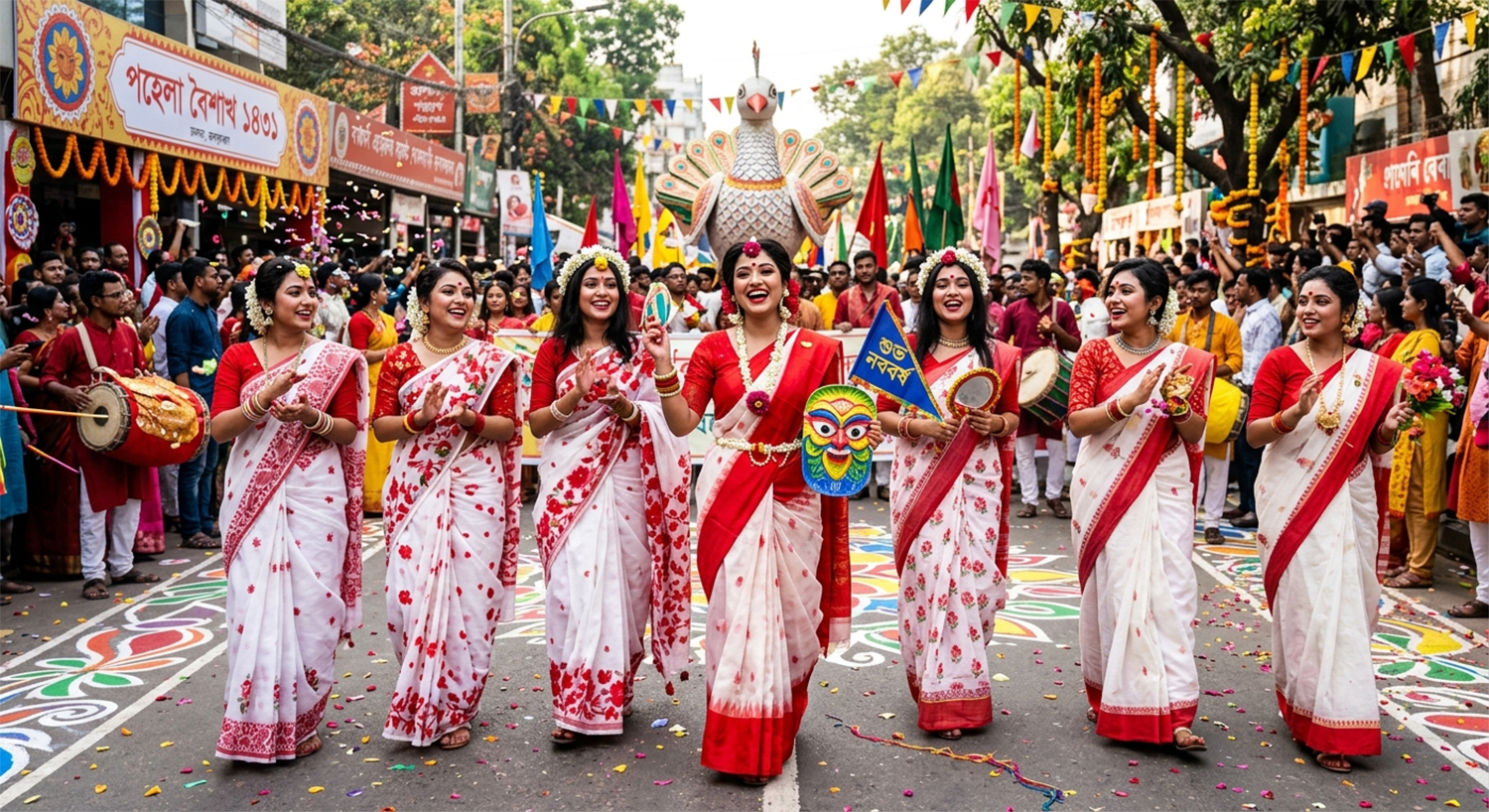
Islam and Pohela Boishakh
Why do Hardline Mullahs Consider the Pohela Boishakh Festival Their Enemy?
When we were children, in our village it was common on the evening of Shab‑e‑Barat for all the boys and girls to go from house to house together eating khichuri, halua, and batasha. That day provided a brief break from study and was a joyful occasion. Gradually, however, local clerics began campaigning against this—saying that rejoicing on the night of Shab‑e‑Barat was forbidden, that one must spend the entire night worshipping Allah; that on this night Allah descends to the lowest heaven to hear His servants’ calls, and that from a distance Allah cannot hear human cries.
It should be said that Allah is described as having human‑like features: 1,400 years ago, when the Prophet Muhammad and the Arabs of his time imagined a being more powerful than humans, that image naturally took a human form. Allah is said to have hands and feet like humans, and to sit on a throne called the Arsh. Poet Nazrul even wrote lines about piercing the throne of God and emerging through it. In any case, over time, the opportunity for village children to experience joy on the night of Shab‑e‑Barat disappeared.
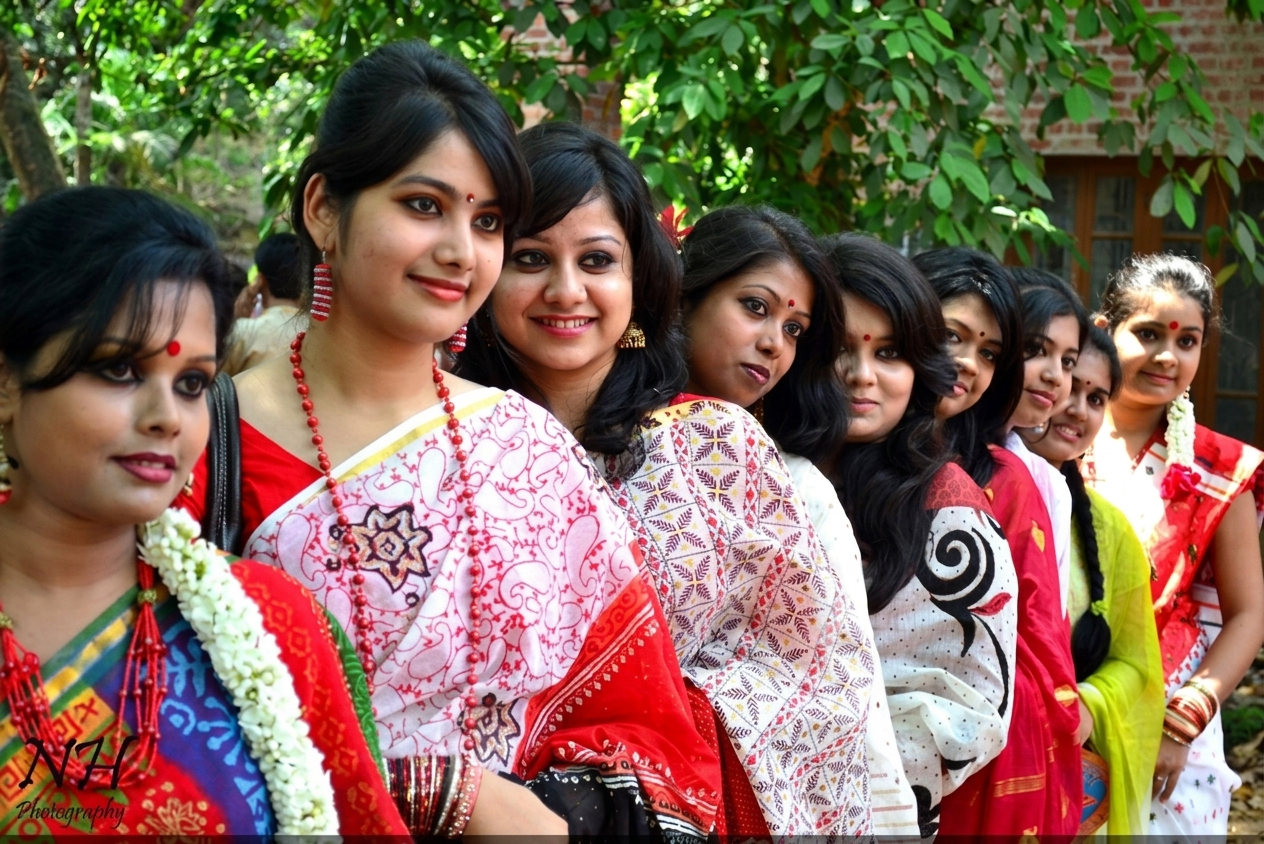
On the eve of Eid‑ul‑Fitr, it used to be customary for villagers to go in groups to the fields to sight the moon. On both Eids, we would wake up early, bathe, eat semai, go to the Eidgah, buy snacks there, then return home, change clothes, and resume daily work—this was what Eid was like in our childhood. On Eid‑ul‑Fitr, boat races used to take place on the Sonai River along the India–Bangladesh border, organized jointly by people from both sides. Older youths would ride bicycles in groups to the border to watch. That probably no longer happens. So when people now talk about “the joy of Eid,” I often wonder—what exactly is that joy?
For us, the biggest festival was Pohela Boishakh. The day after Pohela Boishakh (the date observed in India), the largest Boishakhi fair of the sub‑district used to be held in the neighboring village. As children, we waited all year for that day. Throughout the year we saved small amounts—1, 2, 5, 10, or 20 taka—to buy toys at the fair. Some village elders would say, “That’s a Hindu fair; no need to go there.” On the way, one passed through a neighborhood mostly inhabited by the Ghosh community, and they all attended the fair—but it was never clear what exactly the fair had to do with Hinduism. In practice, no one listened to the prohibitions. Married daughters and sons‑in‑law from across the region returned home just to attend the fair. We tried to go once, twice, even three times. Even during Ramadan in our childhood, the fair spread beyond the football field into adjacent areas. But in 2021–22, during Ramadan, I saw it barely occupying a corner of the field. Everything is now wrapped in the cloak of religion. No one dares step outside Islamic directives.
Durga Puja used to be held almost every year in a nearby neighborhood. We went to the puja fair. Village mothers, aunts, and uncles would go together at night to watch the arati. During puja, Hindu families would visit one another’s villages in groups for an entire week—something we only watched in wonder. During the month of Chaitra, we would go to Hindu neighborhoods to watch sannyasi dances. I also saw many Muslim mothers who would not eat mangoes until the sannyasis arrived—though I never understood why. Still, Hindu‑Muslim relations were warm: everyone attended each other’s weddings, visited relatives in distant villages. As Islamic restrictions grew stricter, social distance increased. In Islam, befriending non‑believers, wishing for their well‑being, or helping them is forbidden. Have you ever seen prayers asking for the welfare of non‑Muslims? You may pray for their hidayah (guidance), but not for their well‑being—that is Islam.
Earlier people would say “Eid Mubarak.” Now they say “Taqabbalallahu minna wa minkum,” claiming the Companions used this phrase. Ideally, Muslims are expected to constantly revere Allah and the Prophet Muhammad. Repeating the idea that Allah is the sole Creator is considered a virtue at all times—and thus saying “Eid Mubarak” is now prohibited. Even the pronunciation of salaam must be perfectly Arabic; Allah will not understand your intentions—if your Arabic pronunciation conveys a different meaning, you will burn in hell.
According to religious doctrine, Muslims are culturally isolated. Hardline Islamists experience very few joyful moments in life. In religious terms, Muslims celebrate only two days: Eid‑ul‑Fitr and Eid‑ul‑Adha. Even these are fundamentally acts of worship, not festivals in the usual sense. These days were fixed by the Prophet Muhammad as religious obligations. Recently, a group called Ahl‑e‑Qur’an has emerged who deny hadith, though denying hadith invalidates both Eids. Fasting and sacrifice are acts of worship—not celebrations—and only Muslims participate.
Because of cultural isolation, many Muslims focus on food during these days, though they are meant for worship. After 29–30 days of fasting, preoccupation revolves around what to eat at sehri and iftar. On Eid‑ul‑Adha, sacrificing animals to prove taqwa has become a “red‑meat festival,” devoid of true spirituality.
They themselves realize this cultural isolation. Seeing others celebrate with music, dance, food, and joy fills them with resentment. When they become a majority, they dream of banning such festivities. Their tendency is: “If we don’t have it, no one else should.” This is why they conduct coordinated campaigns against Pohela Boishakh. They fear that the spread of the Bengali calendar will erase the unscientific lunar‑based Hijri calendar from public life. If Bengalis reconnect with their cultural roots, religious profiteers may lose their livelihood. Hence their organized propaganda branding Pohela Boishakh as a non‑Islamic or bid‘ah practice—propaganda that now resonates with a large segment of the younger generation online.
Humans have always been sensitive to festivals. Melody, rhythm, and harmony resonate evolutionarily with us. Bengalis famously say “twelve months, thirteen festivals.” There are Bhatiyali and Bhawaiya songs, Jari‑Sari, traditional recitations, folk theatre, Pohela Boishakh, monsoon festivals, harvest celebrations, winter fairs, spring festivals, boat races, Baul festivals, kite festivals, and countless others. Yet, once someone becomes Muslim, religiously all these become forbidden. In Islam, literature, culture, music, games—everything is prohibited unless it praises Allah or the Prophet. Only playful interaction with one’s wife, horse riding, and archery are permitted. Drawing pictures, photography, posting photos or videos—all are forbidden.
Urban moderate Muslims tried to introduce Milad‑un‑Nabi and Shab‑e‑Barat as festive occasions, but those attempts failed due to lack of religious foundation. Excessive eating remains their only outcome. When asked about celebrating his birthday, the Prophet said he fasted on Mondays since he was born on a Monday—again turning it into worship. Yet so‑called Bengali moderate Muslims skip fasting and indulge heavily instead.
Fundamentally, there is a conflict between Bengali culture and hardline Islam. A Bengali cannot fully become a hardline Muslim, and a hardline Muslim cannot fully be Bengali. Bengali Hindus’ festivals—Durga Puja, Kali Puja, Saraswati Puja, Rath Yatra, Dol Yatra, Janmashtami, Lakshmi Puja—are flexible and open; anyone can attend and share in their joy. Devout Muslims do not have that freedom. In Kolkata, Christmas is celebrated grandly without issue; Hindus freely participate. A Muslim, however, cannot even post a Christmas wish without abuse—because Islam forbids it.
This conflict explains why many Muslims say, “Muslim first, then Bangladeshi.” They know “Bengali Muslim” is a contradiction. Even those who don’t strictly practice still emphasize “Proud Muslim” identity, knowing that faith—iman—alone ensures paradise. One declaration can ultimately save even the worst criminals, while people like Mother Teresa or Newton are condemned eternally for not making that statement.
In pre‑Islamic times, poetry and music flourished around the Kaaba; women poets like Asma bint Marwan existed. After Muhammad’s prophethood, all that ended. Extremist Muslims oppress minorities—an outcome of cultural isolation. Their sole focus is the afterlife. Hence the destruction of idols then and now, openly declared at mass gatherings.
While people of all backgrounds joyfully celebrate festivals together, a hardline Muslim watches bitterly from the sidelines. This creates psychological pressure, leading to aggression when power is gained. That is why they cannot tolerate festivals like Pohela Boishakh. I have written about this since 2013, but being unpopular, my writing has had little impact.
Read more: There Is No Religious Connection with the Universal Bengali Festival of Pohela Boishakh.
Related Posts
Operation Entebbe – the story of one night, and the Islamic execution suffered by Nazrul Islam and Sweety Akter
What can a state do to save the lives of its citizens abroad? Are thereRead More
অপারেশান এন্টেবে – এক রাতের গল্প এবং নজরুল ইসলাম ও সুইটি আক্তারের ইসলামি হত্যার শিকার হওয়া!
একটি রাষ্ট্র বিদেশে তার নাগরিকদের জীবন বাঁচাতে কী করতে পারে? এর কোন টেক্সটবুক উদাহরণ আছে?Read More
A random page from Muhammad’s self‑made book Qur’an and its unscientific statements
Sometimes I flip through random pages of Muhammad’s self‑made book Qur’an, and today this pageRead More
Comments are Closed