
Is the Quran Universal?
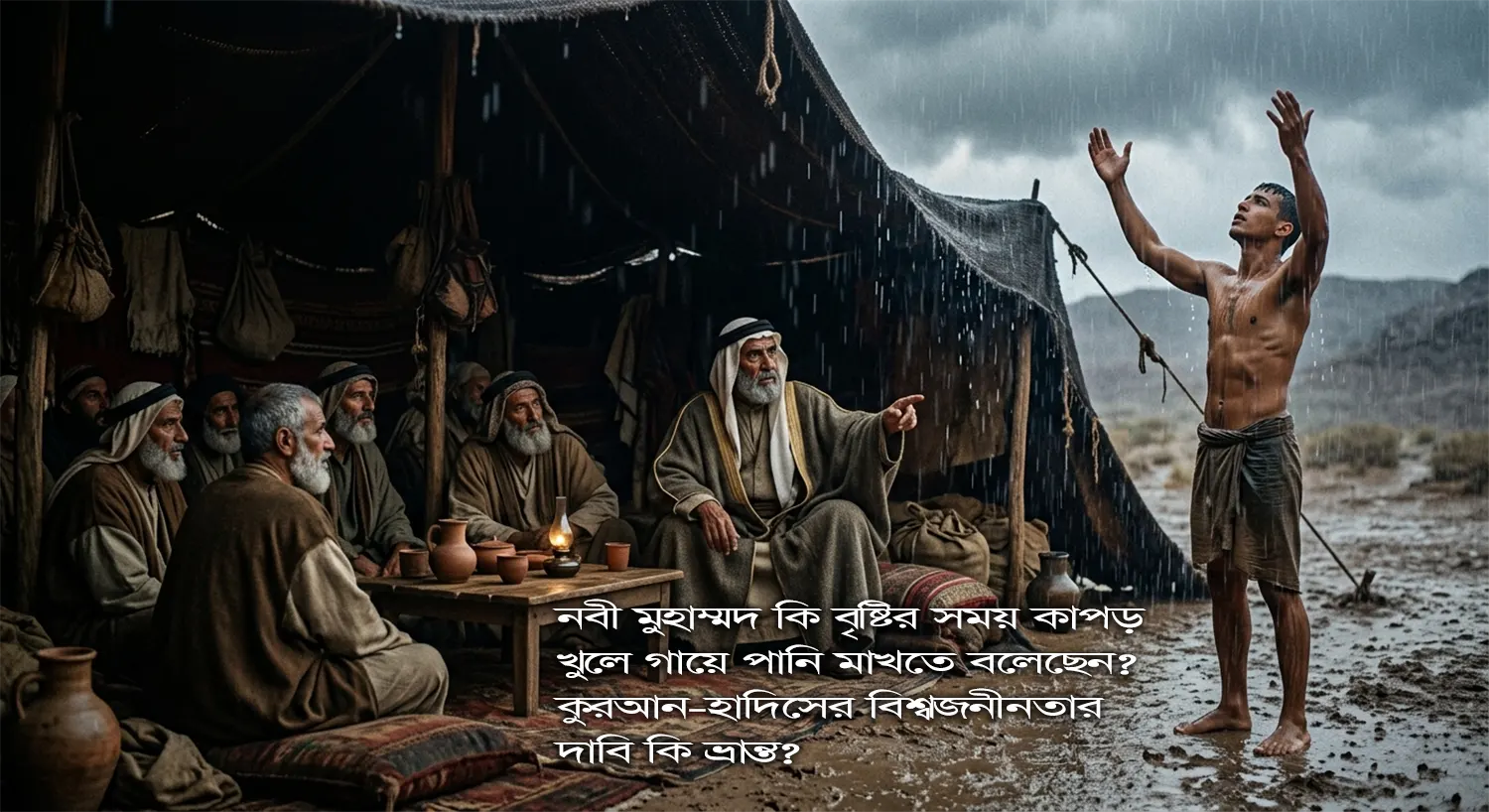
Did Prophet Muhammad Instruct People to Expose Themselves to Rainwater? Is the Claim of Universality Made by the Qur’an and Hadith Flawed?
A hadith in Sahih Muslim (Hadith Academy: 1968) narrates that Anas (RA) said: During a rainfall, Prophet Muhammad (peace and blessings be upon him) moved aside part of his clothing so that the rainwater would touch his body, and he said, “It has just come from its Lord.” This brief narration is not merely an isolated incident. Rather, it opens the door to an important question: are the feelings, symbols, and experiences upon which religious texts (such as the Qur’an and Hadith) are built truly applicable to all people across all times, or do they bear the imprint of a particular geographical and historical context?
In the city where I lived, rain often falls during bitterly cold winter days. Wanting to get soaked in such rain would mean deliberately inviting hardship and illness. Meanwhile, when it is a scorching summer afternoon where we live, Australia and New Zealand may be experiencing freezing winter weather. Did the people of the Hejaz 1,400 years ago have any awareness of these kinds of climatic contrasts? At least the Qur’an and Hadith do not appear to indicate so, because the Qur’an and Hadith are records of their writings, sayings, and activities, are they not?
Rain as an Example: An Indicator of Context Dependence
The climate of the Arabian Peninsula was almost entirely arid and desert-like. Rain there was rare, precious, and often perceived as a symbol of divine mercy. Therefore, getting drenched in rain, praying for rain (istisqa), or describing rain as “Allah’s recent blessing” was entirely natural and deeply meaningful within that society’s lived reality.
However, in monsoon climate regions such as Bangladesh, eastern India, or Southeast Asia, the experience of rain is entirely different. Here, prolonged rainy seasons, excessive rainfall, river erosion, and floods often bring devastation to people’s lives. Homes are washed away, crops are destroyed, and both humans and livestock may perish. As a result, when a scripture or religious message portrays rain as an unconditional blessing, it may frequently conflict with the actual experiences of people living in these regions, especially in cases of excessive rainfall. This suggests that the metaphors and examples found in religious texts are derived not from a “universal human experience,” but from the lived reality of a specific geographical environment.
Descriptions of Paradise: The Cultural Limits of Desire
The same line of reasoning can be extended to the Qur’anic descriptions of Paradise. The Qur’an repeatedly speaks of shaded gardens, flowing streams, cool drinks, fresh fruits (especially dates and grapes), and relief from heat. These are highly attractive promises for a society living amid intense heat, scarcity of water, and barren deserts.
But for societies that already live in green, water-rich, and cool environments, such as those in Scandinavia or Northern Europe, the promise of “evergreen gardens and coolness” may not produce the same degree of longing as it did for the inhabitants of seventh-century Hejaz. Indeed, for people living in snow-covered regions, promises of warmth, sunlight, or brightness might be more appealing. This raises a question: if the descriptions of Paradise truly reflected the innate desires of all human beings across all times and places, why do they appear so strongly shaped by the imagery of a desert-centered way of life?
The Logical Structure of the Claim to Universality
One of Islam’s central claims is that the Qur’an and Hadith are not intended for a specific people or era, but rather for all of humanity and for all time. To evaluate this claim rationally, one must examine the degree to which the texts’ language, metaphors, legal rulings, and social assumptions are independent of any particular culture.
In practice, it can be observed that:
1. Natural metaphors and imagery: desert-centered (oases, camels, date palms, sandstorms, intense sunlight).
2. Socio-economic structures: suited to the tribal society of seventh-century Arabia (slavery, distribution of war booty, particular marriage and divorce customs, inheritance calculations).
3. Legal punishments: formulated in ways comparable to the judicial norms of that era’s Arabian society.
4. Dress and codes of conduct: aligned with desert climates and Bedouin cultural practices.
These characteristics are bound to seem unusual to a reader who grew up in radically different environmental and cultural settings, whether in Sub-Saharan Africa, the Arctic, the Pacific Islands, or East Asia. If a text were truly universal in a literal sense, one might expect its metaphorical language and cultural examples not to be so heavily weighted toward a single region. Instead, it might employ representative imagery from a variety of climates, geographies, and cultures, or present abstract principles that are equally resonant across all societies.
Possible Counterarguments and Their Limitations
Traditional commentators typically offer three responses to this criticism.
First, they argue that the language and metaphors of the Qur’an and Hadith were chosen according to what the initial audience could understand (an idea often expressed in Islamic discourse as “mukhatabat al-qawm bima yafhamun”). In other words, while the essence of the message may be eternal, its mode of expression was adapted to the context of its first audience. According to this argument, images such as rain or oases are merely vehicles of communication, not the core message itself.
Second, many contend that the Qur’anic descriptions of Paradise are symbolic. They argue that human language is being used to convey an indescribable reality, and therefore these descriptions should not necessarily be interpreted literally.
Third, some maintain that the central moral teachings of Islam, such as justice, honesty, and compassion, are culture-independent, while the contextual details serve only as vehicles for conveying those values.
Yet these responses themselves contain an implicit concession: namely, an acknowledgment that the form of expression in the text is culturally specific. To admit this is already to introduce a qualification into the claim that the scripture is “directly” and “literally” applicable in the same way to all people of all eras. If interpretation and reinterpretation are required in order to adapt the text to each new cultural context, then it may be more accurate to discuss not the text’s “literal universality,” but rather its “capacity for interpretive adaptation.”
Concluding Remarks
This small hadith about rain becomes a symbol of a much larger question: are the language, metaphors, and promises of religious texts truly derived from the experiences of all humanity, or are they fundamentally shaped by the lived realities of a particular geographical and historical community that later came to be presented as universal? To the desert dweller, rain is a blessing; to a Bangladeshi farmer, it can sometimes be a catastrophe. This contrast illustrates how religious metaphors and promises grounded in specific natural experiences inevitably carry regional limitations. Consequently, claims of universality should be examined carefully through reasoned analysis rather than accepted solely on the basis of faith.
Such critical readings are not expressions of hostility toward religion. Rather, they are part of the normal intellectual process of understanding any ancient text within its historical context and evaluating its claims through the lens of reason, a method commonly employed in the fields of comparative religion and the history of religions.
Related Posts

The Iranian court sentenced them to death solely because they became Christians!
2009. Two young Iranian women, Marziyeh Amirizadeh and Maryam Rostampour, were sentenced to death byRead More
শুধুমাত্র খ্রিস্টান হওয়ার কারনে ইরানের আদালত তাদের মৃত্যুদন্ডের আদেশ দিয়েছিল!
২০০৯ সাল। ইরানের দুই তরুণী মারজিয়েহ আমিরিজাদে ও মরিয়ম রোস্তামপুরের বিরুদ্ধে ঝুলিয়ে ফাঁসি দেওয়ার রায়Read More

Spending the night in Umm Hani’s house and then meeting Allah in the heavens – he named it Mi’raj
Mi’raj is a central event in Islamic belief. On the night of Mi’raj, the ProphetRead More
Comments are Closed