
Education or the Path to Heaven?
Superiority Complex Syndrome and the Declining Standards of Bangladesh’s Education System
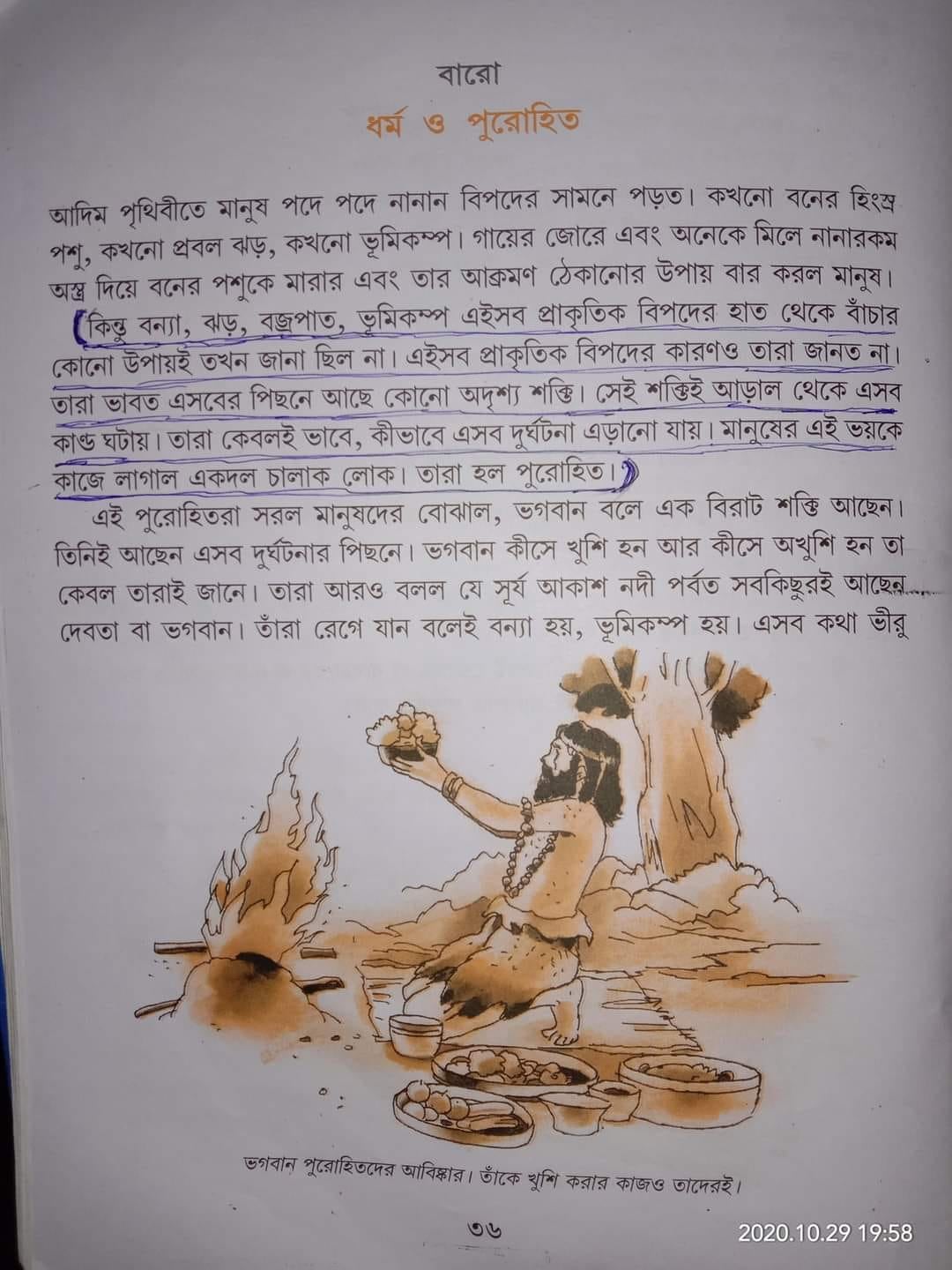
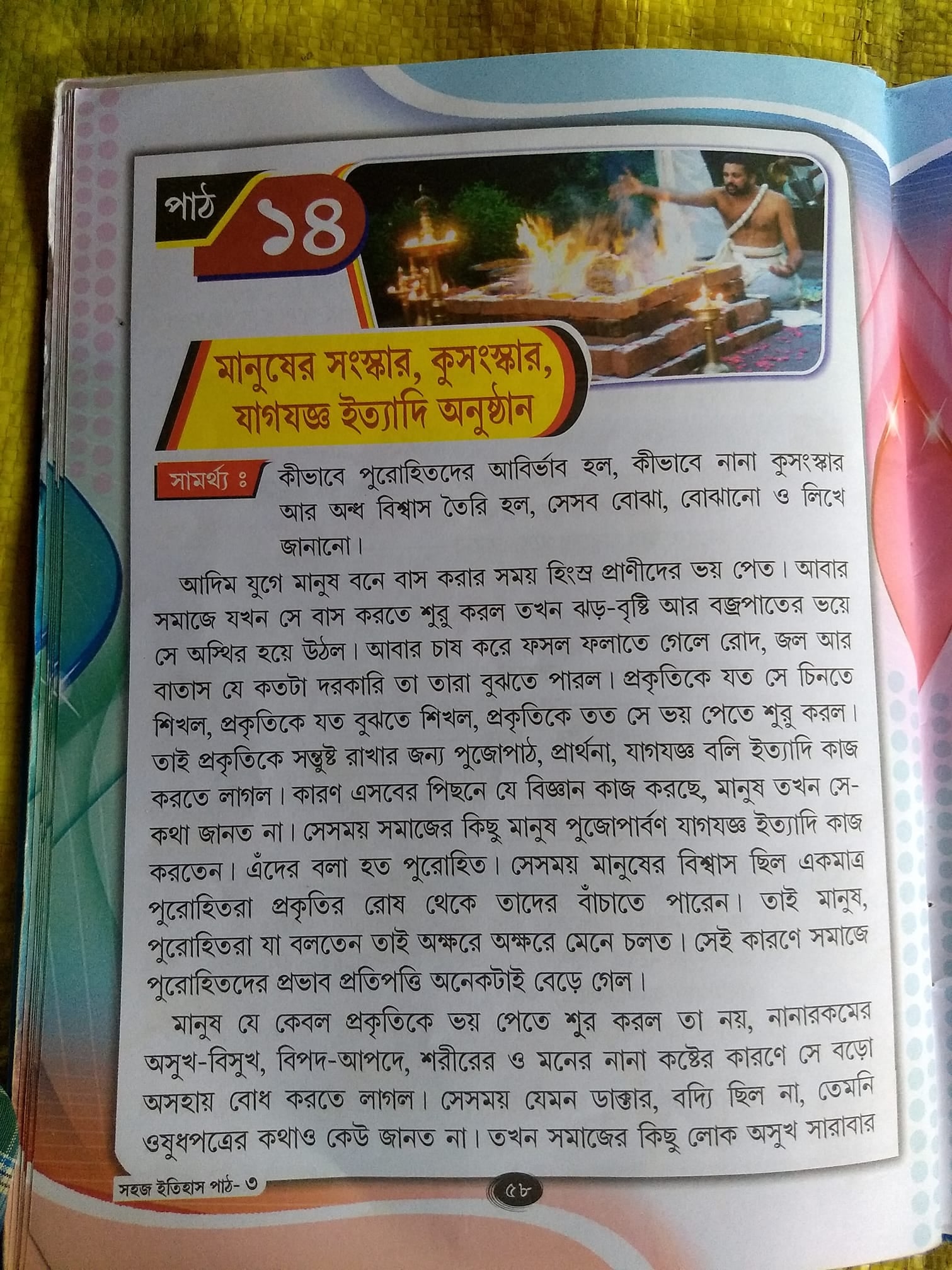
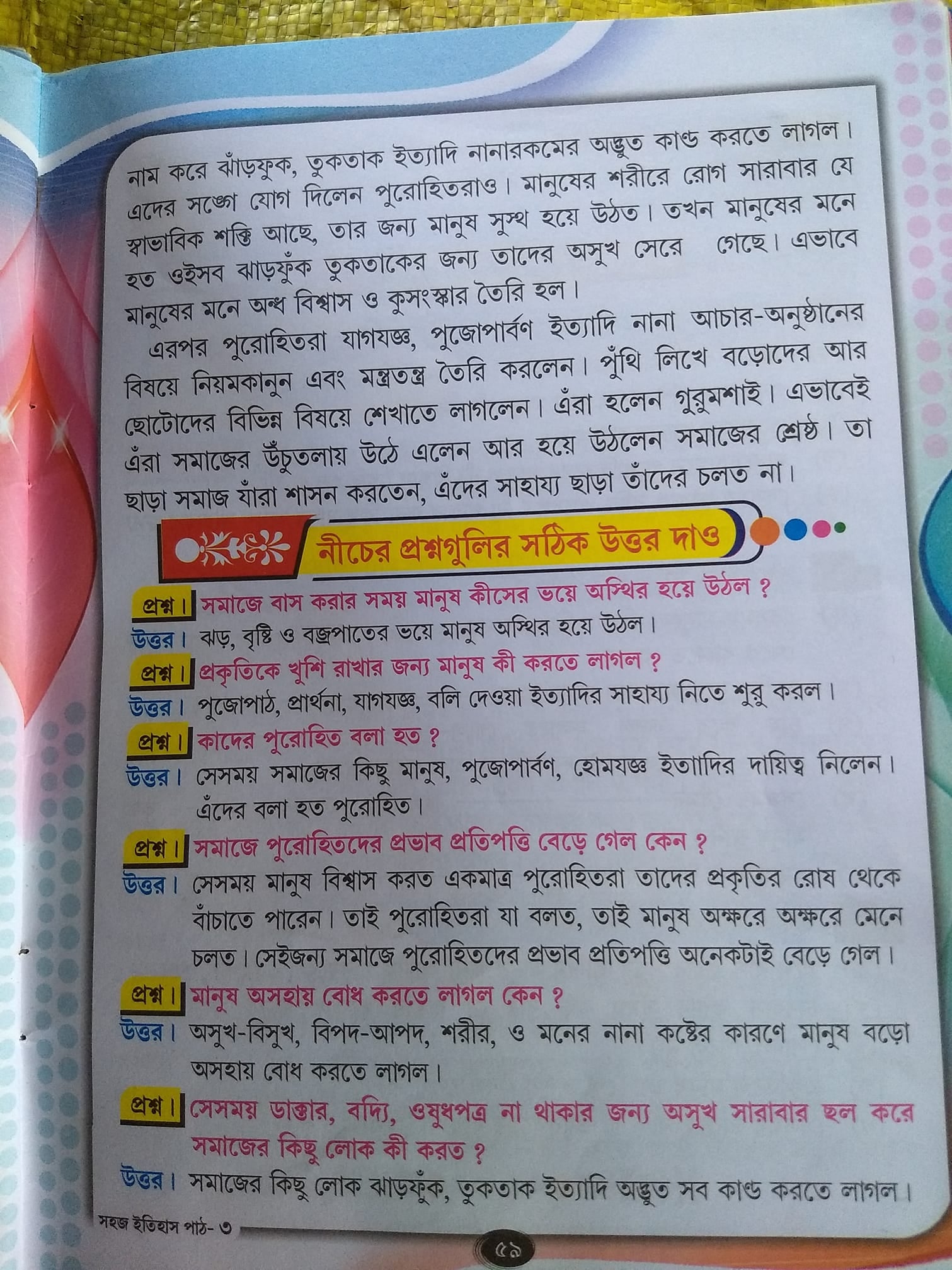
The images I’m sharing here are from children’s textbooks in the Indian state of West Bengal. Now just imagine for a moment what would have happened if similar content—going against Islam—were included in primary school textbooks in Bangladesh! What an uproar Hefazat-e-Islam, the Charmonai factions, and the Muslim majority would have created! Extremists would have announced bounties on people’s heads—how many, do you think? Now tell me: can the majority children of West Bengal, who will grow up with such an enlightened worldview, ever be comparable to the children of Bangladesh?
Do you remember how, in 2013, under pressure from Hefazat-e-Islam and to appease fundamentalist forces, the government removed Rabindranath Tagore’s writings from textbooks, erased Humayun Azad, and dropped many other secular works? Fundamentalists openly boasted that lessons like evolution—one of the foundations of biology—should be removed from the education system! And the government, bowing down, partially agreed to those demands. Even in Bangladesh’s parliament, demands were raised to remove evolution! What an enormous, all-encompassing effort to keep an entire nation blind!
Most of the current generation in Bangladesh is growing up with a terrifying blindness, where they believe that religious books—especially the Qur’an—are everything, and that if something is said in the Qur’an, it must take precedence over science. It has reached a point where instead of justifying a scientific fact within a scientific framework, people feel compelled to justify it using verses from the Qur’an! What a terrifying mindset. Religion is a matter of personal belief, and belief itself is blind. Islam says that there is no such thing as infectious disease—should science or modern medicine accept that? In medical education, which one should take precedence?
Many boys and girls of this generation are so blind that they cannot comprehend any logic; they will go through life immersed in logical fallacies. You will find thousands of them in Facebook posts and comment sections. Remember how, two years ago, science teacher Hriday Mondol was jailed by the police for discussing science in class? He had said, “This is a science class, not a religion class. Science is proven through experimentation, and religion is belief.” Some students deliberately dragged the Qur’an into the discussion, secretly recorded the conversation, then created a mob and accused him of blasphemy. In this article of mine, you’ll find a description of that dark chapter of our time. A teacher talking about science in a science class is completely normal; what religious scriptures say is not something a science teacher is obligated to consider. Most people in Bangladesh cannot accept even this simple logic. Science does not require certification from religion—so why does religion so desperately seek certification from science? And that too, false certification!
During the first year of my career, out of sheer interest, I worked in Cox’s Bazar for a few months. While there weren’t as many Rohingya refugees then as there are now, they were not few either. I used to roam through refugee camps in Ukhiya and Kutupalong. Everywhere I looked, I saw skullcaps—caps everywhere. Even tiny children wore caps. Rakhaine State of Myanmar is right next to Cox’s Bazar, and the Rohingyas share many linguistic and cultural similarities with the people of Cox’s Bazar. For centuries, people moved across this region with hardly any barriers. Even now, they have relatives on both sides. That’s why if you had gone to places like Moriya, Hnila, Ukhiya, or Teknaf even a decade ago, and it happened to be market day, you would surely have seen almost everyone wearing caps—from tiny children to ninety-year-old elders. What I mean is that culturally they are deeply religious, and they prioritize maktabs and madrasas over modern education.
In conversation with the Upazila Nirbahi Officer of Teknaf, I learned that it was difficult to find enough qualified female candidates to fulfill the women’s quota for primary school teacher recruitment there. The literacy rate was extremely low. Perhaps things have changed somewhat after all these years. Bengalis, living in an independent country, may now be more aware of their educational rights. But the Rohingyas still have little understanding of education. That’s why you rarely find among them people who can speak up or provide leadership. Occasionally, two or three people message or comment on my Facebook, saying that no matter how many degrees I hold, if I don’t have knowledge of the Qur’an, I am supposedly ignorant. The Rohingya mindset may be similar. Even though they lack education, wealth, and power, a sense of pride—or superiority complex—works within them, believing they are the superior race as Muslims. They imagine that in the afterlife, others will burn terribly in fire, eating pus and blood, while they will sit in heaven laughing and enjoying wine, women, and mansions. In reality, this superiority complex also stems from the frustration of their joyless lives.
The Rohingyas never understood the essence of education. Studying only in maktabs and madrasas, one cannot easily become an intellectual, social reformer, scientist, or leader. Because of this, over the past century they have made many historic mistakes. From Burma’s independence until today, they have failed to make the right decisions. At the core of all this is their reluctance to engage with modern education. You may argue that they were never given that opportunity. But opportunities are things that must sometimes be earned. Why am I talking so much about the Rohingyas? If you look at the Bengali region a hundred years ago, you’ll find similarities. Back then, Bengali Muslims also didn’t understand the value of modern education. Even with many options available, they chose madrasas as their main educational institutions. As a result, Muslims in the Indian subcontinent began to lag significantly behind.
If you look at historical educational institutions across Bangladesh, you’ll see that apart from Haji Mohsin, hardly any Muslims came forward to promote modern education. Everywhere you look, institutions founded by Hindus or Christians: BL College, BM College, MC College, St. Xavier’s, Holy Cross, Notre Dame, Gregory, MM College, and so on. You might say that there were no wealthy Muslims in those days. That’s not true—rather, they chose madrasas over modern institutions as the primary centers for Muslim education. Even today, the Muslim education patrons you see were themselves educated in institutions founded by people of other religions. Muslims began to become enlightened because they had free access to Hindu-founded institutions. A segment of Muslims broke this stagnation, which is why we saw the Language Movement of 1952, the Liberation War of 1971, and the emergence of an independent Bangladesh. The first major advancement of Muslims in this region in education and cultural movements began with the establishment of Dhaka University in 1921.
A new debate has now emerged: that Nawab Salimullah made great contributions to the founding of Dhaka University, while Rabindranath made none—or even opposed it. I won’t enter that debate. Salimullah, though a visionary, died before the university was founded. And Rabindranath’s alleged opposition is not historically proven. Some people are raising this controversy due to the smoke of so-called “India boycott” sentiments. The real reason is simple: Salimullah was a Muslim, Rabindranath was not. However, after Dhaka University was founded, Rabindranath was officially honored there, and he attended in person. Later, the university awarded him an honorary doctorate. This clearly shows that even at that time, Dhaka University recognized Rabindranath’s stature in Bengali identity, literature, and culture.
The Nawabs of Dhaka owned very little personal land. Their main real estate consisted largely of waqf estates donated by other Muslims. Today, many institutions in Dhaka bear the Nawabs’ names—such as Sir Salimullah Medical College. If you examine its naming history, you’ll find that Salimullah donated five thousand taka, Rani Dinmani donated fifty thousand, and Mitford donated his entire lifetime savings and land. Yet the institution was named after the Nawab, while Dinmani’s name has almost vanished! Do you know these facts? Bengali Muslims rarely verify facts; if religion or a Muslim name is attached, they assume it must be right or superior. Just like they believe Muslims contributed the most to science, that everything was discovered by researching the Qur’an. Yet the so-called Muslim scientists they cite—such as Ibn Rushd, Ibn Sina, and Al-Khwarizmi—were all declared non-believers and imprisoned by Muslim rulers of their time. They pursued science by standing against religious leaders.
People in Bangladesh don’t even have the right to vote, yet they sit in tea stalls analyzing American elections. They don’t grant rights to minorities or dissenters in their own country, yet they shed tears for distant oppressed groups. Bangladesh produces hardly one quality film a year, yet people lose sleep over artists’ association elections. Their thoughts, consciousness, and mindset revolve entirely around religion and politics. They have no concern for free speech, equality, women’s rights, or democracy—yet they passionately argue over irrelevant issues. No one seems concerned that the quality of education at Dhaka University has sunk so low, that there are no notable research achievements, or that campuses are hostage to political student and teacher groups. That the once “Oxford of the East” no longer even appears on Asia’s top university lists sparks no debate. Instead, people are busy arguing about the roles of Salimullah and Rabindranath from a hundred years ago—because such debates allow them to elevate Muslims and belittle Hindus, which helps them sleep peacefully.
Before British rule began in the Indian subcontinent, Hindus had many religious educational centers called tols. Tols were institutions where Sanskrit was taught to train priests—essentially Hindu madrasas or maktabs. Some philosophy, health education, and social service subjects were also included. After India’s independence, these tols were officially abandoned. With the British arrival, Hindu intellectuals argued that learning Sanskrit in tols would not lead to progress; instead, modern scientific knowledge should be pursued. Ishwar Chandra Vidyasagar openly opposed tols and urged people to embrace the British-established education system. Nadia was once the hub for producing Hindu scholars, covering nearly 4,000 square kilometers and 5.2 million people. From many tols, the number has dwindled to just 25 today. These tols receive no government grants or special support. By abandoning tols and embracing modern education, Hindus advanced significantly. Even today, they are relatively more tolerant; criticizing their beliefs rarely leads them to violence.
When one person or one nation moves forward, others don’t just lag behind—they can become deeply ignorant and, in some cases, uncivilized. Hindus had a rich tol tradition, but they abandoned it, losing government patronage without protest. But in the same India, attempting to shut down madrasa education would cause massive upheaval—countless lives would be lost. Fires would burn in the streets of Bangladesh and Pakistan too. Yet no one would ask what role madrasa education plays in modern knowledge, science, civilization, or philosophy—because of that same superiority complex syndrome. They believe madrasa education, meaning Qur’anic and Hadith knowledge, is the supreme form of knowledge.
America abandoned religious education and made primary education compulsory for children in 1852. Many countries couldn’t achieve this even 150 years later. Anyway, the point remains the same: people don’t always like what is right. But what is logical and correct must be pursued. Otherwise, while one person photographs a black hole, another will be practicing jinn worship, declaring things kufr, magic, or occultism! Especially in this subcontinent, many Muslims lag behind because of their own failures; clinging to religion has prevented change. They will continue to suffer from superiority complex syndrome for a long time to come.
Related Posts
Why do Islamist clerics consider Bengali cultural festivals their enemy?
This year, unlike many previous years, the major Hindu religious festival Durga Puja in BangladeshRead More
ইসলামিস্ট মোল্লারা কেন বাঙালিদের আনন্দ উৎসবকে তাদের শত্রু মনে করে?
এবার বাংলাদেশে অন্যবারের তুলনায় বেশ শান্তিপূর্ণ, উৎসবমুখর পরিবেশে হিন্দু ধর্মের বড় ধর্মীয় উৎসব দূর্গাপূজা হয়েRead More
Why do Islamist cyber‑jihadis insult, threaten, and file false reports against people with different opinions?
Maulana Azhari once advised Islamists that sharing his Facebook posts is also an Islamic act;Read More
Comments are Closed