
Education Improves Humanity
If education does not improve you as a human being, then it is no education at all
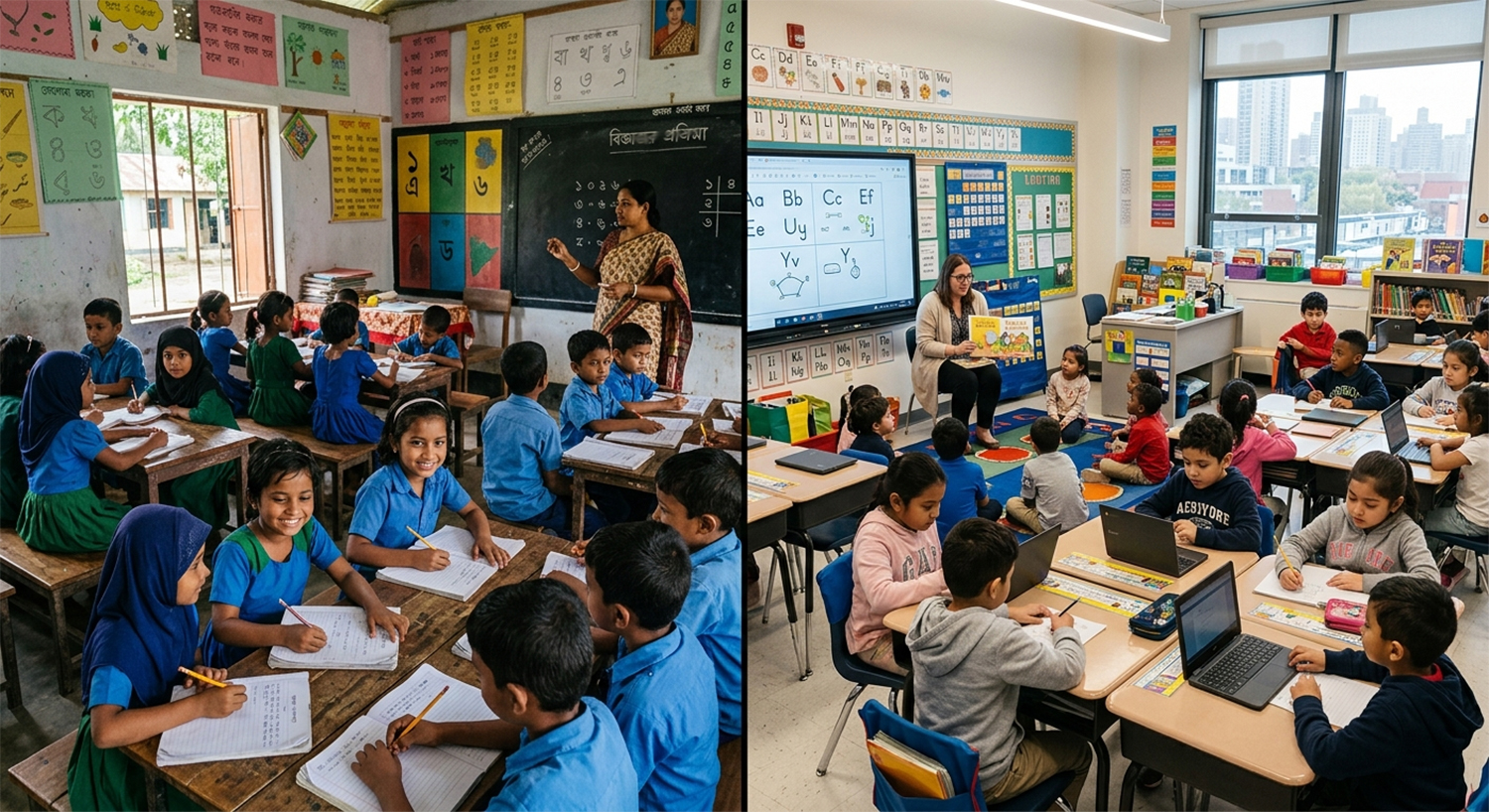
Bangladesh’s education sector is currently facing a major crisis. This cannot be understood merely by looking at pass rates or the number of students. On one hand, more than 36 million children and adolescents in the country are studying from primary to HSC level, while on the other hand, the total budget for the entire education sector (including primary, secondary, technical, madrasa, and higher education) is only around 95,645 crore taka (according to the 2025-26 fiscal year budget). Out of this, approximately 70-75 thousand crore taka is allocated for the primary to HSC level. In contrast, a single city in America—the New York City Department of Education—spends about 33-38 billion dollars for 860,000 students, which is roughly 3.7 to 4.2 lakh crore taka in Bangladeshi currency. The Los Angeles Unified School District (LAUSD) alone spends 18.8 billion dollars, or about 2 lakh crore taka, for 440,000 students. There are other school districts in Los Angeles as well; if their expenses are added, the amount would increase even further. This comparison is not just about money, but also a reflection of national development.
Since Bangladesh has virtually no significant natural resources, the country’s only real asset is its vast population. To improve the overall quality of its people, enhancing the quality of education is essential. The greatest attention must be given to education from the pre-primary or Grade 1 up to Grade 12. The goal should be to build a compassionate, rational, and science-oriented nation. One day, they will ensure the country’s development.
First, it must be understood that the American education system is not directly controlled by a central ministry. Education there is managed through local school districts. For example, if we imagine Mirpur in Dhaka as a school district, then the curriculum, administration, recruitment, budget, and quality standards of all schools in Mirpur would fall under the same district office. The New York City Department of Education (NYC DOE) and the Los Angeles Unified School District (LAUSD) are prime examples of this system. NYC DOE has approximately 860,000 students, and LAUSD has about 440,000. These districts determine their own budgets through local taxes, state aid, and federal grants. As a result, the quality of education can be improved according to local needs. In Bangladesh, everything is centrally controlled by the Ministry of Education, which often ignores local realities. Consequently, the gap between rural and urban schools continues to widen.
The budget comparison is eye-opening. The education expenditure of a single American city is several times higher than Bangladesh’s entire education sector budget. The proposed budget for NYC DOE for the 2026 fiscal year is approximately 33.5 billion dollars (about 3.7 lakh crore taka in Bangladeshi currency), which is more than five and a half times the budget allocated for primary to HSC levels in Bangladesh. LAUSD’s budget is 18.8 billion dollars (about 2 lakh crore taka). For Bangladesh’s approximately 36 million students, the allocation is far less per student than what New York spends on its 860,000 students. Per-student expenditure in Bangladesh at the primary-secondary level is less than 20,000 taka, whereas in America it is several hundred thousand taka. This money is not spent only on salaries—it goes toward modern labs, libraries, teacher training, counseling, sports, and digital facilities. As a result, American students become proficient in science, technology, and problem-solving. In Bangladesh, due to budget constraints, classrooms have 60-70 students, there is a shortage of teachers, and infrastructure is dilapidated—quality education is impossible under these conditions.
Investment in education is the foundation of national development. Economists say that every one taka invested in education yields 7-10 taka in return in the long run. In a country like Bangladesh with a young population, failing to improve education for children and adolescents will prevent the creation of a skilled workforce. Currently, youth unemployment and the NEET (Not in Education, Employment or Training) rate are high in Bangladesh. If the quality of education does not improve, this generation will not become science-oriented; instead, it will remain trapped in superstition and irrationality. The American school district model shows that local autonomy makes education more accountable. In Bangladesh too, school districts could be formed at the district or upazila level, with budget, curriculum, and recruitment handled locally. This would reduce corruption and better meet local needs. Competition among school districts would also increase. But will the bureaucrats in the ministry allow this autonomy and decentralization?
Simply increasing the budget is not enough. The biggest challenge is the quality of teachers. In Bangladesh, political influence in teacher recruitment, lack of training, and low salaries prevent competent teachers from joining the profession. In America, teachers receive high salaries, mandatory training, and much higher professional status. Bangladesh must increase teachers’ salaries, prioritize merit and competence in recruitment, provide regular training and performance bonuses. The student-teacher ratio must be reduced—to a maximum of 30 students per class. A modern curriculum must be introduced that prioritizes science, mathematics, problem-solving, and critical thinking.
Here comes one of the most important demands—removing religious education from schools. In Bangladesh’s public schools, Islamic education, madrasa education, and religious programs are funded by the state. This is wrong. Religion is a personal matter. It can be taught at home, in mosques, or temples by families, but imposing religious education in schools with state money turns education into a breeding ground for blind faith. As a result, students do not learn logic, science, or critical thinking. We often see so-called educated people falling into superstition during even minor discussions. Religious education must be removed from schools and the curriculum made completely secular. This will help students become compassionate, tolerant, and rational. American schools have no religious education, which allows them to live peacefully in diverse societies. Bangladesh must follow the same path. Madrasa education can be modernized and converted into general education, but religious content must be removed from public schools.
Several other aspects of reform are noteworthy.
- First, digital education—every school must have internet, computer labs, and online learning platforms.
- Second, special emphasis on girls’ education—although girls are ahead in primary, dropout rates are higher in secondary.
- Third, change in assessment methods—replace rote-based exams with project-based, creativity-based, and skill-based evaluation.
- Fourth, infrastructure development—ensure every school has labs, libraries, playgrounds, and proper sanitation.
- Fifth, increase participation of parents and society by strengthening PTA (Parent-Teacher Association).
What will be the result of these reforms? A nation where reason prevails, scientific thinking is widespread, and compassion is natural—development and progress will naturally follow. Religious superstition will decrease, gender equality will increase, and innovation will flourish. The economy will become stronger because a skilled workforce will be created. In a country like Bangladesh, without improving education, sustainable development will not be achieved even after graduating from LDC status. The government must allocate at least 4% of GDP to education. The current rate of around 1.5% is insufficient. Funds must be mobilized from international donor agencies, increased tax collection, and by diverting money from unnecessary sectors.
There are certainly challenges. Political will, control of corruption, and implementation capacity are needed. But history shows that countries that invest in education move forward—South Korea and Singapore are prime examples. Bangladesh can do it too if it starts today. Looking at the flawed logic and simplistic thinking of so-called educated people, it is clear that without deep educational reform, the nation will not progress. By removing religious education from the state, we can open the path to genuine free thinking.
In conclusion, Bangladesh’s education system should learn from the American school district model and ensure decentralization, increased budget, teacher development, and secularism. This is not just a question of money, but of the dreams of future generations. If we do not invest today, tomorrow’s Bangladesh will remain in darkness. The government, educationists, parents, and society—all must work together. Only then can we one day proudly say—our nation is rational, science-oriented, and compassionate. Education is the only way. If education does not improve you as a human being, then it is no education at all.
Related Posts

Why do Islamist clerics consider Bengali cultural festivals their enemy?
This year, unlike many previous years, the major Hindu religious festival Durga Puja in BangladeshRead More
ইসলামিস্ট মোল্লারা কেন বাঙালিদের আনন্দ উৎসবকে তাদের শত্রু মনে করে?
এবার বাংলাদেশে অন্যবারের তুলনায় বেশ শান্তিপূর্ণ, উৎসবমুখর পরিবেশে হিন্দু ধর্মের বড় ধর্মীয় উৎসব দূর্গাপূজা হয়েRead More
Why do Islamist cyber‑jihadis insult, threaten, and file false reports against people with different opinions?
Maulana Azhari once advised Islamists that sharing his Facebook posts is also an Islamic act;Read More
Comments are Closed