
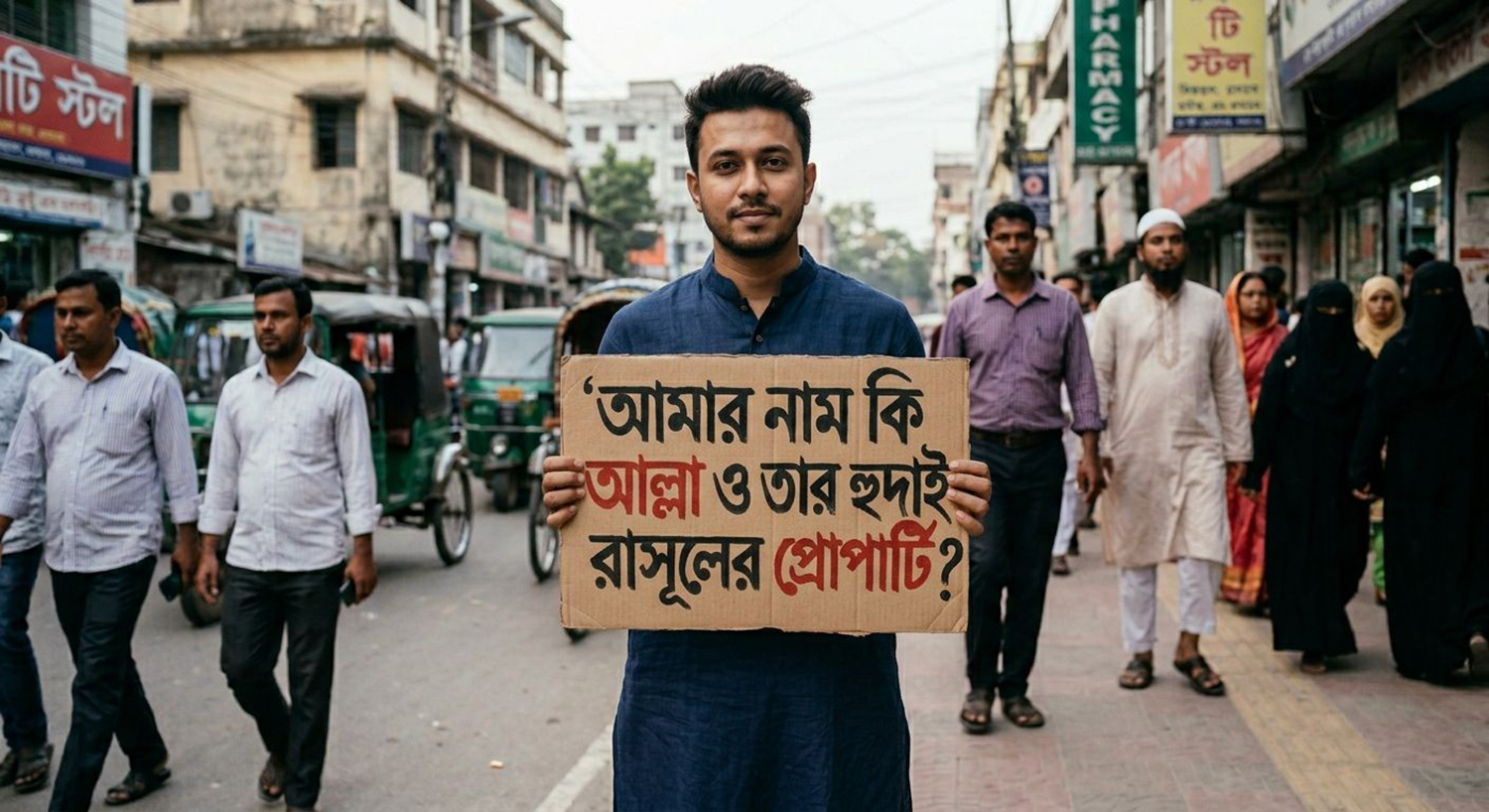
Does the Arabic belong to Muhammad?
Names belong to language and culture, not to any religion: why does Islam claim Arabic words as its own?
Ignorant, child-obsessed believers keep nagging about why I don’t change my name, why my name is associated with Allah! Did I choose my own name? And are the words “Saif” and “Rahman” the property of Islam? Both words are very ancient. They existed thousands of years before Islam. If Prophet Muhammad claims all beautiful adjectival words (such as Rahman or Merciful) as names of Allah, does that automatically make them His property? The Arabic language existed long before Allah. Words that have existed for thousands of years—then one day a child-obsessed gangster comes and claims all of them belong to him and his Allah, and suddenly they become his property?
Did Prophet Muhammad and his companions change their pagan names after becoming Muslim? No, they did not.
Before Islam emerged, the people of Arabia were pagans, Jews, and Christians. They had names like Abdullah, Amina, Muttalib, Muhammad, Umar, Uthman, Khadijah, Zaynab, Kulsum, Ali, etc. Prophet Muhammad himself said that his parents were destined for hell because they were pagans. So after Islam emerged, did these names change? Are these Islamic names? No.
I did not name myself. If my parents had named me John, my name would be John; if Ram, then Ram. What difference does a name make? A name is simply an identifier. It has nothing to do with religion. No name belongs to any religion.
Which came first—the Arabic language or Allah? Surely the Arabic language. In fact, Islam has appropriated all the words of Arabic. After inventing Allah, Muhammad attributed all the beautiful descriptive words in Arabic—such as Rahman, Rahim, Karim, Jabbar, Ghaffar—as names of Allah. Did Muhammad create these words? These words existed in Arabic centuries before him. They existed long before Islam.
Names belong to language and culture, not religion. Many famous people from Arab regions have names that ignorant believers would assume to be Muslim. For example, Tariq Aziz, the foreign minister of Saddam Hussein, was a Christian. In Hebrew, there are similar words like “Rahamim.” Names such as Zakariya, Sarah, Mary, Hannah, Eva, Ilyas, Ibrahim, Amir, Tamar, Rami, Omar, Zakir, Alia, Amana, Dalia, Maya, Naomi, Taliha—these are used by Muslims, Christians, and Jews alike in the Arab world. Just as Muhammad threatened to expel Jews to seize their property by claiming that the world belongs to Allah and His messenger, now his followers try to claim ownership over Arabic words that have existed for thousands of years. How ridiculous!
Both “Saif” and “Rahman” are extremely ancient words. Their usage in the ancient Middle East predates the rise of Islam (7th century CE) by hundreds or even thousands of years. There is clear archaeological, linguistic, and inscriptional evidence for this.
History of the Word “Saif” (سيف)
“Saif” is an original Arabic word whose literal meaning is “sword.” In ancient Arabia, it was widely used as a symbol of bravery, strength, and protection.
How old it is: The root of this word existed in Semitic languages at least 1,000 to 1,500 years before the rise of Islam. It was commonly used in pre-Islamic Arabic poetry and as a personal name centuries before Islam. For example, just before the advent of Islam, the famous Yemeni king “Saif ibn Dhi Yazan” was a prominent figure in Arabia during the time close to Muhammad’s birth.
Historical evidence: The word “Saif” appears frequently in descriptions of warfare in the poetry of famous pre-Islamic poets such as Imru’ al-Qais and Antarah ibn Shaddad. Additionally, inscriptions from ancient North and South Arabia, including Safaitic and Sabaic scripts, show the usage of its root in the sense of sword or weapon.
History of the Word “Rahman” (رحمن)
From a linguistic and archaeological perspective, the history of the word “Rahman” is even more remarkable and better attested in ancient inscriptions than “Saif.” Its root meaning is “merciful” or “compassionate.”
How old it is: The root “R-H-M” dates back 3,000 to 3,500 years in ancient Semitic languages. Variants of it appear in Akkadian, Hebrew, and Aramaic. At least 300 to 400 years before Islam, the term “Rahman” was widely used across the Arabian Peninsula—especially in South Arabia—as the name of a single omnipotent God.
Historical evidence:
Tell Fekheriyeh Inscription: A bilingual inscription from the 9th century BCE (about 1,500 years before Islam), discovered in Syria, refers to the Mesopotamian deity Hadad as “Rḥmn” (the merciful god) in Aramaic.
Himyarite Inscriptions: In the 4th century CE (around 380 CE), when the Himyarite kings of Yemen converted to monotheism (Judaism and later Christianity), they abandoned their ancient polytheistic deities and began worshipping a single God. In South Arabian Musnad inscriptions, this God was referred to as “Raḥmānān” (𐩧𐩢𐩣𐩬𐩬), meaning “the Merciful, Lord of the Universe.”
Inscription of Abraha: Just before Islam (around 550 CE), the Christian ruler of Yemen, Abraha, erected an inscription at Murayghan. It begins with the phrase: “By the power of Rahman and His Messiah (Jesus)…”
Related Posts

Operation Entebbe – the story of one night, and the Islamic execution suffered by Nazrul Islam and Sweety Akter
What can a state do to save the lives of its citizens abroad? Are thereRead More
অপারেশান এন্টেবে – এক রাতের গল্প এবং নজরুল ইসলাম ও সুইটি আক্তারের ইসলামি হত্যার শিকার হওয়া!
একটি রাষ্ট্র বিদেশে তার নাগরিকদের জীবন বাঁচাতে কী করতে পারে? এর কোন টেক্সটবুক উদাহরণ আছে?Read More
A random page from Muhammad’s self‑made book Qur’an and its unscientific statements
Sometimes I flip through random pages of Muhammad’s self‑made book Qur’an, and today this pageRead More
Comments are Closed