
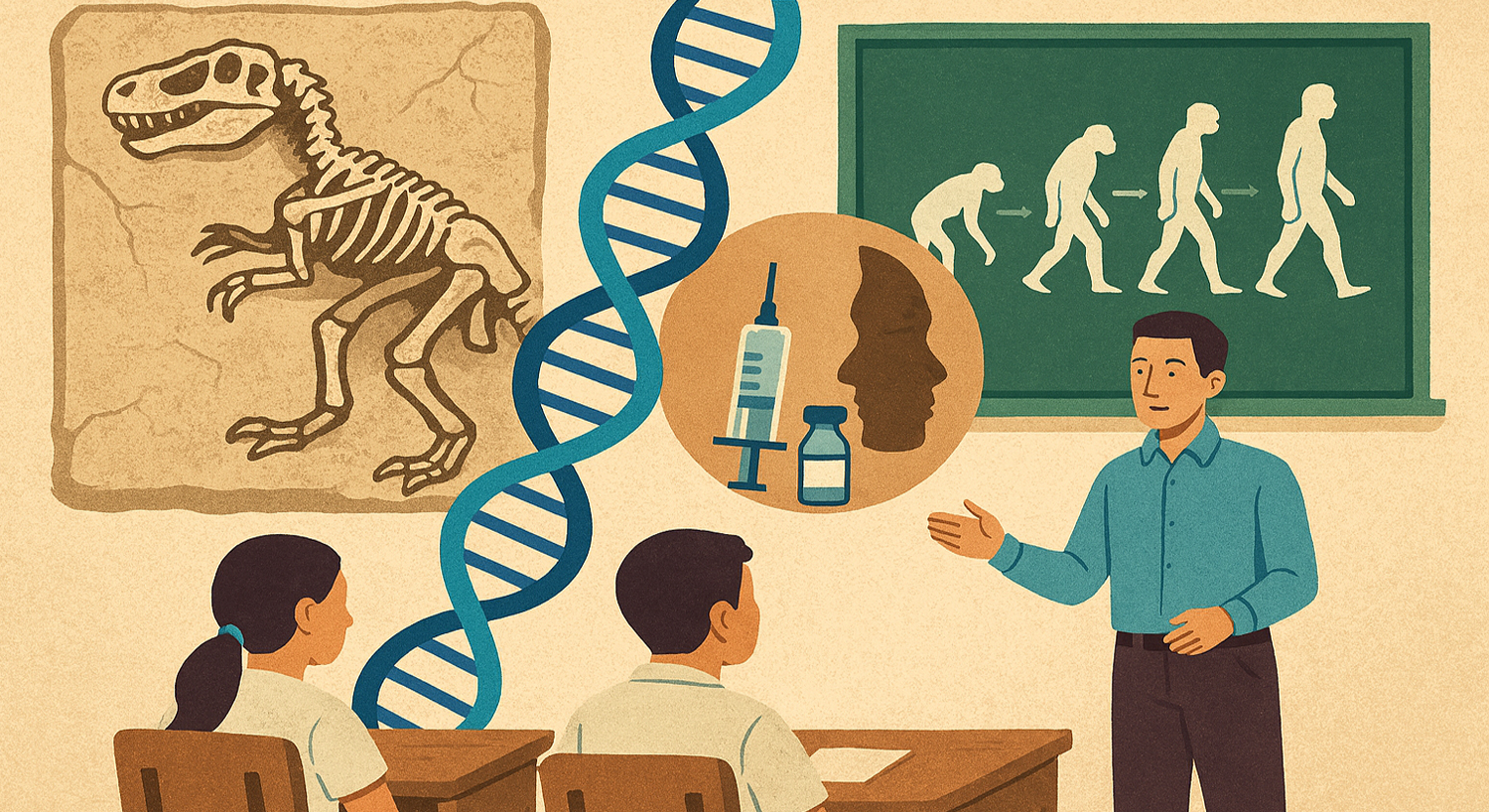
Did humans come from monkeys?
Human from monkey – wrong, completely wrong!
First they came for the atheists. If you did not speak up then, it is high time you speak up now. The essence of this English line is: If you still remain silent, one day they will swallow you along with everyone else.
Evolution is often misunderstood as “humans came from monkeys,” whereas in reality it is a well‑established scientific truth that cannot be denied. Modern medicine, drug development, and vaccine research—all progress on the foundation of evolutionary theory, and everyone benefits from it, even those who publicly oppose it. Removing evolution from Bangladesh’s curriculum would mean falling at least two centuries behind in science, and students would be academically dismissed on the global stage. To keep pace with scientific progress, evolution must remain in the curriculum.
Many people still claim out of ignorance that evolution means “monkey to human,” but this idea is completely wrong and distorts a fundamental scientific truth. To break this misconception, the late Ananta Bijoy Das once wrote an excellent article explaining the real scientific basis of evolution. Tragically, it was for such writings that he was murdered by extremists, and many like me had to leave the country for practicing free thought. Imagine—if Avijit Roy or Ananta Bijoy Das were still alive and free to write today, how profoundly they could have shaped Bangladesh’s intellectual progress—promoting rationalism, scientific thinking, and humanistic values. But that possibility no longer exists, because they are no longer with us. As a result, Bangladesh continues to fall behind, unable to move forward, and the light of free thought is fading into darkness.
Humans belong to the primate order, but we are not “monkeys.” In the primate group, humans, monkeys, and apes—such as gorillas, chimpanzees, and orangutans—all coexist. From an evolutionary perspective, humans are much more closely related to apes, while monkeys are more distant relatives. Among apes, chimpanzees are our closest relatives, followed by gorillas, and then orangutans. Around six to seven million years ago, the human lineage and the chimpanzee lineage split from a common ancestor. Scientists have confirmed this through three methods: comparing human anatomy with modern primates, analyzing ancient fossils, and studying DNA and proteins. Today, molecular biology provides the most accurate information, but fossil research remains essential for understanding the pace of human‑like evolution.
Charles Darwin did not directly discuss human evolution in his famous book Origin of Species, but in The Descent of Man (1871), he clearly stated that humans and apes share a common ancestor—and that ancestor was not a modern human. His statement raised questions from religious groups and even some scientists: Where is the intermediate form between humans and apes? How can the “missing link” be found? Darwin explained human evolution through natural selection and predicted that hominid fossils would be discovered in the future. At the time of his death, no hominid fossils were known, but he correctly predicted that such evidence would eventually be found.
A few years after Darwin’s death, in 1889, Dutch anatomist Eugène Dubois discovered the first hominid fossil on the island of Java in Indonesia. He recovered a femur and a small skull. Tests showed that the femur belonged to a bipedal creature, and the skull volume was only 850 cc—much smaller than that of modern humans. The fossil was dated to about 1.8 million years old. Initially called “Java Man,” it was later classified as a distinct species named Homo erectus. Modern humans are Homo sapiens, and this discovery proved that human evolution occurred gradually over a long period, and that our ancestors once lived on Earth in very different forms.
Several fossils of Archaeopteryx have been recovered over many years from limestone quarries in the Solnhofen region of Germany. The first specimen was discovered in 1860 and the most recent in 2005. It was a small creature, roughly the size of a crow. Its fossils show clear bird‑like features—such as a skull, beak, and feathers—while its skeleton also displays characteristics of bipedal dinosaurs. For this reason, scientists consider Archaeopteryx an important transitional fossil between reptiles and birds.
Some of the earliest evidence of human evolution comes from hominid fossils dating back six to seven million years, discovered in Africa. Among them, Sahelanthropus and Orrorin are notable. Anatomical analysis shows that they were among the first bipeds to dominate the land, although their brains were much smaller than those of modern humans. Around 5.5 million years ago, hominids known as Ardipithecus lived in Africa.
Many fossils of Australopithecus have been found in Africa, showing that they lived about four million years ago. Although they could stand upright, their cranial capacity was only about one pound—similar to gorillas and chimpanzees, and much smaller than modern humans. Their skulls show both ape‑like and human‑like features—such as a low forehead, ape‑like face, but human‑like dental arrangement. At the same time, other hominids such as Kenyanthropus and Paranthropus existed. Some species of Paranthropus were tall but had small brains. Eventually, this branch went extinct, while other hominids continued in the main line of human evolution.
The earliest member of the human genus Homo is Homo habilis. Archaeological and anthropological research shows that they were the first hominids capable of making simple stone tools and everyday objects. That is why they were named habilis, a Latin word meaning “skilled with the hands.” The cranial capacity of Homo habilis was about 600 cc—larger than earlier hominids but only half that of modern humans. They lived in the tropical regions of Africa about 2.5 to 1.5 million years ago. In them we see the earliest beginnings of human technology.
Next came Homo erectus, who lived in Africa about 1.8 million years ago. Their brain volume ranged from 800 to 1100 cc (about 2–2.5 pounds). They made more advanced tools than Homo habilis. Two features of this species are particularly notable:
- Although they lived in many regions for a very long time (from 1.8 million to 400,000 years ago), their anatomical changes were minimal.
- They were the first hominids to leave Africa and spread into Europe and Asia.
Around 1.6 to 1.8 million years ago, they reached Europe, Asia, and even China and Indonesia. The first Homo erectus fossil was discovered on the Indonesian island of Java by Eugène Dubois.
Among the ancestors of modern humans, one of the most important is Australopithecus afarensis, whose famous fossil “Lucy” is about 3.5 million years old. In 1972, about 40% of Lucy’s skeleton was recovered from Ethiopia, showing that although she was bipedal, she had a small brain and a short, slender body.
After Homo erectus, two important species evolved: Homo neanderthalensis and Homo sapiens.
Many Neanderthal fossils have been found in Europe. Research shows they emerged about 200,000 years ago and went extinct around 30,000 years ago. The most recent Neanderthal fossils were discovered in Spain. Their brains were as large as modern humans, and their bodies were similar but somewhat shorter and stockier.
It is believed that Homo sapiens evolved from Homo erectus in Africa about 400,000 years ago. The evolution of modern humans began in Africa roughly 200,000 to 150,000 years ago, and later they spread across the world, replacing other hominids. Although many researchers believe that Homo erectus populations in Asia and Europe did not give rise to new species, the discovery of Homo floresiensis in 2004 on the Indonesian island of Flores suggests they may have been descendants of Homo erectus. This species lived there about 12,000 to 18,000 years ago. However, research is ongoing and no definitive conclusion has been reached.
The spread of modern Homo sapiens across the continents is actually a relatively recent event.
Humans arrived in Southeast Asia and China about 60,000 years ago, and in Australia shortly after. They reached Europe around 35,000 years ago, and the Americas only about 15,000 years ago through migration from Siberia. Cultural and anthropological diversity among humans is not very old; geographic separation began only about 60,000 years ago. One reason for the late arrival in Europe was the long presence of Neanderthals, who had been living there for about 200,000 years and went extinct only 30,000 years ago.
One of the most important scientific undertakings of the last century was the Human Genome Project, which began in the United States in 1989. It was funded by the National Institutes of Health and the Department of Energy. Soon after, the private company Celera Genomics began similar research. The goal was to determine the complete human genome sequence within 15 years. The project’s budget was set at 3 billion USD—symbolically, one dollar for each DNA letter. The first draft was published in 2001, and a major phase was completed in 2003. The human genome contains three billion nucleotides, which would fill thousands of printed volumes. Later technological advances made personal genome sequencing much faster and cheaper—taking only a month and costing about $100,000.
Genomes of other species have also been sequenced. The chimpanzee (Pan troglodytes) genome was first published in 2005. Comparative analysis shows that humans and chimpanzees share about 99% similarity. The difference is only about 1%, but that small difference plays a crucial role in determining human-specific traits and phenotypes. Of the three billion DNA letters in humans, about 30 million differ from chimpanzees. This highlights both our close relationship with other primates and our evolutionary distinctiveness.
Humans and chimpanzees share remarkable genomic similarities. About 29% of enzymes and other proteins are produced by identical genes, while the remaining 71% differ—mostly due to an average of just two amino acid changes. DNA sequence comparison shows that the genomes of the two species are about 96% identical. However, about 3% of the genetic material—roughly 90 million DNA letters—has changed over the last six to seven million years, since humans and chimpanzees diverged from a common ancestor. Notably, many DNA segments do not contain protein‑coding genes; these are called “junk DNA.”
Genome comparisons reveal which genes evolved rapidly. Research shows that genes active in the human brain have changed more than those in chimpanzees. Among 585 genes studied, some—such as those involved in malaria resistance—evolved rapidly in humans. Over the past 250,000 years, genes beneficial to humans have undergone rapid changes. The FOXP2 gene, associated with the development of language, also evolved quickly in humans and is one of the foundations of our unique traits.
To understand human uniqueness, two factors stand out: the large brain and the rapid evolutionary rate of certain genes. However, we still do not fully know which genetic changes truly made us human. In the coming decades, as research expands, we may learn how we became distinct as a species. The development of human traits begins in the embryo, where the information encoded in the genome is expressed step by step, and changes occur over time. The development of the brain plays the most crucial role in shaping human thought and identity.
Humans diverged from other primates mainly because of extraordinary brain development. While other animals adapt to their environment through natural selection, humans have been able to modify and control the environment using technology. The use of fire, clothing, and shelter helped humans spread across different regions of the world. Even in extreme cold, humans adapted through technology rather than waiting for genetic changes. By inventing ships and airplanes, humans learned to travel across seas and skies—an achievement rooted in the evolution of human thought and brainpower.
In the past two decades, neurobiology has made remarkable progress. We now understand much more clearly how senses like light, sound, and smell send information through nerves to the brain, and how the brain controls different organs. Yet neurobiology is still in its early stages, much like genetics once was. How complex experiences such as emotion, feeling, and consciousness arise remains mysterious. Still, it is believed that within the next half‑century, philosophical analysis and scientific investigation will uncover many of these mysteries. Then humanity will be able to live better by understanding itself more deeply.
Related Posts

People knew that the Moon has no light of its own more than 1,150 years before the births of Muhammad and Allah; the story of the Moon splitting in two is a fanciful myth
Islam’s interest in the Moon seems endless. Months, days, dates, acts of worship, Eid, andRead More
মুহাম্মদ ও আল্লাহর জন্মেরও ১১৫০ বছর আগেই মানুষ জানতো চাঁদের নিজস্ব আলো নেই, চাঁদ দ্বিখণ্ডিত হওয়ার কেচ্ছা গাঁজাখোরি
চাঁদ নিয়ে ইসলামের আগ্রহের শেষ নেই। মাস, দিন, তারিখ, ইবাদত-বন্দেগী, ঈদ, রোজা সব চাঁদ কেন্দ্রিক।Read More

Humans cannot even see 1% of the beauty and colors of Earth and the universe! Are humans really the best of creation?
The human eye can generally detect visible light or color in the wavelength range ofRead More
Comments are Closed