
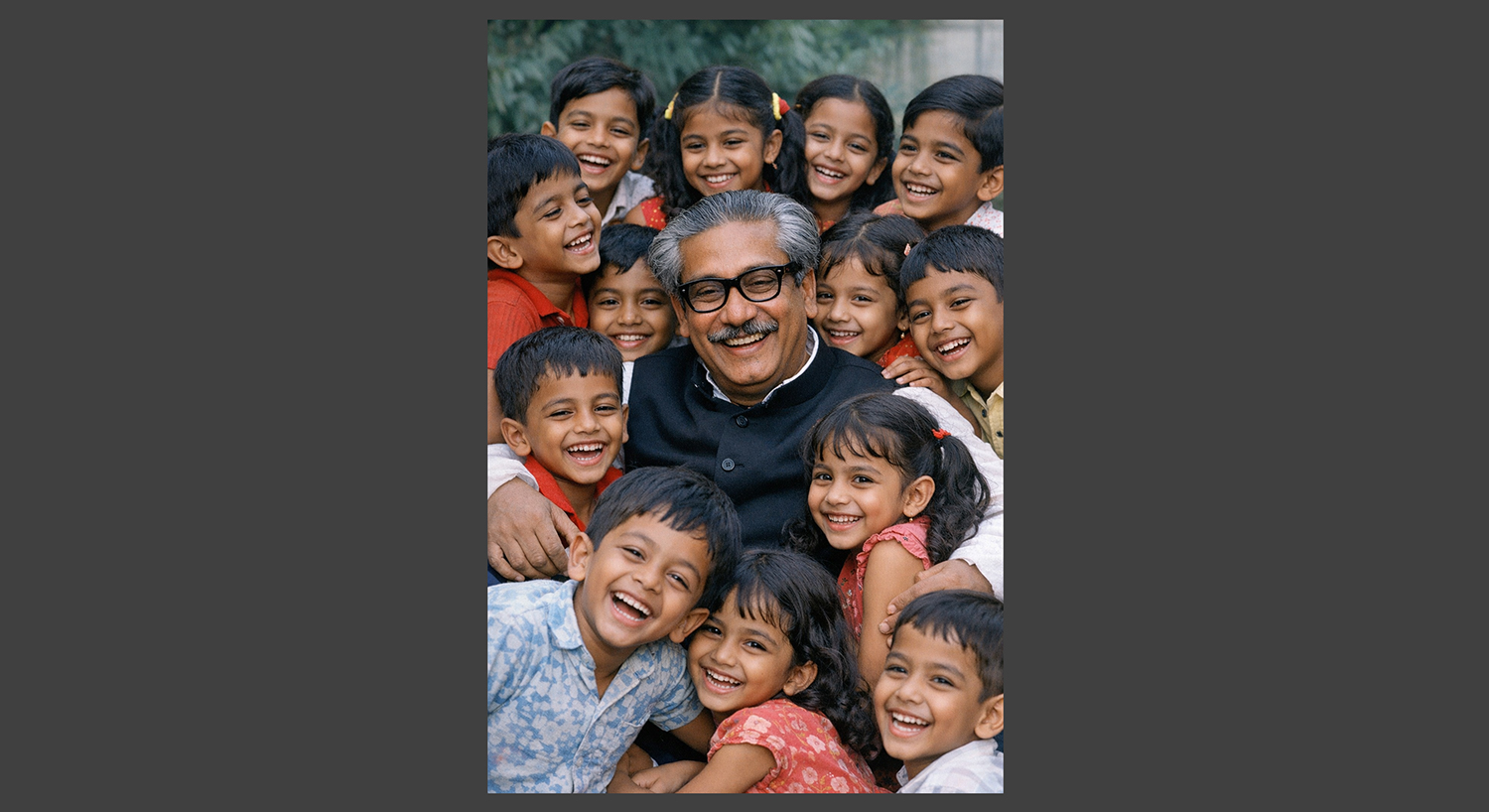
Dhanmondi 32 and Bangabandhu
Birthday, Bangabandhu, Dhanmondi 32 Number, and the History of Its Construction
Today is 17 March, the birthday of Bangabandhu Sheikh Mujibur Rahman and National Children’s Day. We are celebrating the day with great festivity—cutting ribbons and cakes in schools and colleges, offering flowers, arranging ceremonies. But how many of us are teaching children about the sacrifices of this great man’s pre‑1971 life? How many children know that Bangabandhu was born to love humanity? How many politicians have drawn inspiration from his ideals and embraced true patriotism? How many officials and employees have learned to work tirelessly as he did?
Whatever the case, the sun will rise; if one cannot shine in its light, the sun is not to blame.
Today in Dhaka, even minor politicians own luxurious houses. Yet the first great leader of an independent nation, Bangabandhu, could not repay the loan for his own house during his lifetime. He had no wealth or luxury—only a stormy, struggling life filled with constant imprisonment and harassment. Let us hear the story of how he became the owner of a house in Dhaka—a house that, despite everything, remained simple and modest. Even his critics rarely question that.
For someone from a lower‑middle‑class family, building a house in Dhanmondi was extremely difficult. Those of us from such backgrounds know this well. Bangabandhu too built his house slowly, over many years, through loans and debts.
This is not the story of today’s leaders who become wealthy overnight. This is a story of hardship and sacrifice—a mother trying to secure a small shelter for her children while her husband ran tirelessly under the open sky. The loan taken in 1961 for the house was still not fully repaid even in 1982.
If today’s corrupt politicians learned anything from the virtues of this simple man who became an extraordinary leader!
Since the BNP raised unnecessary questions about how Bangabandhu became the owner of House 32 in Dhanmondi, the people of Bangladesh deserve to know the true history. After BNP Chairperson Begum Khaleda Zia was compelled (according to the High Court verdict) to vacate her residence at 6 Moinul Road in the cantonment, BNP leaders made contradictory statements to confuse the nation. They even dragged in the issue of Bangabandhu’s House 32, saying, “Sheikh Mujibur Rahman was from a lower‑middle‑class family—how did he build that house?”
A senior BNP leader’s reckless remark was followed by Youth Dal leader Moazzem Hossain Alal’s threat: “If BNP comes to power, we will demolish Sheikh Mujib’s House 32 and build a Zia Memorial Museum there.” Whether they had the power or not is irrelevant—their intention was clear.
Since such unnecessary questions were raised, the people deserve to know the true history of the house’s ownership. Based on information from various newspapers, here is the story of the birth and creation of that house.
Bangabandhu was so deeply involved in politics that he hardly kept track of household matters. Before 1971—especially in the final decade—he was the voice of the people of East Pakistan. One instruction from him could make people risk their lives. Jail and repression were his constant companions. The household was managed entirely by his wife, Begum Fazilatunnesa Mujib. The family had no permanent place to live in Dhaka. During his brief periods as a minister, they lived in government residences.
In 1954, Bangabandhu became a minister in the United Front government, but the government did not last. In 1956, when a coalition government was formed, Ataur Rahman Khan became Chief Minister and Bangabandhu became Minister of Commerce, Labor, Industry, and Anti‑Corruption. His personal secretary then was Nuruzzaman. At that time, he lived with his family at 15 Abdul Gani Road. PWD was allocating plots to various professionals, and one day his PS brought an application form to Begum Mujib. She filled it out and submitted it. In early 1957, a one‑bigha plot was allotted in her name for 6,000 taka. After paying 2,000 taka upfront, the remaining 4,000 was paid in installments.
In 1957, Bangabandhu became General Secretary of the Awami League and resigned from the ministry. In 1958, while he was Chairman of the Tea Board, a house in Segunbagicha was allotted to him. But after Ayub Khan imposed martial law that same year, Bangabandhu was arrested. On 12 October, his family was ordered to vacate the house within three days. On 15 October, they were forced to leave. The Tea Board jeep, 2,000 taka saved for house installments, and several belongings were confiscated.
After leaving the house, Begum Mujib and her children faced severe hardship. No one wanted to rent a house to them. Eventually, after much effort, they found a house near Siddheswari Boys School for 200 taka per month. But soon the landlord learned who they were and asked them to leave. They then moved to the second floor of another house in Segunbagicha.
On 1 October 1960, Bangabandhu was released from jail and took a job at Alpha Insurance Company as Controller of Agencies. Begum Mujib realized that they needed a permanent home. Construction of the Dhanmondi house began in 1960–61 using loans, debts, help from friends, and financing from the House Building Finance Corporation.
The construction was supervised by PWD Executive Engineer (later Secretary) Mainul Islam. Many political and official colleagues helped financially and otherwise. The greatest support came from Nurul Islam of Hajiganj, Chandpur—Bangabandhu’s devoted colleague and now a member of the Bangabandhu Memorial Museum Executive Committee.
Nurul Islam used to play the “Crossword Lottery.” One day he used Sheikh Rehana’s name and won 6,000 taka. He deposited the money with Begum Mujib. When funds ran short during construction, he insisted that the money be used as a loan. It was later repaid in full.
He is still alive today and remains a living witness to the house’s construction. The caretaker was Arj Ali of Tungipara. The pine tree in front of the house was brought by Nuruddin Ahmed, husband of Badrunnesa Ahmed. The window grills were supplied by Awami League leader Matiur Rahman of Rangpur.
After much struggle, the house was finally completed, and on 1 October 1961, the family moved in. The one‑story house had two bedrooms—one for Bangabandhu and Begum Mujib, the other for Sheikh Hasina and Sheikh Rehana. A small adjacent room served as the kitchen, and Sheikh Kamal and Sheikh Jamal slept in a corner of it. At the entrance was a small room used as the drawing room, furnished with just one set of cane sofas.
The first telephone installed in the house had the number 2561. There is a humorous story about it: Ayub’s military intelligence used to tap the line. So Sheikh Fazlul Haque Moni would call himself “the sand man,” and Sirajul Alam Khan would call himself “the brick man.” Since the house was under construction, the military believed these identities.
Like any low‑income family building a home brick by brick, Bangabandhu and Begum Mujib built House 32 with immense sacrifice. Over time, it became a symbol of people’s hopes and dreams—a house where the seeds of independence were sown. On the eve of the Liberation War, it became a house of history. From this house, Bangabandhu spread the dream of freedom into the hearts of 75 million people.
But after his assassination in 1975, the house was taken over by the government. In 1981, when Sheikh Hasina returned from exile as Awami League President, she regained possession of the house. But within a year, she saw a newspaper notice announcing an auction by the House Building Finance Corporation. The house was listed due to 12,000 taka in unpaid installments. Sheikh Hasina rushed to the office, paid the dues, and reclaimed the house.
Later, instead of keeping the house for herself or her family, she donated it for the establishment of the Bangabandhu Memorial Museum. On 14 August 1994, the museum was inaugurated inside the house.
This is the history of Bangabandhu’s House 32. It is no longer an ordinary house—it is a house of history.
Related Posts
Ayisha and Arpita: A Story of Free Expression and Honesty Between Two Sisters, One Muslim and One Hindu
Ayisha and Arpita’s parents had dated for several years before marrying under Bangladesh’s Special MarriageRead More
আয়িশা ও অর্পিতা – মুসলিম ও হিন্দু দুই বোনের মুক্তবাক ও সততার গল্প
আয়িশা ও অর্পিতার বাবা-মা কয়েক বছর প্রেম করে বাংলাদেশের বিশেষ বিবাহ আইনে বিয়ে করেছিলেন। কেউRead More
Operation Entebbe – the story of one night, and the Islamic execution suffered by Nazrul Islam and Sweety Akter
What can a state do to save the lives of its citizens abroad? Are thereRead More
Comments are Closed