
Causes of Rape of Boys in Madrasas
Rape of boys in madrasas: there is sufficient material in the Quran and Hadith that provokes it
The fact that so many boys in madrasas become victims of rape and sexual violence is also, according to this view, encouraged by the pedophilic tendencies attributed to the gangster Prophet Muhammad and his Allah. How?
So first, let us look at two verses from the Quran –
Surah At-Tur (Verse 24):
“There will circulate among them young boys made eternal, as if they were pearls well-protected.”
Surah Al-Insan (Verse 19):
“And there will circulate among them young boys made eternal. When you see them, you would think them as scattered pearls.”
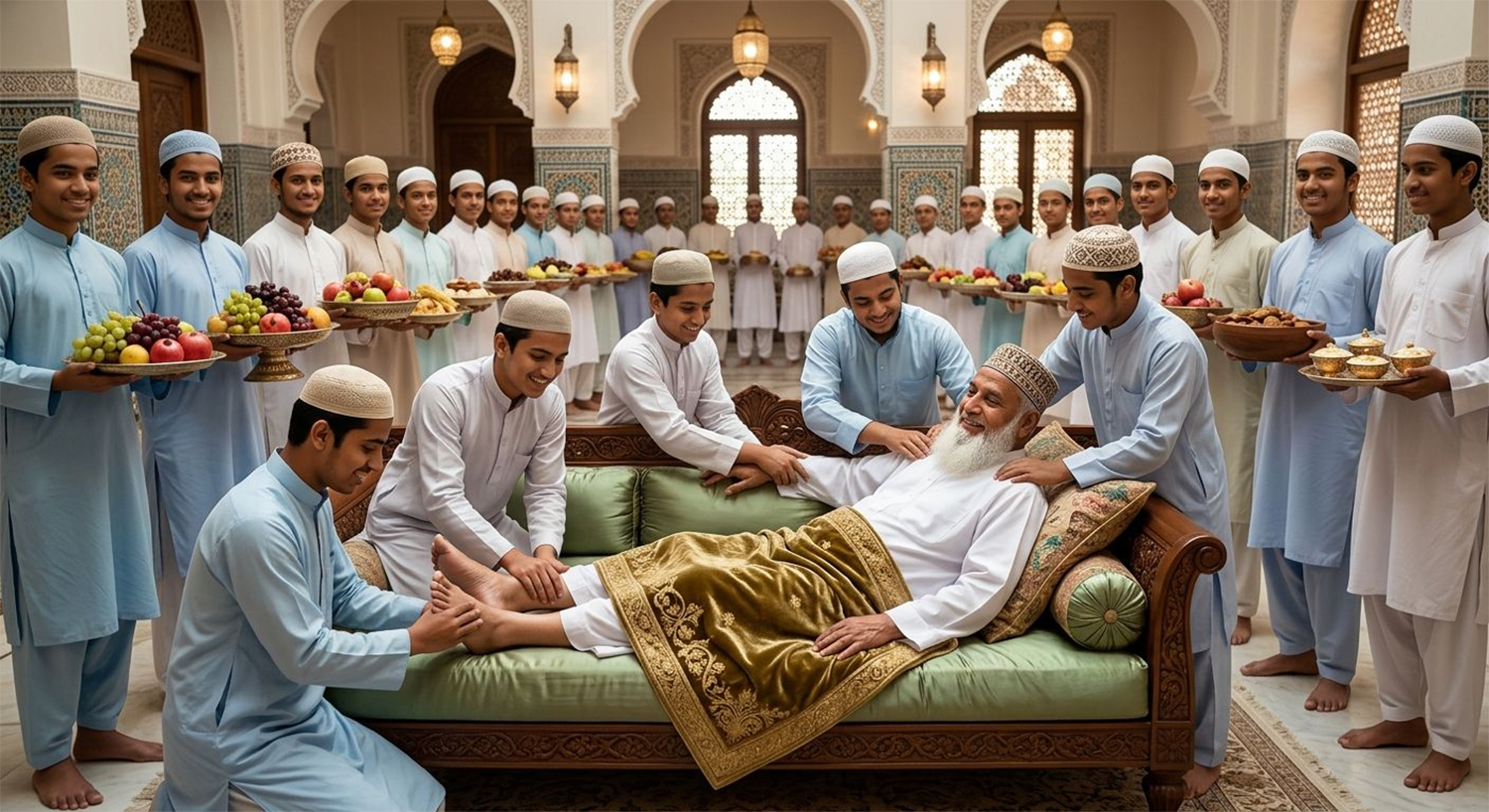
According to Islamic belief, Allah has created a special group of boys or youths to serve the inhabitants of Paradise, known as “Ghilman” (غِلْمَان) or “Wildan” (وِلْدَان). The Quran does not mention an exact number of how many such attendants each person in Paradise will receive. However, various hadiths and exegetical sources suggest that depending on a person’s status and the vastness of Paradise, a large number of such attendants will be assigned to them. Some narrations or interpretations suggest that even an ordinary inhabitant may be served by hundreds or thousands of such boys. They will move around in great numbers and in orderly fashion, which is why the Quran compares them to “scattered pearls.”
The primary role of these attendants in Paradise is to serve the believers and ensure their comfort. They will continuously serve food and drink on golden trays, cups, and vessels. Whatever the inhabitants of Paradise desire, whether in thought or by request, will be brought instantly. They will remain eternally youthful, their beauty never fading. They are meant to enhance the environment of Paradise and make it more delightful.
Now consider this: why would thousands of such children be needed in Paradise? Could there not have been robots? Why would eating even be necessary there—if there is no bodily need, what is the purpose of food? It could have been arranged so that whatever is desired simply appears on the table. If, according to certain hadith narratives, Allah could provide endless portions of meat from a single animal even in this world, then why would service attendants be necessary in Paradise at all?
The inhabitants of Paradise would be able to command the attendants to do whatever they wish. Do you really think these attendants were meant only to wash clothes for desert raiders? The implied temptation, according to this view, is that they would provide bodily services—massage, oiling, pressing limbs, and possibly be used for sexual purposes. This is presented as a hidden incentive. Some religious teachers and older students in madrasas are accused, in this argument, of reenacting parts of this “promise” through abuse of younger boys. Since traditional religious systems often restrict access to arts, entertainment, and other forms of expression, some may channel those suppressed urges into harmful behaviors. Under a strict interpretation of Sharia, such acts would allegedly gain greater legitimacy.
This is framed as a serious form of child abuse in Paradise itself. The argument asks whether any person with conscience would find such a system acceptable. It claims that only individuals with deviant inclinations would design such rules, and that these ideas reflect the mindset of a much earlier era, without awareness of modern developments in science, civilization, and human rights.
According to this perspective, the Quran contains descriptions that reflect the desires of a harsh, impoverished, and desire-driven Arabian tribal environment. It argues that Muhammad promised rewards aligned with what those people longed for but lacked. Historically, elite households in Arabia used young servants to serve food and drink, symbolizing luxury and status, which may have influenced such imagery.
It is further argued that in historical Islamic empires, practices involving young male servants or attendants did exist, and some sources suggest cases of exploitation or aesthetic attraction toward adolescent boys in certain cultural contexts. Some literary works from medieval periods have references interpreted in that light.
Since religious texts do not always state everything explicitly, this argument suggests that the desires of believers would be fulfilled by such attendants in Paradise. It portrays this as a projection of the fantasies of people who lacked access to luxury in worldly life and imagined fulfilling those desires in the afterlife.
Some academic and orientalist researchers have argued that descriptions of “Ghilman” or eternal youths in Paradise may reflect cultural elements of the time, including possible homoerotic or aesthetic ideals. They suggest these descriptions might have served as incentives tailored to the expectations and desires of the original audience.
Janet Afary – Sexual Politics in Modern Iran
In this book, historian Janet Afary discusses representations of sexuality in Islamic texts and societies. She argues that descriptions of both female companions (houris) and youthful attendants emphasize physical beauty in ways that may reflect broader historical and cultural attitudes, possibly functioning as symbolic rewards within a patriarchal society.
Meir J. Kister and Uri Rubin
Some scholars of Quranic studies and pre-Islamic Arabic poetry have examined parallels between Quranic imagery and earlier cultural expressions. They note that admiration for youthful beauty existed in some literary traditions, and argue that these cultural frameworks may have influenced how certain audiences interpreted such verses.
The argument concludes by appealing to reason and common sense: if the purpose were merely to serve food and drink, there would be no need to describe these attendants as “hidden pearls” or exceptionally beautiful. Such descriptions are interpreted here as intended to evoke desire. It is suggested that similar practices in Persian and Roman courts—where young attendants were sometimes used in elite settings—might have influenced these portrayals, which were then reflected in religious descriptions of Paradise.
Related Posts
Why do Islamist clerics consider Bengali cultural festivals their enemy?
This year, unlike many previous years, the major Hindu religious festival Durga Puja in BangladeshRead More
ইসলামিস্ট মোল্লারা কেন বাঙালিদের আনন্দ উৎসবকে তাদের শত্রু মনে করে?
এবার বাংলাদেশে অন্যবারের তুলনায় বেশ শান্তিপূর্ণ, উৎসবমুখর পরিবেশে হিন্দু ধর্মের বড় ধর্মীয় উৎসব দূর্গাপূজা হয়েRead More
Why do Islamist cyber‑jihadis insult, threaten, and file false reports against people with different opinions?
Maulana Azhari once advised Islamists that sharing his Facebook posts is also an Islamic act;Read More
Comments are Closed