
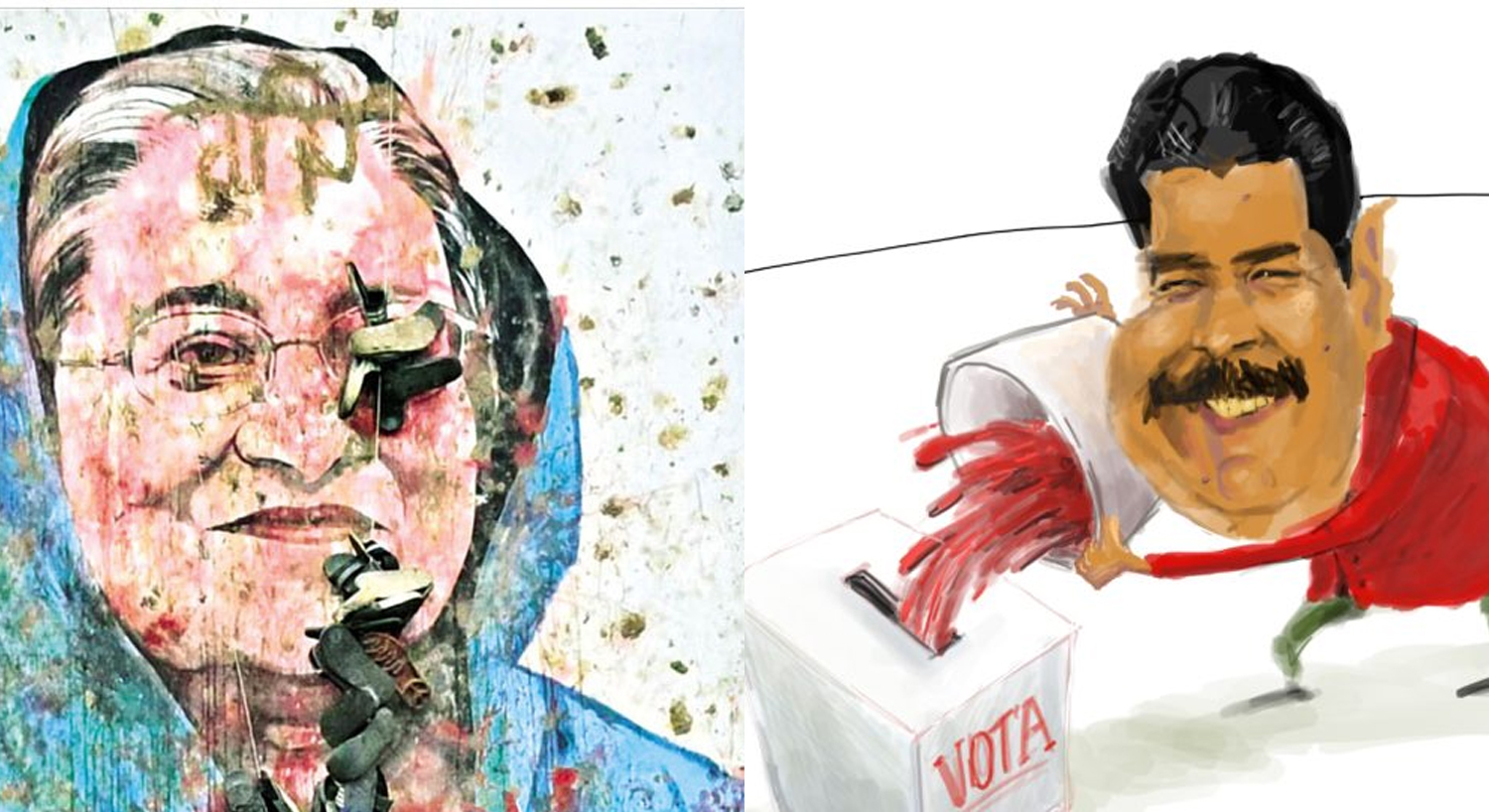
Authoritarianism - Venezuela to Bangladesh
Authoritarianism, Religious Rule, and the Comparative Reality of Democracy: From Venezuela to Bangladesh
I have known a Venezuelan gentleman named Ruben for many years. He works tirelessly every day and regularly sends remittances to support his family – mostly to Venezuela, and occasionally to Brazil. A house painter by profession, he is one of the countless migrant workers struggling through life’s battles. International politics or events like the Nobel Prize are not priorities in their daily existence. Yet when I told him about Machado’s Nobel Prize win, the joy on his face revealed the deep cultural pride and national identity that still lives within working‑class people like him.
People like Ruben are not technologically adept – they do not habitually search for news on Google or verify information online. But their political memory is remarkably sharp. I have often heard Ruben lament Venezuela’s past prosperity, the collapse of its democratic institutions, and the misrule of the Chávez – Maduro era. His reflections make one thing clear: when a state’s political ideology becomes detached from reality, the result is economic decline, social instability, and the erosion of democratic structures.
Venezuela today possesses the largest proven oil reserves in the world – about 303 billion barrels. Yet despite this immense wealth, the overall happiness of its people is modest. In the 2024 World Happiness Index, Venezuela scored around 5.6 – close to the global average but far below developed nations. Even with the world’s largest oil reserves, many Venezuelans struggle to find enough food or access essential life‑saving medicines.
Communist regimes typically rise to power with promises of equality, justice, and a society free from exploitation. But in practice, they quickly move toward what Levitsky and Way (2010) describe as authoritarian resilience. According to the well‑known Authoritarian Resilience Framework, such regimes survive through three mechanisms: repression, co‑optation, and propaganda. Before coming to power, communist leaders paint visions of a prosperous and just society, but in reality, they implement the very mechanisms that entrench authoritarian rule. Nowhere in the world have these lofty promises been fulfilled. In countries where communism prevails, we see the absence of democracy, the dominance of authoritarianism, restrictions on free speech, and widespread economic and social distress. Elections, when they occur, are often mere formalities; incumbents remain in power for decades, immovable like monoliths. Russia, China, Cuba, North Korea, and Venezuela are prominent examples.
When a foreign power recently removed Venezuela’s president Nicolás Maduro, a large portion of the population did not seem to object. Such an operation is nearly impossible without the silent approval of the people. After years of repression, citizens lose the courage to protest and begin to wait for any force – internal or external – that might free them. If you speak to ordinary Venezuelans, you will hear this sentiment repeatedly.
A similar pattern of failure is evident in religious states. Historically, religious governance has not proven successful; rather, it has often brought suffering. In religiously governed states, freedom of speech is restricted, women’s education and mobility are curtailed, and human rights and voting rights are routinely ignored. Iran, Afghanistan, Sudan, and Syria are frequently cited examples. Under the banner of religion, extremism has also spread across the world – groups like ISIS, the Taliban, and Al‑Qaeda represent its most violent manifestations.
In India, the rise of religion‑based politics has fueled the spread of Hindutva extremism. Under the shadow of the current religiously oriented leadership, extremist groups have begun influencing politics, economics, culture, and even sports. A country once celebrated as the world’s largest democracy now appears to be yielding to this wave of extremism – an observation echoed by many and visible in reality.
Both communist and religious regimes share a common feature: the need to identify an enemy. Communist rulers invoke the fear of “American imperialism,” while Islamic rulers warn of “American aggression,” or portray religious minorities, atheists, and humanists as threats to society and knowledge. Pakistan invokes the “India threat,” while India’s Hindutva forces invoke the “Pakistan threat” – and even portray their own Muslim and Christian citizens as enemies. Recent incidents of Muslim killings and the disruption of Christmas celebrations in India demonstrate the growing assertiveness of these extremist groups.
Throughout history, constitutional democracy has proven to be the most successful system of governance. Countries where people enjoy economic stability, personal safety, and trust in the rule of law are almost all democratic. Europe, Australia, New Zealand, Japan, and Canada are prime examples.
Yet authoritarianism can also hide behind the façade of democracy. Bangladesh’s recent history offers many such examples. For years, the country witnessed rigged elections, suppression of free speech, widespread corruption, enforced disappearances, extrajudicial killings, and the collapse of judicial independence – authoritarianism masquerading as democracy. The mass uprising of July 2024, in which many people were killed or maimed by ruling‑party forces and state agencies, revealed the extent to which the authoritarian ruler Sheikh Hasina was willing to go to retain power. Ultimately, the regime collapsed, and its leaders fled the country – seeking refuge in India.
Before August 2024, many Bangladeshis hoped that a foreign power might intervene to free them from Hasina’s oppressive rule. As in Venezuela, if a foreign force had removed the regime, many would have celebrated in the streets; most would have supported it. Such interventions are only possible when a nation’s own people have become exhausted by tyranny and can no longer find a path to liberation on their own.
Related Posts

Actresses Shabana, Moushumi, Popy – Religious Sentiment and the Politics of the Public Sphere
In the history of Bangladeshi cinema, names like Shabana, Moushumi and Popy mark important chapters.Read More
নায়িকা শাবানা, মৌসুমী, পপি – ধর্মানুভূতি এবং জনপরিসরের রাজনীতি
বাংলাদেশের চলচ্চিত্র ইতিহাসে শাবানা, মৌসুমী কিংবা পপির মতো নাম গুরুত্বপূর্ণ অধ্যায়। তারা আশি, নব্বই ওRead More
In Bangladesh, the very meaning of the “blasphemy” law is to find a new pretext for persecuting minorities
The attack on the house, shop, and temple of Deepto Roy in Tahirpur, Sunamganj isRead More
Comments are Closed