
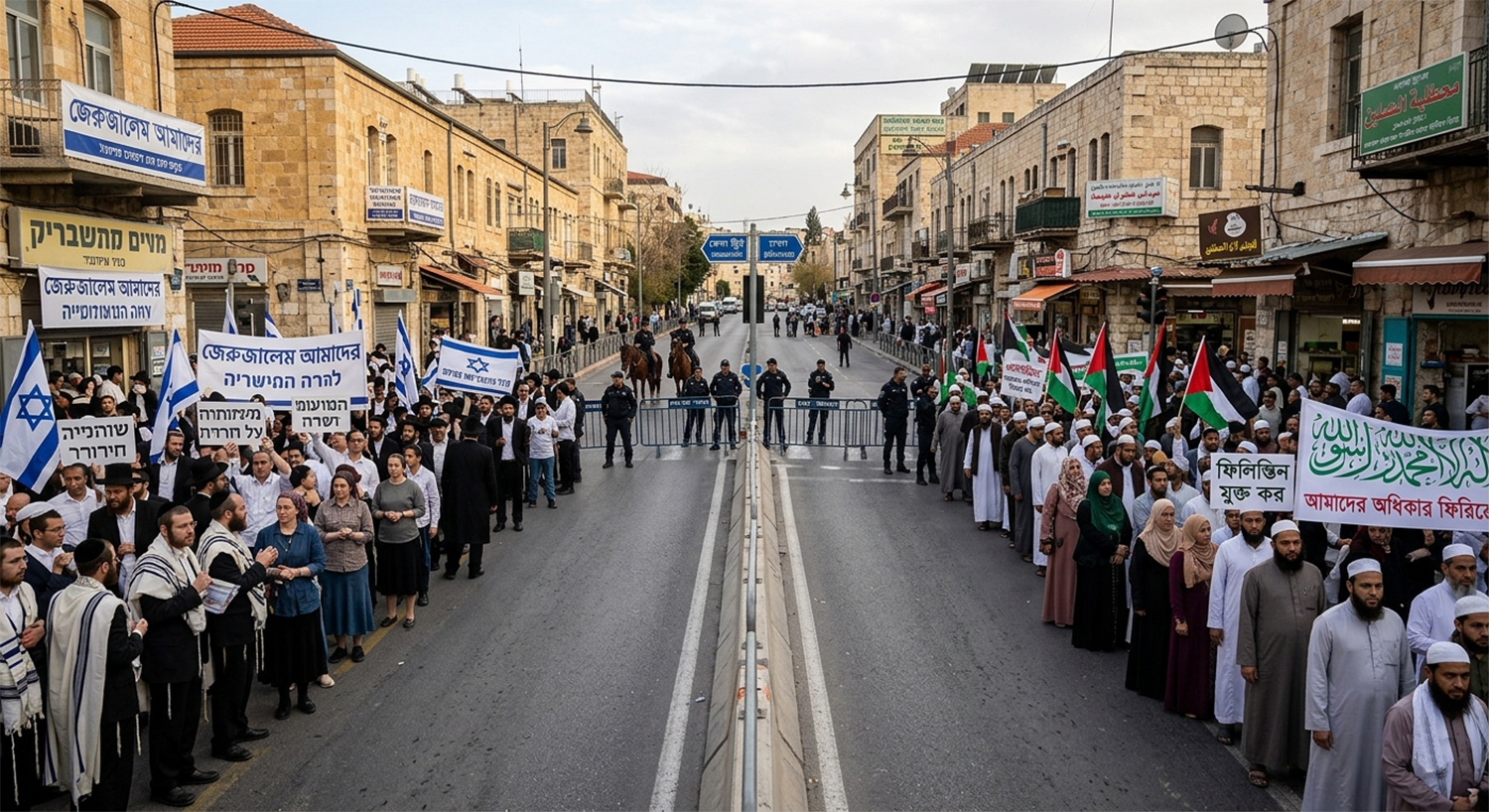
Antisemitism in Islam
Islamic Antisemitism: Theological Foundations, Historical Manifestations, Psychological Dimensions, and Contemporary Geopolitical and Economic Impacts
Jew-hatred—hostility, prejudice, or discriminatory attitudes toward Jews as a religious, ethnic, or national group—is one of the longest and most enduring expressions of hatred in human civilization. From ancient Egypt to the Roman Empire, from medieval Christianity to modern European fascism—this hatred has appeared in every civilization in different forms and with different justifications. In the Islamic context, anti-Jewish sentiment has distinct theological, legal, and historical foundations that developed long before the rise of the modern nation-state and the Israel–Palestine conflict. This subject has long been debated in scholarly circles—on one side are those who see it as arising primarily from political conflict, and on the other are those who find deep theological roots behind it. This essay seeks to present an integrated analysis by honestly engaging with both perspectives.
Bernard Lewis, in his book The Jews of Islam (1984), highlights the tradition of relative tolerance toward Jews under Islamic rule. He shows that, compared to the brutal persecution Jews faced in medieval Christian Europe—Crusader massacres, the Inquisition, the ghetto system—the environment under Islamic rule was somewhat more tolerable. Yet Lewis acknowledges that anti-Jewish attitudes were latently present in the Islamic tradition and at various times turned into active persecution. By contrast, Andrew G. Bostom, in his book The Legacy of Islamic Antisemitism (2008), demonstrates the depth and breadth of this ideological foundation through extensive documentation from early Islamic sources.
This essay acknowledges that not all Muslims are antisemitic, that reformist and liberal Islamic interpretations exist, and that political context can intensify such attitudes. Nevertheless, to ignore the elements present in canonical sources and the evidence of historical continuity would be a violation of intellectual honesty.
1. The theological basis: Qur’an and Hadith
1.1 Qur’anic elements: Context and generalization
The primary scripture of Islam, the Qur’an, contains a vast amount of discussion about Jews and the Children of Israel (Banu Isra’il). The Children of Israel are mentioned in more than fifty verses, and the word “Yahud” (Jews) is used explicitly multiple times. A review of the Qur’an shows that in the Meccan chapters (Makki surahs), biblical narratives are often presented in a positive light. Verses about the exodus from Egypt under the leadership of Musa (Moses) (Qur’an 2:47–50, 7:137) and about God’s special favor upon the Children of Israel (Qur’an 45:16) place the Jews in a position of honor.
But the character of the Medinan chapters (Madani surahs) is different. After the Hijra to Medina, the Prophet Muhammad came face to face with the Jewish tribes of Medina. Although there were initial attempts at cooperation, conflicts arose over religious recognition, political allegiance, and military alliances. The verses revealed in this context are often critical and sometimes condemnatory.
The accusation of tahrif (corruption of scripture): In Qur’an 4:46, 5:13, and 5:41, Jews are accused of altering the original text of the Torah. This doctrine of “tahrif” creates a fundamental obstacle in Muslim–Jewish theological dialogue, because it completely negates the divine validity of the Jewish scriptures.
Accounts of transformation: In Qur’an 2:65, 5:60, and 7:166, there are descriptions of Jews who violated the Sabbath prohibition being transformed into apes and pigs. In classical Islamic exegesis, these verses have been interpreted as symbols of the moral degeneration of the Jews. In subsequent centuries, these descriptions laid the foundation for derogatory epithets directed at Jews, and their echoes can be heard in political rhetoric in the modern Muslim world.
Depiction of enmity: Qur’an 5:82 identifies Jews and polytheists as those who harbor the greatest enmity toward the believers. Qur’an 5:51 instructs believers not to take Jews and Christians as “awliya” (friends, protectors, or allies). In modern Islamic political discourse, this verse is widely used to oppose any form of cooperation with non-Muslims, especially Jews.
The accusation of killing prophets: Qur’an 2:61 and 3:112 associate Jews with divine curse, humiliation, and misery because of their killing of prophets and rejection of God’s signs. In traditional exegesis, these verses have often been interpreted as describing permanent characteristics of the Jewish people.
This raises an important hermeneutical question: Are these verses historical descriptions related to specific Jewish tribes of the 7th century, or are they universal theological statements applicable to all Jews of all times? Progressive and reformist Muslim thinkers argue for the former interpretation. But the traditional mainstream Sunni exegesis—by Ibn Kathir, al-Tabari, al-Qurtubi—has presented these traits as permanent moral characteristics rather than time-bound descriptions. This influential exegetical tradition has been reproduced in madrasas and Friday sermons.
1.2 Hadith literature: Eschatology and everyday rulings
Hadith literature gives the Qur’anic anti-Jewish elements a more specific and intensified form. A widely cited hadith in Sahih al-Bukhari (vol. 4, hadith 177) and Sahih Muslim states: “The Hour will not come until the Muslims fight the Jews, and the Jews will hide behind rocks and trees, and the rocks and trees will say: ‘O Muslim, O servant of Allah, there is a Jew behind me, come and kill him’—except for the Gharqad tree, for it is the tree of the Jews.”
The significance of this hadith is extraordinary. First, it appears in both Bukhari and Muslim—the two most authentic hadith collections—so believers accept it as having the highest degree of reliability. Second, it is quoted verbatim in Article 7 of Hamas’s original 1988 charter. Third, this hadith is regularly recited in sermons in mosques in Palestine, Egypt, and other Arab countries, as documented in translations by MEMRI.
Other relevant hadiths attribute specific negative traits to Jews—treachery, ingratitude, cunning. Among Muslim hadith specialists there is disagreement over the isnad (chain of transmission) of many of these reports, but in popular religious consciousness these distinctions are often ignored.
1.3 The tafsir tradition and modern echoes
Tafsir al-Qur’an al-‘Azim by Ibn Kathir (d. 1373) is one of the most widely read and respected commentaries in the Sunni Muslim world. In his exegesis of verses concerning Jews, he presents their negative traits in generalized form. Egypt’s Shaykh Muhammad Mutawalli al-Sha‘rawi, one of the most-watched Arabic television preachers of the 20th century, delivered sermons in which he identified Jews as permanent enemies. These sermons have been rebroadcast in Arab media for decades.
2. Historical manifestations: Banu Qurayza, jizya, and the dhimmi system
2.1 Jewish–Muslim relations in the early Islamic period
After the Hijra from Mecca to Medina in 622 CE, the Prophet Muhammad laid the foundations of an Islamic state in a multi-religious city. The “Constitution of Medina” (Sahifat al-Madina) established a framework of mutual defense and coexistence among various tribes, including the Jewish tribes. Historians often describe it as a remarkably pluralistic document.
Nevertheless, within a few years, three major Jewish tribes—Banu Qaynuqa, Banu Nadir, and Banu Qurayza—were expelled from or destroyed in Medina. According to Islamic tradition, each case was due to breach of treaty and treachery. Modern historians debate the extent and reliability of these accounts.
2.2 The massacre of Banu Qurayza: Facts and analysis
After the Battle of the Trench (Khandaq) in 627 CE, a campaign was launched against Banu Qurayza. They were accused of aiding the Meccan Quraysh forces during the siege of Medina. Islamic sources (Ibn Ishaq’s Sirat Rasul Allah and al-Tabari’s history) state that after the siege and surrender, the responsibility for judgment was given to Sa‘d ibn Mu‘adh of the Ansar tribe, who himself was mortally wounded.
Sa‘d’s verdict was: execution of the adult men, enslavement of the women and children, and distribution of property. Ibn Ishaq’s account gives the number of those killed as between 600 and 900. It is reported that the Prophet Muhammad approved this verdict as being “in accordance with the judgment of Allah.” Their heads were cut off in the marketplace and trenches were dug to hold the bloodied bodies.
This event is significant for several reasons. First, in traditional Islamic biography it is presented as the just punishment of traitors, thereby establishing it as a religious precedent. Second, the scale of the event—the mass killing of several hundred men in a single day—would, by modern human-rights standards, fall into the category of a war crime. Third, this event has provided a direct historical basis in later Islamic thought for portraying Jews as “treacherous conspirators.”
Medieval Jewish historians and modern scholars such as W. N. Arafat have expressed doubts about the scale of the event and questioned the reliability of the sources. However, regardless of this debate, the event has been accepted in Islamic tradition as authentic and approved, and it is in that sense that its cultural impact must be assessed.
2.3 Jizya, the dhimmi system, and structural subordination
In the Islamic state, the status of non-Muslims was regulated through the “dhimmi” system. Qur’an 9:29 commands fighting the People of the Book (Jews and Christians) “until they pay the jizya with willing submission and feel themselves subdued,” unless they accept what is deemed the true religion and what Allah and His Messenger have declared lawful and unlawful. This verse is the theological basis of the dhimmi system.
Jizya was an annual tax imposed on adult non-Muslim males, collected in exchange for formal exemption from zakat and military service. But its amount and the manner of collection were at times humiliating—some have reported that the tax collector would slap the taxpayer on the cheek and force him to bow while paying.
A legal document known as the “Pact of Umar” contains a list of restrictions for dhimmis: prohibition on building new places of worship or repairing old ones; prohibition on riding horses and carrying weapons; prohibition on dressing like Muslims; height restrictions on houses in Muslim-majority areas; limitations on public religious practices; and so on. These restrictions were enforced with varying degrees of severity and leniency under different regimes, but the basic principle remained in place.
In his research, Bernard Lewis has shown that under the Ottoman Empire (especially in the 16th–18th centuries), dhimmis in many cases achieved prosperity. Jews played important commercial roles in cities such as Salonica, Istanbul, and Aleppo. However, this prosperity was sometimes interrupted by waves of persecution and always occurred within a framework of fundamental structural inequality.
2.4 Jewish expulsion in the modern world: The flight of Jews from Arab countries
A lesser‑discussed but extremely important chapter in the history of Arab–Jewish relations in the mid‑20th century is the mass expulsion of Jews from Arab and Muslim countries. From the establishment of the State of Israel in 1948 until the early 1970s, nearly 850,000 Jews were forced to flee or were expelled from Iraq, Egypt, Syria, Libya, Tunisia, Algeria, Morocco, Yemen, and other Arab countries.
The causes of this expulsion were multilayered: the rise of Arab nationalism, the merging of Zionism with the identity of the State of Israel and the resulting suspicion toward local Jews, pogroms, and state‑sponsored discrimination. The 1941 Baghdad Farhud (pogrom) was a brutal example, in which several hundred Jews were killed and thousands had their property looted.
3. The importation of European antisemitism and ideological fusion
3.1 The import of the Protocols and conspiracy theories
In the late 19th and early 20th centuries, European‑origin antisemitism began to be incorporated into the Islamic world. Its most influential vehicle was The Protocols of the Elders of Zion—a forged document created by the Russian secret police that contains fictional descriptions of a Jewish conspiracy to control the world. From the 1920s onward, this document began to be translated into Arabic and distributed, and it can still be found in Middle Eastern bookstores today.
In his book Jihad and Jew-Hatred (2007), Matthias Küntzel shows how Egypt’s Muslim Brotherhood, during the 1930s and 40s, adopted conspiracy‑centered antisemitism from European fascist ideology and fused it with Islamic theological frameworks to create a unique hybrid ideology. This fusion is evident in the writings of Hassan al‑Banna.
3.2 Haj Amin al-Husseini and Nazi collaboration
Haj Amin al‑Husseini (1895–1974), the Grand Mufti of Palestine, was the most notorious representative of this ideological fusion. In 1941 he traveled to Berlin, met with Hitler, and actively supported the Nazi war effort—assisting in the formation of Muslim SS divisions in the Balkans, opposing the safe passage of Jews, and promoting Nazi propaganda through Arab radio broadcasts. He portrayed Jews as a religiously essential enemy.
This collaboration intertwined Palestinian nationalism from its early stages with Nazi‑inspired antisemitism—a legacy that later generations of Palestinian leadership have struggled to confront.
3.3 Hamas ideology: A fusion of religious and conspiracy doctrines
The original 1988 Hamas Charter represents the mature form of this ideological fusion. The charter quotes the “trees and stones” hadith from Sahih al‑Bukhari (Article 7). It presents Jews as the driving force behind the French Revolution, both World Wars, the founding of the United Nations, and other global events (Article 22)—a purely conspiratorial worldview directly derived from the Protocols.
Although Hamas released a revised political document in 2017, the original charter has not been withdrawn, and religiously framed antisemitic themes continue to appear in the speeches of Hamas leaders.
4. Psychological and social dimensions
4.1 Social identity theory and religious socialization
According to Henri Tajfel and John Turner’s Social Identity Theory, people use their social group identity as a source of self‑esteem and tend to demean or condemn out‑groups to protect that identity. In a religious context, this dynamic becomes even stronger, because religion is not only an identity but a complete worldview that provides a sense of divine endorsement.
In the Islamic context, the concept of the “Ummah” (the global Muslim community) creates a powerful social identity. When Qur’anic and hadith literature presents Jews as the permanent enemies of this Ummah, Muslim identity and anti‑Jewish attitudes become intertwined. Being a devout Muslim and holding negative views about Jews can feel like a psychologically coherent combination.
4.2 Intergenerational transmission and the socialization of children
Reports and observations prior to 2022 present a troubling picture of children’s socialization in the West Bank and Gaza. Palestinian television broadcasts documented by MEMRI have shown that children’s programs often included antisemitic messages. UNRWA‑run schools have been documented using textbooks that portray Jews negatively.
From the perspective of child psychology, attitudes and beliefs formed in early childhood are extremely strong and difficult to change. According to Albert Bandura’s Social Learning Theory, children internalize behaviors and attitudes through observation. When all agents of socialization—family, mosque, school, and television—transmit the same antisemitic messages, children come to accept them as “normal” and “true.”
4.3 Collective victimhood mentality and conspiracy theories
In much of the Muslim world—especially in Arab countries—there exists a deeply rooted “collective victimhood mentality.” The Crusades, colonialism, U.S. policy, and the Israel–Palestine conflict are presented as evidence of centuries‑long Western and Jewish conspiracies against the Muslim Ummah.
This psychological framework creates fertile ground for conspiracy theories. The belief that Muslims did not carry out the 9/11 attacks but that Jews did and framed Muslims has received significant support in polls in many Muslim countries. Pew Research Center’s 2006 survey and subsequent studies have found extremely negative attitudes toward Jews in most Arab and Muslim countries.
5. Geopolitical context: The Israel–Palestine conflict and antisemitism
5.1 The causality debate between conflict and hatred
A fundamental debate in analyzing Islamic antisemitism concerns causality: Is Islamic antisemitism the cause of the Israel–Palestine conflict, or is the conflict itself generating and intensifying this hatred?
One view is that the Israel–Palestine conflict is primarily a territorial and national struggle that has poisoned Muslim–Jewish relations. According to this perspective, a peaceful two‑state solution would significantly reduce antisemitism in Muslim societies.
The alternative view—held by Bostom, Küntzel, and others—is that theological antisemitism predates the conflict and makes peace difficult. When organizations like Hamas reject a two‑state solution and call for the complete destruction of Israel, using religious arguments to justify it, the ideological problem becomes central.
This essay acknowledges the interaction of both causes: ideological antisemitism helps sustain the conflict, and the conflict strengthens ideological hatred—a vicious cycle.
5.2 Political use by Arab regimes
Arab authoritarian regimes have for decades used anti‑Jewish and anti‑Israel sentiment as a tool to distract the public. Blaming the “Zionist enemy” and Jewish conspiracies has been a familiar tactic to divert attention from failures of governance—poverty, corruption, and political repression.
Nasser of Egypt, Saddam Hussein, Gaddafi, and the Assad family of Syria have all used this strategy at various times. Through this process, state media, official curricula, and mosque sermons have socially reproduced antisemitic attitudes.
5.3 Oil‑funded extremism and Wahhabi propagation
Since the 1970s, Saudi Arabia’s oil wealth has funded the global spread of Wahhabi and Salafi Islam. A key component of this propagation is the literalist reading of traditional Islamic texts, including the literal interpretation of anti‑Jewish verses and hadiths. This message has been disseminated through global madrasa networks, mosques, and religious literature.
Alex Alexiev and other researchers have shown that since the 1973 oil embargo, Saudi Arabia has invested billions of dollars in international Islamic outreach. Even if only a fraction of this funding is spent on materials promoting antisemitic ideology, the global impact is significant.
6. Economic dimensions: Development disparities and scapegoating
6.1 Israel’s success and the comparative failure of the Arab world
The Arab Human Development Report (UNDP, 2002) itself acknowledges deep failures in human development in the Arab world—in knowledge production, women’s empowerment, and good governance. By contrast, Israel—a small country with few natural resources—has surpassed many larger nations in global per‑capita innovation indices, technology exports, and scientific publications.
This disparity creates a psychological tension within Muslim societies. Instead of honestly analyzing their own failures, some political and religious authorities explain this backwardness as the result of Jewish and Western “conspiracies.”
6.2 Boycott movements and economic impact
The Arab League’s boycott of Israel—which has existed since 1948 and includes a secondary boycott of third parties doing business with Israel—has proven economically harmful for Arab countries themselves. By obstructing the exchange of goods, technology, and knowledge, Arab states have deprived themselves of development opportunities. This is part of a broader pattern: antisemitic ideology is not only morally wrong, it also materially harms those who embrace it.
6.3 Refugee economies and prolonged conflict
Palestinian refugee camps—in Gaza, the West Bank, Lebanon, and Jordan—have remained isolated from development for decades. These communities, sustained by UNRWA funding, experience extremely high levels of unemployment, insecurity, and despair. This environment creates fertile ground for extremist ideologies, where religious antisemitism becomes not only a doctrine but also an explanation for suffering and a call to resistance.
7. Contemporary manifestations and possibilities for reform
7.1 The Abraham Accords and alternative pathways
The 2020 Abraham Accords—establishing diplomatic relations between Israel and the UAE, Bahrain, Morocco, and Sudan—demonstrated that Muslim nations can recognize and cooperate with Israel. These agreements were driven by strategic interests (particularly the threat from Iran), but they proved that religious ideology can recede in the face of political reality.
However, these accords did not resolve the Palestinian question, and at the level of public opinion—especially in Arab states—they have not produced significant changes in attitudes toward Jews.
7.2 Reformist Muslim scholars and voices
Reformist Muslim scholars around the world argue for reading Qur’anic verses in their historical context. They contend that anti‑Jewish verses refer to specific groups in the 7th century and that applying them universally to all Jews of all eras is a distortion of the text. Scholars such as Khaled Abou El‑Fadl, Fatima Mernissi, and Abdullahi An‑Na’im have worked toward human‑rights‑compatible interpretations of Islam.
But these voices often face opposition from institutional Islam and have limited reach among the general Muslim population.
7.3 South Asia: The specific context of Bangladesh
In Bangladesh, the Jewish population is virtually nonexistent, yet antisemitic attitudes appear in various contexts. Islamic political parties’ pamphlets, Friday sermons, and some Bengali publications portray Jews as leaders of global conspiracies. Emotional solidarity with Palestine—which may be morally justified—often becomes intertwined with generalized negative attitudes toward Jewish people.
Conclusion
Islamic antisemitism is a complex, multilayered, and historically deep phenomenon that resists simplistic analysis. Its roots lie in Qur’anic and hadith literature, in 7th‑century historical events, and in the legal structures that developed over subsequent centuries. However, several points are essential for understanding this phenomenon accurately.
First, not all Muslims are antisemitic. Among the world’s more than 1.8 billion Muslims, there is vast diversity. Many Muslim scholars and citizens actively oppose antisemitism and work toward reform.
Second, reducing antisemitism solely to political conflict while denying its theological dimension lacks intellectual honesty. From the Hamas Charter to many national curricula, the evidence of religious foundations is clear.
Third, the Israel–Palestine conflict complicates the issue. Sympathy for the suffering of Palestinians is entirely legitimate and can be expressed without antisemitism. Confusing these two makes both conflict resolution and the fight against global antisemitism more difficult.
Fourth, long‑term solutions require reform in Islamic education that encourages historically contextual readings of scripture; political solutions that address the legitimate aspirations of the Palestinian people; good governance and economic development in Muslim societies that reduce the appeal of conspiracy theories; and interfaith dialogue that fosters personal human relationships.
Islamic antisemitism is a global challenge with no easy solution. But without honest acknowledgment of the problem, progress is impossible. Moving this discussion forward with respect for historical evidence and human dignity—while avoiding assumptions and defensiveness—is both an academic and moral responsibility of our time.
References
- Lewis, Bernard. The Jews of Islam. Princeton University Press, 1984.
- Lewis, Bernard. Semites and Anti-Semites: An Inquiry into Conflict and Prejudice. W. W. Norton, 1986.
- Bostom, Andrew G. The Legacy of Islamic Antisemitism: From Sacred Texts to Solemn History. Prometheus Books, 2008.
- Küntzel, Matthias. Jihad and Jew-Hatred: Islamism, Nazism and the Roots of 9/11. Telos Press, 2007.
- Hamas Charter (1988), primary documents and analyses.
- Ibn Ishaq. Sirat Rasul Allah (Guillaume trans., The Life of Muhammad, Oxford University Press, 1955).
- Al‑Tabari. The History of al‑Tabari (SUNY Press editions, various volumes).
- Tajfel, Henri & Turner, John C. “An Integrative Theory of Intergroup Conflict.” in The Social Psychology of Intergroup Relations, 1979.
- Bandura, Albert. Social Learning Theory. Prentice Hall, 1977.
- Pew Research Center. Muslim‑Western Tensions Persist and related survey reports (2010–2021).
- MEMRI (Middle East Media Research Institute). Various translations and analytical reports, 2000–2022.
- UNDP. Arab Human Development Report 2002. United Nations Development Programme.
- Arafat, W. N. “New Light on the Story of Banu Qurayza and the Jews of Medina.” Journal of the Royal Asiatic Society, 1976.
- Abou El‑Fadl, Khaled. The Place of Tolerance in Islam. Beacon Press, 2002.
- An‑Na’im, Abdullahi Ahmed. Islam and the Secular State. Harvard University Press, 2008.
- Bangladeshi publications: Prothom Alo, The Daily Star, and Islamic publications, 2010s.
Related Posts

Why do Islamist clerics consider Bengali cultural festivals their enemy?
This year, unlike many previous years, the major Hindu religious festival Durga Puja in BangladeshRead More
ইসলামিস্ট মোল্লারা কেন বাঙালিদের আনন্দ উৎসবকে তাদের শত্রু মনে করে?
এবার বাংলাদেশে অন্যবারের তুলনায় বেশ শান্তিপূর্ণ, উৎসবমুখর পরিবেশে হিন্দু ধর্মের বড় ধর্মীয় উৎসব দূর্গাপূজা হয়েRead More

Why do Islamist cyber‑jihadis insult, threaten, and file false reports against people with different opinions?
Maulana Azhari once advised Islamists that sharing his Facebook posts is also an Islamic act;Read More
Comments are Closed